
GitHub Agentic Autofix can move a code scanning alert toward a proposed pull request, but a closed alert is only one part of security acceptance. The reviewer still needs to establish that the change preserves the application’s intended behavior, closes the relevant exposure and reaches the environment where the vulnerable code runs.
GitHub’s October 15 general-availability announcement describes an agent that explores relevant code, proposes a fix, reruns CodeQL and opens a draft pull request. This is a different workflow from accepting a single suggested edit. It creates a useful opportunity for validation and a new responsibility to review the full change.
This assessment uses primary documentation checked November 14, 2026. The acceptance methods and in-memory example below are proposed engineering practices. They are not an evaluation of a customer repository, a benchmark of GitHub’s model or a claim that a particular generated patch passed the tests described here.
Current workflows and eligibility
について current Autofix documentation separates Agentic Autofix from Copilot Autofix suggestions. The agent investigates one or more alerts and prepares a draft pull request; the suggestion workflow offers a proposed change for a supported alert. They differ in access, usage and review flow.
Choose the workflow according to the problem. A small, localized change may be easy for a developer to inspect directly. A fix requiring repository context can benefit from an agent’s broader exploration, but that broader change surface also requires review. The decision should follow the code and risk rather than a preference for the more autonomous label.
Current eligibility is documented in GitHub’s access guide. It includes eligible public repositories and organization-owned repositories with the relevant security product, while excluding certain Enterprise Managed User-owned repositories. Users do not need a separate Copilot license for Agentic Autofix. Verify the actual repository and organization configuration before planning a rollout.
Use the current administrator guide for the rollout decision and retain the dated launch post as history. Feature scope can evolve after general availability, so the record should name the surface, repository type and effective configuration checked. Another reviewer can then reconstruct the decision without assuming that an older announcement describes every currently supported account.
Keep GitHub.com and Azure DevOps distinct. Microsoft’s Azure DevOps announcement describes its own preview and support for dependency and third-party alerts. That is not a reason to transfer every Azure capability or validation claim into a GitHub.com CodeQL workflow.
A product name alone is insufficient for an internal standard. Name the surface, supported alert type, effective policy and responsible owner. This prevents a team from assuming that a procedure designed for one feature applies unchanged to another service with similar terminology.
The original finding and its security property
Before assigning a fix, capture the alert’s source commit, analysis configuration, rule, affected path and relevant data flow. The baseline should identify the condition being corrected. Without it, a reviewer can see that an alert disappeared but struggle to determine whether the underlying behavior changed.
Write the expected security property in application terms. For example, untrusted input must remain data at a database boundary, or a user must only receive records belonging to an authorized scope. The rule identifier can help locate the issue, but the property explains why it matters.
Identify the reachable path. A finding in unused code, a staging-only component and an exposed production route can have different remediation priorities. Reachability assessment should use the application’s actual build and deployment context. Do not infer exposure solely from a file name or the existence of a dependency.
Record uncertainty before the agent starts changing code. If ownership, intended behavior or deployment scope is unknown, assign the question to a person who can answer it. A model can propose an interpretation, but it should not silently define the business rule it is supposed to preserve.
Preserve a minimal reproduction or regression fixture where practical. The fixture should demonstrate the relevant property without production data or an operational exploit. A known expected result gives the reviewer an independent way to evaluate the proposed fix rather than relying entirely on the agent’s explanation.
For a false positive or an intentionally accepted condition, follow the organization’s review process and record the reasoning. Do not ask the agent to modify code simply to make a metric improve. A justified dismissal and a verified correction are different outcomes and should remain distinguishable in reporting.
Control the change surface around the agent
Repository context can help an agent find the correct helper, coding convention or test location. It can also contain instructions, scripts and configuration that affect what the agent does. Treat that context as material to review, not as authority to expand permissions or waive security checks.
GitHub documents that applicable custom instructions can guide Copilot behavior. Keep such instructions accurate, scoped and reviewed. An instruction saying “skip all tests” or “disable the failing rule” should not become an accepted security policy merely because it appears in a repository.
Define which files the expected fix may reasonably touch. The definition should allow a legitimate multi-file correction while flagging unrelated workflow, permission, dependency and scanning changes for extra review. A rigid one-file limit can prevent a proper fix; an unlimited change budget can hide unnecessary risk.
Identify what the execution environment can access. A fix-generation workflow does not automatically need production secrets, customer records or broad deployment authority. Use the least privilege supported by the chosen platform and the organization’s approved design. The article does not assume that every agent environment has the same permissions.
Review build and test commands before relying on them. A repository’s test script is executable project content. If the repository or relevant branch is under investigation, use the appropriate controlled review environment rather than running unknown scripts on an analyst’s ordinary workstation.
Keep the reviewer independent of the proposed change. The agent can generate tests, but it should not have the last word on which tests count or whether a failing independent test may be removed. Preserve the original acceptance property outside the patch’s editable narrative.
A useful change policy makes escalation concrete. New dependencies, modified security configuration, broad refactoring or altered release workflows can require a deeper review. The policy should explain who can approve those changes and what additional evidence is needed.
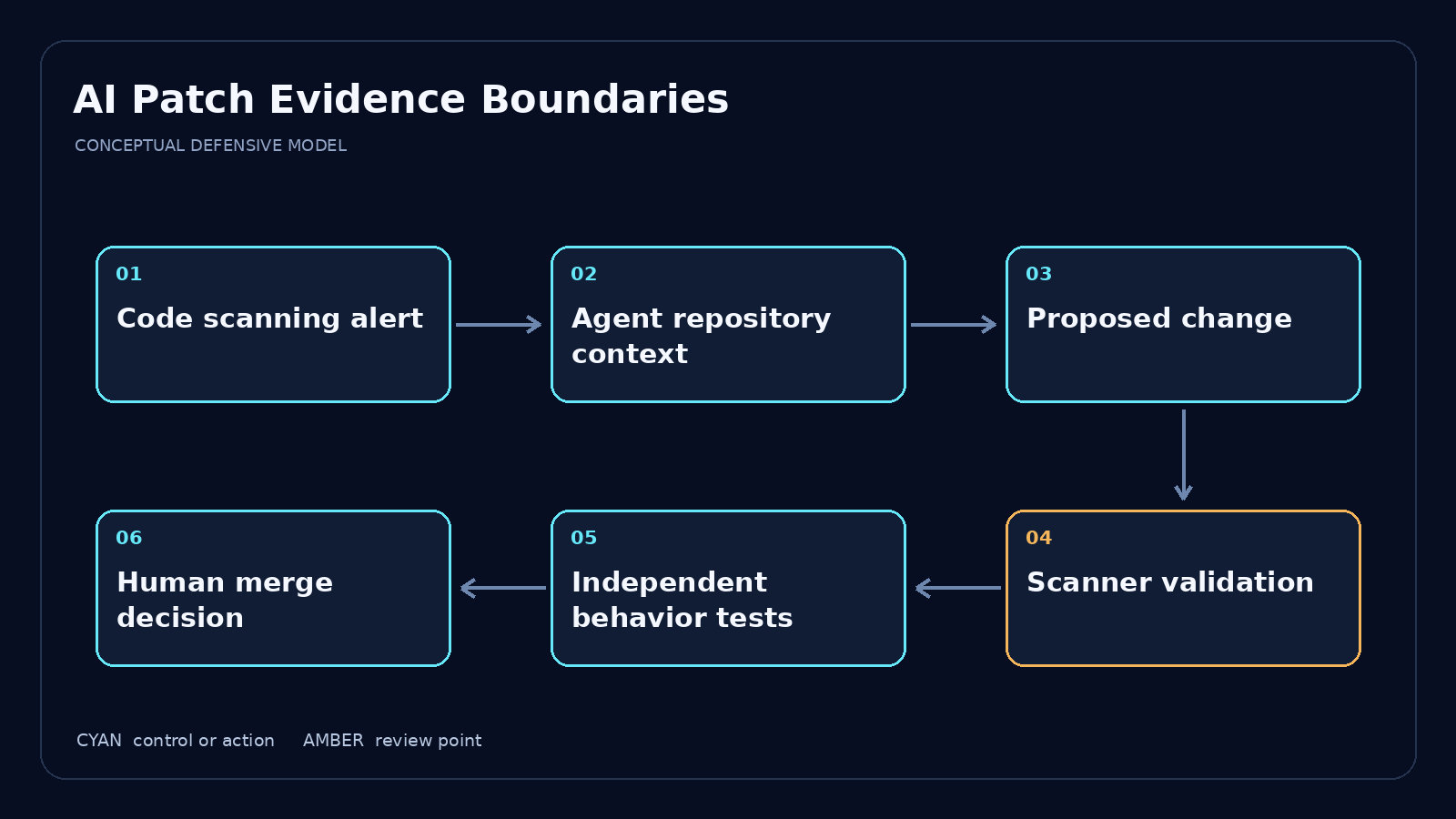
The complete security diff
Start with the security-relevant transformation. Identify which value reaches which sink before and after the patch. Determine whether the change removes the unsafe operation, adds a correct boundary or merely changes the shape of the code so that an analysis no longer recognizes it.
Inspect neighboring paths. A helper can be corrected while another caller retains the same unsafe behavior. A new shared function can improve consistency, but it can also change assumptions for callers outside the original alert. The reviewer should understand the affected call surface and the tests that cover it.
Review failure handling. A patch can reject an unsafe input while leaking data in an error response, skipping cleanup or returning a successful status for a failed operation. Error paths deserve explicit expectations because existing happy-path tests may never exercise them.
Check changes to tests and analysis configuration with particular care. A test deleted, weakened or redirected by the same patch can make the result look better without improving security. Such changes may be legitimate, but they need an explanation tied to the intended property and independent review.
Inspect dependencies and lockfiles as part of the security diff. GitHub’s application card warns about misleading, partial and dependency-related suggestions, including fabricated dependency names. Verify that a proposed dependency is real, necessary, supported and appropriate for the project.
Look for scope expansion. A simple fix that changes authentication, serialization, database access and deployment tooling at once deserves a clear rationale. The more behavior the patch changes, the more evidence the reviewer needs. A large diff is not automatically wrong, but its review cost should be acknowledged.
Do not approve from the pull-request summary alone. The summary is a useful map, not the code itself. Compare the explanation with the actual changes and observed test results. If the summary claims a property that no test or code path supports, ask for clarification or revise the conclusion.
What scanner validation establishes
について current Agentic Autofix documentation describes best-effort validation by rerunning CodeQL with the code scanning query suite. It says that this does not confirm fixes for custom CodeQL queries, the security-extended suite or third-party alerts. Preserve that scope in the review record.
A scanner result is meaningful when its inputs and configuration are known. Compare the baseline and patched analysis under the intended setup. A missing alert can reflect corrected code, changed coverage, a disabled query or a failed analysis. The reviewer needs enough context to distinguish those outcomes.
Record the analysis commit and configuration alongside the result. If the pull request changes the query setup, build mode or analyzed language set, the disappearance of an alert needs additional interpretation. Treat the configuration change as part of the diff, not an administrative detail outside security review.
A supported scanner can establish that it no longer reports a particular pattern under its analysis. It cannot, by that fact alone, establish every business authorization rule, runtime environment assumption or negative workflow. Those properties require tests designed around the application.
Use scan failures as unresolved results. A job that did not complete is not a pass. A warning about incomplete analysis should be understood before closure. Hiding the warning or treating a missing result as “no findings” destroys the meaning of the validation step.
Maintain the distinction between an alert being fixed, dismissed, suppressed or no longer analyzed. These states can all reduce a dashboard count while describing very different security outcomes. Report them separately if the organization wants to know whether exposure is actually decreasing.
Keep the supported scan result in the evidence set and add tests for the properties it leaves open. This preserves the value of the analysis while making its limits operationally useful. The reviewer should be able to point to a particular result for a particular claim: query coverage for the reported pattern, fixture behavior for the application rule and deployment evidence for the running artifact.
Build independent behavior tests around the original property
An independent test should not merely repeat the patch’s implementation. It should express the behavior the owner requires. For a record-access boundary, that can include one allowed request and one otherwise valid request that changes only the authorization relationship.
Use controlled fixtures and stable expected outcomes. Two fictional tenants, two records and distinct roles can reveal whether a patch preserves the boundary without exposing real customer data. The fixture should be small enough for a reviewer to understand and broad enough to exercise the relevant decision.
Test both denial and non-disclosure. A response that says “forbidden” while returning the protected record still violates the data boundary. Likewise, a failed write request may have performed a side effect before returning an error. Verify the actual resulting state where the test property requires it.
Choose alternate paths according to the application. A detail route, export, background worker or cache can share the same data access logic differently. Do not create an exhaustive catalog by habit. Identify the paths whose architecture makes them relevant to the proposed change and explain why each is tested.
Keep the independent fixture outside the agent’s authority to redefine the expected result. The agent can propose additions, but changes to the original security expectation need an owner decision. Otherwise, the patch can “fix” the test by changing what the test calls acceptable.
A failed independent test should return the patch to review with a concrete observation. State the fixture, action, expected result and actual result. The agent or developer can then repair the specific defect. Avoid a vague request to “make it secure,” which encourages broad and difficult-to-review changes.
Record the limits of a pass. A fixture demonstrates the tested relationship under its declared conditions. It does not prove every permission combination or every production integration. The reviewer can use the architecture to determine which additional conditions matter before release.
Use a local example to separate injection safety from authorization
The following example uses Python’s built-in SQLite library and an in-memory database. It creates only synthetic records and makes no network requests. It is not a GitHub-generated patch or a CodeQL experiment. Its purpose is to show why two different security properties need two different acceptance tests.
The first function binds the record identifier as a query parameter, which keeps that value separate from SQL syntax in this toy. It still omits the tenant relationship. A perfectly ordinary identifier can therefore return another tenant’s synthetic note. No injection payload is needed to demonstrate the missing authorization condition.
import sqlite3

db = sqlite3.connect(":memory:")
db.execute("CREATE TABLE notes (id INTEGER, tenant TEXT, body TEXT)")
db.executemany(
    "INSERT INTO notes VALUES (?, ?, ?)",
    [(1, "alpha", "alpha-demo"), (2, "beta", "beta-demo")],
)

def parameterized_but_unscoped(note_id):
    return db.execute(
        "SELECT body FROM notes WHERE id = ?", (note_id,)
    ).fetchone()

def scoped_lookup(tenant, note_id):
    return db.execute(
        "SELECT body FROM notes WHERE tenant = ? AND id = ?",
        (tenant, note_id),
    ).fetchone()

assert parameterized_but_unscoped(2) == ("beta-demo",)
assert scoped_lookup("alpha", 1) == ("alpha-demo",)
assert scoped_lookup("alpha", 2) is None
assert scoped_lookup("beta", 2) == ("beta-demo",)
assert scoped_lookup("alpha", 999) is None

print("Toy query and tenant-boundary tests passed.")
db.close()
The example deliberately uses valid input. This makes the distinction easier to review: treating input as data does not establish whether the caller may receive the selected record. A patch can improve one property while leaving another unchanged. That is why the acceptance record should name the property rather than rely on a broad “security fixed” label.
In a real application, the tenant value must come from an appropriately established authorization context. Do not accept an arbitrary caller-supplied tenant string as proof of permission. The toy leaves authentication and policy architecture out of scope so that the database relationship remains visible.
The final assertion checks an absent record as a normal failure case. Production handling may need to avoid revealing whether an unauthorized record exists, preserve an API contract or emit an audit event. Those requirements belong in the application’s own expected behavior and tests.
The code cannot establish that CodeQL would detect the original condition or validate either function. No scanner is invoked. It demonstrates a review method: identify independent properties, create fixtures for each and inspect the result without transferring one test’s success to another claim.
Read the toy results as a property matrix
The local example becomes more useful when each assertion is tied to a specific claim. It should not be described as a general application-security test. The first function and the scoped function answer different questions, and the fixture contains no authentication service, cache, export or background worker.
| Toy observation | Supported interpretation | Remaining question |
|---|---|---|
| Unscoped lookup returns beta’s note | Record selection lacks the tenant relationship | How a real caller’s authority is established |
| Alpha receives its own note | The selected allowed fixture succeeds | Other legitimate roles and workflows |
| Alpha cannot receive beta’s note | The selected cross-tenant fixture is denied | Other object and function boundaries |
| Beta receives its own note | The correction preserves another allowed owner | Multi-user and shared-resource policy |
| An absent identifier returns no row | The selected missing-record path is handled | Production error contract and disclosure policy |
A reviewer should be able to explain why each row matters without reading the implementation first. That independence helps keep the test anchored to the owner’s requirement. If the requirement changes, update the expected behavior through review rather than adjusting assertions merely because a new patch produces different output.
The next test should follow the actual architecture. If the corrected lookup is reused by an export job, review that caller’s authority context. If the application caches the result, evaluate whether the cache preserves the relevant separation. These are proposed follow-up questions, not claims that the toy or a particular GitHub patch contains those components.
This property matrix also makes completion reporting clearer. The team can state which boundary was verified, under which fixture and in which environment. It can then identify the remaining conditions without weakening the value of the completed test or pretending that one successful lookup proves every form of application authorization.
Use negative controls to check the tests themselves
Trace the test from fixture setup to the final assertion. An administrator identity, hardcoded response or early mock can prevent it from exercising the boundary named in the review. A green result then describes the harness rather than the patch. Check that the tested input reaches the intended decision and that the assertion observes its security-relevant output or side effect.
A negative control deliberately removes or bypasses the property inside an isolated fixture and checks that the test detects the difference. In the local database example, a test intended to enforce tenant separation should fail if the tenant predicate is absent. If it still passes, the test is not measuring the claimed boundary.
Keep the negative control outside production. It can be a small local implementation variant, a controlled test double or a deliberately flawed fixture. The objective is to validate the sensitivity of the test, not to introduce a vulnerable deployment or demonstrate an operational attack.
Inspect authentication setup in integration tests. A helper that grants every test user full access can make an authorization test meaningless. Use a known limited role and record how that role is established. The test should change one authority condition while keeping the rest of the request valid enough to reach the intended policy decision.
Verify that fixtures are actually distinct. Two supposedly different tenants can accidentally reference the same record or share an unrestricted test identity. Give the synthetic data clear ownership relationships and assert those preconditions before testing the denied operation. This makes fixture errors easier to distinguish from application defects.
Test side effects as well as responses when they are part of the property. A mocked database write may prevent a test from observing that an unauthorized action occurred before an error. Choose the smallest controlled environment that preserves the behavior being assessed, and explain what the mocks remove.
A negative control also helps review agent-generated tests. A test written alongside the patch can encode the patch’s assumption rather than the owner’s requirement. An independent reviewer should be able to explain why the test would reject an implementation that violated the original property.
Retain the negative-control result with the fixture definition, not as a permanent insecure option in the application. Future maintainers need to understand how the test was validated without having an accidental bypass available in the released system. The security property and the exercise belong in a clearly bounded testing context.
Reconcile the finding when code moves or is replaced
A refactor can change the location and structure of an unsafe operation. The original alert may disappear because the file or function no longer exists, while a similar data flow remains elsewhere. The reviewer should connect the original finding to the replacement behavior rather than rely only on its old location.
Maintain a short finding lineage: original commit and rule, original boundary, proposed change and the location that now implements the property. This is an organizational review method, not a claim about a specific GitHub alert-matching algorithm. It keeps the security question stable while code evolves.
For an extracted helper, identify every relevant caller and the assumptions each supplies. A caller can provide a validated value, an untrusted string or an authorization context. If the new helper expects stronger preconditions than its callers guarantee, the patch can move the weakness instead of removing it.
For deleted code, establish that the deployed application no longer reaches the old behavior. A file removed from the repository may remain in a generated artifact, a copied service or an older deployment. Source deletion is useful evidence, but the artifact and deployment records determine whether the behavior remains available.
For a replacement library, map the original security requirement to the new API. A function with a safer name may still require correct options or caller policy. Read the supported documentation for the exact dependency and test the property in the application’s context. Do not transfer an old test blindly when its assumptions no longer apply.
Review configuration that selects between implementations. A secure new path can coexist with an older fallback or feature flag. The acceptance record should identify which path runs in the affected environment and which configurations were tested. A patch that is inactive in production has not changed production exposure.
If the lineage cannot be established, keep the result unresolved and assign the missing architecture question. This is better than either rejecting a valid refactor reflexively or accepting an alert’s disappearance without understanding it. The objective is a traceable security property across the change.
Preserve application contracts while changing the boundary
A security correction can change behavior that callers depend on. Identify the contract before approving the patch: accepted inputs, output shape, error handling, side effects and authorization expectations. A test suite that checks only successful output may miss a contract change that affects users or another service.
Review normalization and validation together. An application may transform input before checking it or serialize it again after processing. The patch should enforce the intended property at the representation that matters. A check on an earlier representation is not automatically sufficient for a later sink.
Consider missing, empty and malformed values as distinct cases where the application distinguishes them. A generated patch may use a convenient truthiness check that collapses meaningful states. The reviewer should determine whether the new behavior matches the product’s intended policy and compatibility requirements.
Inspect side effects on failure. A request can return an error after sending a message, updating a record or initiating a background task. If the security property concerns whether the action occurred, the test needs to inspect the resulting state. An error response alone is insufficient evidence.
Use representative callers rather than testing one function in isolation when the change affects a shared helper. One caller may provide a trusted identifier while another passes user input. A helper-level improvement can leave a caller-level authority problem unresolved. Map the relevant relationships and test the ones that can change the conclusion.
Keep compatibility decisions with the appropriate owner. If a safe correction requires changing an external API contract, the agent should not silently choose the business tradeoff. The reviewer can identify the necessity, document the change and obtain the product decision. Security urgency does not make an undocumented interface change easier to operate.
Review dependency changes as new trust decisions
A dependency update can be the right fix, but it introduces a separate set of questions. Verify the package identity, supported release, provenance and reason for the change. Do not accept a plausible package name solely because it appears in a generated diff.
Compare the manifest and lockfile together. A manifest can request one range while the lockfile selects a specific resolved graph. The reviewer needs to understand what the build will actually consume. Record relevant transitive changes rather than reducing a multi-package update to one top-level version label.
Check the project’s supported runtime and build environment. A dependency can address the original finding while requiring an incompatible runtime or changing a native component. The security patch should include the tests and deployment plan needed for those changes, or be redesigned to fit the supported environment.
Review newly introduced install or build behavior through the organization’s normal process. A package can execute code during installation or contribute artifacts to the build. This is a reason for controlled review and supported tooling, not an invitation to run an unfamiliar package on an ordinary workstation.
Avoid transferring a vulnerability claim to every version of a package. Use the relevant authoritative advisory and actual dependency graph when a version change is security-driven. The patch should explain which affected condition the update addresses and why the selected release is applicable.
A generated replacement library also needs a design review. Switching dependencies can alter encoding, authentication behavior, parsing or error semantics. A smaller diff is not always safer, but a broad replacement requires evidence beyond a successful import. Test the application properties the original dependency helped enforce.
Retain the reason for the selected dependency in the review record. Future maintainers should understand whether the change closed a vulnerability, removed an unsupported component or worked around a limitation. Without that context, a later routine update can undo the intended property.
Review CI authority separately from application correctness
A patch can correct application code while unnecessarily increasing the authority of the workflow that tests it. Inspect changes to workflow triggers, permissions, secret access, actions and artifact handling as their own security decisions. A green application test cannot justify an unrelated expansion of CI privileges.
GitHub’s secure-use reference recommends minimal token permissions and warns about privileged workflows processing untrusted pull-request content. It also cautions that automatic secret redaction is not guaranteed. These are reasons to review the effective workflow, not assume that a familiar platform makes every configuration safe.
Separate the jobs that execute proposed code from the authority needed to publish or deploy. The exact supported design depends on the repository and platform, but the trust decision should be explicit. A test job should not receive a production publishing credential merely because a later release job needs one.
Treat uploaded artifacts as inputs with provenance and scope. If one job consumes a file produced by another context, identify who could influence it and what the consuming job will do with it. An artifact’s presence in the platform is not an independent approval of its content.
Review workflow dependencies through the organization’s supported controls. Identify the action or reusable workflow actually selected by the change and the policy for keeping it trustworthy. The reviewer should understand how updates are approved and how an unexpected dependency change would be detected.
Test failure diagnostics without exposing live secrets. A newly added command can print environment data or include sensitive content in an error. Review the logs from controlled valid and invalid cases and use synthetic credentials where practical. Do not rely solely on a redaction badge or the absence of an obvious password string.
Give workflow changes a qualified owner. An application reviewer may understand the source fix while a CI administrator understands token and runner consequences. Bring both perspectives into a material change, and retain the explanation for any new authority. This preserves the independence of the test environment and the release decision.
Bind the reviewed patch to the built artifact
Merge status describes source control. It does not identify the executable, container or package running in an environment. The release workflow should bind the reviewed source commit to the build inputs and resulting artifact, using the project’s supported identification and provenance mechanisms.
Record the build configuration relevant to the security change. A patched source file may be excluded from a build, overridden by generated code or replaced by a bundled component. The reviewer needs to know which implementation the artifact contains. This is especially important when several release variants share a repository.
Use immutable artifact identifiers where the platform supports them. A tag such as “latest” or a reusable deployment label can move after verification. The evidence should let another operator identify the bytes tested and the bytes deployed, rather than rely on a name that may point somewhere else later.
Verify the artifact in an owned staging environment with the relevant configuration. A unit test establishes a useful local property; an integration test can establish that the deployed application uses the corrected path under realistic conditions. Keep the claims distinct and choose the smallest test set that resolves the remaining uncertainty.
The runtime check should include the authorization context that matters. A request made as a superuser may bypass the boundary the patch was intended to enforce. Use controlled roles and synthetic records so that the observed result reflects the property under review.
Record deployment completion and activation separately where the platform distinguishes them. A rollout can be scheduled, partially applied or waiting for a restart. A completed source task cannot close an installation that still serves the earlier artifact. Reconcile the deployment inventory before declaring exposure removed.
If the organization uses an authorized application-testing workflow, including one evaluated through Penligent, define the exact target and expected observation. Such a check can add runtime evidence within its supported scope. It does not certify every AI-generated change or replace source and build review.
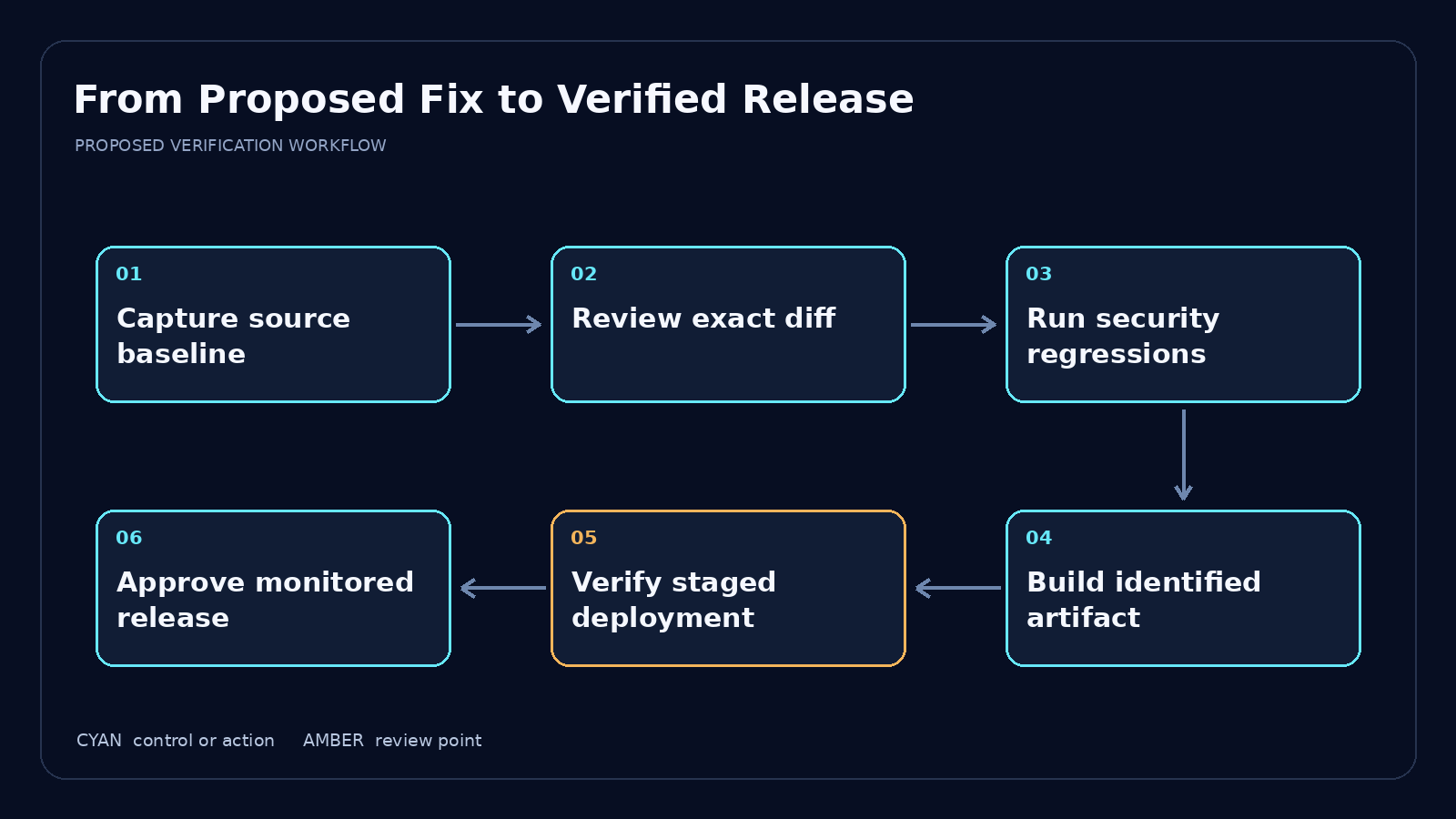
Roll out according to risk and review capacity
GitHub’s alert-resolution documentation describes assignment from the default-branch backlog. The release announcement supports grouping up to 25 alerts in one pull request. That is a feature limit, not a recommendation that every team should start with the largest possible batch.
Group changes by a reviewable relationship. Alerts sharing one helper or dependency can benefit from a combined fix. Unrelated changes across authentication, serialization and release automation may be harder to reason about together. The batch should make the security decision clearer rather than merely reduce the number of pull requests.
Prioritize according to actual exposure and consequence. An actively used public application path can deserve attention before a low-impact internal fixture, even when both alerts have similar labels. The relevant evidence includes reachability, data sensitivity, deployment state and any authoritative exploitation information for the specific issue.
Set a work-in-progress limit for unreviewed fixes. An agent that creates proposals faster than reviewers can assess them can turn an alert backlog into a change backlog. Pause new assignments when the review queue exceeds capacity and direct effort toward validation or resolving ambiguous requirements.
Pilot the workflow on changes whose expected properties are understandable. A successful pilot should establish how reviewers interpret evidence, how failures return for revision and how deployment closure works. It should not be selected only because the repository has no meaningful tests or the patch is easy to merge.
Preserve a route for urgent manual correction. Automation should assist the response, not force the team to wait for an agent that cannot produce a suitable fix. If the proposed change is incorrect or the vulnerability requires architectural work, assign a qualified owner and retain the baseline evidence.
Assign responsibility for each acceptance claim
The person who enables a feature is not necessarily the person authorized to merge a patch or accept a production risk. Define ownership for the alert, code review, security property, release and exception decision. A small organization can combine roles while still recording which decision was made.
The code reviewer should understand the actual diff and its application context. The security reviewer should inspect the relevant boundary and evidence. The release owner should identify the artifact and deployment state. None of those roles can be replaced by a generated summary that claims all checks passed.
A feature administrator owns rollout configuration and applicable budgets, not the correctness of every application change. GitHub’s access documentation describes controls cascading through enterprise, organization and repository levels. Use that hierarchy to make enablement deliberate and exceptions visible.
For a material behavior change, identify who can define intended policy. A model cannot decide whether a support user should retain access to a former customer’s records or whether an export is meant to include a particular field. Those are owner decisions that tests must then enforce.
Record residual risk in terms the decision maker can assess. State the unresolved property, affected deployment, existing containment and next review date. A signature under a generic “AI reviewed” label gives little information about what was accepted.
Review responsibility after an incident without treating the model as an accountable person. Determine which control failed: requirements, generation, review, build, deployment or monitoring. The organization can then improve the specific boundary rather than respond with a general instruction to be more careful.
Measure exposure reduction instead of proposal volume
Count completed outcomes separately from generated work. Useful categories include proposed fix, under review, verified correction, justified dismissal, incomplete analysis, failed fix and deployed correction. A single falling alert count can conceal all of these states.
Choose a stable denominator. If scanning coverage changes, a trend in alert volume may reflect the coverage change rather than safer code. Record repositories, analyzed configurations and the observation period alongside the result. Comparisons are meaningful only when readers know what was measured.
Measure time from a relevant exposure being identified to a verified correction reaching the affected environment. Break out waiting for review, implementation, testing and deployment. This shows where automation helps and where another bottleneck remains.
Track reopened findings and regressions. A quickly merged patch that later requires rollback may have a different value from a slower correction that preserves the intended behavior. Record the reason for rework so that recurring failure modes can inform test and review improvements.
Separate confidence from severity. A high-impact hypothesis with weak evidence may need urgent validation, while a well-established low-impact issue may be straightforward to schedule. An automated proposal should not make the confidence field disappear simply because it supplies a detailed explanation.
Use cost measures with reviewed outcomes. The current documentation identifies Code Security AI credits and Actions minutes for agent sessions. Do not infer a fixed savings percentage or cost per accepted fix without observing the organization’s own workload and review effort.
Avoid comparing unlike work. A one-line safe API replacement and a multi-service authorization redesign should not be treated as equivalent units. Segment the results by complexity and risk so that an apparent speed improvement does not reward selection of only easy tasks.
Handle failed fixes and unsupported validation explicitly
A proposed change can fail to compile, preserve the original weakness or introduce a new one. Treat that as a review result with specific evidence. Return the smallest actionable explanation: the property, fixture, observed result and relevant diff. A precise failure is easier to repair than a broad rejection without context.
If scanner validation is unavailable for the alert type, label it unavailable. Do not substitute a generic green build or a test from another query suite as though it proves the same condition. Add an appropriate independent check or assign manual review.
A patch that partly improves the code can still be useful, but partial completion must remain explicit. Separate the accepted portion from the unresolved property and decide whether the partial change is safe to merge independently. Avoid closing the original security task merely because some related code improved.
Dismissing an alert is an administrative decision, not a code correction. Record the reason and evidence under the organization’s process. A false-positive decision should be reproducible enough that a future reviewer can understand it after the original analyst leaves.
Do not weaken a security test just to accept a generated patch. A changed test expectation needs an independent explanation grounded in intended behavior. If the original test was wrong, repair it openly and preserve the reasoning. Otherwise, the workflow can learn to optimize its own acceptance criteria.
Repeated failures may indicate that the task is poorly specified or requires a different architectural approach. Stop asking for minor rewrites when the underlying policy remains undefined. Bring the relevant owner into the decision and preserve the valid baseline work rather than starting the entire investigation again.
Test rollback as a security decision
A release plan should state what will trigger rollback and what state the rollback restores. Returning to a previous artifact can also restore the original vulnerability. The owner needs an explicit decision about containment and residual risk rather than a purely operational instruction to “revert if anything breaks.”
Use the same artifact identity discipline for rollback. Know which version will run, which configuration accompanies it and which security property may change. An ambiguous rollback label makes it difficult to assess whether the service is stable, exposed or simply unknown.
A staged rollout can reduce the number of users affected by a regression, but it does not remove the need for the right tests. Choose meaningful health and security observations for the changed boundary. A generic uptime check may remain green while an authorization defect affects a small subset of requests.
When a rollback occurs, reopen the relevant security work and retain the failure evidence. Do not leave the alert closed solely because the source pull request once merged. The deployed state is the state that matters to exposure.
Investigate whether the regression arose from the patch, environment or test assumptions. The answer determines the repair. A patch can be correct in isolation and unsuitable for the current deployment, or a deployment can be incorrect despite a good patch. Preserve both possibilities until evidence resolves them.
After repair, rerun the affected acceptance set and reconcile the final artifact. This should be targeted verification, not an automatic repetition of every unrelated test. The completed record should explain why the new release is acceptable and what changed from the failed attempt.
Reassess the workflow when its context changes
A model, agent behavior, repository instruction or analysis configuration can change while the feature retains the same product name. Maintain a short configuration record for the pilot and rollout so that later results can be interpreted against the system actually used.
Use a stable set of representative fixtures to detect meaningful regressions in the workflow. Include a localized fix, a shared-helper change, an authorization-sensitive case and an ambiguous requirement. Evaluate evidence and review burden as well as whether a proposal appears.
Do not assume that a better benchmark transfers directly to the organization’s codebase. Language, framework, build setup and testing quality can affect results. Use provider information as context and the organization’s controlled evaluation as the basis for its own rollout decision.
Review repository instructions after material process changes. An instruction that once pointed to the correct test command can become stale. Keep the instruction’s owner and update path clear, and ensure security-critical decisions remain enforced outside free-form guidance.
Changes in reviewer capacity also matter. A workflow that was safe for a small queue can become difficult to operate when assignments expand across hundreds of repositories. Adjust concurrency and ownership rather than treating the original pilot approval as unlimited capacity.
Retain a supported off switch for new assignments and a plan for existing proposals. Disabling generation should not erase the evidence or leave open pull requests without owners. The organization still needs to decide which changes to review, revise or close.
Work through a fictional multi-alert batch
Consider a fictional application with three code scanning alerts. Two involve the same input-handling helper; the third concerns a separate authorization path. The team captures the baseline commit, expected properties and deployment scope before assigning work. No real repository or GitHub session was tested for this example.
The agent proposes a shared-helper change for the first two alerts and opens a draft pull request. The supported scan no longer reports those alerts. Reviewers inspect the callers and find that one error path now returns an unexpected response. The independent regression identifies that behavior without disputing the useful scanner result.
The developer repairs the error path and retains the original security property. The application tests now cover both permitted input and the relevant failure case. The reviewers can explain why the corrected diff satisfies the application contract rather than merely showing a green job.
For the third alert, the proposed fix changes a query but leaves a tenant boundary unresolved. The team uses controlled records to demonstrate the missing relationship. It does not claim that the scanner should have proved an unrelated business rule; it assigns the policy decision and adds a test for the actual requirement.
The release owner builds an identified artifact and deploys it to staging. A normal request and the relevant denied request both produce the expected results. The owner then follows the approved rollout and monitoring plan, recording the artifact that reaches production.
The final report distinguishes two completed fixes from one task that needed an additional policy decision and repair. That distinction helps the team assess the workflow honestly. Proposal count, scan closure, reviewed correctness and deployed correction are separate measures of progress.
Make the acceptance statement concise and reviewable
A useful acceptance statement names the original property, the reviewed source change, the analysis result, independent tests and the deployed artifact. It also names any limitations or exceptions. The statement should let another engineer locate the evidence without reproducing the whole conversation.
For example, an organization might record that a parameter-handling boundary was corrected at a particular commit, the supported analysis completed, the controlled allowed and denied fixtures passed and an identified artifact was verified in staging. Those are concrete claims. They are stronger than “AI fixed the vulnerability” because they can be checked.
Keep the evidence package small enough to review. Preserve raw logs and detailed traces where required, but use an index and focused excerpts in the main record. A large unstructured transcript can obscure the very result the reviewer needs to assess.
State who accepted residual uncertainty. A technical pass under a limited fixture does not automatically become a business decision about every deployment. If another system or environment remains outside the test scope, keep that exclusion visible.
Archive the final configuration and test references according to the project’s normal process. A later change to the helper, query suite or build can then identify which acceptance evidence may need to be refreshed. The value of the record is its connection to future decisions, not its length.
Frequently asked questions
What does GitHub Agentic Autofix do?
- It investigates assigned supported alerts, proposes changes and prepares a draft pull request with validation.
- Review the resulting diff and evidence as an engineering change, not as an automatically accepted security conclusion.
Is it the same as Copilot Autofix suggestions?
- No. GitHub documents separate workflows with different access and usage characteristics.
- Choose according to the required scope and verify the current product documentation.
Does the user need a Copilot license?
- The current Agentic Autofix access guide says a separate Copilot license is not required.
- Repository eligibility, organization policy and applicable billing still need verification.
Does a closed CodeQL alert prove the application is secure?
- It supports a result within the analysis that actually ran.
- Business authorization, runtime configuration and untested paths need their own evidence.
Can Azure DevOps support details be applied to GitHub.com?
- Check the documentation for the actual surface.
- Similar product names do not establish identical alert support, validation or rollout behavior.
Should a generated fix be merged automatically?
- Keep review and release decisions under the organization’s approved policy.
- A scanner result does not replace full-diff review, independent behavior tests or deployment verification.
Where does authorized runtime testing add value?
- It can verify that the identified deployed application exhibits the expected allowed and denied behavior within a defined scope.
- It complements source and scanner evidence; it does not prove every property or every environment.
The useful outcome is a verified change in the running system. Let the agent accelerate investigation and proposal work, then bind the result to an explicit security property, independent tests and an identified release. That is the evidence needed to know whether exposure actually changed.
The following official Penligent video presents the general product workflow. It is separate from the source research and does not demonstrate or certify the specific findings discussed above.
 Japanese
 English
 German
 French
 Spanish
 Portuguese
 Korean
 Hindi
 Arabic
 Turkish
 Hebrew