
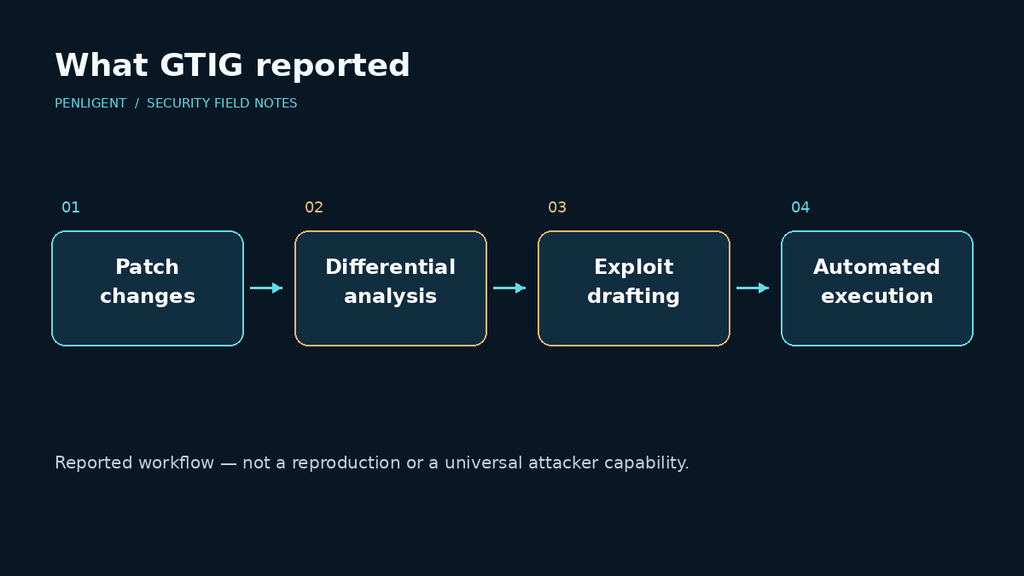
Google Threat Intelligence Group’s November 16, 2026 report describes an exposed staging server hosting a framework it calls exploit_agent. According to GTIG, the framework compared software changes around patch announcements, analyzed potential vulnerabilities, drafted exploits and executed them without human intervention. The finding gives defenders a concrete reason to tighten the handoff between a vendor advisory, exposure analysis and remediation. See the GTIG AI Threat Tracker report.
Read the autonomy claim precisely
GTIG presents this as its first observation of fully automated vulnerability discovery and exploitation using LLM frameworks. That is an observation about a reported workflow, not proof that every campaign is autonomous or every generated exploit works. The same report notes nonfunctional LLM-generated exploits and says contemporary autonomous execution can leave conspicuous forensic traces. Our analysis below turns those findings into defensive decisions; we did not reproduce the reported intrusion.
Measure the exposure window you can actually control
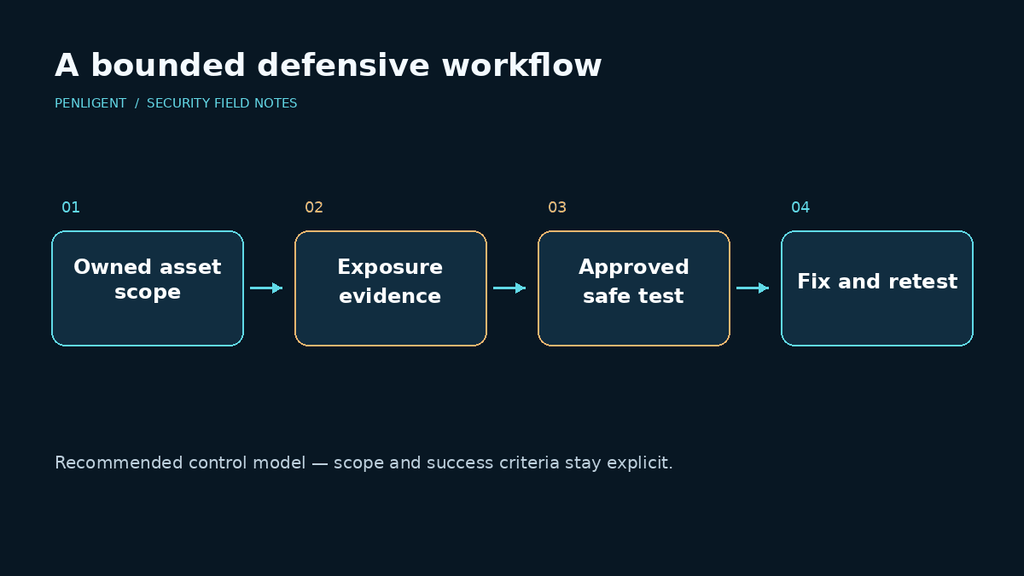
Start with internet-facing applications for which your team can identify both an owner and a deployed version. For each relevant advisory, record when it became known, when you confirmed exposure, when you applied a fix or containment, and when a retest finished. This timeline reveals delays hidden by a simple “patch installed” status.
A version string is only one part of the decision. Confirm the affected component is present, the vulnerable feature is enabled, and the relevant trust boundary is reachable. If a requirement cannot be established safely, mark it unknown and assign an owner. Do not turn an unverified scanner finding into a confirmed compromise statement.
Use distinct evidence for distinct decisions
- Patch priority: combine verified affected scope with external reachability and the consequence of compromise. Record the reason for elevating an asset.
- Incident investigation: preserve relevant authentication, application and process telemetry before routine remediation overwrites it. A successful patch does not explain earlier activity.
- Closure: require a version or configuration record plus an authorized behavioral retest with a defined expected result. Keep failures and limitations alongside successes.
For identity-sensitive applications, include low-privilege and unauthenticated access in the approved test plan. A test performed only as an administrator says little about whether another role can cross an authorization boundary. Use dedicated test accounts and synthetic records so evidence collection does not expose customer data.
A safe model for automated test boundaries
The following pseudocode is an educational policy model, not exploit code or a complete production authorization system. It illustrates the checks an owned staging test should satisfy before any tool runs:
if target not in approved_staging_assets:
    deny("target outside scope")
elif action not in approved_read_only_checks:
    require_human_review()
elif request_budget_exhausted:
    stop()
else:
    record_expected_result()
    run_check_with_synthetic_data()
    retain_evidence_and_limitations()
Implement scope enforcement outside the model’s generated text, and test it with harmless denied requests. A written instruction to stay in scope is not the same as an enforced boundary. Also verify that redirects, retries and tool delegation cannot silently widen the approved target set.
When evaluating an AI pentesting workflow, request the smallest useful evidence bundle: target authorization, tested identity, sanitized request and response, the claimed security outcome, and a retest after the fix. Compare the result with a human-reviewed expected outcome. This is more informative than counting tool calls or accepting a polished narrative.
Questions about Google’s report
- Is exploit_agent a new CVE? No. It is the framework name used in GTIG’s report.
- Does the report prove universal autonomous hacking? No. Keep conclusions within the observed workflows.
- Should defenders execute every newly published PoC? No. Verify provenance and use an isolated, authorized test plan.
- Can an automated test close an incident? A test result informs closure; the incident owner still needs to resolve exposure and historical evidence.
- What should a small team do first? Identify its most consequential exposed application, assign an owner and run the advisory-to-retest workflow once end to end.
The useful operational target is a shorter, evidenced path from known exposure to verified remediation. Measure that path before buying more automation.


 Japanese
 English
 German
 French
 Spanish
 Portuguese
 Korean
 Hindi
 Arabic
 Turkish
 Hebrew