
A mobile application penetration test should assess the client, its platform behavior and every backend service that trusts it. Testing only the installation package misses authorization and business impact; testing only the API misses local secrets, unsafe inter-process communication, insecure rendering and platform-specific controls.
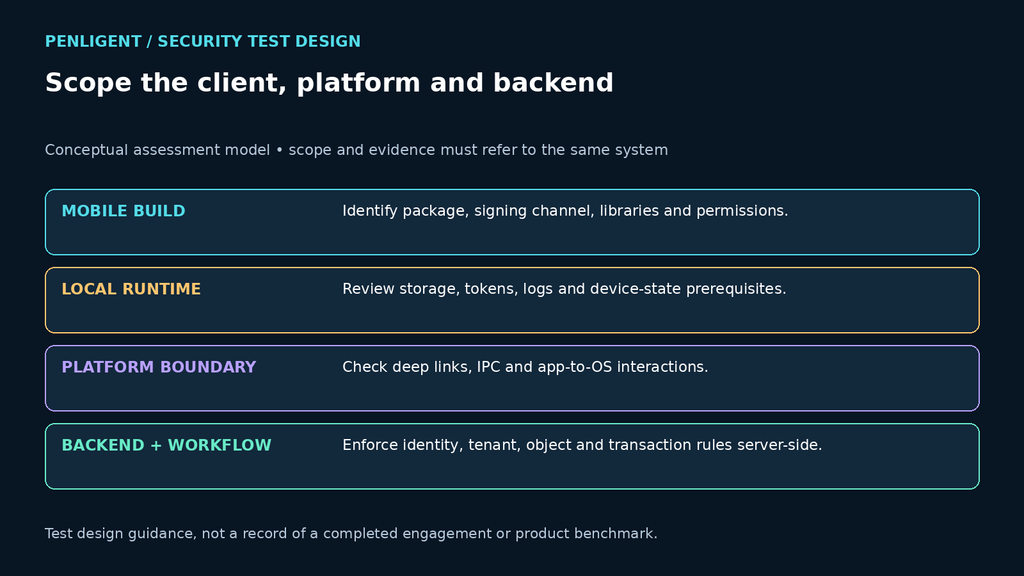
Scope the complete mobile system
| レイヤー | Security questions | エビデンス |
|---|---|---|
| Application package | What permissions, components, libraries and hard-coded material are present? | Build identifier, package metadata and attributable observation |
| Local runtime | How are secrets, tokens, files, logs and screenshots protected? | Device state, storage location and access condition |
| プラットフォーム統合 | Are deep links, intents, URL schemes, pasteboard and notifications constrained? | Caller, target component and resulting action |
| ネットワーク | Are transport, certificate and proxy assumptions appropriate? | Connection path and server-side decision |
| Backend API | Does the server enforce identity, tenant, object and entitlement rules? | Role, object ownership, request and response |
| Business workflow | Can mobile-specific state or replay create an unauthorized outcome? | State transition and demonstrated impact |
Explore Penligent for authorized security testing
について OWASP Mobile Application Security project, including MASVS そして MASTG, provides requirements and testing guidance. Use the controls relevant to the application’s data, privileges and threat model rather than treating every item as identical priority.
Provide testable builds and accounts
Give the tester the exact release candidate or production build identifier, supported OS versions, test devices or device requirements, roles, tenants and synthetic data. If certificate pinning or integrity controls block inspection, agree on a test build or documented bypass that does not invalidate the rest of the behavior.
Client controls do not replace server authorization
Root and jailbreak detection, obfuscation, attestation and anti-tamper controls can raise attacker cost. They should not be the only controls protecting accounts, objects or transactions. The backend must independently authorize every sensitive action and tolerate a hostile client.
Authentication and session testing
- registration, device binding, SSO and passkey flows;
- MFA enrollment, recovery and removal;
- token storage, rotation, revocation and logout;
- application switching, backgrounding and device backup behavior;
- deep-link and universal-link account transitions;
- multiple accounts and tenant changes on one device.
Evidence requirements
Each finding should identify the application version, OS, device state, account and backend environment. Separate a locally observable artifact from an exploitable security boundary. For example, a string in memory is not automatically a critical secret disclosure; the report should show sensitivity, access prerequisites, lifetime and resulting impact.
Test distribution and update behavior
Review signing, release channels, update enforcement and deprecated API versions. If old clients remain functional, test whether they bypass newer authorization or validation. Verify that forced upgrades and remote configuration fail safely and cannot strand users in insecure states.
Provider evaluation
- Ask which physical devices, OS versions and analysis methods are included.
- Confirm that APIs and business workflows are in scope, not only the binary.
- Request a redacted finding showing client and server evidence together.
- Define how sensitive test artifacts and signing material are handled.
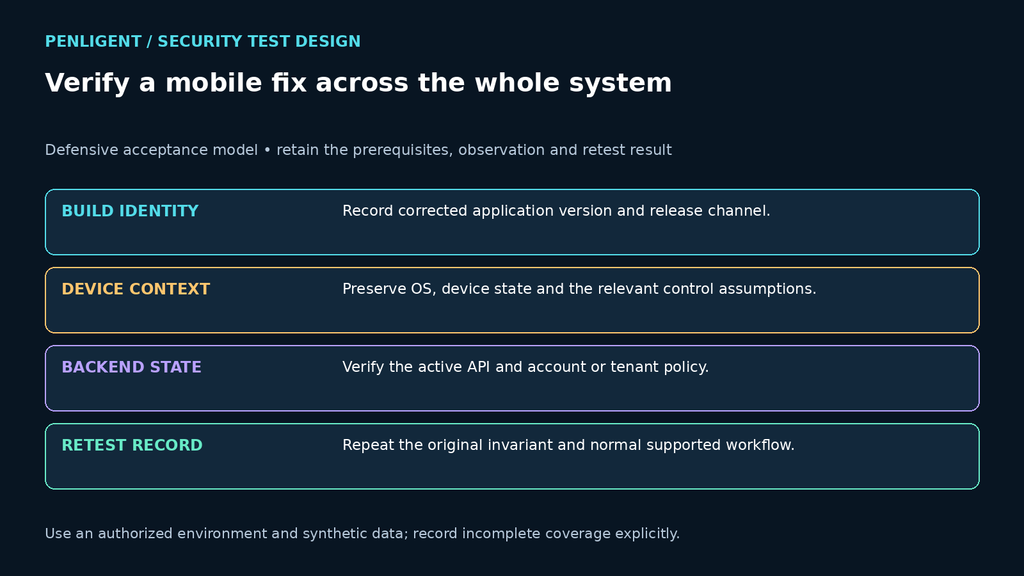
- Require a retest on the corrected build and active backend.
Explore Penligent for authorized security testing
Make the purchase measurable
Select a mobile testing service that can trace security decisions across the device, operating system and backend. The deliverable should help mobile and API engineers reproduce and verify fixes. Confirm native iOS and Android analysis, device access and backend testing explicitly in the chosen provider’s scope; an AI-assisted API workflow alone does not establish native-client coverage.
The following Penligent overview introduces a general authorized testing workflow. It does not demonstrate that every assessment capability discussed in this guide is included in a particular product plan.
 Japanese
 English
 German
 French
 Spanish
 Portuguese
 Korean
 Hindi
 Arabic
 Turkish
 Hebrew