
SvelteKit’s core security updates require feature-level triage. Four advisories cover server-only imports reaching a browser bundle, costly remote-function request parsing, collisions between private query.batch functions, and cross-origin code import during server-side route resolution. The 3.1.1 release includes fixes corresponding to all four. The 2.70.4 release includes the routing fix; that backport must not be represented as proof that it resolves all four issues.
The package in this article is @sveltejs/kit. Adapter versions are a separate inventory item, covered in the existing SvelteKit adapter security article. Updating an adapter alone does not establish that the core build and runtime paths described here have changed.
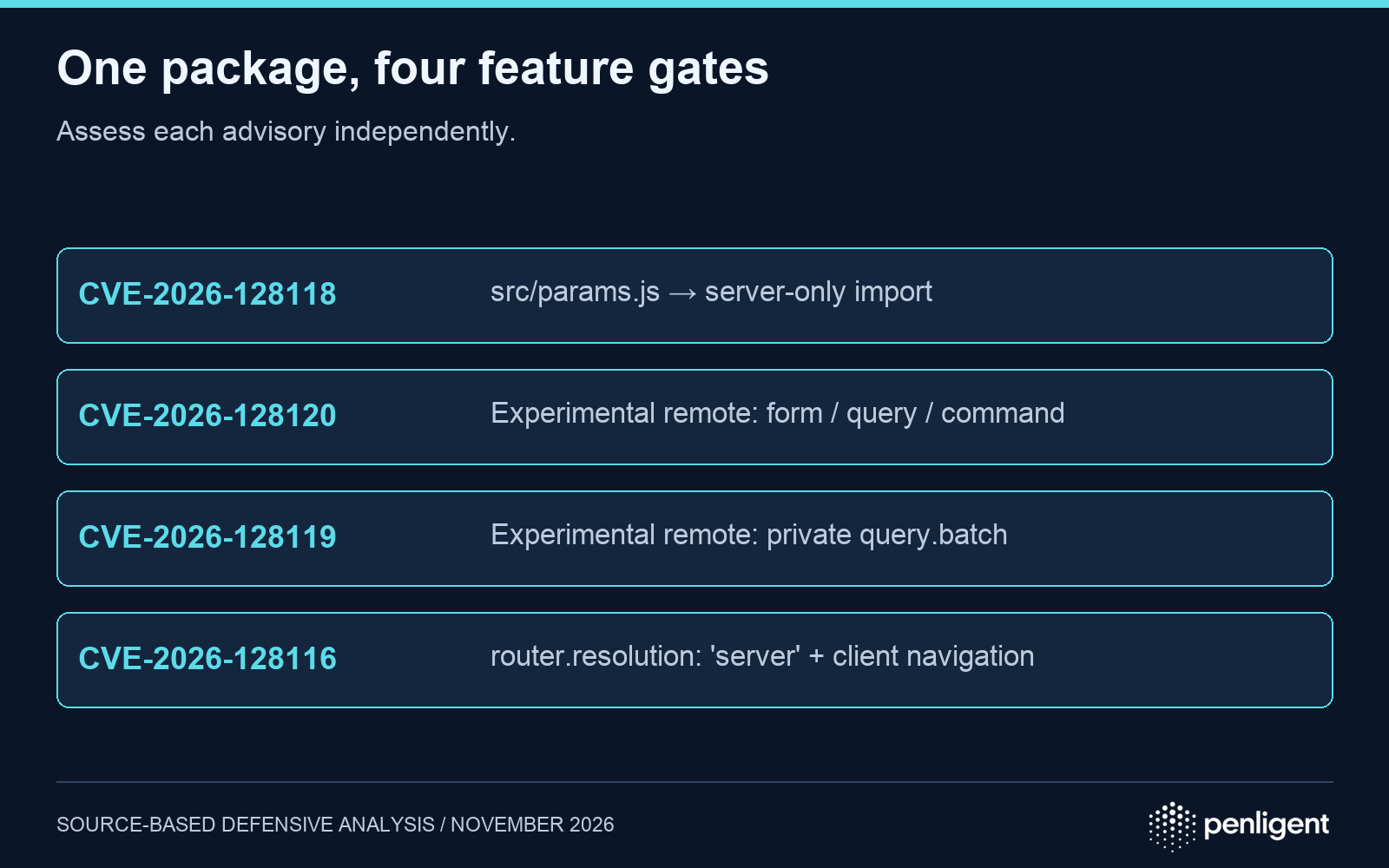
Match each advisory to a feature and a fixed release
| Advisory | Published affected range | Feature prerequisite | Published fixed version |
|---|---|---|---|
| CVE-2026-128118 | 3.0.0–3.1.0 | Server-only imports made through src/params.js | 3.1.1 |
| CVE-2026-128120 | 2.42.0–3.1.0 | Experimental remote functions using form, query, or command | 3.1.1 |
| CVE-2026-128119 | 2.60.1–3.1.0 | Experimental remote functions with non-exported query.batch functions | 3.1.1 |
| CVE-2026-128116 | 2.x through 2.70.3; 3.0.0–3.1.0 | router.resolution set to server, plus a specially crafted link reached through client-side navigation | 2.70.4 or 3.1.1 for the respective branch |
Sources: the maintainer advisories for server-only imports, remote-function parsing, private batch collisionsそして server-side route resolution. The routing record’s range string combines branches awkwardly; the explicit fixed versions and release notes supply the branch distinction shown here.
Why the 2.70.4 routing backport is not a universal closure
について 2.70.4 release notes list prevention of cross-origin code loading for server-resolved pathnames. The 3.1.1 notes additionally identify separate private-batch isolation, linear-time remote-form parsing, and the src/params.js server-only import guard.
For a 2.x application using experimental remote functions, the published parsing and batch advisories still require attention even after the routing backport. Their records identify 3.1.1 as the fixed release. Plan a compatible migration to a release containing those fixes, or remove the affected experimental feature while resolving the upgrade. Do not close a multi-advisory ticket solely because the router row is patched.
Build-time secret handling needs an artifact response
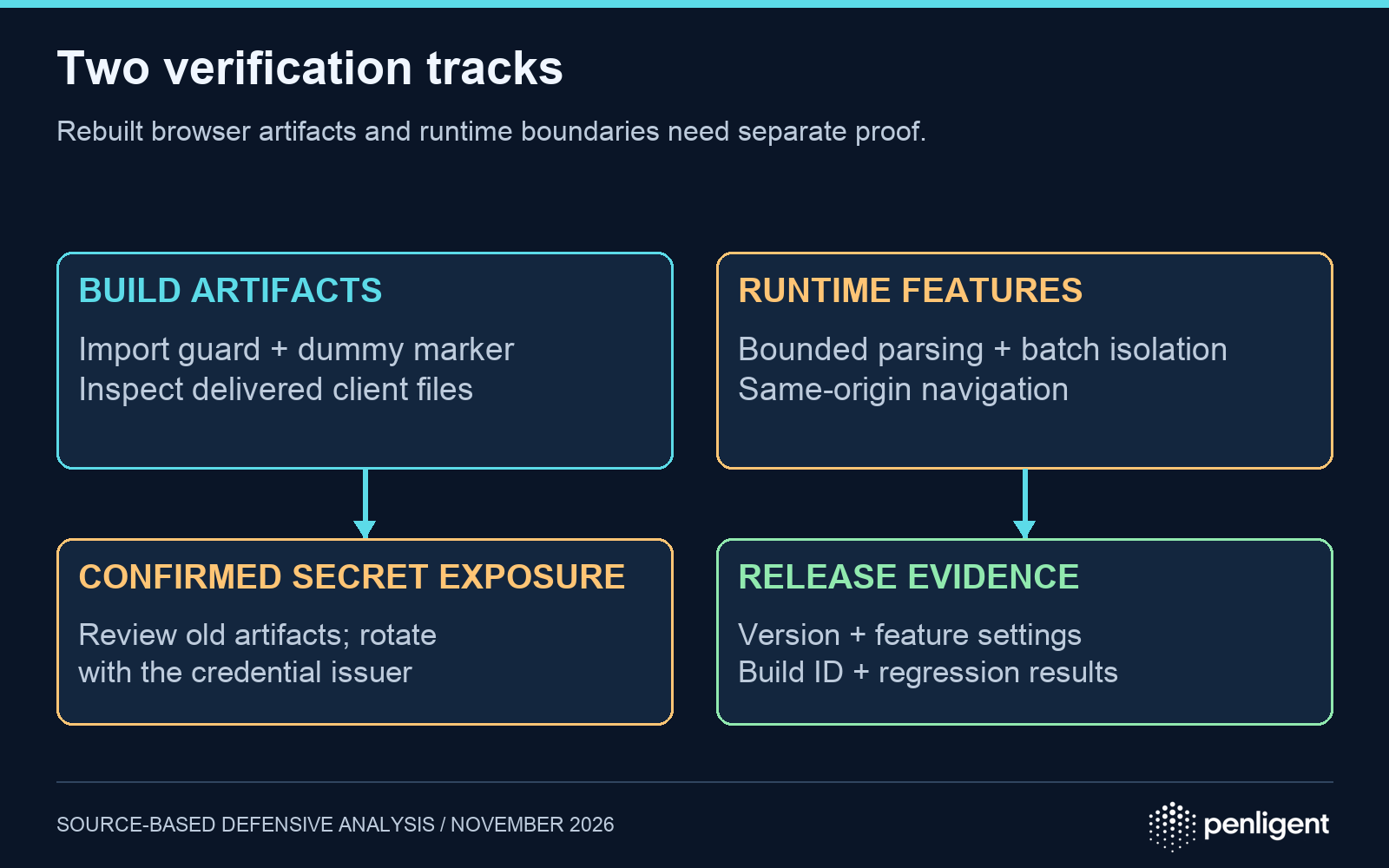
CVE-2026-128118 is about server-only imports through src/params.js reaching client code under certain circumstances. It does not establish that every application’s environment variables leaked. Inspect whether the relevant import path exists, then inspect the browser artifacts that were actually built and distributed.
A safe regression fixture uses a unique dummy marker in a server-only module and the relevant import path. In a disposable build, verify that the unsupported client import is blocked and that no marker appears in emitted client assets. A search with no matches is useful evidence for that fixture; it is not proof about all historical builds, transformed secret values, or artifacts outside the search scope.
If a real secret was present in previously delivered browser assets, a new deployment cannot recall downloaded copies. Investigate old CDN objects, source maps, caches, and other distributed build artifacts. Revoke or rotate a confirmed exposed credential with its issuer and verify dependent workloads separately from rebuilding the site. Keep the secret value out of the ticket and screenshots.
Remote functions: keep availability and batch identity separate
For CVE-2026-128120, the experimental flag and use of form, query, or command are material prerequisites. The parsing fix referenced by 3.1.1 groups FormData entries in one pass instead of repeatedly retrieving entries for each name. That source-level change explains the availability boundary; it is not a measured latency improvement for a particular application.
Use bounded synthetic requests in an isolated service with monitoring and a termination limit. Retain input size, elapsed time, and service responsiveness across increasing, modest input sizes. Avoid load tests against production or assigning a universal safe request limit from a single result.
CVE-2026-128119 concerns non-exported query.batch functions sharing a batch under certain circumstances. In an isolated regression fixture, give two private batch functions distinct synthetic argument sets and distinct output markers. Assert that each function receives only its own arguments. A successful single-function request cannot verify separation, and the advisory does not establish that every application leaked user data.
Server-side route resolution: verify the origin boundary
CVE-2026-128116 requires router.resolution: ‘server’ and client-side navigation to the crafted link. Its stated outcome is importing and running code from another domain in the user’s browser context; describing it as unauthenticated server RCE would change the reported mechanism.
について 3.1.1 routing patch builds the route-module specifier from the validated URL, setting its pathname and clearing its search and hash. This preserves the origin boundary where a protocol-relative pathname could otherwise select a different host. A defensive browser regression test should use a local synthetic navigation case and network observation, verify that no external route module is requested, and retain normal internal navigation as a positive control. No attacker-hosted code is needed.
Attach evidence to the release, not just the lockfile
npm ls @sveltejs/kit
npm explain @sveltejs/kit
Record the resolved core version, enabled experimental features, router configuration, deployed build identifier, and results for each applicable row. Keep build-output checks separate from runtime parsing, batch, and navigation checks. For absent features, record why a row is not applicable; for untested paths, retain an open verification item.
Teams using 寡黙 for authorized validation should preserve these separate evidence boundaries. The following video demonstrates a general product workflow; it is not a SvelteKit exploit reproduction or proof that any deployment is remediated.
Method: AI assisted organization. Material facts were checked against the linked SvelteKit advisories, branch release notes, and source fixes. The fixture designs are proposed defensive checks. No first-hand secret exposure, denial of service, batch collision, or browser code execution is claimed.
 Japanese
 English
 German
 French
 Spanish
 Portuguese
 Korean
 Hindi
 Arabic
 Turkish
 Hebrew