
CVE-2026-103406 is an unauthenticated OS command-injection vulnerability in the AutomatedProvisioner component of Juniper Session Smart Conductor. Juniper’s CVE record says a specially crafted salt minion ID can cause commands to run as root. The immediate task is to identify the Conductor systems in your deployment, match each to its release branch, and verify a fixed release is actually running.
그리고 Juniper-issued CVE record, checked on November 26, 2026, lists fixes in 7.0.5, 7.1.7 and 7.2.3 and reports that at least one instance of malicious exploitation reached Juniper SIRT. CISA added the vulnerability to its Known Exploited Vulnerabilities catalog on November 25. That catalog update is a new prioritization signal; the vulnerability was originally disclosed on October 28.
Resolve the Conductor and Router naming difference first
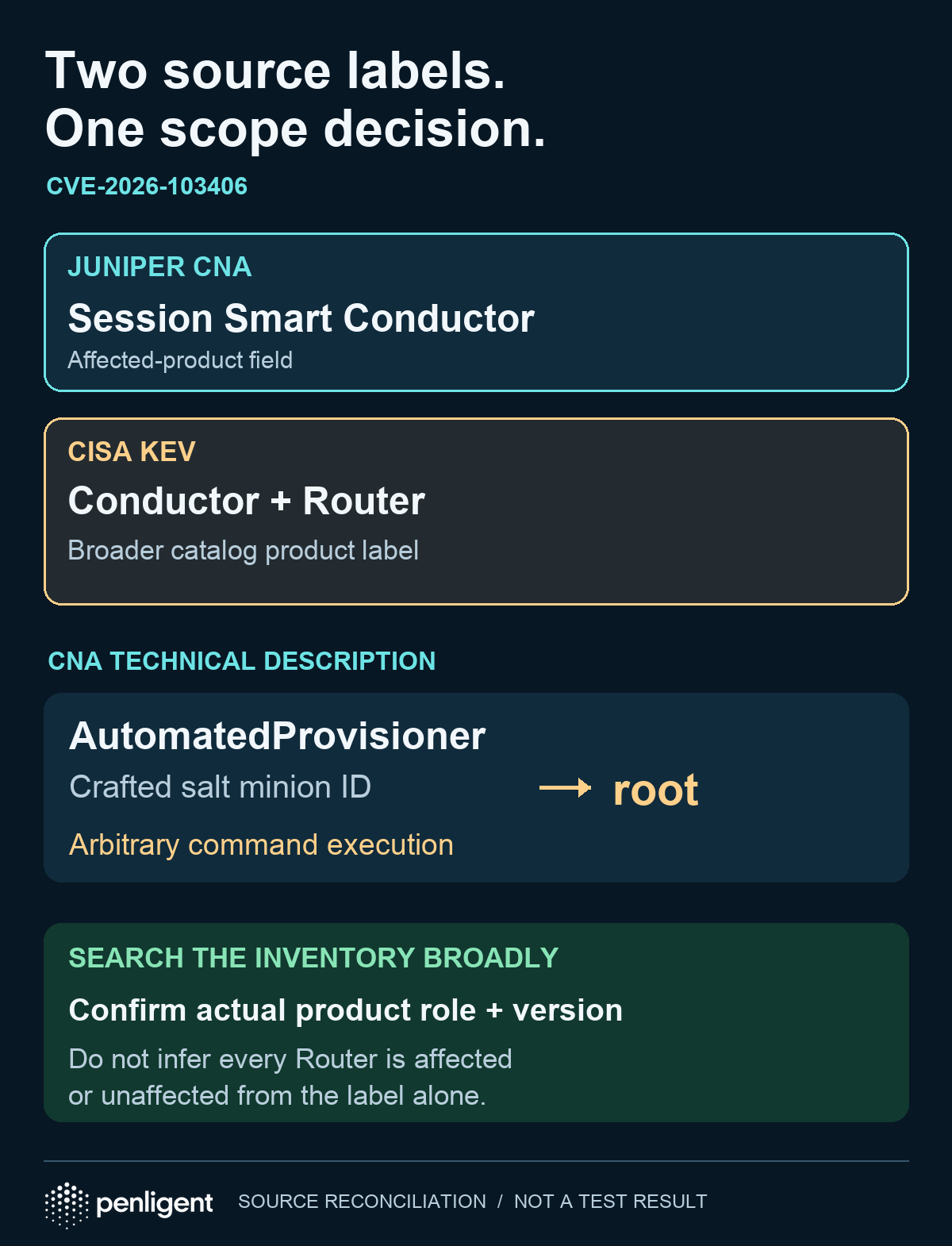
The two primary records do not use identical product scope. The Juniper CNA record names Session Smart Conductor in its affected-product field and identifies AutomatedProvisioner as the vulnerable component. CISA’s catalog uses the broader product label “Juniper Session Smart Conductor and Session Smart Router.” The vendor bulletin linked from both records also covers multiple internally discovered issues across that product family.
For this specific CVE, use the CNA’s component description to establish the initial technical scope. Keep the broader KEV label in the tracking record so that an inventory search does not silently drop relevant assets. A product-family label alone does not demonstrate that every Router instance exposes the Conductor component, and the narrower CNA field should not be converted into a blanket assurance that all Router deployments are unaffected.
Classify assets by their actual role and deployed software. Identify Conductor instances first; separately record Router-only entries and any uncertain or combined deployment roles for confirmation against Juniper bulletin JSA112183 or vendor support. This is a scope-reconciliation method, not a new finding about which undocumented configurations are exploitable.
What the root impact establishes—and what remains unpublished
그리고 CNA description identifies OS command injection, classified as CWE-78, through a specially crafted salt minion ID. Its title places the issue during key management. The assigned CVSS v3.1 score is 9.8, with network access, no privileges and no user interaction in the vector. Those fields support treating the issue as a critical unauthenticated exposure; they do not supply a reproducible test.
The statement that commands can execute as root comes directly from Juniper’s record. It is not an inference from the severity score. Root execution is a reason to investigate the integrity of an affected Conductor after suspicious activity, but the record does not establish that a particular customer system was compromised or that an attacker subsequently controlled every managed router.
The material reviewed does not provide a verified request format, service port, payload or complete sequence for this CVE. It also does not establish a vulnerability in every upstream Salt installation. An asset team should use supported product inventory and configuration records rather than inventing a probe from the phrase “salt minion ID.” Avoid turning a management identifier into an unsolicited test input on a production system.
Apply the fix for the installed release branch
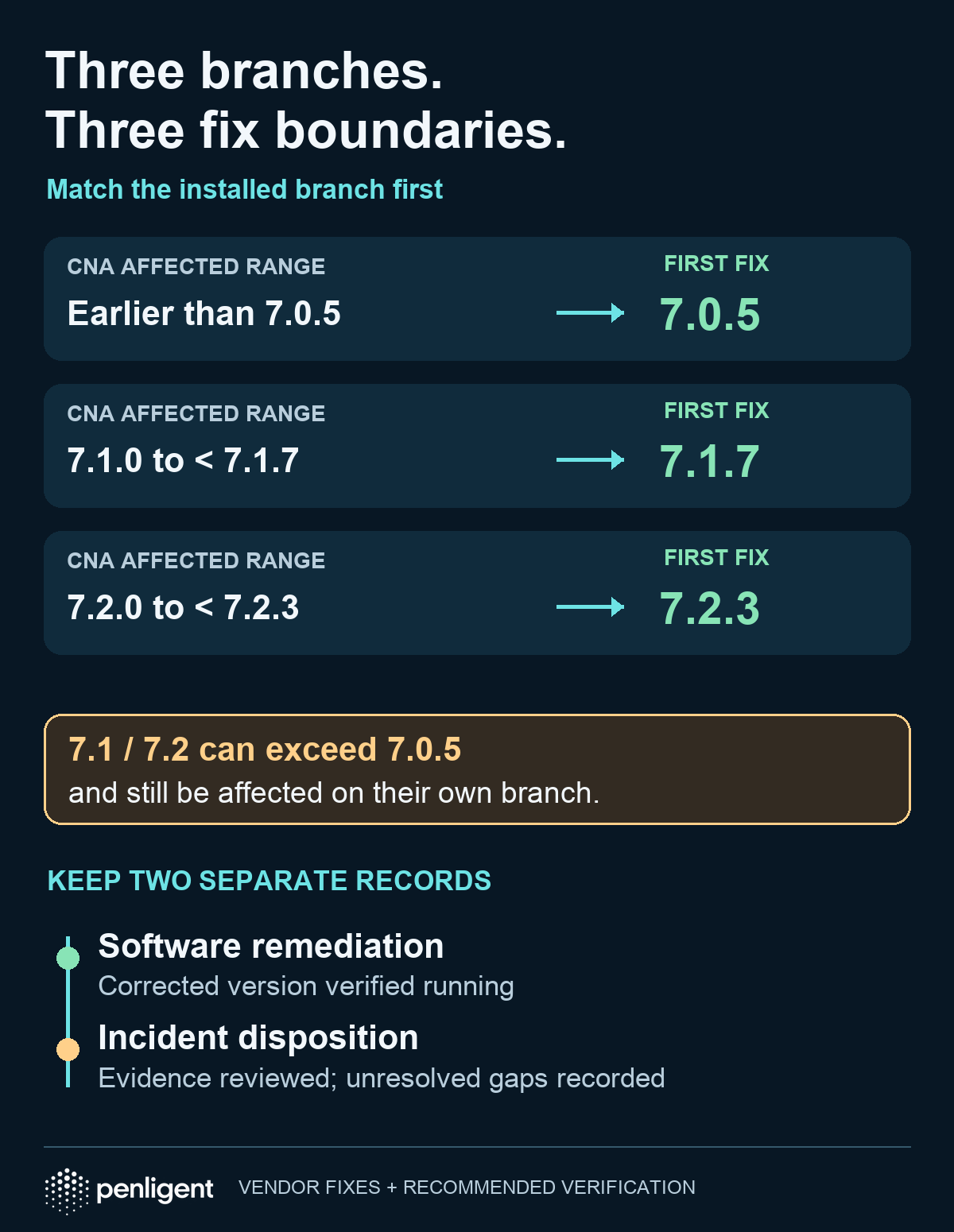
Read the fixed versions as separate branch boundaries. A 7.1 or 7.2 build can compare higher than 7.0.5 while still sitting inside its own affected range. The following table preserves the version ranges from Juniper’s CNA record instead of collapsing them into one minimum-version rule.
| Recorded release range | CNA status for this CVE | First listed fixed release |
|---|---|---|
| Versions earlier than 7.0.5 | 영향을 받는 | 7.0.5 |
| 7.1.0 up to, but excluding, 7.1.7 | 영향을 받는 | 7.1.7 |
| 7.2.0 up to, but excluding, 7.2.3 | 영향을 받는 | 7.2.3 |
Juniper lists those releases and subsequent releases as resolving the issue. Select a supported target using the vendor’s upgrade guidance and the deployment’s compatibility requirements; this table is not an upgrade-path document. If a legacy or unusual version cannot be mapped confidently, keep its disposition unresolved while obtaining vendor guidance. Do not assign a fixed status solely because a scanner compared one version string with 7.0.5.
Retain the product role, exact version, instance identity, relevant branch and selected target in the change record. After the change, obtain the version from the running system through the product’s supported management workflow. A downloaded package, a scheduled task or an upload completion message is not sufficient evidence that the Conductor is running the corrected code.
No workaround means containment must keep its limits
Juniper’s CNA workaround field explicitly states that no available workaround exists for this issue. Its exploitation note urges customers to upgrade promptly and take mitigating steps in the meantime. Those statements should not be combined into a claim that a particular firewall rule, disabled option or service restart is a vendor-approved substitute for the fix.
As a general containment measure, review who can reach the affected management environment and reduce unnecessary access through the organization’s established controls. Preserve required administration and provisioning operations while planning the change. This recommendation reduces exposure opportunities; it is not a validated workaround for CVE-2026-103406. Record the temporary restriction separately from the software remediation so it cannot accidentally close the patch task.
Separate the upgrade result from the incident decision
The exploitation report raises the urgency of both remediation and investigation. It does not tell an operator when attacks began against their own infrastructure. CISA’s entry lists ransomware-campaign use as unknown; that field is not evidence that ransomware activity is absent. Do not infer campaign size, attacker identity or a first-exploitation date from either source.
When activity is suspicious, preserve the operational records available for the Conductor before changes erase useful history. Ask the service owner and incident-response team to review unexpected provisioning or key-management activity alongside administrative access and configuration changes. These are investigation categories suggested by the documented component and impact, not vendor-published indicators of compromise or a tested detection rule.
| Observed evidence | Appropriate recorded conclusion |
|---|---|
| Conductor role confirmed; version falls within an affected range | Affected software identified; upgrade required. |
| Fixed branch release verified on the running Conductor | Software remediation verified for that instance. |
| Access restriction applied while fixed code is not yet active | Temporary exposure reduction; software remediation remains open. |
| Suspicious activity or integrity changes remain unexplained | Incident review remains open, even if the upgrade succeeded. |
| Product role, version or historical evidence is incomplete | Document the gap and owner; do not claim a clean historical state. |
This decision table is an operational synthesis of the source facts. For an environment with multiple Conductor instances, retain evidence for each instance instead of inheriting one successful result across the inventory. If recovery actions are required, agree them with the response team and vendor support. Installing corrected code addresses the vulnerability; it does not by itself establish that earlier unauthorized changes have been removed.
A useful closure record therefore contains two independently owned decisions: the software branch and running fixed version have been verified, and the investigation has reached a documented disposition with its evidence limits. Keep the reconciled product scope with both records so future audits can explain why a broad KEV alert led to specific Conductor actions.
Teams using 펜리전트 as part of an authorized assessment should preserve the same scope boundary in their reporting: an observed validation result applies to the systems and conditions actually checked. The following Penligent 3.0 video is a general product demonstration; it does not demonstrate exploitation or remediation of this Juniper vulnerability.
Methodology: Prepared with AI assistance and checked against Juniper’s CNA record and CISA’s KEV entry on November 26, 2026. The scope and closure framework is editorial analysis. We did not reproduce the exploit, test a customer deployment, or independently validate Juniper’s exploitation report.
 Korean
 English
 German
 French
 Spanish
 Portuguese
 Japanese
 Hindi
 Arabic
 Turkish
 Hebrew