
CVE-2026-8933 is a high-severity local privilege escalation vulnerability in snap-confine, the privileged helper that Canonical’s snapd uses to construct the execution environment for Snap applications. On affected Ubuntu systems, a local unprivileged user may be able to abuse a race condition during sandbox initialization, create attacker-influenced files in privileged locations, and ultimately execute code with full root privileges.
The vulnerability received a CVSS 3.1 score of 7.8, with a local attack vector, low attack complexity, low privileges required, no user interaction, and high confidentiality, integrity, and availability impact. Canonical published the vulnerability and its associated security update on July 21, 2026. Ubuntu 22.04 LTS, 24.04 LTS, and 26.04 LTS received fixed snapd packages. (우분투)
CVE-2026-8933 is not a conventional remote vulnerability and does not, by itself, allow an unauthenticated attacker on the internet to compromise an Ubuntu host. The attacker first needs the ability to run code as a local, unprivileged user. That prerequisite nevertheless appears in many realistic attack chains: a compromised desktop application, stolen developer account, malicious build task, vulnerable local service, exposed remote shell, misconfigured container boundary, or another initial-access vulnerability may all provide the foothold needed to attempt local privilege escalation.
The most important scope distinction is that CVE-2026-8933 does not affect every version or installation of snap-confine. It specifically affects vulnerable builds configured with Linux file capabilities rather than the traditional set-user-ID-root execution model. Qualys, which discovered the vulnerability, demonstrated exploitation on default Ubuntu Desktop 26.04 and 25.10 installations and on an updated Ubuntu Desktop 24.04 installation using the snap-confine binary delivered through the snapd Snap. Canonical’s maintained-release advisory identifies Ubuntu 22.04 LTS, 24.04 LTS, and 26.04 LTS as affected and patched.
This article explains the vulnerability from a defensive and authorized-testing perspective. It deliberately does not reproduce the public exploit or provide a working privilege-escalation payload. The included commands inspect versions, file attributes, security configuration, logs, and patch state without attempting to trigger the vulnerability.
CVE-2026-8933 at a Glance
| 필드 | 세부 정보 |
|---|---|
| CVE | CVE-2026-8933 |
| 영향을 받는 구성 요소 | snap-confine, distributed as part of snapd |
| 취약점 유형 | Local privilege escalation and sandbox initialization flaw |
| Common weakness | CWE-250, execution with unnecessary privileges |
| 공격 벡터 | Local |
| Privileges required | 낮음 |
| 사용자 상호 작용 | 없음 |
| CVSS 3.1 score | 7.8 High |
| CVSS vector | CVSS:3.1/AV:L/AC:L/PR:L/UI:N/S:U/C:H/I:H/A:H |
| Primary prerequisite | Ability to execute code as an unprivileged local user |
| Affected execution model | 취약한 snap-confine builds using file capabilities |
| Potential result | Arbitrary code execution as root |
| Upstream affected range | snapd 2.75.0 through versions before 2.76.1 |
| Upstream fixed release | snapd 2.76.1 |
| Ubuntu disclosure date | July 21, 2026 |
| Researcher | Qualys Threat Research Unit |
The NVD record associates the upstream affected range with snapd versions beginning at 2.75.0 and ending before 2.76.1. Ubuntu does not necessarily expose the same version string because Canonical backports security fixes into distribution-specific packages. Administrators should therefore compare their installed package against the Ubuntu fixed version for their release rather than assuming that every package whose version appears lower than 2.76.1 remains vulnerable. (NVD)
What Is snap-confine?
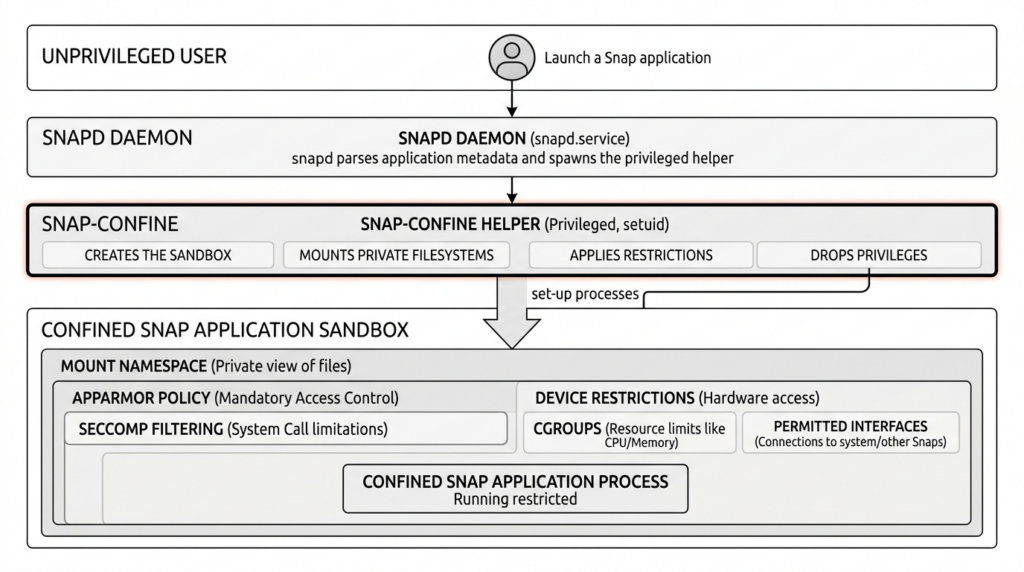
Snap packages are application bundles distributed and managed by snapd. A strictly confined Snap application is not intended to receive unrestricted access to the host operating system. Instead, snapd combines multiple Linux security mechanisms to create an application-specific execution environment.
These mechanisms may include mount namespaces, AppArmor policies, seccomp filters, cgroups, device restrictions and carefully mediated interfaces that grant access to selected host resources. No single mechanism represents the entire Snap security boundary. Snap confinement is a layered system in which each component handles a different class of access.
snap-confine is one of the components involved in building this environment. Before a confined application starts, snap-confine performs operations that ordinary applications cannot normally perform. Depending on the platform and build configuration, these operations may include constructing mount namespaces, creating temporary filesystem structures, changing ownership, entering directories, configuring process credentials and arranging the filesystem view presented to the application.
A program that performs those tasks must possess substantial privileges. Historically, privileged Linux helpers have often been installed as setuid-root executables. When an unprivileged user executes a correctly configured setuid-root program, its effective user ID becomes root while it performs the privileged work.
More recent designs may instead assign a narrower set of Linux file capabilities to the executable. Capabilities divide the traditional all-powerful root privilege into separate units such as permission to override file ownership checks, change user IDs, administer mount namespaces or change file ownership.
In principle, capabilities support least privilege. A process can be granted the particular kernel privileges it needs without receiving every authority traditionally associated with root. In practice, a process carrying a broad combination of powerful capabilities still needs to be treated as a security-critical privileged program.
CVE-2026-8933 demonstrates a subtle risk in this transition. Moving from a setuid-root process to a process that retains the invoking user’s effective UID while receiving powerful capabilities can change the ownership semantics of files and directories created by the process. Code that was safe under one credential model may become unsafe under another, even when its high-level behavior appears unchanged.
Why the File-Capabilities Configuration Matters
Qualys found that the vulnerable condition was counterintuitive: the affected snap-confine variants were the versions using file capabilities, while the standard setuid-root variants were not vulnerable to this specific flaw.
Under the vulnerable execution model, snap-confine did not simply run with an effective UID of zero. It continued to run with the effective UID of the unprivileged user who invoked it, while holding a set of capabilities that allowed it to perform operations approaching root authority.
This distinction matters when the process creates a new file or directory. Unless the program explicitly changes ownership or creates the object through another trusted mechanism, the kernel initially associates the new object with the process’s effective user ID. In the vulnerable configuration, that UID belonged to the unprivileged caller.
During sandbox initialization, snap-confine created a temporary scratch directory with a pattern similar to:
/tmp/snap.rootfs_XXXXXX
It also created files under that directory while assembling the root filesystem view for the Snap application. The program quickly changed the ownership of those objects to root, but “quickly” is not equivalent to “atomically.”
For a short period after creation and before the ownership change, the temporary object belonged to the unprivileged caller. During that interval, the user could potentially modify, replace or otherwise influence an object that a highly capable process would continue to trust.
Qualys identified two related race windows: one around creation and ownership adjustment of the scratch directory, and another around creation and ownership adjustment of a file inside that directory.
This is a time-of-check-to-time-of-use problem, commonly abbreviated as TOCTOU. The security decision and the sensitive operation do not occur as a single indivisible action. An attacker who can alter the relevant filesystem object between those steps may cause the privileged process to operate on something other than what the developer intended.
The Root Cause of CVE-2026-8933
The root cause can be understood as the interaction of four conditions:
snap-confinepossessed powerful Linux capabilities.- It retained the invoking user’s effective UID.
- It created temporary filesystem objects that initially belonged to that user.
- It subsequently performed privileged operations on paths derived from those temporary objects.
Individually, none of these conditions necessarily creates a vulnerability. Their combination created an attacker-controlled transition inside a privileged workflow.
The problematic file creation used open() with creation and truncation flags but without O_NOFOLLOW. When the final component of the path was a symbolic link, the operation could follow the link and act on its target instead of rejecting it. The privileged capabilities available to snap-confine allowed the operation to reach locations that the unprivileged caller could not normally modify.
The program then changed the opened file’s ownership to root. However, there was another interval between file creation and the ownership change. During this second window, an attacker controlling the file could modify its permissions so that it remained writable after becoming root-owned.
The result was more serious than an ordinary temporary-file weakness. A local user could potentially transform the race condition into attacker-influenced file creation in a location reachable by the snap-confine AppArmor policy.
The vulnerability was therefore not merely “a predictable filename in /tmp.” The security impact depended on a chain involving temporary ownership, privileged capabilities, symlink following, namespace construction, FUSE behavior, permission manipulation and a writable privileged subsystem.
How the Attack Chain Works
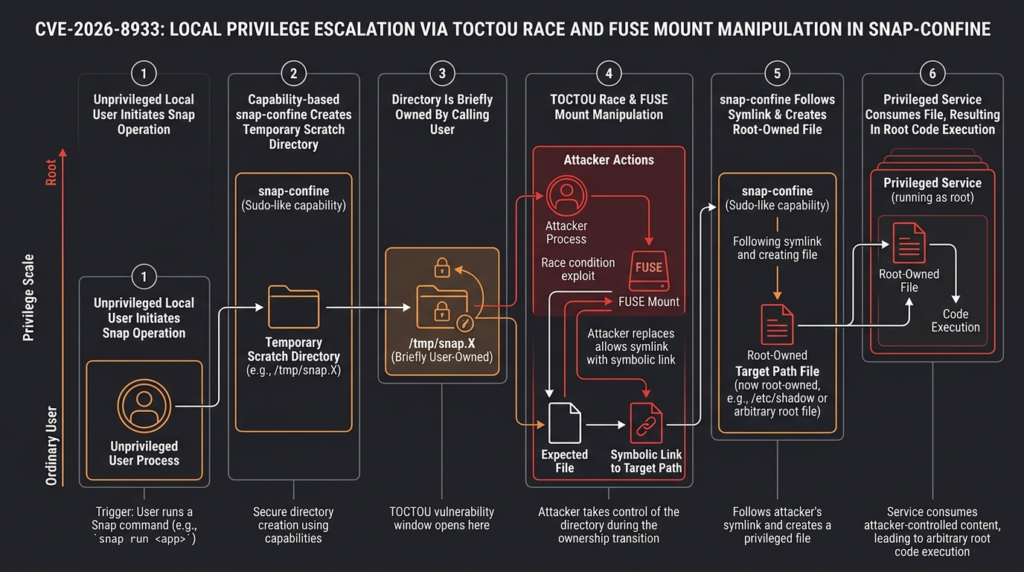
A complete exploit requires precise coordination and is more complex than running a single command. At a high level, however, the chain can be divided into several stages.
Stage 1: Obtain Local Code Execution
The attacker begins with access to an ordinary local account or another context capable of executing programs under a non-root UID.
This may be an interactive shell, a compromised desktop session, a malicious task running on a shared build machine or code execution obtained through a separate vulnerability. CVE-2026-8933 does not provide this initial foothold.
Stage 2: Trigger snap-confine
The attacker causes an operation that invokes the vulnerable snap-confine helper to create a sandbox environment for a Snap application.
The application itself does not necessarily have to be malicious. The vulnerable behavior occurs in the privileged setup process responsible for constructing its environment.
This distinction is important. CVE-2026-8933 is not best described as a malicious Snap application directly escaping confinement. It is a local host user exploiting the privileged helper while that helper builds a sandbox.
Stage 3: Race the Temporary Scratch Directory
The vulnerable helper creates a scratch directory below /tmp. Because the process retains the unprivileged caller’s effective UID, the directory initially belongs to the caller.
Before snap-confine changes the directory’s ownership and finishes arranging the mount namespace, the attacker attempts to take control of the temporary path.
Qualys used FUSE-related mount behavior to interfere with the helper’s expected view of the directory. FUSE allows filesystems to be implemented in user space, and ordinary users may be permitted to mount FUSE filesystems under controlled circumstances.
The role of FUSE in the research chain was not simply to store a malicious file. It helped the attacker manipulate which filesystem was visible at the scratch path while snap-confine continued its namespace construction. This made it possible to defeat assumptions created by the helper’s temporary mounts.
Stage 4: Introduce a Symbolic Link
While the temporary path remains attacker-controlled, the attacker places a symbolic link where snap-confine expects to create a regular file.
The symlink points to a different target elsewhere on the filesystem. When the vulnerable helper opens the expected pathname without O_NOFOLLOW, the kernel follows the link.
왜냐하면 snap-confine possesses powerful capabilities, the resulting operation may succeed against a destination that would be inaccessible to the ordinary user.
Stage 5: Preserve Write Access
The file initially appears under the caller’s ownership because the helper is operating under the caller’s effective UID. The helper subsequently changes the file owner to root.
The attacker races this transition and modifies the mode before the ownership change completes. If successful, the file can remain writable by the attacker even after it becomes root-owned.
At that point, the attacker has crossed an important privilege boundary: a low-privilege process has influenced a file created through a highly privileged execution path.
Stage 6: Find a Privileged Consumer
snap-confine itself runs under an AppArmor profile. The profile prevents it from writing freely to many obvious targets, including arbitrary files under /etc.
That restriction reduces the attack surface, but it does not eliminate every writable location. Qualys identified an allowed path under /run/udev/ and demonstrated that an attacker-controlled udev rule could be consumed by the privileged systemd-udevd service.
A subsequent device-related event could cause the service to process the malicious rule and execute attacker-selected behavior as root.
The exact proof-of-concept payload is unnecessary for defensive validation and is intentionally omitted here. From a risk perspective, the important lesson is that a restricted arbitrary-file-creation primitive can still become full privilege escalation when one of the permitted destinations feeds a trusted, privileged parser or event handler.
Why AppArmor Did Not Fully Stop the Exploit
It would be incorrect to conclude that AppArmor was absent or completely ineffective. The snap-confine profile significantly constrained where the privileged helper could write. According to the Qualys analysis, straightforward attempts to target ordinary sensitive files under /etc were blocked.
However, mandatory access control is only one layer of the system. A policy can prevent access to thousands of paths and still leave one path that participates in a dangerous trust relationship.
The weakness arose because the attacker did not need unrestricted filesystem access. The attacker needed only one location satisfying three conditions:
snap-confinewas permitted to create or modify a file there.- The file’s contents could remain attacker-controlled.
- A separate root-level component would later interpret or execute the file.
The allowed /run/udev/** path provided that bridge in the demonstrated exploit chain. The privileged consumer was not snap-confine itself, but the system’s device-event processing infrastructure.
This is a recurring sandbox-security pattern. A policy may correctly restrict direct access to high-value targets while unintentionally permitting access to a lower-profile control surface that another privileged service trusts.
Defenders should therefore assess not only whether a confined component can directly write /etc/passwd, replace a system binary or alter a service unit. They should also ask whether it can influence configuration fragments, hooks, rule directories, sockets, queues, caches or runtime files consumed by another trust domain.
Affected Ubuntu Releases and Fixed Versions
Canonical’s current CVE status identifies Ubuntu 22.04 LTS, 24.04 LTS and 26.04 LTS as affected. The following fixed package versions were released:
| Ubuntu release | CVE-2026-8933 status | Fixed snapd package |
|---|---|---|
| Ubuntu 26.04 LTS | Affected, fixed | 2.76+ubuntu26.04.3 |
| Ubuntu 24.04 LTS | Affected, fixed | 2.76+ubuntu24.04.1 |
| Ubuntu 22.04 LTS | Affected, fixed | 2.76+ubuntu22.04.1 |
| Ubuntu 20.04 LTS | Not affected by this CVE | Update may still be required for other snapd issues |
| Ubuntu 18.04 LTS | Not affected by this CVE | Update may still be required for other snapd issues |
| Ubuntu 16.04 LTS | Not affected by this CVE | Update may still be required for other snapd issues |
Canonical’s USN includes updated packages for older Ubuntu releases because the same security notice also covers other snapd vulnerabilities. An update appearing in USN-8579-1 for Ubuntu 20.04, 18.04 or 16.04 does not mean those releases are affected by CVE-2026-8933 itself. (우분투)
What About Ubuntu 25.10?
Qualys demonstrated that a default Ubuntu Desktop 25.10 installation used a vulnerable set-capabilities version of snap-confine. However, Ubuntu 25.10 reached end of life on July 9, 2026, twelve days before coordinated disclosure of CVE-2026-8933.
After an Ubuntu release reaches end of life, Ubuntu Security Notices no longer list it or provide new packages through its normal repositories. Canonical identified Ubuntu 26.04 LTS as the supported upgrade path from Ubuntu 25.10. Administrators still running 25.10 should not interpret its absence from the CVE package table as evidence that it is safe. They should migrate to a supported release, preferably Ubuntu 26.04 LTS, and then verify that the fixed snapd package is installed.
Why Ubuntu 24.04 May Have Two snap-confine Paths
The Qualys advisory observed a relevant distinction on Ubuntu 24.04. The system may contain:
/usr/lib/snapd/snap-confine
and a version delivered through the snapd Snap at:
/snap/snapd/current/usr/lib/snapd/snap-confine
Qualys demonstrated exploitation against the latter path on an updated Ubuntu Desktop 24.04 system. Checking only /usr/lib/snapd/snap-confine could therefore produce an incomplete assessment.
A defensive inventory should inspect both paths when they exist and should rely primarily on the installed Ubuntu package status rather than attempting to infer vulnerability solely from one executable’s mode bits.
How to Check Whether a System Is Exposed
The following checks are non-exploitative. They identify the Ubuntu release, installed snapd package and security attributes of available snap-confine binaries.
Check the Ubuntu Release
. /etc/os-release

printf 'Distribution: %s\n' "${PRETTY_NAME:-unknown}"
printf 'Version ID:   %s\n' "${VERSION_ID:-unknown}"
printf 'Codename:     %s\n' "${VERSION_CODENAME:-unknown}"
For fleet tooling, prefer VERSION_ID 그리고 VERSION_CODENAME over parsing the human-readable PRETTY_NAME.
Check the Installed snapd Package
dpkg-query -W -f='Package: ${binary:Package}\nVersion: ${Version}\nStatus: ${db:Status-Status}\n' snapd
You can also inspect the package candidate available from configured repositories:
apt-cache policy snapd
A system may be vulnerable when the installed package is below the fixed version for its Ubuntu release, even if a fixed candidate is already available.
Inspect snap-confine Paths
for path in \
    /usr/lib/snapd/snap-confine \
    /snap/snapd/current/usr/lib/snapd/snap-confine
do
    if [ -e "$path" ]; then
        echo
        echo "Inspecting: $path"
        stat -Lc 'mode=%A (%a) owner=%U:%G uid=%u gid=%g path=%n' "$path"

        if command -v getcap >/dev/null 2>&1; then
            getcap "$path" || true
        else
            echo "getcap is not installed"
        fi
    fi
done
A getcap result does not, on its own, prove that the installed version is vulnerable. It indicates that file capabilities are present and helps identify the configuration to which the vulnerability description applies.
Similarly, the absence of capabilities on one path is not sufficient to clear the host if another active snap-confine path exists.
Confirm the Active snapd Environment
snap version
Typical output identifies the snap client, snapd daemon, series, distribution and kernel. Record this information alongside the package version when collecting remediation evidence.
Safe CVE-2026-8933 Assessment Script
The following script performs release-aware version comparison. It does not create temporary race conditions, manipulate namespaces, mount FUSE filesystems, create udev rules or attempt privilege escalation.
#!/usr/bin/env bash

set -u

if [ ! -r /etc/os-release ]; then
    echo "ERROR: /etc/os-release is unavailable."
    exit 2
fi

# shellcheck disable=SC1091
. /etc/os-release

release="${VERSION_ID:-unknown}"
codename="${VERSION_CODENAME:-unknown}"

if ! command -v dpkg-query >/dev/null 2>&1; then
    echo "ERROR: This check expects an Ubuntu or Debian-style dpkg environment."
    exit 2
fi

installed_version="$(
    dpkg-query -W -f='${Version}' snapd 2>/dev/null || true
)"

echo "CVE-2026-8933 safe exposure check"
echo "--------------------------------"
echo "Ubuntu release: ${release}"
echo "Codename:       ${codename}"
echo "snapd version:  ${installed_version:-not installed}"
echo

if [ -z "$installed_version" ]; then
    echo "RESULT: snapd is not installed through dpkg."
    echo "Verify whether an alternative snapd installation exists before closing the finding."
    exit 0
fi

fixed_version=""
release_status=""

case "$release" in
    26.04)
        fixed_version="2.76+ubuntu26.04.3"
        release_status="supported-affected"
        ;;
    24.04)
        fixed_version="2.76+ubuntu24.04.1"
        release_status="supported-affected"
        ;;
    22.04)
        fixed_version="2.76+ubuntu22.04.1"
        release_status="supported-affected"
        ;;
    25.10)
        release_status="eol"
        ;;
    20.04|18.04|16.04)
        release_status="not-affected-by-this-cve"
        ;;
    *)
        release_status="manual-review"
        ;;
esac

case "$release_status" in
    supported-affected)
        echo "Canonical fixed version: $fixed_version"

        if dpkg --compare-versions "$installed_version" ge "$fixed_version"; then
            echo "RESULT: Installed package meets or exceeds the published fix."
        else
            echo "RESULT: POTENTIALLY VULNERABLE."
            echo "Upgrade snapd and reboot the system."
        fi
        ;;

    eol)
        echo "RESULT: Ubuntu 25.10 is end of life."
        echo "Qualys demonstrated an affected configuration on Ubuntu 25.10."
        echo "Upgrade to Ubuntu 26.04 LTS and verify the fixed snapd package."
        ;;

    not-affected-by-this-cve)
        echo "RESULT: Canonical marks this Ubuntu release as not affected by CVE-2026-8933."
        echo "Continue applying USN-8579-1 updates because the notice fixes other snapd CVEs."
        ;;

    manual-review)
        echo "RESULT: Release not covered by this script."
        echo "Review the distribution vendor's CVE advisory and snapd package metadata."
        ;;
esac

echo
echo "snap-confine file inspection"
echo "----------------------------"

found_path=0

for path in \
    /usr/lib/snapd/snap-confine \
    /snap/snapd/current/usr/lib/snapd/snap-confine
do
    if [ -e "$path" ]; then
        found_path=1
        stat -Lc 'mode=%A (%a) owner=%U:%G path=%n' "$path"

        if command -v getcap >/dev/null 2>&1; then
            getcap "$path" || true
        fi
    fi
done

if [ "$found_path" -eq 0 ]; then
    echo "No expected snap-confine path was found."
fi
Save the script as check-cve-2026-8933.sh, make it executable and run it as a normal user:
chmod 0755 check-cve-2026-8933.sh
./check-cve-2026-8933.sh
Root privileges are not required for the version and file-metadata checks shown above.
How Canonical Fixed CVE-2026-8933
The upstream snapd changes between versions 2.76 and 2.76.1 show that the fix was not limited to adding one isolated check. Canonical hardened the temporary-filesystem workflow through several complementary controls. (GitHub)
1. Prevent Following the Final Symbolic Link
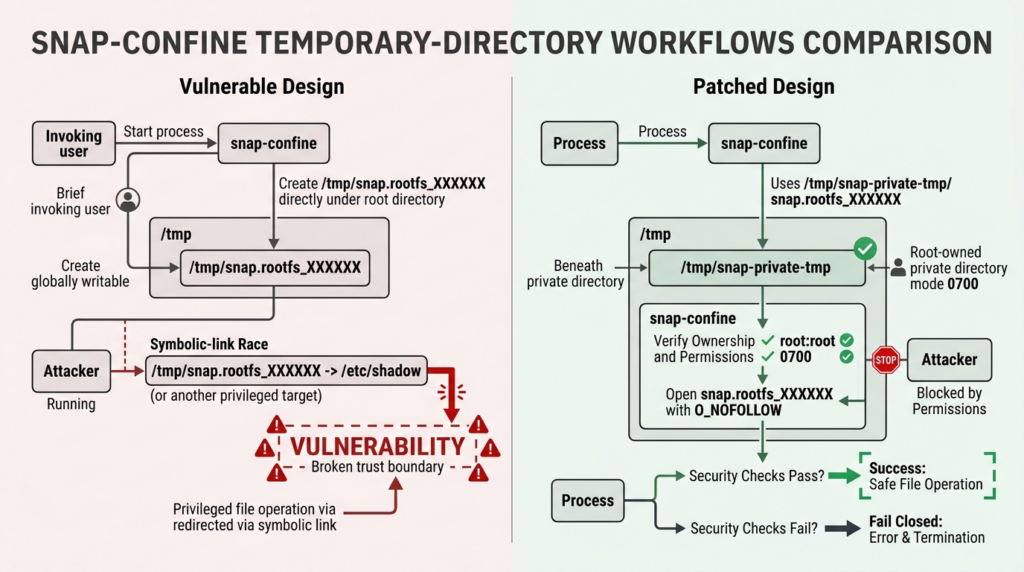
The vulnerable file creation did not specify O_NOFOLLOW. The fix added this flag to the relevant open() operation.
On Linux, O_NOFOLLOW causes open() to fail when the trailing component of the path is a symbolic link. It therefore prevents the privileged helper from unknowingly following an attacker-provided final symlink to another file.
This directly addresses the symlink-following step used to convert creation of an expected sandbox file into creation or truncation of a different target.
O_NOFOLLOW is valuable, but it should not be viewed as a complete universal solution to filesystem races. Parent path components may still require protection, and attackers may manipulate directories, mounts or path resolution in ways that do not rely exclusively on the final component.
2. Move the Scratch Directory Under a Private Parent
The patch changed the scratch directory from a direct child of the globally writable /tmp directory:
/tmp/snap.rootfs_XXXXXX
to a child of a dedicated private directory:
/tmp/snap-private-tmp/snap.rootfs_XXXXXX
The private parent is expected to be owned by root:root with mode 0700. This prevents ordinary users from traversing the directory, enumerating scratch objects or racing newly created entries inside it.
The use of a private trusted parent changes the attacker’s relationship to the temporary path. Even when a process retains the invoking user’s UID, an unprivileged user cannot simply enter or manipulate a root-only directory protected by the kernel’s normal path permissions.
3. Pre-create the Parent as Root
The patch series arranged for /tmp/snap-private-tmp to be created by trusted root-level mechanisms, including package-maintenance scripts, snapd startup behavior or system temporary-file management.
This avoids asking the capability-bearing snap-confine process to create the trusted parent dynamically in response to an unprivileged invocation.
Canonical’s upstream change notes specify that the directory must exist as root:root 와 함께 0700 permissions before snap-confine bootstraps the mount namespace. (GitHub)
4. Verify Ownership and Permissions
A secure design cannot assume that a path is trustworthy merely because it normally exists. The patched workflow verifies the private parent’s attributes and refuses to proceed when the directory is missing, has unexpected ownership or exposes unsafe permissions.
This is a fail-closed approach. A Snap launch may fail when the security invariant cannot be established, but the program does not silently continue through an untrusted directory.
5. Remove Redundant On-demand Creation
The patch series also removed a code path in which snap-confine attempted to ensure that the private directory existed itself. Canonical’s change description explicitly notes that removal of this behavior also removed an associated race condition. (GitHub)
Together, these changes address the vulnerability at multiple levels:
- The final symlink is not followed.
- The scratch directory is moved out of a user-traversable parent.
- The parent is created by a trusted root context.
- Ownership and mode are validated before use.
- Unsafe fallback creation is removed.
This layered response is stronger than treating the issue as a single missing flag.
How to Patch CVE-2026-8933
Canonical states that the issue is corrected through a standard system update and that the system should be rebooted afterward so all required changes take effect. (우분투)
On a supported affected Ubuntu system, run:
sudo apt update
sudo apt install --only-upgrade snapd
sudo reboot
After the reboot, confirm the installed package:
dpkg-query -W -f='${Version}\n' snapd
Compare the result against the release-specific fixed version:
Ubuntu 26.04 LTS: 2.76+ubuntu26.04.3 or later
Ubuntu 24.04 LTS: 2.76+ubuntu24.04.1 or later
Ubuntu 22.04 LTS: 2.76+ubuntu22.04.1 or later
Canonical’s distribution package version does not need to equal the upstream 2.76.1 string. Ubuntu’s fixed packages incorporate the security changes through distribution-specific packaging and backports.
Updating a Fully Managed System
Organizations that apply complete Ubuntu maintenance rather than upgrading one package can use their standard update process:
sudo apt update
sudo apt full-upgrade
sudo reboot
The exact command should follow the organization’s normal change-control, kernel, dependency and reboot procedures.
Ubuntu 25.10 Remediation
Ubuntu 25.10 is no longer supported. Running apt upgrade against an end-of-life 25.10 repository should not be treated as a reliable CVE-2026-8933 remediation strategy.
The supported path is to upgrade the operating system to Ubuntu 26.04 LTS and then verify that snapd is at or above:
2.76+ubuntu26.04.3
Because an operating-system upgrade changes more than snapd, enterprises should test application compatibility, third-party repositories, drivers, disk capacity and recovery procedures before fleet deployment.
Do Not Replace the Official Fix With Permission Hacks
Administrators may be tempted to remove file capabilities from snap-confine, change its owner, convert it back to setuid-root, disable its AppArmor profile or manually replace the binary.
Those actions are not recommended as a substitute for the vendor patch.
snap-confine is tightly integrated with snapd’s packaging, re-execution behavior, security profiles and update mechanisms. An improvised permission change could break Snap applications, create an unsupported state or introduce a different privilege problem.
The correct response is to install the fixed package supplied by Ubuntu or the applicable Linux distribution. Temporary containment should be considered only when an immediate patch is impossible and should be designed and reviewed by administrators who understand the affected host’s Snap dependencies.
Post-patch Validation
Installing a package successfully does not automatically prove that every relevant host is remediated. A good verification process should check package state, filesystem invariants and basic Snap functionality.
Confirm the Package Version
dpkg-query -W -f='Package: ${binary:Package}\nVersion: ${Version}\nStatus: ${db:Status-Status}\n' snapd
Confirm the Private Temporary Directory
After patching and rebooting:
if [ -e /tmp/snap-private-tmp ]; then
    stat -Lc 'owner=%U:%G mode=%a path=%n' /tmp/snap-private-tmp
else
    echo "/tmp/snap-private-tmp is not present"
fi
The expected security invariant described in the upstream patches is:
owner=root:root mode=700
Do not automatically run chmod 또는 chown when the result differs. First determine whether the package upgrade and reboot completed correctly, whether the directory is being managed by snapd or systemd-tmpfiles and whether local configuration-management software changed it.
Check snapd Service Health
systemctl --no-pager --full status snapd.service
systemctl --no-pager --full status snapd.socket
Check Snap Version Information
snap version
Perform a Benign Functional Test
List installed Snaps:
snap list
Launch a known, approved Snap application through the organization’s normal test process. The goal is to verify that namespace and confinement setup still works, not to reproduce the race condition.
Review Upgrade-related Logs
journalctl -u snapd.service --since "24 hours ago" --no-pager
Search for errors involving:
snap-private-tmp
snap-confine
ownership
permissions
mount namespace
security profile
Repeated failures caused by an unsafe private-directory owner or mode may indicate that local cleanup jobs, hardening scripts or configuration-management agents are recreating the path incorrectly.
Detecting Possible Exploitation
Version-based remediation should remain the primary control. Runtime detection for a local race-condition exploit is difficult, and the absence of an alert does not establish that exploitation did not occur.
Nevertheless, several behaviors from the documented chain can support threat hunting.
Unexpected Files Under /run/udev/rules.d
The Qualys proof of concept used a writable rule file under /run/udev/rules.d as the bridge between attacker-controlled file creation and root execution.
Administrators can review the directory:
sudo find /run/udev/rules.d \
    -maxdepth 1 \
    -type f \
    -printf '%TY-%Tm-%Td %TH:%TM:%TS %u:%g %m %p\n' \
    2>/dev/null
Investigate rule files that:
- Do not match the organization’s baseline.
- Were created during a suspicious user session.
- Are world-writable or group-writable without a documented reason.
- Contain unexpected command-execution directives.
- Have filenames resembling ordinary application resources rather than managed udev rules.
- Appear shortly before an unexplained root process or account change.
Not every file in /run/udev/rules.d is malicious. Networking tools and legitimate system components may generate runtime rules. Compare findings against known-good hosts and package ownership.
Audit Changes to the Runtime udev Rule Directory
On systems using Linux Audit, a temporary watch can be added:
sudo auditctl \
    -w /run/udev/rules.d \
    -p wa \
    -k cve_2026_8933_udev
Review matching records:
sudo ausearch -k cve_2026_8933_udev -i
A persistent rule can be managed through the organization’s normal audit configuration, for example:
-w /run/udev/rules.d -p wa -k cve_2026_8933_udev
Test the rule carefully. High-volume environments may generate legitimate events, and audit-policy changes should follow performance and retention requirements.
Track snap-confine Execution
A basic Audit watch for the system binary is:
sudo auditctl \
    -w /usr/lib/snapd/snap-confine \
    -p x \
    -k snap_confine_exec
On systems where the snapd Snap path is active, evaluate whether monitoring the resolved executable path is practical:
/snap/snapd/current/usr/lib/snapd/snap-confine
Frequent snap-confine execution is normal on desktops that regularly launch Snap applications. The useful signal comes from correlation with other activity, such as rapid FUSE mount changes, creation of unusual udev rules, repeated launch failures or privilege transitions.
Review FUSE Activity
The published exploit chain used FUSE mount and unmount operations to manipulate visibility of the scratch directory.
Current FUSE mounts can be reviewed with:
findmnt -t fuse,fuseblk
Recent kernel or service messages may contain relevant events:
sudo journalctl --since "24 hours ago" \
    | grep -Ei 'fuse|fusermount|snap-confine|snap\.rootfs|udev'
FUSE is widely used by legitimate applications, including desktop file integrations, encrypted filesystems, AppImages, remote filesystem clients and development tools. FUSE activity alone is not an indicator of compromise.
Search for Legacy Scratch Directories
On an unpatched system, scratch paths may resemble:
/tmp/snap.rootfs_*
A defensive review can use:
sudo find /tmp \
    -maxdepth 1 \
    -name 'snap.rootfs_*' \
    -printf '%TY-%Tm-%Td %TH:%TM:%TS %u:%g %m %p\n' \
    2>/dev/null
The existence of such a path is not proof of exploitation. Temporary objects may be created during legitimate Snap launches and may remain after an interruption or crash.
More suspicious conditions include a path owned by an unexpected user, unusual mounts attached to it, symbolic links where regular resources are expected or timestamps matching other evidence of compromise.
Examine udev Logs
sudo journalctl \
    -u systemd-udevd.service \
    --since "7 days ago" \
    --no-pager
Depending on system logging configuration, individual rule execution may not be visible. Endpoint telemetry capable of recording process ancestry can provide stronger evidence.
A suspicious chain might include:
unprivileged user process
    → FUSE helper
    → snap or snap-confine activity
    → runtime udev rule creation
    → systemd-udevd spawning an unexpected process as root
Process-ancestry and file-creation correlation are more reliable than treating any single event as conclusive.
Incident Response When Exploitation Is Suspected
A host should not be declared clean merely because the vulnerable snapd package has now been upgraded. Patching removes the known entry point but does not remove persistence, credentials or files created by an attacker who previously obtained root.
When available evidence suggests exploitation, preserve volatile and filesystem information before making extensive changes. Depending on organizational policy, useful evidence may include:
- Current process tree and executable paths.
- Active mounts and namespaces.
- Files under
/run/udev/rules.d. - Audit logs and system journals.
- Authentication records.
- Sudo activity.
- Shell histories, where collection is lawful and appropriate.
- Recently changed setuid and setgid files.
- Newly created systemd units, timers and cron entries.
- SSH authorized keys.
- New local users or group memberships.
- Changes to security agents and logging configuration.
- Package integrity results.
- Connections initiated by unexpected root processes.
A basic review of recently modified privileged files can begin with carefully scoped queries such as:
sudo find /etc/systemd/system \
    /usr/local/bin \
    /usr/local/sbin \
    /etc/cron.d \
    /etc/cron.daily \
    /root/.ssh \
    -xdev \
    -type f \
    -mtime -14 \
    -ls 2>/dev/null
Review setuid and setgid files:
sudo find / \
    -xdev \
    -type f \
    \( -perm -4000 -o -perm -2000 \) \
    -printf '%TY-%Tm-%Td %TH:%TM:%TS %u:%g %m %p\n' \
    2>/dev/null
These commands generate investigative leads, not automatic compromise verdicts. Many legitimate packages install setuid helpers or modify system files during updates.
Because successful exploitation grants full root privileges, high-confidence compromise may justify rebuilding the host from a trusted image rather than attempting to clean it in place. Rotate credentials and tokens accessible from the affected system, including SSH keys, cloud credentials, source-control tokens, CI/CD secrets and browser-stored sessions.
Realistic Risk Scenarios
CVSS correctly identifies CVE-2026-8933 as local, but local vulnerabilities can have very different operational significance depending on the environment.
Shared Developer Workstations
Developer systems frequently contain source code, package-registry credentials, SSH keys, cloud command-line profiles, signing credentials and production-administration tools.
A malicious dependency, compromised IDE extension or browser exploit that initially runs as the developer may use a local privilege escalation vulnerability to disable endpoint controls, steal credentials from other users, inspect protected files and establish durable persistence.
CI/CD and Build Hosts
Build workers routinely execute repository-controlled scripts and third-party build tooling. Ideally, each job runs in an isolated ephemeral environment, but long-lived runners and shared build hosts remain common.
On a vulnerable runner, low-privilege code execution could become root access to the host. The attacker might then tamper with later builds, access secrets belonging to other jobs or compromise build artifacts.
CVE-2026-8933 should therefore be prioritized on any Ubuntu worker that both runs untrusted or semi-trusted code and has snapd installed.
Multi-user Research and Education Systems
University servers, training systems, security labs and shared Linux workstations intentionally provide local accounts to many users. The prerequisite of an unprivileged account is already satisfied.
Even when each account has limited application access, a local root exploit can collapse the separation between users and expose data belonging to the entire host.
Virtual Desktop Infrastructure
A compromised VDI session may initially be constrained to one user profile. Local root access can enable credential theft, cross-user data access, endpoint-agent tampering and persistence beyond the affected session.
Golden images should be updated, and existing clones should be independently verified rather than assuming image remediation automatically fixed already-deployed machines.
Bastion Hosts and Administrative Workstations
A bastion host may accept logins from several administrators while storing credentials or network paths to sensitive systems. Local vulnerabilities deserve elevated priority on these hosts because root compromise can expose broader administrative infrastructure.
Single-user Ubuntu Desktops
A single-user laptop is not immune. Malware running as the logged-in user may already access much of that user’s data, but root access still expands its capabilities.
Root can support kernel-level persistence, inspection of other accounts, modification of trusted binaries, disabling security controls and access to secrets protected from the ordinary user.
Ubuntu Servers
The public research focused primarily on Ubuntu Desktop configurations, but Canonical lists supported Ubuntu releases by package rather than limiting the advisory to desktop systems.
Server administrators should inventory whether snapd is installed, whether the relevant capability-based helper is present and whether the package version is below the vendor fix. Avoid assuming that “this was demonstrated on Desktop” means every Server installation is automatically safe.
Prioritizing CVE-2026-8933
A practical priority decision should combine package exposure with local-access likelihood.
Highest Priority
Patch immediately when the system:
- Runs an affected Ubuntu release and vulnerable snapd package.
- Allows multiple untrusted or semi-trusted local users.
- Executes third-party build jobs or repository-controlled code.
- Serves as a developer workstation with production credentials.
- Acts as a jump host, support workstation or administrative endpoint.
- Has experienced a recent malware, browser, application or account compromise.
- Uses long-lived sessions with sensitive secrets.
- Cannot reliably prevent users from invoking Snap applications.
High Priority
Patch promptly when the host:
- Is an ordinary employee desktop.
- Is remotely accessible through SSH or desktop protocols.
- Runs complex user-facing applications that may provide an initial code-execution path.
- Is a persistent CI runner restricted to one project.
- Stores locally protected data whose confidentiality depends on root separation.
Standard Accelerated Maintenance
Hosts may follow an accelerated routine patch window when they:
- Are single-purpose systems with no untrusted local code.
- Have snapd installed but Snap applications are rarely used.
- Are strongly isolated and provide no ordinary user access.
- Have compensating endpoint controls and closely monitored administrative access.
Even in those cases, installing the vendor update is preferable to relying indefinitely on environmental assumptions.
Why CVSS 7.8 Is Still Serious
Some vulnerability-management programs automatically prioritize remote critical vulnerabilities while placing local vulnerabilities into a slower queue. That model can underestimate the role of local privilege escalation in modern intrusions.
An initial-access vulnerability often provides code execution under a restricted service account or desktop user. Attackers then need a second vulnerability or misconfiguration to obtain root. CVE-2026-8933 can fill that second-stage role.
The CVSS vector reflects this distinction:
AV:L/AC:L/PR:L/UI:N/S:U/C:H/I:H/A:H
AV:L means the vulnerable operation is locally reachable rather than directly exposed over the network. PR:L means the attacker already needs low-level privileges. Once the vulnerability succeeds, however, the confidentiality, integrity and availability impacts are all rated high. (우분투)
For a system that intentionally runs untrusted local workloads, the local prerequisite may offer very little risk reduction. For an isolated appliance with no user shell and tightly controlled software, the same prerequisite may significantly lower practical exploitability.
Relationship to CVE-2026-3888
CVE-2026-3888 is another high-severity snapd local privilege escalation vulnerability disclosed earlier in 2026. It involved the interaction between a Snap private temporary directory and systemd-tmpfiles.
When the private directory was deleted by automatic cleanup, a local attacker could recreate it and influence subsequent privileged behavior. Canonical assigned CVE-2026-3888 a CVSS score of 7.8 and published fixes in March 2026. (우분투)
Although both vulnerabilities involve temporary directories and snap-confine, they are not the same issue.
| CVE | Core condition | Boundary failure |
|---|---|---|
| CVE-2026-3888 | A trusted private temporary directory could be deleted and recreated by an attacker under certain systemd-tmpfiles configurations | Loss and attacker recreation of a trusted directory |
| CVE-2026-8933 | Capability-based snap-confine temporarily created user-owned objects during privileged sandbox construction | Race condition, symlink following and attacker influence before ownership transition |
The distinction matters for detection and remediation. A system patched for CVE-2026-3888 in March is not automatically protected against CVE-2026-8933. Administrators must verify the July 2026 snapd update separately.
The recurrence of temporary-filesystem issues also offers a broader design lesson: trusted directory ownership must remain invariant throughout the full lifecycle of a privileged operation. Secure creation is insufficient when cleanup, recreation, mounts or UID semantics can later invalidate the assumption.
Relationship to CVE-2026-15226
USN-8579-1 also fixes CVE-2026-15226, a different Snap sandbox weakness.
CVE-2026-15226 concerns the default seccomp policy applied to confined Snap applications. The policy failed to block certain operations capable of creating or manipulating executables with set-user-ID attributes. Canonical rated the issue 8.4 High and hardened the seccomp templates to prevent confined processes from creating such executables. (우분투)
The attacker position differs:
| CVE | Attacker position | Main security mechanism |
|---|---|---|
| CVE-2026-8933 | Unprivileged local host user invoking a vulnerable privileged helper | Temporary filesystem handling, capabilities and AppArmor-constrained file creation |
| CVE-2026-15226 | Process already executing inside a confined Snap | Seccomp filtering of setuid-related file operations |
Because Ubuntu delivered fixes for both issues in the same package versions, updating snapd addresses both on supported releases. Security teams should still track the findings separately because their preconditions, evidence and architectural implications differ.
The Broader Sandbox Boundary Lesson
CVE-2026-8933 is a useful example of why sandbox security cannot be evaluated only by checking whether a policy file appears restrictive.
The vulnerability emerged from interactions across several layers:
- Unix user and group identities.
- Linux file capabilities.
- Temporary-directory ownership.
- Mount namespaces.
- FUSE mount behavior.
- Symbolic-link resolution.
- File mode changes.
- AppArmor path rules.
- udev’s privileged event-processing model.
Each layer behaved broadly according to its own rules. The vulnerability existed in the composition.
The move from setuid-root to file capabilities was motivated by least privilege, but it changed the effective UID under which files were initially created. That semantic change invalidated assumptions in existing temporary-file code.
This does not mean file capabilities are inherently less secure than setuid. It means privilege-model transitions require a complete audit of secondary effects, including:
- Who owns newly created files and directories.
- Which supplementary groups remain active.
- How permission checks interact with capabilities.
- Whether cleanup runs under the same identity.
- Whether error paths preserve safe state.
- Whether existing AppArmor and seccomp policies still match the new process model.
- Whether child processes inherit unexpected privilege.
- Whether temporary objects remain reachable by the invoking user.
Security hardening is not always monotonic. A change that reduces one form of privilege may expose another class of assumptions.
Enterprise Remediation Playbook
A large organization should handle CVE-2026-8933 as an exposure-management and evidence-collection task rather than issuing one generic upgrade command.
Phase 1: Inventory
Identify Ubuntu assets with snapd installed:
dpkg-query -W snapd
At fleet scale, collect at least:
hostname
asset owner
business function
Ubuntu release
support status
snapd package version
package candidate version
snap-confine paths
file capabilities
last successful update
last reboot
local-user exposure
Include desktops and developer machines, not only servers. The public exploitability analysis specifically covered default Ubuntu Desktop configurations.
Phase 2: Classify
Separate assets into:
- Supported and affected.
- Supported and already fixed.
- Ubuntu 25.10 end-of-life systems.
- Older releases marked not affected by CVE-2026-8933 but requiring other USN-8579-1 fixes.
- Unsupported or derivative distributions requiring vendor-specific analysis.
- Systems where snapd is absent.
- Systems with incomplete or conflicting inventory data.
Do not mark an asset safe merely because the expected binary was not found at one path.
Phase 3: Prioritize
Move shared systems, build hosts, developer endpoints, administrative workstations and systems with recent security alerts to the front of the queue.
For standard user endpoints, patching should still be accelerated because the local prerequisite can be satisfied by commodity malware or another application exploit.
Phase 4: Deploy
Use the organization’s existing package-management platform, such as Landscape, configuration management, endpoint management or an internally controlled APT workflow.
Record the package version before and after deployment.
Phase 5: Reboot
Canonical requires a reboot after the standard update for all necessary changes to take effect. A package installation without completion of the required restart should remain in a pending-remediation state. (우분투)
Phase 6: Validate
Confirm:
- The correct fixed version is installed.
- The system has rebooted after the update.
/tmp/snap-private-tmphas the expected ownership and mode.- snapd and approved Snap applications function normally.
- No local automation changes the protected directory.
- The endpoint-security agent remains healthy.
- No suspicious udev files or privilege events require investigation.
Phase 7: Close With Evidence
A high-quality closure record should contain machine-readable evidence rather than a statement such as “patch deployed.”
Suitable evidence includes:
Asset identifier
Ubuntu release
Installed snapd version
Applicable fixed version
Version-comparison result
Reboot timestamp
Private-directory owner and mode
Validation timestamp
Validation tool version
Operator or automation identity
Exceptions and follow-up actions
Safe Validation Versus Exploit Reproduction
Downloading a public local-root exploit and running it on a production Ubuntu machine is not a reasonable patch-validation method.
A successful exploit can alter privileged runtime configuration, trigger root-level commands, disrupt Snap launches, leave behind race artifacts or create persistence. An unsuccessful attempt may still destabilize namespace construction or interfere with system services.
For most organizations, safe validation consists of:
- Confirming the operating-system release.
- Comparing the installed package against the vendor-fixed version.
- Inspecting relevant executable attributes.
- Checking the private temporary-directory invariant.
- Reviewing service health.
- Performing a benign Snap launch.
- Preserving the results as evidence.
Exploit reproduction belongs in an isolated, disposable and explicitly authorized laboratory. The lab should use test credentials, no production connectivity, no reused secrets and a snapshot that can be destroyed after testing.
For organizations managing many CVEs, an evidence-driven platform such as Penligent can help structure authorized verification around asset identification, package-version comparison, configuration review and post-patch evidence collection. For CVE-2026-8933, the safest workflow should prioritize non-destructive checks and use exploit execution only in an isolated lab where the organization has explicit authorization.
Automation is most valuable when it distinguishes “package present” from “vulnerable configuration verified,” records every command and result, and independently confirms the remediation state. It should not turn a public local-root proof of concept into an unsupervised production scan.
Frequently Asked Questions
Is CVE-2026-8933 remotely exploitable?
Not directly. Canonical’s CVSS vector uses a local attack vector. An attacker must first obtain the ability to execute code under a low-privilege local account.
The vulnerability can still participate in a remote attack chain. For example, a remote application flaw may provide initial code execution as a restricted user, after which CVE-2026-8933 may be used to obtain root.
Does CVE-2026-8933 affect every Ubuntu installation?
No. Canonical lists Ubuntu 22.04 LTS, 24.04 LTS and 26.04 LTS as affected and fixed. Ubuntu 20.04 LTS, 18.04 LTS and 16.04 LTS are marked not affected by this specific CVE. (우분투)
Exposure also depends on the installed snapd version and the snap-confine execution model.
Does the vulnerability affect every snap-confine binary?
No. The vulnerability specifically affects vulnerable versions configured with file capabilities. Qualys stated that the setuid-root variants were not affected by this particular flaw.
This does not mean setuid-root is generally safer. It means the vulnerable code path depended on ownership behavior introduced by the capability-based execution model.
Is Ubuntu 25.10 affected?
Qualys demonstrated an affected default Ubuntu Desktop 25.10 configuration. However, Ubuntu 25.10 reached end of life on July 9, 2026, so Canonical no longer publishes Security Notice package tables or normal security updates for it.
The supported remediation is to upgrade to Ubuntu 26.04 LTS and install the current fixed snapd package.
What snapd version fixes CVE-2026-8933?
The upstream fix is snapd 2.76.1.
Ubuntu uses distribution-specific fixed packages:
Ubuntu 26.04 LTS: 2.76+ubuntu26.04.3
Ubuntu 24.04 LTS: 2.76+ubuntu24.04.1
Ubuntu 22.04 LTS: 2.76+ubuntu22.04.1
Use the Ubuntu package version applicable to the host rather than comparing only with the upstream release number. (NVD)
Must the system be rebooted?
Yes. Canonical’s update instructions state that the computer should be rebooted after the standard update so all required changes take effect. (우분투)
A remediation dashboard should distinguish between “package downloaded,” “package installed” and “system rebooted and validated.”
Should administrators remove Snap entirely?
Removing snapd is generally unnecessary when a supported vendor patch is available.
Snap may be required by desktop applications, system workflows or managed environments. Unplanned removal can cause availability and support problems.
Patch the package unless the organization has already made a deliberate architectural decision not to use Snap and has tested its removal.
Can AppArmor prevent CVE-2026-8933?
AppArmor constrained the exploitable file-creation primitive, but it did not prevent the demonstrated chain. The attacker used a path that the snap-confine profile permitted and that was consumed by another privileged service.
The vulnerability shows that a sandbox policy must be evaluated together with the semantics of every allowed destination.
Is the presence of file capabilities proof that the host is vulnerable?
No. File capabilities indicate that the relevant execution model may be in use, but vulnerability status also depends on the snapd version and vendor patch state.
Use package-version comparison as the primary determination and file attributes as supporting configuration evidence.
Can vulnerability scanners detect CVE-2026-8933 safely?
Yes, when they rely on authenticated package and configuration checks. A scanner can safely collect:
- Ubuntu release.
- snapd package version.
- Candidate update version.
snap-confinepaths.- File mode and capabilities.
- Private temporary-directory attributes.
- Reboot status.
A scanner does not need to trigger the race condition or create a privileged file to determine that a supported Ubuntu package is below its fixed version.
Does a patched system need compromise hunting?
Not automatically. Patching is sufficient when there is no reason to suspect prior exploitation.
Additional investigation is warranted when the host was exposed for a significant period and has suspicious local activity, unexplained udev rule files, unusual root processes, FUSE activity correlated with Snap launches, endpoint alerts or signs of credential theft.
Is CVE-2026-8933 a Snap sandbox escape?
The phrase can be misleading.
The demonstrated attack begins with an unprivileged host user and abuses snap-confine while it constructs a sandbox. It is not simply a confined Snap application calling one forbidden operation and escaping.
“Local privilege escalation in the Snap sandbox setup helper” is a more precise description.
Final Assessment
CVE-2026-8933 is a high-impact local privilege escalation vulnerability created by an unexpected interaction between least-privilege capabilities and temporary-file ownership. A capability-based snap-confine process retained the invoking user’s UID, briefly placing security-critical scratch objects under that user’s control while the process continued performing privileged sandbox-construction operations.
Through carefully timed filesystem races, symbolic links and FUSE mount manipulation, Qualys demonstrated that an ordinary local user could influence privileged file creation and use an allowed runtime path to reach root execution. Canonical responded by adding symlink protections, moving the scratch filesystem under a private root-owned directory, pre-creating that directory through trusted mechanisms and validating its ownership and permissions before use.
Ubuntu 22.04 LTS, 24.04 LTS and 26.04 LTS administrators should verify that their installed snapd packages meet the published fixed versions and reboot after updating. Ubuntu 25.10 systems should be upgraded to Ubuntu 26.04 LTS because 25.10 reached end of life before the coordinated disclosure.
The broader lesson extends beyond Snap. Changes to a privilege model must be reviewed not only for the privileges removed, but also for the ownership, identity and filesystem semantics they alter. In security-critical code, a directory that is attacker-controlled for only a fraction of a second can still be attacker-controlled long enough to collapse the intended boundary.


 Korean
  English
  German
  French
  Spanish
  Portuguese
  Japanese
  Hindi
Hindi  Arabic
  Turkish
  Hebrew