
As of October 31, 2026, DeepSeek has not publicly announced a dedicated product named Cyber or confirmed an identity-verification program for it. A report published by IT Home on October 30 says developers found references to a Cyber application flow in DeepSeek website front-end code, including the strings cyber-personal-v3 그리고 cyber-enterprise-v4, a feature gate, and a separate key-management path. The same report describes identity checks in application instructions it says were exposed in that code. Those are reported observations, not a confirmed public product specification. DeepSeek’s public news page 그리고 transparency center list public announcements and released models, but do not confirm the reported access program as of the date of this review.
That distinction matters to security teams. If a provider separates access to a high-capability cybersecurity service from its general API, identity proofing may be one part of a broader risk-control system. It does not, by itself, demonstrate that an applicant is competent, authorized to test a target, or operating a secure environment. Nor does the presence of an application route prove that a model is live, that a reported identifier maps to a functioning model, or that a reported eligibility rule is final. Treat the DeepSeek Cyber story as a useful prompt to examine verified access-control design, not as a reason to submit identity documents to an unconfirmed page.
The practical question is larger than one vendor: how should a security team assess identity-gated access to an AI service that can assist with vulnerability research, secure coding, or authorized testing? The answer requires a chain of controls: authentic provider identity, proportionate identity proofing, organization and authorization checks, scoped credentials, policy enforcement, data-handling terms, monitoring, revocation, and evidence that the service behaves as represented. The chain must work without collecting more personal data than necessary or confusing a verified identity with permission to attack a system.
What the DeepSeek Cyber report actually says
The October 30 IT Home report, summarized in an October 31 Pandaily report that attributes its account to IT Home, says the Cyber details came from developers inspecting front-end code on DeepSeek’s website and from limited user reports. It names two identifiers, cyber-personal-v3 그리고 cyber-enterprise-v4, and describes an application route, a feature-gated page, Cyber Key creation, and usage or quota management. It says the reported personal path requested identity-card information and face verification, while the enterprise path requested company materials and authorization documentation. It also says the instructions it reviewed required an account in good standing, mainland China registration and a mainland mobile number, and no violations during a recent 90-day period. These statements should be attributed to the report, not presented as terms published by DeepSeek.
The report explicitly says the entry was not in DeepSeek’s public menu, appeared to be in a limited rollout, and had not been announced by DeepSeek. It also says most users could see only code references, not an accessible product page. A front-end string can be a dead feature, a test artifact, an experiment, a regional flow, or a component awaiting launch. A hidden route can be gated without any model being generally available. A model identifier can be a label in client code rather than a currently served API value. Code inspection is useful evidence, but it is not a substitute for a provider’s dated documentation, terms, support statement, or reproducible authorized account experience.
As of this article’s publication date, DeepSeek’s public research and transparency pages list released models such as DeepSeek-V4.1-Flash. The API change log publishes several cybersecurity-related benchmark results for V4.1-Flash, including CyberGym 88.1, SEC-Bench Pro 62.8, and ExploitGym 15.3. That is official evidence that DeepSeek publicly reports cybersecurity benchmark performance for a general released model; it is not confirmation of the separately reported Cyber product, its access process, or the meaning of the identifiers found in front-end code. This distinction is important: the evidence supports “DeepSeek publishes cyber benchmark results for V4.1-Flash,” not “DeepSeek officially launched cyber-personal-v3.” The DeepSeek API change log 그리고 public DeepSeek API reference document the current public model/API and bearer authentication, but do not confirm the reported Cyber Key scheme or any relationship between the two.
There is a second, separate source of confusion: social-media posts can circulate screenshots, snippets, or paraphrases without establishing who published them or whether they came from DeepSeek. A post about a model is not an official announcement simply because it appears on X, contains a screenshot, or is repeated by accounts with security-themed names. The safest editorial wording is “IT Home reported that developers found…” and “DeepSeek had not publicly confirmed the reported Cyber program as of October 31, 2026.” Do not write “DeepSeek announced on X that users must verify their identity” unless an authenticated DeepSeek account post can be located and verified directly.
Readers should also separate three terms that are often collapsed into “verification.” Identity proofing establishes that a person or organization is linked to claimed attributes. Authentication establishes that a claimant controls an enrolled account or authenticator at a later login. Authorization decides whether that authenticated subject may perform a particular action on a particular resource. An identity check at onboarding does not prove continuing account control, and neither identity proofing nor authentication grants permission to test a third-party target. A trustworthy article must explain those boundaries before discussing implementation details.
Why cyber-capable AI access is a distinct control problem
Cybersecurity work is dual use because many of the same techniques can find and fix a weakness or help exploit it. A model that reviews a patch, traces a tainted value, explains an alert, or helps reproduce a bug in a local lab can be useful to a defender. Similar capabilities can also be used to develop an exploit, automate reconnaissance, or scale activity against systems the user does not own. Access policy therefore cannot rely on a simplistic “good user versus bad user” label. It has to consider the task, requested capability, environment, user authorization, likely impact, and the controls around tool execution.
A tiered service can separate low-risk defensive assistance from higher-risk work requiring stronger safeguards. That does not mean every provider must use the same identity threshold, nor does it establish that DeepSeek has adopted any specific tier model. It means that the access decision should reflect service risk. A general code assistant, a vulnerability-triage assistant operating over user-supplied source, and a model permitted to assist with authorized adversarial simulation have different consequences if misused. A single identity checkbox is too coarse to express those differences.
In October 2026, Anthropic described an expanded Cyber Verification Program with three access tiers and different verification and security-control requirements, explicitly distinguishing defensive work, organization-based red-team access, and a more restricted specialized tier. OpenAI’s current cybersecurity documentation likewise describes different access paths and says specialist access requires separate approval; identity verification alone does not grant the more permissive specialist capability. These are examples of published approaches by other providers, not evidence about DeepSeek. They illustrate a useful design principle: identity is one signal in a decision that also includes organization, intended use, authorization, safeguards, and ongoing monitoring. See Anthropic’s Cyber Verification Program announcement and OpenAI’s cybersecurity safeguards documentation.
Providers should not confuse the sophistication of a model with the security of the service that exposes it. The service layer includes account recovery, API key issuance, quota enforcement, model routing, policy classifiers, logging, support operations, and downstream tool integrations. Any one of these can become a weak link. A verified user with an over-scoped, long-lived key can still expose an account. A correctly authenticated user can still invoke a function outside their authorized scope if the application does not bind authorization to target and task. A model that refuses a harmful request can still be embedded in a tool chain that performs an unintended action because the orchestrator accepts unsafe output.
For customers, the relevant question is not simply whether a provider requests a government ID. It is whether access is tied to a clearly described service, whether the identity data is necessary and protected, whether the organization can restrict operators and targets, whether credentials can be limited and revoked, and whether the data-use terms fit the organization’s obligations. A provider may choose a different assurance method for an individual researcher, an employee of a security firm, a university lab, a critical infrastructure operator, or a public-sector buyer. Whatever the method, the provider should explain its purpose and the user should be able to assess the privacy and operational trade-offs.
Identity proofing, authentication, and authorization are not synonyms
NIST’s Digital Identity Guidelines separate identity proofing, authentication, and federation, and describe a risk-based process for selecting appropriate assurance. The guideline suite is not a universal rule for private AI services, and NIST explicitly notes that the guidance is scoped to its stated use cases. It is nevertheless a useful vocabulary for evaluating a high-impact online service. The NIST SP 800-63-4 publication page describes the July 2025 final guidelines and their coverage. The online text explains the identity model and the distinction between an applicant being proofed, a subscriber being enrolled, and a claimant authenticating.
Identity proofing asks whether the applicant’s claimed identity attributes are sufficiently credible for the service’s risk. Depending on the service, proofing can involve evidence validation, attribute verification, a remote session, an organization-controlled identity provider, or another method. Stronger proofing can reduce some forms of impersonation but may increase privacy cost, exclusion, data-breach impact, and friction. The right question is not “Can we collect more data?” but “What risk does this data reduce, is there a less intrusive method, and how will the information be protected and deleted?”
Authentication is a recurring control. It establishes that a session or request is associated with an enrolled identity or credential at the time of use. Passwords, passkeys, hardware security keys, client certificates, signed workload identity, and short-lived access tokens have different properties. An API service may use a bearer token for requests while separately authenticating the human administrator who created that token. If an API key is copied into a source repository or build log, a prior identity check does not prevent its use by someone else. Strong onboarding must therefore be paired with secure authentication, secret lifecycle controls, and anomaly detection.
Authorization determines the actions the authenticated subject may take. For AI security access, that may mean which model, tools, workspaces, organizations, source repositories, projects, or categories of testing are enabled. Authorization should be checked at the relevant operation, not inferred from a general “verified” account flag. It should distinguish model access from target authorization: a service provider can decide who may use a capability, but only the asset owner or properly delegated authority can authorize a test against a specific system. The customer must preserve that target-level permission in its own engagement records and workflow.
Federation adds another layer. An enterprise may rely on a corporate identity provider, but a successful SSO assertion does not establish that every employee is allowed to use every cyber capability. The service needs to map identity claims to roles, groups, project scopes, and lifecycle events. It should handle employee departure, contractor expiration, compromised identity providers, account recovery, and removal of access. NIST’s guidance on federation and identity risk management can help teams ask these questions, but API-specific machine-to-machine access still needs its own design; the standard cautions that its scope does not explicitly cover API access on behalf of subjects.
A practical review therefore follows a chain: establish who is requesting access; authenticate the person or workload on each relevant interaction; authorize a bounded capability and target; constrain the tools and data available to that capability; monitor meaningful activity; and provide rapid revocation and incident response. Each link should have an owner. If an application only says “verified,” ask which link that label represents and what evidence supports it.
What a responsible access application should establish
A strong application process should explain the capability being requested in plain language. “Cyber access” is not a meaningful scope by itself. The provider should describe whether the service supports defensive code review, vulnerability triage, malware analysis, reverse engineering, security operations, authorized penetration testing, or another task. It should state which tools are enabled, what the model can access, whether external network actions are possible, and what prohibited use applies. Applicants should not have to infer these boundaries from model names or forum posts.
The application should establish a legitimate relationship between the applicant and the proposed work. For an individual researcher, relevant evidence may include a public vulnerability disclosure history, current employment or academic affiliation, or a description of a controlled research environment. For an organization, the evidence may include a verified business identity, an accountable security contact, documented internal policy, and proof that the applicant can bind the organization to the requested controls. These examples are design options, not claims about DeepSeek’s reported process. A provider should avoid pretending that one document proves competence, good intent, or authorization in every context.
Target authority deserves explicit treatment. A red-team firm might be a legitimate company and still lack permission to test a particular customer asset. A researcher may be highly qualified yet operate outside a program’s scope. A provider can ask applicants to accept an acceptable-use policy, but the operational system should also make it difficult to mistake general platform access for blanket permission. Where a workflow supports testing, it should capture a customer-approved scope, a time window, excluded assets, emergency contacts, and rules of engagement. High-impact operations should require human confirmation before execution and should not rely on model-generated assertions of permission.
Application review should be proportionate and reviewable. Applicants need to know what evidence is requested, why it is necessary, how long it is retained, who can see it, and how to correct errors or appeal a denial. If access is denied, a clear reason category can help the applicant resolve missing documentation without exposing sensitive anti-abuse signals. A provider can keep some detection logic confidential, but secrecy should not make the entire decision unaccountable. The right balance is a concise public policy, a private review record, controlled reviewer access, and a defined process for exceptions and appeal.
Reviewers need training and separation of duties. One reviewer should not be able to approve a high-risk account, issue privileged credentials, alter monitoring, and suppress alerts without oversight. For sensitive tiers, a second approval or independent review can reduce insider risk and accidental over-granting. Periodic recertification should confirm that the organization, users, business purpose, and controls remain current. If a customer is approved for a narrow defensive workflow, that approval should not silently expand when the provider launches a more capable model or a new tool integration.
The service should give applicants a route to use less intrusive evidence where feasible. A personal ID and face scan can be highly sensitive. Alternatives may include enterprise identity federation, a trusted institutional attestation, a verified professional account, or human review of evidence with minimized retention. Alternatives do not automatically provide equivalent assurance; the provider must assess impersonation, coercion, fraud, and account takeover risk. But collecting biometric or government-ID data should not be treated as the default answer simply because it is convenient for an onboarding form.
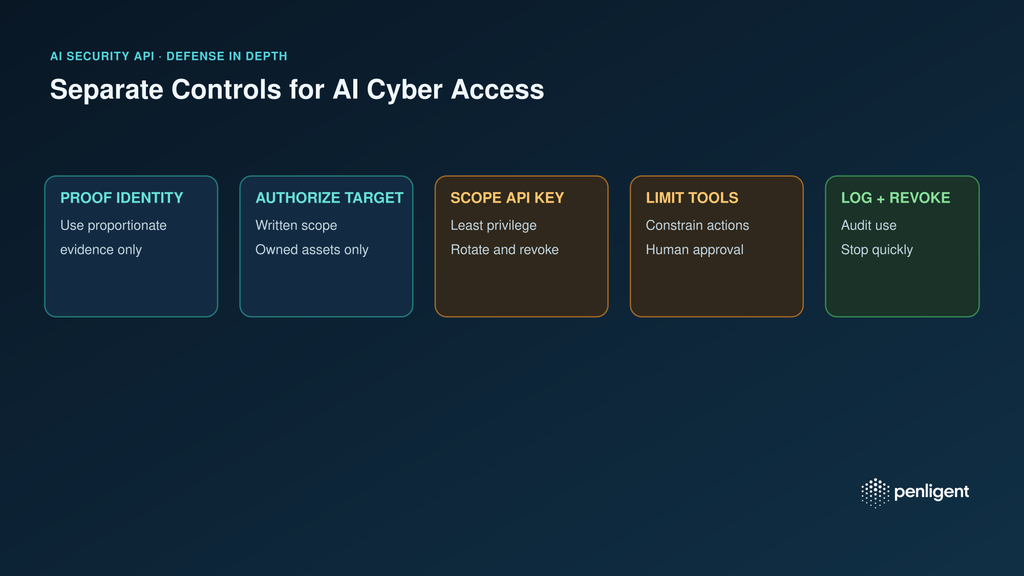
API keys are capabilities, not proof of good intent
An API key is a credential that authorizes requests according to the service’s implementation. It is not a certificate of identity, a statement of legal permission, or a guarantee that the holder is a defender. If a provider issues a special-purpose key after application approval, that key should have a clear owner, a documented scope, an expiration or rotation policy, and a path for revocation. If keys can be used only with a particular model or workspace, that restriction should be enforced server-side rather than treated as a client-side convention.
Key management should cover creation, storage, use, rotation, and destruction. At creation, show the secret only through a protected channel and make the user acknowledge that it must not be embedded in a browser application, mobile client, public repository, ticket, or shell history. During use, transmit it over TLS and store it in an approved secret manager. For automated workloads, prefer a workload identity or short-lived credential when the provider supports one. On rotation, avoid a gap that forces teams to paste secrets into unsafe channels. On suspected exposure, revoke first, investigate second, and issue a new credential with the minimum required scope.
Use separate credentials for development, staging, production, and each independently operated project. This limits blast radius and helps attribute requests to a workload. Keep credentials out of source control and CI output. Scan repositories and artifact stores for accidental secret exposure, but do not treat scanning as a substitute for preventing exposure. Restrict who can create and view keys in the provider console, require strong authentication for account administrators, and review the audit log for key creation, permission change, use from unexpected environments, and revocation.
Quota limits protect availability and cost but are not authorization boundaries on their own. A quota can constrain volume while still permitting an inappropriate action. A model access tier can reduce some request classes while an orchestration tool remains able to reach a sensitive target. Apply limits by account, key, workspace, and task where practical, and use conservative budgets for any system that can trigger costly or state-changing downstream actions. The OWASP API Security Top 10 calls out broken authentication, unrestricted resource consumption, broken function-level authorization, and unsafe API consumption as distinct risk areas. See the OWASP API 보안 톱 10; the exact risk depends on the provider’s actual service design.
A minimal local secret-handling check can demonstrate the operational rule without contacting any provider or probing any endpoint. Save this as a local script and run it only with a placeholder value:
import os

key = os.environ.get("AI_SECURITY_API_KEY")
if not key:
    raise SystemExit("Set a test-only key in the process environment")
if key in {"", "replace-me", "example"}:
    raise SystemExit("Refusing an empty or placeholder credential")
print("Credential is present; value intentionally not displayed")
This demonstration does not authenticate to DeepSeek or any other API, verify a key, or prove the key is scoped correctly. In a real deployment, add a secret manager, short-lived credentials where supported, CI secret masking, access logging, rotation tests, and a documented revocation path. Never paste a production key into a public issue, chat, or sample command to validate it.
Authorization must follow the target and the task
Security permissions should be explicit, bounded, and tied to the system under test. “I am a security researcher” describes a role; it does not establish authorization for a given target. “I have a Cyber Key” would likewise, if such a key is eventually confirmed, establish only whatever access the provider’s terms and technical implementation grant. It would not override a customer’s contract, a bug bounty’s scope, law, or the system owner’s rules. Providers should say this clearly, and users should retain written authorization before running any active test.
For a controlled assessment, record the customer, assets, dates, source IPs if relevant, permitted techniques, prohibited actions, rate limits, data-handling rules, emergency contact, and stop conditions. Keep that scope in an engagement system that a human operator can review. If an AI agent can call tools, constrain the tool to the approved target set and validate every operation at the enforcement layer. A prompt that says “only test my staging site” is not an access-control mechanism. A model can misunderstand, be influenced by untrusted content, or produce output that a tool runner interprets too broadly.
Use environment separation. A safe development lab can use intentionally vulnerable toy applications or isolated snapshots. Staging should use synthetic or minimized data and deny egress by default unless the test requires it. Production testing should require written approval and a carefully selected window, with monitoring and a human stop mechanism. Where an assessment could affect availability, physical processes, public services, or financial transactions, use a separate approval path and additional operational safeguards. The principle is least privilege applied to both the user and the model’s tools.
Authorization should be checked at the point where an action occurs. If a request asks an agent to read a repository, the orchestrator should confirm repository access. If it asks to run a test, the runner should confirm the target is in scope. If it asks to submit a patch, the code-hosting platform should enforce repository permissions and branch rules. Do not assume that an initial provider-side identity decision authorizes every downstream integration. Each integration has its own principal, permissions, and audit trail.
For vendors, this is also a liability and trust issue. A clear policy can state that customers remain responsible for authorization, but it should be reinforced by product controls that make safe use practical. For users, the presence of a refusal or a verification gate is not proof that a service is safe to use on sensitive data. Read the terms, inspect the available controls, and test only inside approved scope.
Protect the identity data as carefully as the API credential
Identity verification can introduce a new high-value data set: legal names, ID numbers, document images, facial imagery, business registrations, authorization letters, phone numbers, and account history. These data can be more damaging if exposed than an ordinary service preference. A team evaluating an application flow should ask whether the provider collects the raw document or only a result, whether a specialist vendor processes it, which regions handle it, how long it is retained, whether it is used for model training, and how deletion and data-subject requests work.
Data minimization means collecting only attributes needed for a stated decision. If a reviewer needs to know that an applicant is an adult resident of a region, the service may not need to retain a full document image and all its fields. If an enterprise needs to demonstrate organizational control, a domain and identity-provider attestation may be more appropriate than broad employee ID collection. Whether a particular alternative is legally or operationally sufficient depends on context; do not promise equivalence without evaluating it.
Separate verification data from usage telemetry. A model prompt log should not casually include government ID information, and an identity-review record should not contain full prompt transcripts unless necessary. Apply role-based access, encryption in transit and at rest, audit access to sensitive records, and define retention schedules. Ensure that support staff cannot retrieve raw identity documents by default. For a vendor relationship, ask whether subprocessors are involved and whether the data processing terms identify them and the applicable purposes.
DeepSeek’s public privacy policy describes categories of personal data processed when users interact with the services and should be reviewed before submitting any personal information. That general policy is not enough to infer how an unannounced Cyber flow would handle identity documents. The provider should publish product-specific terms before asking users to provide sensitive materials. See the DeepSeek Privacy Policy 및 DeepSeek Open Platform Terms. An enterprise should evaluate the current document versions directly rather than rely on a news paraphrase.
Biometric checks need special care because a face template or image can be difficult to replace after compromise. A face scan can also fail for reasons unrelated to fraud, create accessibility problems, or affect people differently across environments. An applicant needs a recovery or appeal path when automated checks fail. If a third party performs the check, ask whether the provider receives the raw image, a reusable template, a pass/fail assertion, or a minimal signed claim. The service should not retain biometric material indefinitely simply because retaining it is technically easy.
Incident response must include identity-data exposure. Define who investigates, how affected people are notified, how compromised credentials are revoked, and how a vendor’s incident process coordinates with the customer’s. Keep evidence sufficient to investigate misuse without collecting every prompt forever. The goal is not maximal surveillance; it is enough attributable, access-controlled evidence to detect abuse and respond proportionately.
Assessing the public evidence without overstating it
Readers can use a simple evidence ladder. At the top are dated first-party materials: an official product announcement, current API documentation, terms, a help-center entry, or a signed response from the provider. Next are directly reproducible observations from an authorized account or publicly inspectable client code, with the date and method documented. Independent reporting can add context and quote or inspect the underlying material. Social-media screenshots, reposts, anonymous claims, and summaries without primary evidence are weaker and should be described as such.
For the DeepSeek Cyber story, the IT Home article is a dated report, but the underlying code and application instructions are not an official public specification. The reported model identifiers and identity checks can be discussed as reported observations with clear attribution. The article should not provide steps to bypass a feature gate, invoke an unapproved endpoint, create a key without authorization, or reverse engineer a private application flow beyond normal public reporting. Those steps would not improve reader safety and could cross access boundaries.
Attribution quality matters. If someone claims “DeepSeek said X,” confirm the account is listed by DeepSeek’s own official site or verified through a direct link from an official property. Then check the post itself, timestamp, edits, and whether it links to a primary document. Do not infer product policy from a repost or a third-party account’s name. If the original post has disappeared, say that it could not be independently verified instead of reconstructing it from screenshots.
Technical evidence should be reproducible without exposing secrets or violating access terms. Record the public URL, date, browser version, visible state, and relevant text; redact personal data and tokens; preserve a cryptographic hash of a public artifact if chain of custody matters. Do not publish private customer data or proprietary code just to prove that a page exists. When a vendor offers a security reporting channel, follow its disclosure process for accidental exposures rather than amplifying sensitive artifacts.
Absence of a public announcement is evidence of a publication gap, not proof of absence of the service. Conversely, the appearance of a string is evidence that a client or artifact contains the string, not proof that a backend model is operational. Maintaining these distinctions builds credibility. It also protects readers from false claims that can lead them to submit identity documents, buy access from an impersonator, or configure systems around an unreleased feature.
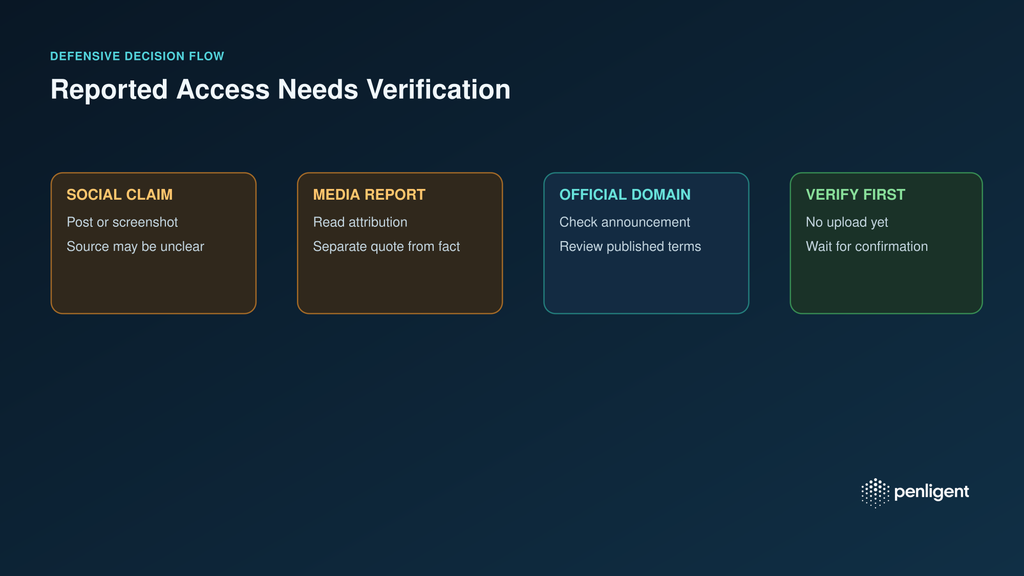
A practical security review for teams considering a gated AI service
Start with provider authenticity. Navigate from a domain linked by the vendor’s official site rather than a search ad, shortened URL, direct message, or social post. Confirm that the domain is the intended service and that the product page, API documentation, and support contact belong to the provider. Look for a dated announcement or a current support statement. If an alleged Cyber portal is reachable only through a private invitation, ask the provider through a published contact channel to confirm the invitation and the exact URL before uploading anything.
Then evaluate the requested evidence. Map every field to a purpose: identity proofing, organization verification, account recovery, eligibility, or abuse response. Ask whether the field is required, whether a less intrusive alternative exists, who processes it, where it is stored, and when it is deleted. Treat an unexplained request for an ID scan, face image, payment, or key as a stop condition until verified. Do not send identity documents to a personal account or an unofficial form. Never pay a broker or share an account to gain access to a purported private model.
Review the service terms and data flows. Determine whether prompts, files, tool outputs, and account details may be retained, reviewed by staff, used to improve models, or processed by subprocessors. Identify regional storage and transfer conditions that matter to your organization. Classify data before sending it. If the service does not provide commitments that meet your requirements, use a locally hosted or separately contracted option only after evaluating its own model, infrastructure, and operational risks. “Self-hosted” changes the trust boundary; it does not automatically make a system secure.
Review the API and account controls. Confirm how keys are generated, scoped, stored, rotated, and revoked. Determine whether the provider supports distinct workspaces, roles, per-key budgets, IP restrictions, audit exports, and alerting. Check how administrators authenticate and recover accounts. Verify that a key does not grant more capability than the approved tier. A provider’s public API docs may describe bearer-token authentication for general API calls; do not assume those controls also describe a separate reported Cyber service unless the provider documents that relationship.
Assess the safety boundary in your own architecture. Use a human approval step for code changes, external communication, destructive commands, and actions against live systems. Give tools read-only access unless write access is necessary. Restrict network egress and filesystem scope. Treat model output and retrieved web content as untrusted input. Validate commands against an allowlist or a policy engine before execution. Keep the model from directly handling production credentials when a brokered, narrowly scoped action can accomplish the task.
Finally, exercise the operational path in a non-production environment. Confirm that administrators can remove a user, revoke a key, rotate a secret, export relevant logs, and contact support during an incident. Test what happens when an account is suspended or a provider changes a model identifier. Record who owns periodic review. These steps can be performed with a documented test account and placeholder workload; there is no need to probe undocumented endpoints or attempt to evade a gate.
Controls for providers building cyber-specific access tiers
A responsible provider should document the capability and its boundaries before asking for high-risk evidence. Publish what each tier can do, which models and tools it exposes, what remains blocked, how an applicant qualifies, whether the tier is individual or organization-only, what monitoring is applied, what data is retained, and how decisions can be appealed. If an offer is in a pilot, say so, identify the eligible cohort at a high level, and avoid presenting a partially visible client flow as a generally available product.
Use risk-based assurance. A general defensive workflow may require verified email, strong account authentication, and an acceptable-use commitment. A tool-enabled assessment workflow may require organization verification, role assignment, proof of target authorization, and controls around execution. A highly consequential environment may require deeper review, independent approvals, constrained deployments, and pre-agreed incident procedures. These are illustrative patterns rather than a one-size-fits-all template. Risk assessment should determine the level, and the provider should avoid making assurance stronger than its evidence supports.
Separate identity data from capability policy. A person may be strongly identity-proofed but still not qualify for an advanced tier. A company may be legally registered yet lack the controls required to conduct safe testing. Use policy attributes such as role, organization, training or track record, authorization, environment, and operational safeguards as appropriate. Do not infer trust from a real name alone. A verified name can help accountability; it cannot make harmful actions safe.
Enforce least privilege and segmentation. Use short-lived tokens, tier-specific model routing, project-specific credentials, rate and cost limits, tenant isolation, and explicit tool permissions. Keep high-risk capabilities out of general-purpose keys. Provide separate approval for external network access or autonomous actions. Log security-relevant events with a defined purpose and retention period. Ensure that a user moving between tiers does not inherit stale permissions or old keys without review.
Monitor for behavior inconsistent with the declared purpose while respecting privacy. Useful signals may include unusual request patterns, repeated policy-boundary attempts, high-risk tool invocation, credential anomalies, or activity outside an approved engagement window. Monitoring should be documented and access-controlled. Providers should have an incident response path that can suspend a compromised credential, preserve evidence, notify the customer where appropriate, and restore access after remediation. Excessive or opaque monitoring can undermine trust and create its own data risk.
Evaluate the safeguards rather than just describing them. Run controlled tests using documented scenarios, measure false positives and false negatives, compare performance across tiers, and independently review the methods where feasible. Publish enough methodology for readers to interpret the claims. Anthropic’s published Cyber Verification Program describes tiered access and reports evaluation results for its own model and test suite; those numbers are provider-specific and should not be generalized to DeepSeek or another service. Transparency about test scope and limitations is more valuable than a headline claim that a model is “safe.”
Make user recourse usable. Security researchers need a way to report a mistaken block, suspected account compromise, or unsafe system behavior. An access program should provide a human contact for high-impact issues, a response target if one can be responsibly promised, and a means to appeal a decision. Providers should not promise response times that operations cannot meet. They should also publish how to report vulnerabilities in the service itself and distinguish product support from vulnerability disclosure.
Risks of false verification and impersonation
When a model or service gains attention, attackers can exploit interest with fake access forms, bogus waitlists, counterfeit verification badges, phishing messages, and resold keys. An identity-gated story can make the attack more persuasive: a scammer may claim to help applicants pass a face check or obtain an invitation. Users should not upload identity documents through a link supplied only in a social reply or direct message. Navigate from the vendor’s official home page and verify support channels using a separate trusted source.
A user should inspect the full hostname, not just the page branding. Check for lookalike characters, unexpected subdomains, unusual redirects, certificate warnings, and requests to install software or browser extensions. A valid HTTPS padlock means the connection is encrypted to that hostname; it does not prove that the site is owned by DeepSeek. Never paste an existing API key or account password into an access application unless the vendor’s official documentation explicitly instructs a safe, standard flow. Application approval should not require sharing a secret credential with a human reviewer.
Organizations should brief staff before an exclusive-access announcement. Provide the official URL, approved application contact, allowed data classification, and internal owner. Centralize keys in the enterprise secret manager and prohibit personal resale or account sharing. If a staff member receives an invitation, verify it through a known corporate channel. If they already submitted an ID or credential to a suspicious site, preserve the message and URL, report it to the security team, revoke any exposed API key, and follow the organization’s identity-theft and account-compromise procedures.
Do not assume that a real brand account on X means every reply in the thread is trustworthy. Verify the original post through the provider’s linked account and compare the URL with official documentation. If a purported DeepSeek account claims that Cyber access requires identity verification but the official site does not corroborate the account or destination, treat the claim as unverified. This is particularly important when a rumor is recent and coverage may be copied from one source without independent confirmation.
How to write about a limited-access model without misleading readers
Use a date-stamped lead. Say what was reported, who reported it, what evidence the source says it reviewed, and what the vendor has or has not confirmed. Avoid implying that a public product exists merely because client code contains route names. Do not call an application path an API endpoint unless the source establishes that it is one. Do not describe a feature gate as a security control unless its enforcement behavior is known. A front-end gate can hide a page but should not be mistaken for server-side authorization.
Separate exact strings from inferred meaning. The identifiers cyber-personal-v3 그리고 cyber-enterprise-v4 are reported strings. Calling them “model versions,” “model endpoints,” or “independent weights” requires separate confirmation. “Cyber Key” is a term reported in the source, not proof of key semantics. The words “identity verification” may refer to a human application review, document check, login authentication, or something else. Preserve the source’s language and note what remains unknown.
Use a compact unknowns box in coverage: whether the service is generally available; whether the reported identifiers are callable; the exact model capability; the definitive eligibility rules; whether document or face data are collected; the retention and processing terms; pricing and quota; supported integrations; and the threat model or safeguards. Update the article when a first-party announcement answers those questions. Do not keep presenting old discovery details as breaking news after the provider clarifies the product.
Do not make benchmark, exploitation, or performance claims from a name. A “Cyber” label does not establish that a model has exploit-development capabilities, has been independently evaluated, or outperforms general models. DeepSeek’s reported V4.1-Flash scores should be attributed to that released model and to the named benchmark; they cannot be transferred to the unconfirmed identifiers. A cybersecurity-focused service could be optimized for defensive workflows, use different routing, or simply be a product label. Specific capability claims require a model card, technical report, evaluation, or reproducible test with a disclosed harness and scope.
Finally, distinguish consumer account verification from specialized capability access. A provider may add multi-factor authentication to all accounts, require identity proofing only for a higher-risk tier, or use organization approval without biometric checks. Reports of account login verification do not confirm a cyber model access policy, and a model access program does not necessarily alter ordinary consumer login. The article should identify which flow is under discussion.
What to monitor next
For a fact-based update, monitor DeepSeek’s official news and transparency pages, the public API change log, current API documentation, platform terms, and any official security or support statement. Compare the dates and the exact product names. If a public announcement appears, verify whether it links to application requirements, model documentation, data-processing terms, and API reference. A press report or social post may be an early alert, but the provider’s own material should determine the service’s confirmed behavior.
Monitor the access mechanics only through authorized channels. If an account is invited to a pilot, record what the user interface actually says and get permission before sharing screenshots or account-specific details. Do not use another person’s credentials, enumerate hidden routes, bypass a feature gate, or call undocumented methods to test whether a model exists. The absence of a public API route is not an invitation to discover one. Report accidental exposure privately through the provider’s published security channel.
Monitor the broader industry too, but keep comparisons fair. Anthropic’s Cyber Verification Program and OpenAI’s cybersecurity safeguards have public descriptions that can be compared on stated access levels, application requirements, supported environments, data retention, and customer controls. Do not compare a reported DeepSeek pilot with a fully documented program as if the evidence were equivalent. Instead, use the documented programs to frame the questions that a future DeepSeek announcement should answer.
For security teams deciding whether to adopt a service, maintain a vendor register with product name, data flow, model and API identifiers, approved use cases, allowed data classes, credential owner, and review date. Revisit it when the vendor changes model routing, retention, terms, or tool features. A product may change without the company name changing. Pin the exact documentation and terms version reviewed so the decision can be reproduced later.
A decision framework for security leaders
Before approving an identity-gated AI cyber service, answer five questions. First, is the service and application channel authentic and currently supported by the provider? Second, what specific capability is requested, and what is its misuse impact? Third, what evidence establishes the user, organization, and target authorization, and is each item proportionate? Fourth, what information and credentials will flow to the service, and do retention, residency, and deletion terms meet policy? Fifth, can the organization bound, observe, revoke, and investigate use without exposing production systems or collecting unnecessary personal data?
If any answer is unknown, classify the service as not yet approved for sensitive data or active testing. That does not mean every employee must be blocked from all experimentation. A team can begin with public code, synthetic data, a local model, or a sandbox while procurement and privacy review proceeds. Keep the experiment isolated, record the provider and model version, and do not connect it to production credentials or customer systems. This gives the team a path to learn without treating a rumor as an authorization decision.
Approval should have a defined owner and expiration. Security can assess controls, privacy can assess personal data and transfers, legal can assess terms and authorization, procurement can assess vendor assurances, and engineering can implement the technical boundary. A concise decision record should state approved tasks, prohibited data, key owner, integration method, logging expectations, review date, and incident contact. Reapproval is appropriate when the model, tier, or data practices materially change.
Denial should also be specific and constructive. If the service lacks acceptable data-retention terms, the decision can say that sensitive source code is not approved, while allowing public-source experimentation. If the team lacks a target-scope mechanism, prohibit active scanning but allow code review in a controlled repository. A blanket “AI is unsafe” rule often pushes use into unmanaged channels; a bounded policy can reduce that shadow use while preserving accountability.
For a model provider, the parallel decision record should explain the tier, evidence reviewed, controls enabled, monitoring applied, and recertification trigger. The provider should not expose sensitive reviewer notes to all staff, but it should be able to explain decisions to an applicant and to an auditor. A defensible access program is not a one-time KYC form; it is a documented lifecycle for identity, authorization, credentials, data, behavior, and incident response.
Questions about DeepSeek Cyber and identity-gated AI access
Did DeepSeek officially announce a Cyber model?
- Not in the public DeepSeek news and transparency materials reviewed for this article as of October 31, 2026. IT Home reported that developers found Cyber-related references in website front-end code and described limited testing. Attribute those details to the report until DeepSeek publishes a first-party announcement.
Did DeepSeek say on X that users must verify their identity?
- I could not confirm an official DeepSeek X announcement establishing that policy. The current evidence is a media report about code and reported application instructions, not a verified first-party statement. Check the official account linked from DeepSeek’s own site before treating a social post as authoritative.
What is the difference between identity verification and authentication?
- Identity proofing checks whether an applicant’s claimed attributes are credible. Authentication later checks that a login or API request controls an enrolled credential. Authorization decides what that identity is permitted to do. None of these alone proves permission to test a particular target.
Should I upload identity documents to a Cyber application link?
- Only after confirming the exact destination through an official provider channel and reviewing the purpose, retention, processing, and privacy terms. Do not submit documents to an X reply, direct message, unofficial mirror, or reseller. A reported pilot route is not enough to establish that a form is genuine or currently supported.
Does an approved API key authorize penetration testing?
- No. A provider-issued key authorizes requests under the provider’s service terms. Testing a customer or third-party system still requires authorization from that system’s owner and a defined scope, window, and rules of engagement.
What should a company check before using a cyber-focused model?
- Verify the provider and model identity, data-use and retention terms, key controls, tier permissions, logging, tool access, revocation process, and incident contact. Begin with public or synthetic data until privacy, legal, and security review approve a specific use case.
Can a verified identity make a model safe?
- No. Verification can support accountability and reduce some impersonation risk, but it does not establish competence, authorization for a target, safe intent, or correct model behavior. Combine it with least privilege, bounded tools, monitoring, review, and revocation.
How should the DeepSeek story be updated if the company confirms the service?
- Replace reported claims with dated first-party documentation, link to the exact application and API terms, verify model identifiers and supported capabilities, and document data handling and access levels. Preserve unknowns until the provider answers them; do not infer model performance or security properties from a product name.
결론
The DeepSeek Cyber report is timely, but its evidentiary status remains limited: on October 30, 2026, IT Home reported code references and limited user observations, while DeepSeek had not publicly confirmed a Cyber product in the public materials checked by October 31. That is enough to make the story worth monitoring; it is not enough to state that DeepSeek officially launched an identity-gated cyber model or announced verification on X.
For practitioners, the useful takeaway is a disciplined access-control review. Ask what is being verified, why the evidence is proportionate, how identity data is protected, what a key permits, whether target authorization is explicit, and how access is observed and revoked. A provider’s identity gate is only one layer in a system that must also protect credentials, constrain tools, respect data boundaries, and support incident response. Until first-party details are available, verify the channel, protect personal data, and keep experimentation inside systems and scopes you control.
 Korean
 English
 German
 French
 Spanish
 Portuguese
 Japanese
 Hindi
 Arabic
 Turkish
 Hebrew