
Last updated: November 4, 2026.
Penetration testing for startups should protect the product decisions that could stop a launch, lose a customer or expose another tenant. The best first engagement is rarely the largest possible scope. It is a focused assessment of the externally reachable application, APIs, authentication, tenant boundaries and business workflows that carry the most consequence.
A useful report can support customer due diligence and risk treatment, but it is not a substitute for a secure development program or an automatic compliance outcome. The startup should know which questions the test answers and what evidence it will retain after remediation.
For the assessment framework, consult OWASP Application Security Verification Standard and map the relevant guidance to the actual environment and authorized scope.
Choose scope by product risk and company stage
Map the product’s critical user journeys and customer commitments. Early-stage teams should avoid spending the entire budget on anonymous surface scanning while authenticated authorization and business logic remain untested.
| Stage or trigger | Priority scope | Evidence goal |
|---|---|---|
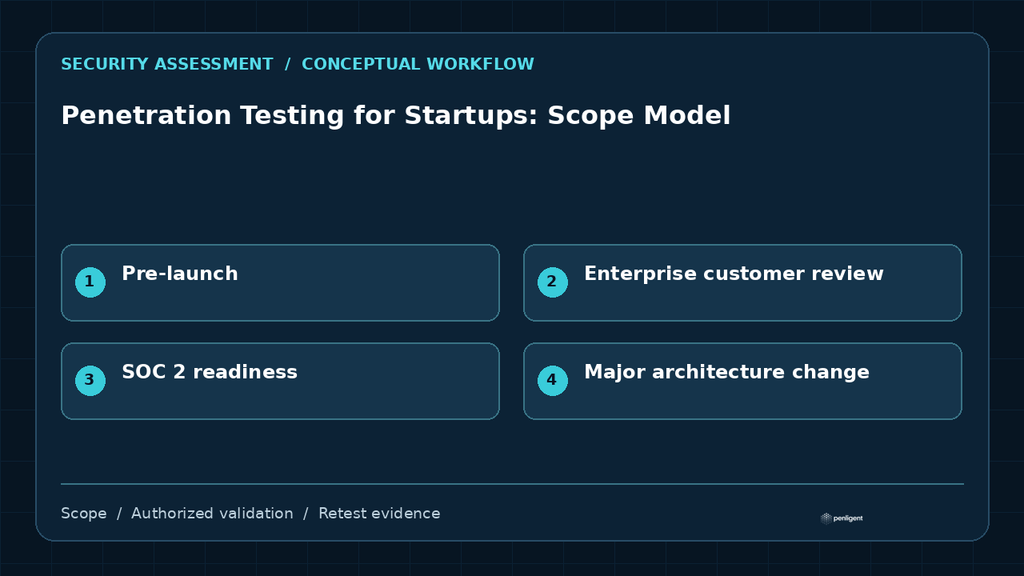
| Pre-launch | Authentication, authorization, tenant isolation and critical API paths | Block release-changing failures |
| Enterprise customer review | Customer roles, admin functions, exports, SSO and audit paths | Answer due-diligence questions |
| SOC 2 readiness | Defined production scope, report, owners and retest | Support risk and control evidence |
| Major architecture change | New cloud, identity, payment or agent boundary | Validate changed trust assumptions |
Turn the scope into testable evidence
Define an authorized target, validate meaningful attack paths, and keep the evidence connected to remediation and retesting.
Prepare an efficient test environment
Provide a stable staging environment when it accurately represents production controls, or explicitly authorize a production-safe scope. Create test users for every material role and at least two tenants when cross-tenant isolation matters. Seed synthetic data and identify actions that could send messages, charge cards or affect real customers.
Protect the budget from scope ambiguity
A quote should state targets, roles, APIs, cloud components, testing window, exclusions, report format and retest. Endpoint count alone is a weak pricing unit when one endpoint contains a complex financial or tenant workflow. Prioritize business risk and reserve time for remediation review.
Turn the report into operating evidence
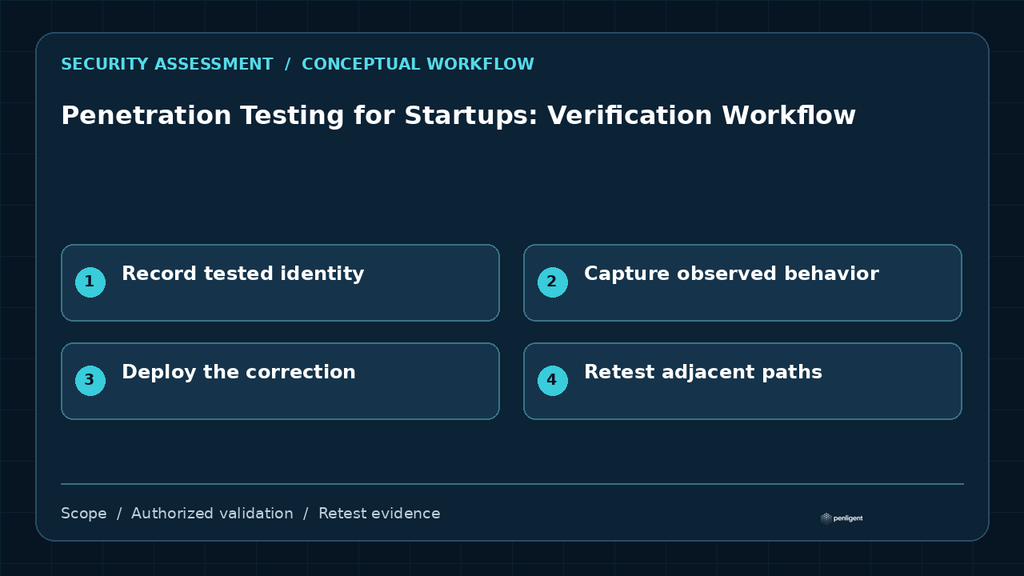
Assign each finding to an owner, severity decision and target release. Retest material fixes in the deployed environment. Preserve the final report, closure record, scope and limitations so sales, security and engineering teams communicate the same facts.
Turn the scope into testable evidence
Define an authorized target, validate meaningful attack paths, and keep the evidence connected to remediation and retesting.
Questions buyers should ask
- Which workflows could expose another tenant, change money or grant administrative access?
- Are all material roles and at least two test tenants available?
- Does the proposal include business logic and remediation retesting?
- What evidence will be safe to share with customers or auditors?
결론
A startup pentest should reduce a specific business risk, not produce the largest possible finding count. Focus the scope on identity, tenant isolation, critical workflows and APIs, then retain a clear remediation and retest record that customers and engineers can both use.
Sources and standards
- OWASP Application Security Verification Standard
- NIST Secure Software Development Framework
- NIST SP 800-115
 Korean
 English
 German
 French
 Spanish
 Portuguese
 Japanese
 Hindi
 Arabic
 Turkish
 Hebrew