
Automated penetration testing for SaaS is worth evaluating when it can test the application your customers actually use: authenticated pages, APIs, tenant boundaries, privileged operations, and the paths that export or share data. A scan of your public homepage is not evidence that one customer cannot read another customer’s records. Start with a small, owned test environment and explicit security rules, then judge the workflow by the evidence it produces.
For a founder, the purchasing question is concrete: can this assessment uncover a consequential defect, explain it well enough for a developer to fix, and show whether the fix works? A second question matters when a customer requests a pentest report: will that customer accept this methodology, scope, assessor, and deliverable? Settle the second question before buying a report solely because it exports to PDF.
Scope and evidence: This guide was reviewed October 25, 2026. The test plan and acceptance criteria below are recommendations. We executed the included offline Python policy fixture; we did not benchmark pentesting products or assess a production SaaS application. Penligent publishes this article and is discussed as one workflow to evaluate, with product claims distinguished from the local experiment.
Choose the assessment around the job you need done
| Immediate need | Useful approach to evaluate | What would justify continuing |
|---|---|---|
| An enterprise prospect requests a report | Confirm required scope, assessor independence, methodology, and retest evidence with the recipient first. | A representative deliverable meets those requirements; exported format alone is insufficient. |
| A new API or role is about to ship | A scoped assessment plus deterministic checks for the changed permissions. | The workflow reaches the changed feature and tests the intended authorization rules. |
| A developer wants an initial security review | An isolated pilot against an owned app with synthetic users and records. | Findings are reproducible and setup failures are explicit. |
| Frequent releases keep changing the attack surface | Repeatable authentication, maintained fixtures, exploratory assessments and targeted regressions. | The team can keep coverage working and act on results at that cadence. |
These are different buying triggers. A single release or customer request can justify one assessment without justifying an indefinite subscription. Repeated changes can justify recurring testing, but only if someone maintains the accounts, scope, fixtures, and findings queue. Start with the smallest evaluation that resolves your immediate uncertainty.
Treat the NIST technical testing guide as a planning reference: it connects conducting tests with analyzing findings and developing mitigations. An automated job is one part of that process. The engineer accepting a finding and the person approving a customer-facing report still need to know what was tested and what remains unresolved.
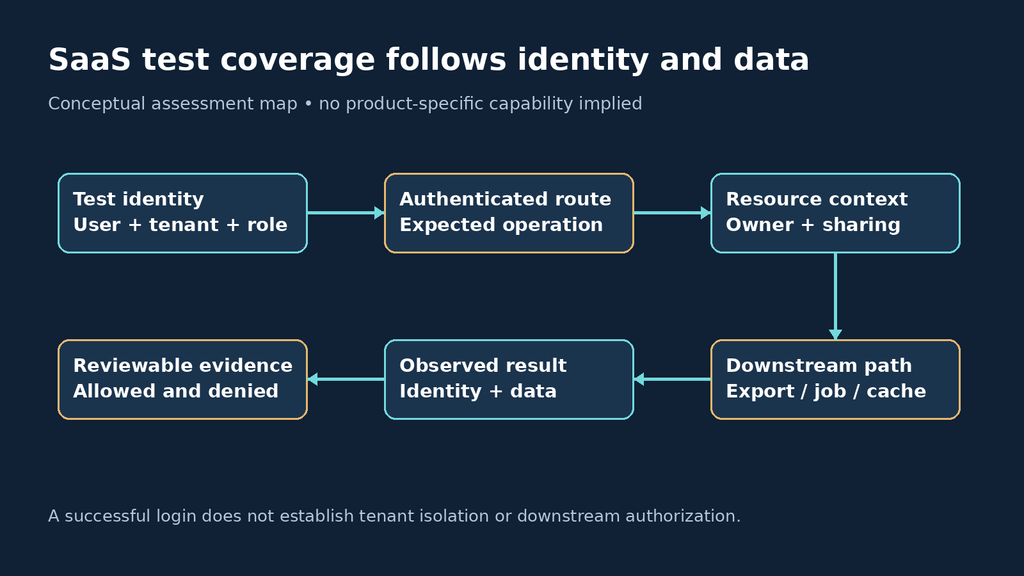
Login success is the beginning of SaaS coverage
AWS’s tenant-isolation guidance explicitly distinguishes isolation from ordinary authentication and authorization. A valid login and an allowed application role do not, by themselves, establish that resources belonging to another tenant are unreachable. The assessment must connect the acting identity with the resource’s tenant context.
Build a small identity map before running the pilot. Use two synthetic tenants and at least a normal user and an administrator where your product has that distinction. Record membership, role, permitted sharing, and the owner of each fixture record. A cross-tenant read may be forbidden for a private object and intentionally allowed for a shared object. The tester needs that policy; otherwise it can mistake a feature for a vulnerability or a missing check for permitted behavior.
Account names should make the context unmistakable in sanitized evidence. “Tenant A reader” and “Tenant B reader” are more useful than two email addresses whose organization membership is unclear. Use separate browser contexts or another supported isolation mechanism so one login does not silently replace the other. Expired credentials should produce a blocked-coverage result, not a reassuring assessment of a login page.
Begin with one harmless authenticated operation, such as reading a synthetic project created for the assessment. Confirm the expected identity server-side where you can. Only then expand the run. A page count or a completed progress bar cannot establish that an agent retained the right session while navigating the application.
A tenant-and-role matrix gives automation something to prove
그리고 OWASP IDOR testing guidance recommends multiple users with known objects and, where relevant, different privileges. This avoids guessing ownership. For your pilot, turn that approach into an explicit matrix with allowed and denied cases. The following is an illustrative policy for a fictional project-management SaaS; adapt every expectation to your product.
| Acting identity | Synthetic operation | Expected policy | Meaningful observation |
|---|---|---|---|
| Tenant A reader | Read A’s private project | Allow | Expected project marker and identity are returned. |
| Tenant A reader | Read B’s private project | Deny | No B data or identifiers are exposed. |
| Tenant B reader | Read A’s explicitly shared project | Allow only the permitted share | Allowed fields are returned; unrelated private records remain inaccessible. |
| Tenant A reader | Export A’s administrative report | Deny under this example’s policy | No export job or file is created. |
| Tenant A admin | Export A’s administrative report | Allow | The resulting artifact contains A’s permitted data only. |
| Tenant A admin | Export B’s administrative report | Deny | No B-scoped job, artifact, or data is returned. |
| Removed member | Access a previously available private project | Deny after the defined revocation boundary | Old membership no longer authorizes the operation. |
Status codes help but are not the success criterion. A 200 response can contain a login page or an empty result; a rejected front-end action can still create an export in the background. Define what data or side effect you must observe. Use synthetic markers that let you identify the wrong tenant without storing real customer records in the evidence.
Keep positive controls beside negative cases. If every request fails because the application is unavailable, the denied cases are inconclusive. If a fix prevents all exports, it may close the demonstrated path while breaking legitimate work. A useful retest demonstrates denial of the forbidden operation and continued success of the intended operation.
Follow the data beyond the first API response
A SaaS assessment should account for the paths its architecture actually uses. The OWASP multi-tenant security guidance covers tenant context across database access, caches, asynchronous work, storage, and lifecycle operations. Client-supplied tenant identifiers need authorization checks; an opaque identifier is not an access-control decision. Apply those principles to specific workflows rather than treating the entire checklist as proven coverage.
For an export, separate requesting the job, polling its status, and retrieving the artifact. Record which tenant and user authorized each step. A correct check when the job is created does not establish that a later download is restricted. Use small synthetic exports and avoid triggering real emails, payments, or expensive processing. The assessment’s authorization should cover the effects you intend to observe.
For a queued operation, inspect how tenant context is carried from the request to the worker and result store. Where you control the code, a focused integration test can assert that the worker uses the authorized context rather than accepting an unrelated tenant selector. An external tester may be unable to observe that internal decision; the report should identify the boundary it actually exercised.
For caching, repeat a permitted read under one fixture identity and then under another, with cache state documented. Test the expected product policy, including legitimate sharing. A clean uncached request does not settle a defect that appears only after another user warms the cache. Conversely, a shared public result is not a tenant leak simply because two users receive it.
For revocation and offboarding, define the expected timing. “Removed users lose access” is not a complete oracle if the product intentionally allows a short session transition or a previously issued public share. Document the intended boundary and test after that point. Include direct artifact access and background results when they form part of the relevant workflow.
Run an offline policy fixture before trusting a green dashboard
The following Python fixture models a fictional read-and-export policy. Its deliberately broken implementation checks activity and role while omitting the tenant boundary. The corrected implementation preserves explicit cross-tenant sharing for reads and restricts exports to the owning tenant’s administrator. No network requests, real credentials, framework code, or database are involved. Save it as tenant_fixture.py and run python tenant_fixture.py.
"""Synthetic policy fixture. No product, HTTP service, or database is tested."""
USERS = {
    'a_reader': {'tenant': 'A', 'role': 'reader', 'active': True},
    'a_admin': {'tenant': 'A', 'role': 'admin', 'active': True},
    'b_reader': {'tenant': 'B', 'role': 'reader', 'active': True},
    'revoked': {'tenant': 'A', 'role': 'reader', 'active': False},
}
OBJECTS = {
    'a_private': {'tenant': 'A', 'read_grants': set()},
    'b_private': {'tenant': 'B', 'read_grants': set()},
    'a_shared': {'tenant': 'A', 'read_grants': {'b_reader'}},
}

def allowed(user_id, object_id, action):
    user, obj = USERS.get(user_id), OBJECTS.get(object_id)
    if not user or not user['active'] or not obj:
        return False
    same_tenant = user['tenant'] == obj['tenant']
    if action == 'read':
        return same_tenant or user_id in obj['read_grants']
    if action == 'export':
        return same_tenant and user['role'] == 'admin'
    return False

def broken(user_id, object_id, action):
    user, obj = USERS.get(user_id), OBJECTS.get(object_id)
    if not user or not user['active'] or not obj:
        return False
    return action == 'read' or (action == 'export' and user['role'] == 'admin')

CASES = [
    ('owner read', 'a_reader', 'a_private', 'read', True),
    ('A cannot read B', 'a_reader', 'b_private', 'read', False),
    ('B cannot read A', 'b_reader', 'a_private', 'read', False),
    ('explicit share works', 'b_reader', 'a_shared', 'read', True),
    ('reader cannot export', 'a_reader', 'a_private', 'export', False),
    ('admin exports own tenant', 'a_admin', 'a_private', 'export', True),
    ('admin cannot export B', 'a_admin', 'b_private', 'export', False),
    ('anonymous denied', 'unknown', 'a_private', 'read', False),
    ('missing object denied', 'a_reader', 'missing', 'read', False),
    ('revoked user denied', 'revoked', 'a_private', 'read', False),
]
for label, fn in [('broken', broken), ('corrected', allowed)]:
    failed = [name for name,u,o,a,want in CASES if fn(u,o,a) != want]
    print(f'{label}: {len(CASES)-len(failed)}/{len(CASES)} cases match policy')
    print('policy mismatches:', failed)
    assert len(failed) == (3 if label == 'broken' else 0)
print('Fixture assertions passed; no vendor or production system was assessed.')
We ran this fixture on October 25, 2026. The broken implementation matched 7 of 10 expected outcomes; the three mismatches were the two forbidden private reads and a cross-tenant administrator export. The corrected implementation matched all ten. This is evidence about a deliberately constructed local policy model, not a detection score for Penligent or another pentesting tool.
The allowed share matters as much as the forbidden reads. A simplistic “always deny cross-tenant access” rule would pass some isolation cases while breaking a documented feature. The model makes that disagreement visible. Its limits are equally clear: it does not test authentication, session storage, HTTP parsing, a queue, a cache, file permissions, or database enforcement. Those require tests at their own boundaries.
To turn this into application evidence, implement the same named cases in your normal test environment using supported APIs and known fixture objects. Assert the authenticated principal, returned data, and permitted side effects. Do not replace the backend’s authorization logic with this demonstration or treat a passing function test as a complete penetration test.
Distinguish exploration, regression checks and human assessment
그리고 OWASP 웹 보안 테스트 가이드 describes automation as useful for breadth and repeatable checks while emphasizing application-specific context and human verification. For a SaaS team, that suggests combining complementary methods rather than asking a single tool category to prove everything.
| Method | Useful contribution | Limit to make explicit |
|---|---|---|
| Automated discovery or scanning | Maps reachable features and runs supported checks repeatedly. | Unknown roles or unreachable workflows remain outside demonstrated coverage. |
| Agentic exploratory testing | Can investigate hypotheses and stateful paths when the workflow supports them. | A plausible explanation still needs observable evidence; execution can fail or drift. |
| Deterministic authorization regression | Repeats known allowed and denied cases after changes. | Passing the known cases does not discover every new business-logic flaw. |
| Human-led assessment | Resolves ambiguous policy, impact, unusual workflows and customer-specific requirements. | Scope, time and starting access still constrain the result. |
A repeatable program converts accepted findings into regression cases and retains exploration for changed behavior. OWASP’s authorization regression guidance describes role-demotion and cross-tenant boundary tests and warns against relying on hidden UI controls. The actionable outcome is a server-side assertion your team can maintain, with the product policy stated next to it.
Do not use this comparison to excuse unexplained coverage gaps. If a workflow needs manual setup, say so. If the tool cannot retain an authenticated session, resolve that before running a broader assessment. If a business rule has no agreed expected outcome, get the product owner’s decision before labeling the behavior secure or vulnerable.
Agree the evidence your developer and customer will receive
For an accepted finding, retain the tested environment and build, acting identity and tenant, required prerequisites, sanitized request sequence, observed data or effect, expected policy, and a concise impact explanation. The developer should be able to reproduce the observation with the supplied fixtures. Preserve the original evidence when editing the executive summary so a polished report does not weaken the technical record.
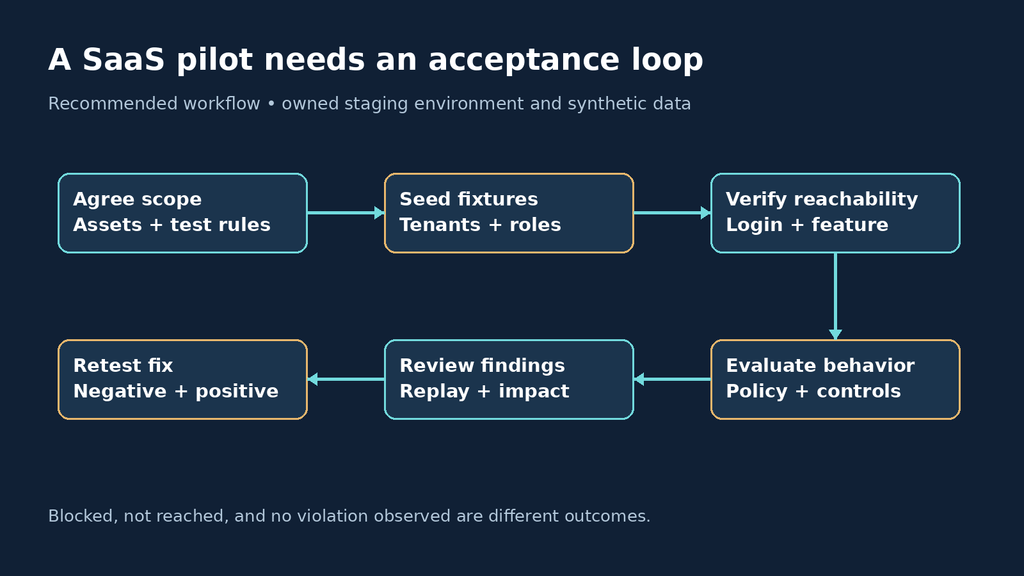
Use explicit result states: demonstrated violation, tested with no violation observed, blocked by a prerequisite, not reached, and excluded. A test that never reached the export feature belongs in a different category from a tested export that respected the defined policy. Reporting those states makes the remaining work visible without inventing a numerical coverage percentage.
Illustrative assessment record — not a product schema
Case: export-B-as-A-admin
Environment/build: staging / supplied release identifier
Expected policy: deny; create no job or artifact
Observed result: fill from protected application evidence
Coverage state: demonstrated / no violation observed / blocked / not reached
Positive control: export-A-as-A-admin
Retest: original path + positive control, with build and time
Evidence: sanitized request IDs, identity assertions, artifact marker
A pentest report can be submitted as evidence in a customer review; it is not automatically an independent assessment, certification, or an accepted compliance deliverable. Ask the recipient what they require before procurement. If they require a named independent assessor or a particular assessment scope, arrange that service rather than inferring acceptance from a framework label in an automated template.
Buy a useful next assessment, then decide whether to repeat it
Compare total effort per accepted assessment, not the smallest advertised monthly number. Include setup and authentication maintenance, subscription or one-time fees, separately billed model or infrastructure use, retries, finding review, report editing, and retesting. Record actual pilot usage. A larger credit allowance does not make two applications equally expensive to test.
For a one-off launch or customer request, establish that a single engagement can produce the required evidence within your budget. For ongoing releases, check whether the recurring workflow is maintainable: who replaces expired credentials, keeps tenants and fixtures consistent, reviews findings, and confirms fixes? A schedule without those owners can repeatedly test a shrinking surface.
For a Penligent evaluation, review the current AI pentesting workflow and plan grid, then start with one owned application and dedicated test identities. The public material describes browser-based verification, operator intervention and reporting. Confirm which account capabilities are available and demonstrate the specific authenticated and tenant-boundary cases you need. This guide does not establish automatic multi-tenant coverage, guaranteed findings, or acceptance of its report by your customer.
Continue when the initial evaluation reaches a consequential feature and produces evidence you can independently inspect. Pay for additional usage or a required capability only after confirming what it unlocks. If the immediate obstacle is an inaccessible login flow, undefined policy or an unacceptable report format, address that obstacle before buying more execution.
Questions to settle before the first SaaS assessment
Can I start with only a URL?
A public URL can establish public-surface reachability. Authenticated SaaS coverage additionally needs the appropriate access, tenant and role context, and expected policies. Record what remains untested.
Should I use production or staging?
Choose an explicitly authorized environment with the required behavior and acceptable effects. Staging with synthetic data is a practical pilot starting point; document any differences from production that limit the result.
Is a denied HTTP request enough evidence of tenant isolation?
No. Establish the active identity, returned data, downstream effects, and a working allowed control. A proxy error or broken login can make a forbidden request fail without testing the intended boundary.
Will automated testing replace an independent customer pentest?
Only if the recipient’s actual requirements are met. Confirm methodology, assessor requirements, scope and deliverables before purchasing; do not assume that an exported report resolves independence.
How often should a SaaS product be tested?
Set cadence around meaningful changes, contractual requirements and the team’s ability to maintain coverage. Repeat focused regressions after fixes and review broader scope when identities, tenants or data flows change.
Does the local Python result prove a SaaS app is secure?
No. It demonstrates ten outcomes in a synthetic policy model. Application security still depends on the real authentication, storage, execution paths and agreed scope.
Begin with one consequential workflow, two synthetic tenants, explicit permissions and an agreed evidence standard. Expand after you can distinguish a real violation from a failed prerequisite and reproduce a fix without breaking the allowed operation. That gives automated SaaS penetration testing a result your team can use, rather than another completed job to interpret.


 Korean
 English
 German
 French
 Spanish
 Portuguese
 Japanese
 Hindi
 Arabic
 Turkish
 Hebrew