
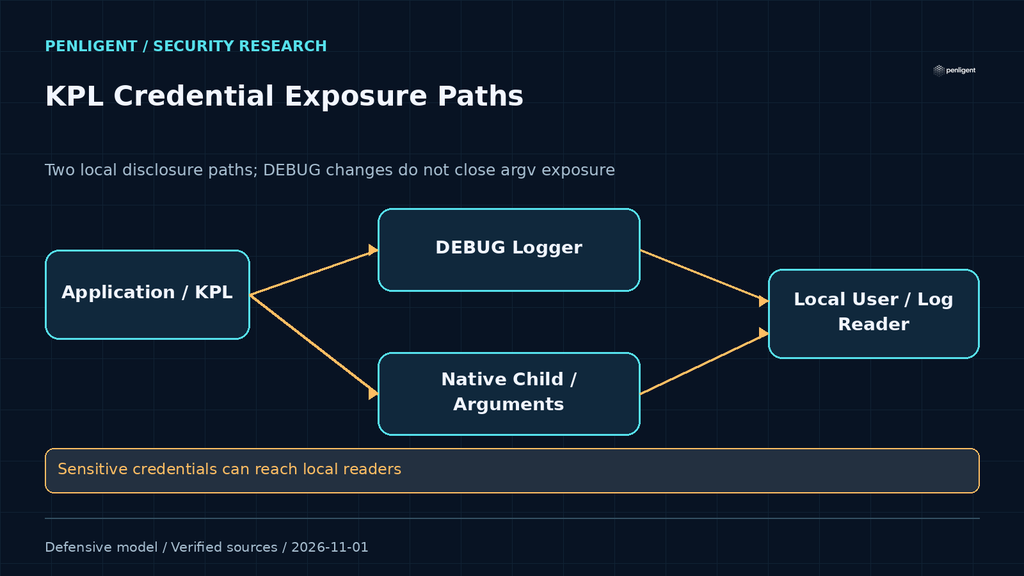
CVE-2026-119117 affects the Amazon Kinesis Producer Library for Java. AWS describes two credential-disclosure paths in affected releases: the library may write resolved credentials to a log when the relevant logger is configured at DEBUG, and it passes credentials to a native child process as command-line arguments that a local user may be able to read. These are separate exposure surfaces. Disabling DEBUG reduces the logging risk, but it does not remove credentials from the native process argument list. Official advisory.
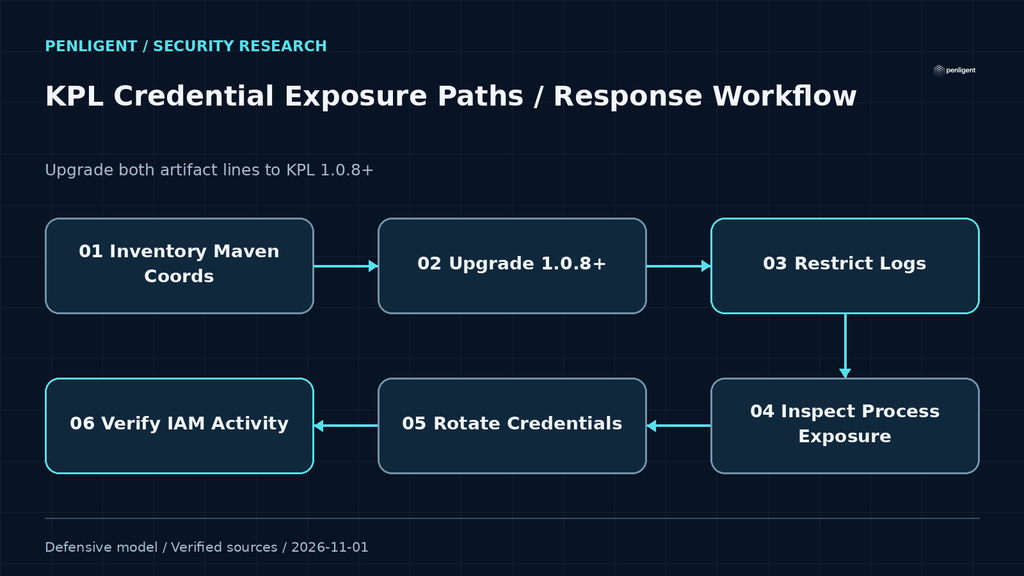
AWS identifies KPL 1.0.8 as the fixed release and says upgrading to 1.0.8 or later is the only complete remediation. The bulletin also recommends rotating long-term IAM user keys, revoking active role sessions where needed, and restricting or redacting affected logs. Operators should check both Maven coordinates because deployments may use an older artifact line.
This is not an unauthenticated internet vulnerability. KPL is a client library running inside the customer’s application and AWS account. The bulletin describes local access to sensitive logs and a process argument list. The practical risk depends on who can read the producer’s logs or inspect processes on its host or container, and whether credentials have already been captured.
Affected artifacts and versions
그리고 AWS Security Bulletin 2026-159 identifies these affected coordinates:
| Maven coordinate | Affected range | Fixed target |
|---|---|---|
com.amazonaws:amazon-kinesis-producer |
through 0.15.12 | Migrate to the 1.x artifact and upgrade to 1.0.8 or later |
software.amazon.kinesis:amazon-kinesis-producer |
earlier than 1.0.8 | 1.0.8 or later |
The official CVE record 그리고 GitHub advisory GHSA-mr97-jq69-qr5f provide additional identifiers for inventory and dependency review. Use the exact artifact coordinate and deployed version rather than searching only for the phrase “Kinesis.” The KPL project repository 그리고 Amazon Kinesis Producer Library documentation are useful for understanding the producer integration and migration context.
An application may receive KPL transitively through another component. Inspect dependency trees and lock files, then compare those results to the built artifact or container image actually running in each environment. Include CI runners, batch producers, development environments, sidecars, and older rollback images if they may still execute.
Two different local disclosure paths
DEBUG logging
For affected versions, AWS says that when the library’s logger is configured at DEBUG level, local users might obtain credentials resolved for the application from log output. The bulletin notes that KPL’s own LogLevel setting does not control the Daemon logger. The effective logging framework configuration matters, including the root logger and the specific logger category used by the KPL daemon.
AWS recommends explicitly keeping the relevant daemon logger at INFO or higher to prevent the credential-bearing DEBUG messages from being emitted. The class names differ by artifact line: software.amazon.kinesis.producer.Daemon for 1.x and com.amazonaws.services.kinesis.producer.Daemon for 0.x. A central logging configuration can override an application-level setting, so verify the effective runtime level rather than relying on a source file or intended default.
The bulletin also recommends filtering or redacting messages beginning Starting Native Process in log pipelines. It warns that the values may be hex-encoded and secret scanners may not recognize them. Apply the filter at collection and storage boundaries, restrict access to existing log archives, and search for old affected records. A forward-looking filter does not remove a credential already written to an archive or copied to another system.
Native process arguments
Independently of the DEBUG logger path, affected versions pass credentials to a native child process as command-line arguments. A local user with sufficient process visibility may read the argument list. AWS explicitly states that no configuration removes this exposure in affected versions. Lowering the log level therefore does not make an affected library fully safe.
Do not run diagnostic commands that print full command lines into shared tickets or terminal logs while investigating. Such output can create a new copy of the secret. Instead, use host-level monitoring or a narrowly scoped inspection that records process identity, executable, parent-child relationship, and argument names while redacting values. If a process capture tool has already collected complete arguments, handle that capture as sensitive credential material.
The separate paths have different control points:
| 경로 | Condition or access boundary | Interim action | Complete remediation |
|---|---|---|---|
| DEBUG log | Relevant Daemon logger at DEBUG; reader can access the logs | Set logger to INFO or higher; redact/filter affected message; restrict archive access | Upgrade and clean up/rotate credentials already exposed |
| Process arguments | Local user or process observer can inspect the producer process | Run on hosts/containers without untrusted local accounts; restrict process visibility | Upgrade to 1.0.8 or later |
Response when an affected version ran
First, establish the exposure window and affected runtime inventory. Record artifact coordinates, package versions, container image digests, logger levels, process isolation, and log destinations. Preserve relevant evidence under the incident team’s handling rules before deleting or rewriting logs. Avoid copying raw secret-bearing messages into chat, issue trackers, or reports.
Next, upgrade to 1.0.8 or later and rebuild the application artifact. A dependency declaration change is not enough if an old image remains running. Verify the version inside the deployed process or an equivalent artifact inspection, roll through all producers, and confirm that no scheduled job or standby node can start the old release.
Then assess credentials. AWS recommends rotating long-term IAM user keys and revoking active role sessions where needed. Prioritize secrets that were present while an affected producer ran and were accessible through the relevant log or process boundary. Follow the credential owner’s rotation procedure, update dependent services, and verify that old credentials no longer authenticate. Do not paste access keys into shell commands, test prompts, or incident notes.
Use AWS’s IAM security best practices 그리고 access-key management guidance to reduce persistent credential exposure. Prefer short-lived role credentials over long-lived user keys where the deployment supports them, and scope the role to the stream and actions actually needed. A producer commonly needs write operations such as kinesis:PutRecords; add only other actions supported by the application’s requirements and scope resources narrowly.
Review audit records for suspicious use of the relevant identity after the likely disclosure window. AWS CloudTrail documentation explains how to examine account activity, but available events and fields depend on service, configuration, and event type. An absence of an event is not proof that credentials were never read locally. Use host, container, identity, and cloud-side evidence together.
Safe verification without exposing real credentials
The safest routine validation combines dependency inventory, deployment verification, and redaction tests. Confirm that the dependency graph resolves to the fixed artifact. Confirm that running producers use the rebuilt image. In a controlled test environment, pass a synthetic value such as TEST_CREDENTIAL=never-valid through a logger fixture and assert that it does not appear in collected output. Test that the logging pipeline redacts or drops the known message form without emitting the original field into debugging telemetry.
Do not use a production access key as a test secret. Do not intentionally enumerate process arguments on shared or multi-tenant hosts. If process-level validation is required, use a disposable lab worker with synthetic credentials and a single administrator-controlled account. After the test, destroy the synthetic credential and confirm it cannot be used.
For log retention, AWS CloudWatch Logs data protection provides a service feature for masking sensitive data in supported workflows. Masking is not a substitute for preventing disclosure at the source: access control, retention, and the library upgrade still matter. Confirm the feature is configured for the specific log groups and that only authorized roles can unmask data.
Operational hardening after the upgrade
- Keep producer hosts and containers free of untrusted local accounts. Container boundaries do not automatically protect process arguments from privileged host users or a compromised co-tenant.
- Keep logs private, encrypted, access-controlled, and retained only as long as operationally required. Separate application operators from broad log readers where practical.
- Avoid long-lived access keys in process environments when role-based short-lived credentials are available.
- Scope IAM permissions to the required Kinesis stream and monitoring actions. Review trust policies and role-session duration.
- Pin and monitor dependency versions. Alert when a deployed image contains the vulnerable coordinate or a retired artifact line.
- Treat log exports, crash bundles, process captures, and support archives as possible secret stores until inspected and redacted.
The CVE’s value is not just that it names a package release. It exposes a broader design rule: credentials should not be copied into diagnostic logs or process metadata when safer IPC or credential-provider patterns are available. The immediate action remains the upstream fixed release, because the advisory says configuration cannot eliminate the argument-list path in affected versions.
A practical dependency and artifact review
Start in source control, but continue through the build and runtime layers. Search Maven manifests and dependency-management files for both coordinates. If the older com.amazonaws artifact is present, determine whether the application can move to the current software.amazon.kinesis coordinate and what API changes the migration requires. Do not update only the version number while leaving the old artifact in a transitive dependency path. Record the resolved tree from the same build command that produces the deployment artifact.
Next inspect the application archive or container image. Build caches, dependency shading, application servers, and internal libraries can package an older KPL copy even after a top-level manifest is updated. If the library is shaded or relocated, use a software composition analysis tool or inspect the archive contents and build metadata. Keep the evidence associated with an immutable artifact digest so the team knows which producer instances it applies to.
Include dormant but executable artifacts in the review: rollback images, disaster-recovery environments, scheduled jobs, blue-green pools, and worker fleets that do not normally receive traffic. A node that is powered off but can be restarted by automation still matters if the restart procedure selects an old image. Update deployment templates and image references so that a scale-out event cannot introduce the vulnerable version again.
If a vendor or internal team maintains a fork, do not infer that the upstream fix was inherited. Compare the fork with the fixed upstream release, inspect how credentials are passed to the child process, and run a regression test with synthetic credentials. A version string may remain unchanged or may not reflect a downstream patch. In that case, store the source commit and build attestation that demonstrate the fix.
Investigating logs without multiplying exposure
The first containment task is to reduce access to affected logs. Identify every sink that received the producer’s output: local files, container stdout, centralized logging, object storage exports, SIEM ingestion, support bundles, and developer consoles. Check both the source retention and downstream copies. If an archive is shared with teams that do not need access, restrict it while preserving the evidence under incident procedures.
The bulletin names messages beginning Starting Native Process and warns that values can be hex-encoded. Search tooling should therefore handle the known format without printing matching lines and credential values to a terminal. Prefer a scanner that emits only the log group, time range, record identifier, and a redacted match classification. Restrict the raw result to the incident team. If a match needs analyst review, open it in a controlled system that masks the sensitive portion by default.
Do not treat a clean search as a guarantee. Logs may be truncated, shipped to an unindexed store, transformed by an agent, or retained only on a host that has already been recycled. The exact log message can also vary by library version, logger configuration, and platform. Combine package inventory, logger configuration, deployment history, and available data-flow evidence. Report what was searched and what was unavailable so readers do not interpret “no matches found” as proof that no disclosure occurred.
When removing a log record, preserve a restricted forensic copy if the incident owner requires it, then remove ordinary-access copies according to retention policy. Check ticket attachments, CI artifacts, crash dumps, and chat transcripts that may contain pasted output. Rotate credentials based on exposure risk rather than waiting for a confirmed authentication event; the possibility that a local user read a secret may not leave a cloud audit event.
Host and container boundaries
The word “local” should be evaluated against the deployment model. On a shared virtual machine, other local accounts, privileged operators, monitoring agents, or compromised processes may have different levels of visibility. On a container host, the container boundary reduces some access but does not make the host administrator untrusted-proof. Privileged sidecars, host PID namespace sharing, debugging tools, and node-level agents can alter the process-visibility boundary.
Inventory who can administer the producer host, attach a debugger, enter the container, read /proc data, collect process metadata, or download logs. These abilities are usually legitimate operational powers, but they define who may observe process arguments or log files. Use separate administrative roles, narrow access to production hosts, and record privileged access. Avoid granting broad shell access to contractors or CI agents that do not need it.
Process visibility controls are defense in depth, not a substitute for patching. If immediate upgrade is blocked, AWS recommends running producers on hosts or in containers without untrusted local accounts to limit who can read the argument list. This may reduce exposure for a short period, but it does not remove the credentials from process metadata. Track an owner and deadline for the fixed release rather than allowing a temporary restriction to become permanent.
Migration and rollout planning
Plan the KPL upgrade as an application change, not only a security-package update. Review the official KPL documentation, API compatibility, deployment configuration, and throughput behavior in a representative test environment. Validate that producers still write records to the intended stream, that retry and aggregation behavior remains acceptable, and that operational metrics and alarms continue to report correctly.
Use a staged rollout when the producer fleet is large. Start with a non-production producer that uses synthetic or low-impact data, verify the fixed version and log level, then move a small production canary if the service’s release process supports it. Watch record success, throttling, latency, retries, error rates, and downstream consumer health. These operational indicators detect rollout regressions; they do not establish whether credentials were previously disclosed.
Update the base image, dependency lock, SBOM, and deployment templates in the same change. If a producer’s credential provider is also changing, separate the change where practical so operators can attribute failures. When rotating credentials, explicitly track the point at which the new identity is active and the old one is revoked. Do not leave both valid indefinitely for convenience.
Least-privilege producer identity
The KPL producer should receive only the permissions required for its task. AWS recommends limiting the role to the necessary actions and specific stream and metrics resources. Review the actual calls in the application and avoid copying broad developer permissions into a production role. If the application writes to one stream, scope the resource policy to that stream rather than every stream in the account. Add CloudWatch permissions only for the namespaces and operations required by the integration.
Prefer short-lived role credentials where the environment supports them. A credential that expires quickly limits the window in which a copied value can be replayed, though it does not eliminate data exposure or the need to assess suspicious use. Review role trust relationships, session duration, external IDs where applicable, and the principals that can assume the producer role. Keep credentials out of source code, image layers, logs, and deployment metadata.
Use AWS IAM best practices 그리고 access-key guidance for the organization’s credential lifecycle. AWS CloudTrail can help examine relevant AWS API activity, while CloudWatch Logs data protection can help mask supported sensitive data patterns. These controls complement the fixed library; they do not neutralize the native process argument exposure in an affected build.
Threat model for local credential exposure
“Local user” is not a single capability. On a dedicated host, it may refer to an operator account, a deployment agent, a monitoring service, or an attacker who already has a foothold. In a container platform, it may include a host administrator, a process running in a shared namespace, a privileged sidecar, or another tenant that can read a mounted log volume. The bulletin does not state that all of these actors can read the same data. Operators should map the actual host and container configuration before estimating exposure.
Separate the ability to read a log from the ability to inspect a process. A central log reader may never have shell access to the producer node. A node administrator may inspect process metadata without permission to query the log archive. The same team may hold both powers, but the technical controls and incident evidence differ. Inventory role bindings, host access, container runtime privileges, shared volumes, and log archive ACLs independently.
The presence of an AWS credential in an environment also does not establish that the credential was exposed through both paths. The DEBUG path depends on the described logger condition and log access. The process argument path exists in affected versions and depends on local visibility to that process. Assess the two branches separately. A configuration review may conclude that the log path was not enabled while still requiring an upgrade because the process path remains.
Network reachability is not the primary boundary described in the AWS bulletin. A remote attacker would need some separate way to become a local reader or compromise a service that can observe the host. Do not state that network isolation alone removes the risk, and do not turn the local disclosure issue into a claim of direct remote credential theft. Instead, identify the local principals and telemetry consumers that can access each disclosure surface.
A safe log and process investigation
Begin by suspending broad access to suspect logs and process captures while preserving them for the incident team. Document the time range, host or container identity, KPL coordinate, logger configuration, and log sinks involved. Avoid dumping raw command lines or complete matching log records into a terminal session that may be recorded centrally.
For logs, search with a tool that supports redacted output or a metadata-only mode. The AWS bulletin warns that values may be hex-encoded and not recognized by secret scanners. Therefore, treat a scanner with zero detections as one piece of evidence, not a final answer. Include a targeted review of the named Starting Native Process message family in relevant records, but do not assume the exact text is identical across all releases or logging frameworks. Search archives, object-store exports, SIEM copies, build artifacts, and support bundles where policy permits.
For process visibility, identify whether host telemetry records executable, parent process, start time, and argument metadata. If full arguments were collected, protect the record as sensitive. Do not run ps 또는 /proc queries that print all values to a shared terminal just to prove the issue. A disposable lab using synthetic credentials can demonstrate the visibility boundary without exposing a live key. In production, collect only the minimum metadata needed to determine whether an unauthorized principal could access the process.
When the initial review is complete, record which sources were searched, the retention interval, access scope, redaction behavior, and any gaps. For example, the SIEM may retain only 14 days while the KPL version ran for months; the host process monitor may not have been enabled; or a log shipper may have transformed the message. These limitations should affect confidence and credential decisions, not be hidden in the final status.
Credential response and access review
Create a credential-response table without including secret values. For each candidate credential, record its owner, identity type, KPL environment, privileges, lifetime, logger/process exposure, rotation method, downstream dependencies, and decision. Mark whether the credential was in a potentially affected runtime, whether logs or process metadata were accessible to an untrusted local principal, and whether there is evidence of use after the exposure window.
If a long-lived IAM user key may have been exposed, plan replacement and revocation. AWS recommends rotating such keys. Create the new key through the approved identity process, update the producer’s secret source, deploy and verify the new configuration, then deactivate and delete the old key when dependencies are confirmed. Avoid having both keys active longer than necessary. If the old key may have been copied, do not wait for a suspicious cloud event before revoking it.
For role credentials, determine whether the producer assumed a role or received credentials through an identity integration. Identify session duration, active sessions, trust policy, and whether the provider supports revocation. AWS recommends revoking active role sessions where needed. A session may remain valid even after the underlying access path changes, so coordinate with the identity owner and monitor both old and replacement principals.
Inspect cloud audit activity for the implicated identity and timeframe. Check for API actions inconsistent with the producer’s function, unexpected regions or user agents, and access outside the expected stream. These signals require context: producers may legitimately retry, autoscaling may create a new host, and service integrations may use shared egress. Conversely, no suspicious cloud call does not prove that the credential was never read; it may have been copied but not used, or used outside the available audit scope.
Dependency Migration and Compatibility
Moving from the older com.amazonaws artifact to software.amazon.kinesis may require dependency and application work beyond changing a version field. Review the migration path in the KPL documentation, inspect API compatibility, and test any wrapper or shaded dependency. Keep the security fix and the application migration in the same tracked effort, but use a staged rollout where practical so behavior changes can be isolated.
Build a matrix of producers by service, stream, artifact coordinate, current version, runtime owner, image digest, credential source, and deployment path. Include inactive failover pools and periodic jobs. A fleet may contain multiple Java applications with different build systems, and a centrally maintained library can be shaded into another artifact. A repository-level search alone can miss the packaged dependency.
In a test environment, verify record delivery, serialization, retry behavior, metrics, and shutdown behavior after upgrade. Use a non-production stream, synthetic records, and the same authentication approach used in production. Observe application errors and downstream consumer health. Do not use production access keys in a test harness, and do not create a new broad role just to simplify the upgrade.
Roll out to a small group of producers first, then expand according to the service’s deployment policy. Before moving to the next group, confirm the fixed version and artifact digest, verify that new hosts use the updated image, and check that log level is not unexpectedly reset by centralized configuration. If a rollback is necessary, ensure the rollback image does not restore the vulnerable KPL version. A rollback process should preserve the security patch or have a documented and time-limited risk decision.
How to handle a confirmed log match
If a log record contains a credential or credential-like value, treat the record and every copy as sensitive until reviewed. Do not attach it directly to an issue. Capture a protected reference to the record, restrict access, and ask the credential owner to determine its identity and scope without repeating the value. If the record has been exported to a third-party logging service or support system, include that destination in the containment plan.
Apply a source filter to stop future occurrences, but test the filter with a synthetic marker first. Verify that it works in the Daemon logger category and that centralized root logger configuration does not override the intended INFO+ level. Check both KPL 0.x and 1.x logger names where both artifacts exist. AWS states that KPL’s own LogLevel setting does not change the Daemon logger’s effective level, so validate the actual logging framework configuration.
When reviewing old logs, handle encoding carefully. A value may appear encoded or transformed, so scanners can miss it. Avoid writing a general decoder that prints all transformed content; instead, use a restricted workflow that matches expected structures and emits redacted findings. Do not assume every hex-like sequence is a credential. Validate a suspected match in a protected environment and let the credential owner confirm the secret identifier.
After preservation and triage, remove unnecessary ordinary-access copies in line with retention policy. Keep the controlled evidence copy only as long as required. Review backups, object storage replicas, CI artifacts, and ticket attachments. If a secret was present, treat rotation separately from log cleanup: removing the record prevents future readers, while rotating the credential makes a copied value less useful.
Architecture options to reduce future exposure
The long-term objective is to avoid carrying a reusable secret through diagnostic surfaces. Where possible, use workload identity or another short-lived credential provider instead of static IAM user keys. This reduces credential lifetime, though it does not remove the need to patch software that exposes credentials. Keep the producer role scoped to the necessary stream and metrics resources. Review access-key age, role trust, session duration, and the principals that can assume the role.
Separate producer identities by application and environment. A shared credential across test and production means that an exposure in a low-impact job can affect a critical stream. Distinct roles support narrower permissions and clearer audit trails. Use deployment-specific secret references so an image cannot accidentally inherit a developer’s environment or a broad CI token.
Treat logs as a security boundary. Store only operational fields needed for debugging, redact sensitive patterns before data enters a shared sink, restrict raw access, and set retention appropriate to the application. A masking feature in a log service is a secondary defense; it does not prevent local readers from seeing source logs before the service applies masking. Make sure redaction happens at the earliest practical point and test every export path.
Consider host isolation as a temporary or supporting control. Dedicated nodes, non-privileged containers, restricted PID namespaces, and limited shell access can reduce who can observe process metadata. These settings should be reviewed against observability and incident-response needs. A security control that prevents normal operators from debugging production can lead to unsafe workarounds, so document a controlled break-glass path and audit its use.
Verification matrix for the fixed build
| 확인 | Safe method | Expected result |
|---|---|---|
| 종속성 | Inspect lock file and packaged artifact | KPL 1.0.8 or later is resolved and present |
| Logger | Inspect effective runtime configuration | Daemon logger is not set to DEBUG while rollout completes |
| Synthetic log | Emit a fake marker in an isolated test | Collection path redacts or drops the marker as intended |
| Process boundary | Use a disposable lab and synthetic credentials | No production value is captured; host visibility is documented |
| Credential source | Inspect identity configuration without printing values | Producer uses intended role or secret reference |
| IAM scope | Review policy and trust relationship | Only required actions and stream resources are allowed |
| Fleet state | Compare runtime image digests and deployment inventory | No active or failover producer remains on an affected artifact |
| Audit | Query relevant cloud activity | Findings are correlated and interpreted within telemetry limits |
Keep the result for each producer group, not just the first canary. A deployment may contain several build pipelines or manually maintained hosts. If a check cannot be performed, document why and assign a risk owner rather than marking it passed. A version report generated from one node does not establish the status of the entire fleet.
Incident handoff and service continuity
The security responder should work with application and stream owners before revoking credentials or stopping producers. A stream may feed downstream services with delivery guarantees, and an abrupt restart can lead to duplicates or gaps depending on the application’s own processing design. Use the service’s normal deployment and checkpoint procedures. Security urgency justifies prioritization, but it does not eliminate the need to preserve data consistency.
Decide whether to disable a producer, restrict local access, or proceed directly to a rapid upgrade based on exposure and operational impact. A DEBUG log match containing a valid secret or evidence of unauthorized local access is a stronger trigger for immediate rotation. A vulnerable library with no evidence of local readers still requires upgrade because the process-argument path is not removed by logger configuration. Document the choice and the compensating control if maintenance is delayed.
Maintain a clear handoff record containing artifact versions, affected hosts, logger settings, credential owners, rotation status, evidence sources, and open questions. Keep secret values out of the record. The next shift should know which producers have been upgraded, which old keys are still valid, whether a rollback image remains, and what event would trigger additional containment. Close the incident only when all producer groups have an owner and the remaining exposure is explicitly accepted or removed.
Credential lifecycle considerations
Credential rotation can introduce outages if applications cache credentials or if multiple producer processes share a key. Map the credential to the process and refresh behavior before making changes. If a producer reads a secret only at startup, updating the secret store may not change the active process; the application may need a restart or redeploy. Verify the new identity from a safe health check rather than printing the credential or full SDK configuration.
For long-term IAM user keys, create a replacement only through the organization’s controlled process, update the producer, confirm successful Kinesis writes, then deactivate the old key and observe for a defined period before deletion if policy allows. If unauthorized use is suspected, shorter overlap may be appropriate. Do not keep the old key enabled indefinitely because a downstream service owner has not completed a dependency inventory; escalate and set a decision deadline.
For role-based credentials, inspect the role session source and any credential caching. Determine whether the role can be assumed by other workloads, whether session revocation is supported, and whether temporary credentials remain valid. Restrict the role trust relationship if the disclosure path involved an identity that can be assumed from a broader set of principals. Monitor API events for both the old and replacement role sessions, and avoid using the same role for a test producer and a production stream.
After rotation, review secrets in configuration repositories, build logs, environment snapshots, and container image layers. A runtime environment variable may have originated from a deployment manifest or CI variable. Replacing the key in the live process does not remove copies from a source repository or historical build record. Scan those stores with a tool that redacts findings; rotate any additional value discovered and remove it from ordinary-access history where policy permits.
Read cloud audit evidence carefully
The AWS bulletin recommends credential rotation and session revocation as appropriate. Audit services can help determine whether an identity was used, but they answer a narrower question than whether a local reader saw the value. A credential may be copied without use. It may be used by the legitimate producer and an unauthorized actor in similar ways. A service may attribute calls to a role session instead of a local process. Interpret events with the producer’s deployment schedule, host inventory, stream activity, and identity trust policy.
Start with the credential’s expected actions and resources. For a producer, review writes to the intended stream and required metrics calls. Look for unrelated resource access, unusual administrative actions, unexpected regions, new role assumptions, or activity outside the producer’s normal schedule. Use a baseline from the same service and account; a busy deployment window may produce legitimate bursts. If an event is suspicious, preserve its raw record in a controlled evidence store and record a redacted summary in the incident ticket.
Do not rely on a fixed indicator set unless AWS publishes one for this issue. The bulletin describes credential disclosure but does not establish a unique malicious user agent, IP address, API sequence, or exploit signature. Threat actors can use a copied key through ordinary APIs. Detection should therefore focus on identity behavior and least privilege, not a fabricated CVE-specific network pattern.
Communication and post-incident review
When communicating internally, describe the issue as local credential exposure in affected KPL for Java versions. State whether DEBUG logging was configured, whether process visibility was restricted, which credentials were present, and what actions have completed. Avoid saying “AWS credentials were stolen” unless evidence supports that conclusion. The finding can still warrant rotation when exposure is plausible even if unauthorized use has not been observed.
If a customer-facing service is affected, coordinate updates through the incident owner and service communications team. Explain whether data ingestion was interrupted or delayed, what was restored, and whether credential replacement changed behavior. Do not expose internal IAM details or raw log records. If there is no evidence of customer data impact, do not imply that the Kinesis stream contents were disclosed; this CVE concerns credentials handled by the library, not an automatic stream-data exfiltration path.
After the immediate issue is closed, review why the producer had DEBUG logging enabled, why credentials were present in arguments, and whether the host boundary matched the threat model. Update logging defaults, build policies, dependency alerts, and IAM role design. Track changes such as replacing static keys, reducing local access, or splitting identities as separate improvements with owners and deadlines. A retrospective should distinguish the fixed software behavior from broader architecture changes that reduce future impact.
Closing decision checklist
Before closing the incident, ask whether every producer with the affected coordinate has been identified, including dormant and failover deployments; whether each running instance uses the fixed release; whether a rollback or scale-out path can launch an older image; whether effective logger configuration has been checked rather than inferred; whether log and process evidence was handled without creating new secret copies; whether candidate credentials were rotated or explicitly assessed; and whether evidence gaps have an owner. If any answer is unknown, keep the item open or record a time-bound risk acceptance.
The response should be considered complete only when the security and application owners agree on the remaining risk. A clean test producer is not evidence that the entire fleet is patched. A successful credential rotation is not evidence that the library is fixed. A version change in source control is not evidence that old images have stopped running. Each control addresses a separate part of the problem and needs its own verification record.
Handling uncertainty by exposure branch
If the DEBUG logger was set to DEBUG and logs were available to local or broad log readers, prioritize log preservation, archive restriction, targeted review, and rotation of credentials that could have appeared there. If the Daemon logger was INFO or higher, record the effective runtime configuration and the source that proves it. Do not infer the setting from a repository default if a central logging framework can override it.
If affected KPL processes ran on hosts with untrusted local users or broad process visibility, treat the argument-list path as relevant even when logs appear clean. Determine whether endpoint telemetry collected full command lines and whether that data was stored or exported. If the process boundary was limited to a dedicated, audited administrator group, document the control and the administrators who had access; the boundary reduces likelihood but does not remove the vulnerable behavior.
If the library ran only in a disposable test environment with synthetic credentials, the impact may be contained to that environment, but verify that no developer or CI credential was injected. If the image was built but never deployed, preserve evidence of non-deployment, including release inventory and orchestration state. If a rollback image remains available, update or quarantine it before the next deployment event. These cases have different exposure levels and should not be collapsed into a single fleet-wide label.
If evidence is incomplete, state the uncertainty plainly. For example, “The old image ran for 20 days; DEBUG configuration is not retained; process telemetry was not enabled; the role key has been rotated” is more useful than “no exploitation found.” A risk owner can then decide whether to accept the remaining uncertainty or continue a wider credential review. The documented reasoning should include the business impact of rotation, the identity’s privilege scope, and the available evidence rather than treating uncertainty as a reason to do nothing.
Dependency verification across build and runtime
KPL can enter an application through a direct Maven dependency, a transitive dependency, a shaded artifact, or a prebuilt container layer. Verify the resolved dependency tree and the runtime classpath, then compare them with the image digest deployed by each producer. A repository lockfile or build report is useful evidence, but it does not establish what a failover node or scheduled job will launch. Keep the version check in the release gate and repeat it against the final image before promotion.
The verification record should include the old and fixed coordinates, image digest, producer identity, deployment revision, and timestamp. Do not paste full environment variables, command lines, or credentials into the record. This build-to-runtime chain matters because a clean primary deployment can coexist with an older autoscaling template, rollback image, or batch worker that still contains the vulnerable library.
결론
CVE-2026-119117 is a local credential-exposure issue with two distinct paths. DEBUG logging can place credentials in logs under the relevant logger configuration; affected versions also pass credentials to a native process argument list that local users may read. The second path means a log-level change cannot fully remediate the vulnerability. Upgrade to KPL for Java 1.0.8 or later, rebuild the application, and verify all active and failover producers.
The incident response should look beyond package installation. Restrict and review affected logs, handle process captures as sensitive, identify which credentials were present, rotate long-lived keys and revoke role sessions where warranted, and examine relevant identity activity without treating missing audit events as proof of no disclosure. Keep secret values out of tickets, test with synthetic credentials, and prevent rollback images from restoring the vulnerable library.
For future deployments, use short-lived least-privilege identities, limit local host access, keep log sinks private, and inventory dependency versions through the full build-to-runtime chain. These controls reduce exposure and simplify response, but the fixed library is the only complete remediation identified by AWS for affected versions.
Operational testing should be performed by the team that owns the producer and the host. Security reviewers can define the synthetic-data checks and evidence expectations, while application operators verify delivery and service health. This split avoids two common problems: a security test that unintentionally disrupts a stream, and an application deployment that declares success without checking the credential paths. Keep the test record short enough to repeat during every dependency upgrade, and rerun it when logging configuration or container isolation changes.
Finally, treat credentials as data with a lifecycle, not just configuration strings. Know where each secret is created, how it reaches the producer, where it may be logged or copied, how quickly it can be revoked, and which service depends on it. CVE-2026-119117 makes those transitions visible in the logs and process boundary; a good response removes the vulnerable behavior and makes the next disclosure easier to contain.
Common misconceptions
- “Turning DEBUG off completely fixes it.” No. It reduces one disclosure path, but credentials remain in native process arguments in affected releases.
- “Any internet attacker can read the key.” The bulletin describes local access to logs or process arguments, not a direct unauthenticated remote exploit.
- “No secret scanner alert means no credentials leaked.” The advisory says a relevant log value may be hex-encoded and missed by scanners.
- “Updating the source branch fixed every producer.” Verify deployed images, active processes, rollback nodes, and scheduled jobs.
- “Deleting old logs is enough.” Credentials may have been copied or used; preserve evidence, restrict access, and rotate where warranted.
자주 묻는 질문
- Which version fixes CVE-2026-119117? Amazon KPL for Java 1.0.8 or later.
- Are old 0.x applications covered by the 1.0.8 fix? The bulletin directs 0.x users to migrate to
software.amazon.kinesis:amazon-kinesis-producer1.0.8 or later. - Is setting the logger to INFO sufficient? It is an interim way to stop the described DEBUG logging path. It does not remove credentials from native process arguments.
- Can a remote unauthenticated attacker exploit this directly? The AWS advisory describes local access to logs or process arguments. Do not characterize it as direct remote theft without separate evidence.
- Should I rotate credentials? AWS recommends rotating long-term user keys and revoking active role sessions where needed. Scope action to credentials that may have been present or exposed.
- Can secret scanners find all affected logs? Not necessarily. AWS warns that hex-encoded values may evade secret scanners; inspect and redact safely.
- How do I confirm remediation? Verify the resolved coordinate and version in the built and deployed artifact, then confirm all producer instances have moved to it.
- Does this CVE imply Kinesis stream records were exposed? No. The advisory concerns credentials used by the producer; any access to stream data depends on what those credentials could do and whether they were used.
- Should I inspect process arguments on a production host? Avoid printing full arguments to shared terminals. Use controlled host telemetry or a disposable lab with synthetic credentials.
- Could a deployment rollback reintroduce the issue? Yes. Update rollback images and scale-out templates so they cannot start an affected KPL version.
- Does a clean CloudTrail review prove the credential was never read? No. Cloud audit events can show some credential use, but local disclosure may leave no corresponding event.
- Are log filters a replacement for upgrading? No. They reduce the DEBUG log path; AWS says configuration cannot remove the native process argument exposure in affected versions.
- Should I check both old and new Maven coordinates? Yes. A dependency tree may contain the legacy
com.amazonawsartifact transitively even after the application begins using the newersoftware.amazon.kinesispackage. - Can process isolation be the permanent fix? No. It can restrict local readers as a supporting control, but the affected version still exposes the credential in process arguments and must be upgraded.
참조
- AWS Security Bulletin 2026-159
- GitHub Security Advisory GHSA-mr97-jq69-qr5f
- CVE Record
- NVD 기록
- Amazon Kinesis Producer Library repository
- KPL documentation
- AWS IAM best practices
- AWS access-key management
- AWS CloudTrail user guide
- CloudWatch Logs sensitive data masking
- AWS Secrets Manager overview
 Korean
 English
 German
 French
 Spanish
 Portuguese
 Japanese
 Hindi
 Arabic
 Turkish
 Hebrew