
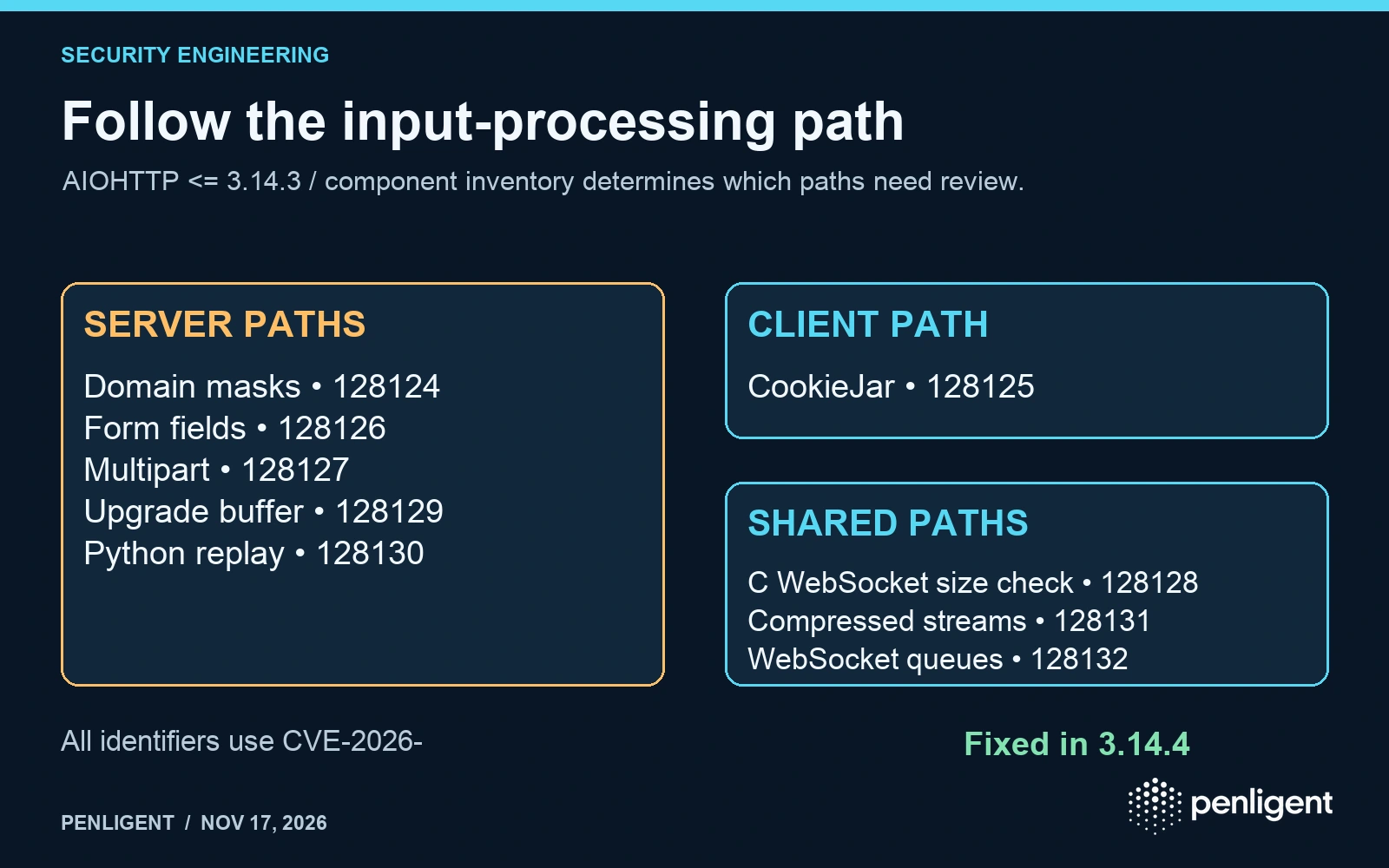
AIOHTTP 3.14.4 fixes a group of nine vulnerabilities affecting versions through 3.14.3. The issues span server routing, form parsing, multipart input, HTTP upgrades, WebSocket buffering, decompression, and client cookies. A service inventory limited to public web endpoints will miss the client-side paths. The official 3.14.4 release and the individual maintainer advisories provide the affected-version and fix information.
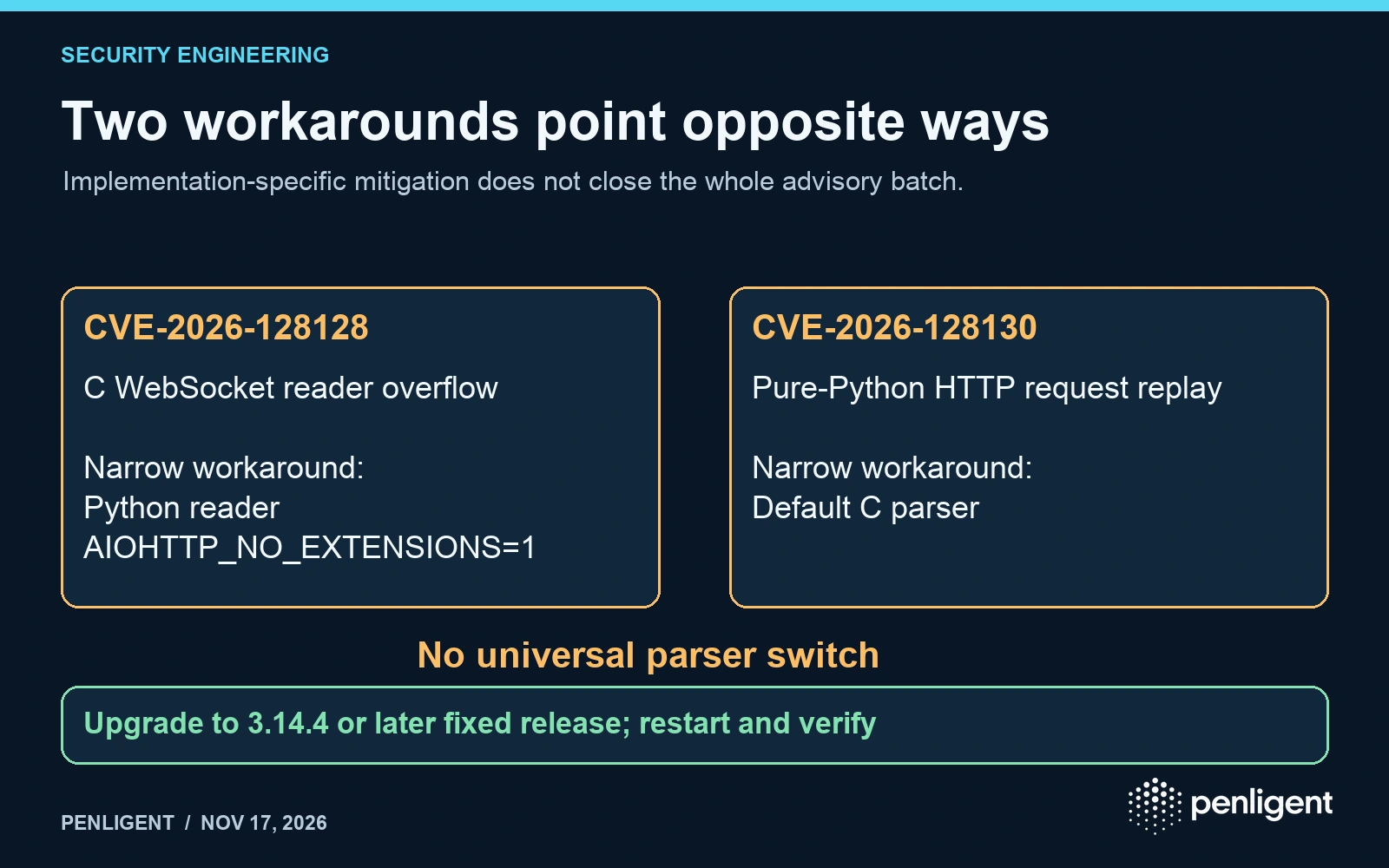
The immediate action is to move affected runtime environments to 3.14.4 or a later supported release containing these fixes. Before treating a temporary workaround as sufficient, identify the actual reader or parser in use. The workaround for CVE-2026-128128 selects the Python WebSocket reader; CVE-2026-128130 affects the pure-Python HTTP parser and advises switching back to the C parser. These are separate defects with opposing implementation-specific mitigations, documented in the WebSocket advisory 및 request-replay advisory.
Use the application path to prioritize the nine CVEs
Every row below lists affected versions as <= 3.14.3 and the first patched version as 3.14.4 in its linked advisory. The third column translates the disclosed mechanism into an inventory question; it is a defensive assessment aid, not proof that an application is exploitable.
| CVE | Disclosed behavior | Where to inspect |
|---|---|---|
| CVE-2026-128124 | Multiple wildcards in an add_domain() host mask can cause polynomial-time matching and stall the event loop. | Server domain masks containing more than one *. |
| CVE-2026-128125 | Cookie parsing and unbounded CookieJar storage can consume excessive resources and create oversized outgoing headers. | Clients that accept cookies from remote servers, including redirects. |
| CVE-2026-128126 | Many repeated URL-encoded fields can produce quadratic work within the default body-size limit. | Handlers calling Request.post(). |
| CVE-2026-128127 | Base64 multipart handling can read excessive data before size checks or spin on the event loop. | Handlers reading multipart data. |
| CVE-2026-128128 | Integer overflow in the C WebSocket reader can bypass max_msg_size. | WebSocket connections using the C reader. |
| CVE-2026-128129 | Data arriving while an upgrade request is handled can be buffered without a bound. | Handlers that do not immediately accept or reject an upgrade. |
| CVE-2026-128130 | After a declined upgrade, the pure-Python parser can replay pipelined requests and grow its buffer. | Pure-Python HTTP parsing with upgrade rejection and pipelining. |
| CVE-2026-128131 | Concatenated compressed members cause quadratic decompression work. | Server request bodies, WebSocket messages, and clients receiving compressed data. |
| CVE-2026-128132 | Small or compressed WebSocket messages can bypass receive-queue limits and consume excessive memory. | Client and server WebSocket consumers, particularly slow consumers. |
This matrix separates exposure questions that a package scanner cannot answer. A client-only crawler may have no Request.post() handler, yet still process untrusted cookies and compressed responses. A server may avoid multi-wildcard routing while retaining multipart or WebSocket exposure. Those are deductions from the documented component boundaries; absence of one path should not close the entire package finding.
Why a body-size limit does not close this batch
Several advisories describe resource consumption that a byte cap measures poorly. In CVE-2026-128126, repeated form fields fit within the default client_max_size but take quadratic time to insert into a MultiDict. CVE-2026-128131 can spend CPU on compressed members that produce no output, so output backpressure and the decoded size limit do not bound the work. In CVE-2026-128127, excessive data can be consumed inside the multipart reader before the size check takes effect. The form-field, decompression및 multipart advisories each describe that distinction.
The engineering implication is to track at least three separate budgets: input bytes, object or member counts, and work performed on the event loop. A reverse-proxy body cap can still reduce exposure, but it does not establish that these internal operations are bounded. Review proxy controls as compensating controls with a documented scope, and retain the package upgrade as the closure action for this batch.
The parser workaround conflict deserves its own change review
For CVE-2026-128128, the maintainer advisory states that the Python reader is unaffected by the particular C-extension arithmetic overflow and lists AIOHTTP_NO_EXTENSIONS=1 as a workaround. That is a narrow statement about one WebSocket size check.
For CVE-2026-128130, the maintainer advisory identifies the pure-Python parser as affected and lists the default C parser as the workaround. The condition involves a full pipelined-request queue and a declined upgrade. Changing the extension setting across an old deployment can therefore change which of these documented paths is present.
The safer decision rule is explicit: use implementation switching only as a time-limited, path-specific mitigation supported by a verified inventory. Record which CVE it addresses and which other paths remain. Upgrade and restart the runtime instead of marking all nine records resolved after one environment-variable change.
The request-replay patch changes the ownership of buffered bytes
그리고 CVE-2026-128130 patch provides a concrete way to reason about the error. When the request queue reaches its cap, the pure-Python parser stores the unparsed remainder in its internal tail. The fix clears the returned data at that point, so the same bytes are not simultaneously retained by the parser and handed back to the caller for later refeeding. The patch also applies queue-pause handling after processing buffered messages.
That change explains why availability monitoring alone is an incomplete acceptance test for this CVE. The disclosed impact includes the application processing a pipelined request more than once. In a controlled staging test, give each harmless request a unique identifier and compare accepted request IDs with handler invocations. Use the upstream regression test as the behavioral specification: requests behind a declined upgrade must each be served once. This is a proposed validation method derived from the patch; no production replay test is required or claimed.
Verify the installed environment and the restarted workload
Use the interpreter belonging to each actual application environment to collect a minimal inventory. The following command imports the installed package and prints metadata; it sends no requests and changes no files:
python - <<'PY'
import os
import sys
import aiohttp
from importlib.metadata import version

print("python:", sys.executable)
print("aiohttp:", version("aiohttp"))
print("package:", aiohttp.__file__)
print("AIOHTTP_NO_EXTENSIONS:", os.getenv("AIOHTTP_NO_EXTENSIONS", "<unset>"))
PY
Run it in the relevant container, virtual environment, worker image, or scheduled job environment. Its output describes that invocation. It does not prove that an already-running process has reloaded the updated package, and an unset extension variable does not by itself prove that a compiled reader is installed. Record the deployment artifact, process restart, and startup configuration alongside the package evidence.
A useful closure record has four parts:
- Runtime inventory: every server, outbound HTTP client, WebSocket client, background worker, and job using the affected dependency is accounted for.
- Patch evidence: the deployed artifact contains 3.14.4 or a later supported fixed release. If a distribution backports fixes, use its explicit security advisory and package revision rather than assuming that an older upstream version string is unpatched or fixed.
- Behavioral evidence: ordinary routing, form uploads, multipart uploads, redirects, cookies, and WebSocket handling still work for the paths the application actually uses. Where appropriate, run bounded upstream regression tests in isolation.
- Operational evidence: restarted workloads use the intended artifact; event-loop latency, memory growth, request counts, and failed handshakes remain consistent with the application’s baseline during controlled testing.
These are proposed acceptance criteria, not claims of a completed test. They make the fix observable without sending resource-exhaustion traffic to a production service.
The official Penligent 3.0 video below demonstrates a general product workflow. It is not evidence that these AIOHTTP CVEs were exploited or that a particular deployment has been remediated.
Keep publication dates separate from patch status
The upstream request-replay advisory was published on November 8, 2026; its global GitHub CVE record was published on November 16. The nine global records in this assessment all identify 3.14.4 as the first fixed version. The November 17 task is to reconcile those records with installed workloads and available patches, rather than infer that each issue or fix originated today.
Methodology: This article was prepared with AI assistance and verified against the AIOHTTP maintainer advisories, the 3.14.4 release notes, and the request-replay patch as of November 17, 2026. The exposure matrix and acceptance criteria are source-based analysis. No exploit reproduction, benchmark, or observed in-the-wild campaign is claimed.
 Korean
 English
 German
 French
 Spanish
 Portuguese
 Japanese
 Hindi
 Arabic
 Turkish
 Hebrew