
What CVE-2026-20805 Is—and What Microsoft Actually Said
CVE-2026-20805 is an information disclosure vulnerability in Windows Desktop Window Manager (DWM). The NVD description is explicit: it’s an exposure of sensitive information to an unauthorized actor in DWM that allows an authorized attacker to disclose information locally. (NVD)
NVD also provides the most decision-useful detail for prioritization: the CVSS v3.1 vector 는 AV:L/AC:L/PR:L/UI:N/S:U/C:H/I:N/A:N, which translates to:
- Local attacker (AV:L)
- Low complexity (AC:L)
- Low privileges required (PR:L)
- No user interaction (UI:N)
- High confidentiality impact (C:H), but no integrity/availability impact
That’s why it lands at a 5.5 (Medium) in CVSS—yet still deserves “patch like it’s real,” because the “C:H” bit is the entire story for exploit chaining. (NVD)
Multiple independent Patch Tuesday analyses confirm the key leaked artifact: exploitation leads to disclosure of an ALPC port section address, a section of user-mode memory used for coordination between Windows components. (Rapid7)
And unlike the average “memory leak” you triage and move on from, this one is not theoretical—it was flagged as exploited in the wild in January 2026 patch coverage and was treated as the standout item in that release. (Rapid7)
Why DWM Is a Prime Target
If you want one sentence that captures why DWM shows up in real-world exploitation: DWM is ubiquitous and privileged.
DWM is responsible for compositing what you see on screen; practically every desktop session depends on it. Rapid7 notes that this makes DWM “an enticing combination of privileged access and universal availability.” (Rapid7)
That combination matters because modern exploit development is less about finding a single magical RCE and more about assembling reliable primitives:
- an initial foothold (often low-priv local code execution, or malware already running as a user),
- a memory disclosure to break uncertainty (addresses, pointers, layout),
- then a second bug (EoP/RCE) that becomes stable once the memory uncertainty is removed.
CVE-2026-20805 fits the second step perfectly.
The Leak: “A Section Address From a Remote ALPC Port” in Plain English
The recurring phrase across Microsoft’s own advisory quotations and third-party reviews is very specific: “a section address from a remote ALPC port” and it’s user-mode memory. (해커 뉴스)
Here’s what that implies in practical security terms:
- ALPC (Advanced Local Procedure Call) is Windows’ high-performance IPC mechanism used heavily by system components.
- A “section address” is, effectively, a memory mapping address tied to a shared section used for message passing or coordination.
- When a process can learn a valid address inside a high-value target process (or in a predictable mapping involved in privileged interactions), it can shrink the search space needed to locate gadgets, objects, or structure layouts.
Even if the leaked value is “just” user-mode, it can still undermine assumptions that make exploitation brittle—especially where attackers are trying to defeat Address Space Layout Randomization (ASLR).
Rapid7’s Patch Tuesday write-up is unusually direct: the disclosed address likely gives an attacker a starting point to find in-memory addresses and sidestep ASLR, making a stable follow-on exploit far more achievable. (Rapid7)
Zero Day Initiative makes the same point from a different angle: it’s unusual to see an info disclosure exploited in the wild, and the obvious reason is that threat actors can use the leaked address in a next stage—turning unreliable exploitation into practical exploitation. (Zero Day Initiative)
“Medium” CVSS, “Important” Reality: Why Scores Understate Memory Leaks
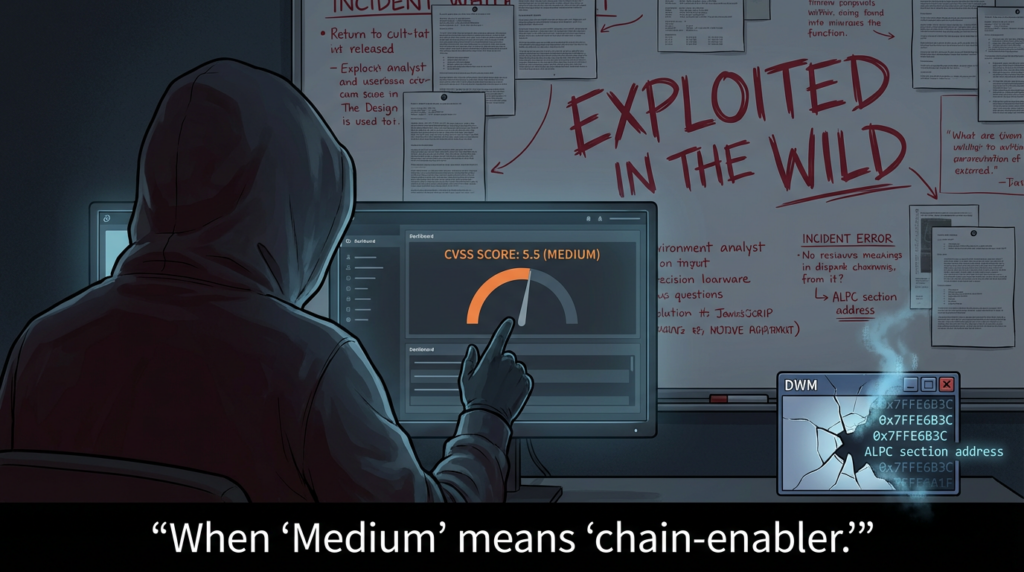
Security teams that rely on CVSS alone tend to underreact to exactly this class of vulnerability. Rapid7 explicitly calls out the mismatch: CVSS 5.5 wouldn’t normally scream “patch me first,” but Microsoft rates it “Important,” and information disclosure vulnerabilities often land with lower CVSS because they don’t directly hit integrity/availability—despite being critical for exploit chains. (Rapid7)
This is the mental model shift that matters:
- CVSS captures standalone impact.
- Attackers capture composability.
CVE-2026-20805 is composability in CVE form.
How CVE-2026-20805 Gets Used in Real Attack Chains
Public reporting does not provide detailed exploitation telemetry—who, where, exactly how it was first used—so you should treat any attribution claims as noise unless they come from a primary incident report. The reliable and repeated public detail is the primitive: leaking an ALPC section address in user-mode memory. (해커 뉴스)
With that constraint, here’s the defender-accurate way to think about how it’s typically used:
Stage 0: The attacker already has local execution
This can be:
- malware running as a normal user,
- a low-privilege foothold on a shared workstation,
- a “living off the land” step after phishing,
- or a post-exploitation step after a browser or document exploit.
The key is: CVE-2026-20805 is local (AV:L). (NVD)
Stage 1: Leak → reduce ASLR uncertainty
ASLR turns many memory corruption bugs into “crash-only” events unless you can predict or discover addresses. A reliable memory disclosure changes that equation.
Rapid7 explicitly links the leak to improving the chance of a stable DWM privilege escalation exploit rather than a “flakey blue screen of death generator.” (Rapid7)
Stage 2: Pair with an EoP or RCE to get something meaningful
The ZDI review describes the likely next step: the leaked address is used in the next stage of the chain—probably gaining arbitrary code execution—and stresses that memory leaks can be as important as code execution because they make RCE reliable. (Zero Day Initiative)
This doesn’t mean CVE-2026-20805 alone gives SYSTEM. It means it can make the difference between:
- “we have a bug but can’t exploit it reliably,” and
- “we can exploit it on demand.”
That delta is exactly what defenders should prioritize.
Who Should Patch First: A Practical Prioritization Strategy
If you’re deciding patch order under time pressure, the right question is not “what’s the CVSS?” but “where does a local leak become a chain multiplier?”
Highest priority environments
- VDI / shared desktop fleets Multi-user density increases the probability of local footholds and lateral movement.
- Developer workstations They’re high-value and often run tooling that expands attack surface; they also hold credentials, tokens, and signing material.
- Jump boxes / admin workstations If an attacker lands as a low-priv user here, chain amplification becomes existential.
- Endpoints with frequent untrusted content execution Heavy browser use, office docs, download-heavy roles, contractor machines.
Lower priority
- Kiosk-like devices with strict application allowlisting and minimal user-driven execution paths (still patch, but your risk model may differ).
What You Can Do Today: Patch, Verify, Detect, and Hunt
1) Patch management: treat it as a chain enabler
CVE-2026-20805 is part of January 2026 Patch Tuesday coverage discussed across multiple vendor analyses. (해커 뉴스)
액션: ensure January 2026 Windows security updates are applied across supported versions. Use your normal WSUS/Intune/SCCM pipeline, but do not let “Medium” de-prioritize it if you operate high-risk endpoints.
2) Verification: prove the patch landed (don’t assume)
Below are example checks you can adapt. These do not exploit anything—they are meant to confirm update state and reduce “false patched” risk.
# Check recent installed updates (hotfixes)
Get-HotFix | Sort-Object InstalledOn -Descending | Select-Object -First 20

# Check OS build info (useful for baseline / compliance reporting)
Get-ComputerInfo | Select-Object WindowsProductName, WindowsVersion, OsBuildNumber

# If you manage via Windows Update history:
Get-WindowsUpdateLog
In enterprise environments, the real goal is to map “patched” to device identity:
- Device is in scope (Windows endpoints where DWM runs in the user session).
- Device received January 2026 security update package(s).
- Device rebooted if required (many orgs forget this step in compliance math).
3) Detection: what signals can exist for a DWM-focused local chain?
No public source gives a single canonical detection query for CVE-2026-20805 exploitation, because the exploitation specifics are not published. (해커 뉴스)
So detection should focus on behavioral edges that commonly appear in local exploit chains:
- Unusual process interactions with session-level privileged components
- Abnormal child process trees originating from user context that then pivot into privilege boundaries
- Credential access / token theft behaviors soon after suspicious local activity (because memory leak primitives often support follow-on credential theft or stable EoP)
A pragmatic approach:
- Hunt for recent local privilege escalation sequences on endpoints that had suspicious initial access.
- Correlate with the timeline of January 2026 patch application gaps.
- For unmanaged endpoints or BYOD, prioritize telemetry collection.
4) Hardening: reduce the chance that “local” becomes “catastrophic”
Even though CVE-2026-20805 is local, you can reduce chain viability:
- Least privilege on endpoints: eliminate local admin for daily users.
- Credential isolation: enforce LSASS protections / credential guard where feasible.
- Application control: WDAC/AppLocker on high-value systems.
- Attack surface reduction: reduce ability to run arbitrary binaries/scripts.
This is not generic advice for padding—this is specifically about ensuring that “local foothold” is harder to obtain, because local-only primitives are only useful once execution is achieved.
The January 2026 Context: Related CVEs You Should Understand Together
CVE-2026-20805 stood out in January 2026 coverage because it was exploited in the wild, but it wasn’t the only patch that month worth a defender’s attention. (해커 뉴스)
Here’s a table you can paste into an internal advisory to help teams triage related risk in a chain-aware way.
| CVE | 구성 요소 | 유형 | Why it matters in practice | 출처 |
|---|---|---|---|---|
| CVE-2026-20805 | Desktop Window Manager (DWM) | Info disclosure | Leaks ALPC port section address (user-mode memory). Chain multiplier for ASLR bypass & exploit reliability. Actively exploited. | NVD / Rapid7 / ZDI / Qualys (NVD) |
| CVE-2026-21265 | Secure Boot certificate expiration / Secure Boot | Security feature bypass | Secure Boot bypass risk; boot-chain trust is foundational. Often high priority in org baselines. | ZDI / Qualys / Tom’s Guide (Zero Day Initiative) |
| CVE-2023-31096 | Agere soft modem driver | 권한 수준 향상 | Legacy driver risk; “living off the land” device driver surface can remain for decades. | Rapid7 / ZDI / Qualys (Rapid7) |
| CVE-2024-30051 | DWM (historical reference) | 권한 에스컬레이션 | Example of DWM as a recurring exploited surface; useful for explaining “why DWM again.” | The Hacker News (해커 뉴스) |
How to Write a Real Patch Exception Policy for “Local-Only” Exploited Bugs
A common failure mode in enterprise patch programs is the “local-only discount”:
“It’s local, so it’s lower priority.”
CVE-2026-20805 is the counterexample. Rapid7 explicitly notes Microsoft info disclosure bugs rarely get marked exploited; those that do are likely part of longer exploit chains. (Rapid7)
A defensible exception policy should require at least:
- Evidence that the endpoint class has no credible local execution path (rare in real life).
- Strong compensating controls (application allowlisting + no script execution + strict EDR coverage).
- A time-bounded exception with a defined remediation window.
참조
- NIST NVD — CVE-2026-20805: https://nvd.nist.gov/vuln/detail/CVE-2026-20805
- CVE.org record — CVE-2026-20805: https://www.cve.org/CVERecord?id=CVE-2026-20805
- Microsoft Security Update Guide (MSRC) — CVE-2026-20805: https://msrc.microsoft.com/update-guide/en-US/vulnerability/CVE-2026-20805
- Rapid7 Patch Tuesday (Jan 2026): https://www.rapid7.com/blog/post/em-patch-tuesday-january-2026/
- Zero Day Initiative (ZDI) Jan 2026 review: https://www.thezdi.com/blog/2026/1/13/the-january-2026-security-update-review
- Qualys Patch Tuesday Jan 2026 review: https://blog.qualys.com/vulnerabilities-threat-research/2026/01/13/microsoft-patch-tuesday-january-2026-security-update-review
- The Hacker News coverage (Jan 2026 Patch Tuesday): https://thehackernews.com/2026/01/microsoft-fixes-114-windows-flaws-in.html
- SentinelOne vulnerability database entry: https://www.sentinelone.com/vulnerability-database/cve-2026-20805/
- CISA Known Exploited Vulnerabilities (KEV) catalog (search/filterable): https://www.cisa.gov/known-exploited-vulnerabilities-catalog
- CVE-2026-20805 PoC Analysis (DWM info disclosure / ASLR context): https://www.penligent.ai/hackinglabs/cve-2026-20805-poc-analysis-dwm-information-disclosure-as-the-key-to-bypassing-aslr/
- CVE-2026-20805 Dissected (Penligent HackingLabs): https://www.penligent.ai/hackinglabs/cve-2026-20805-dissected-the-memory-jack-rce-in-ai-agent-frameworks/
- CVE-2026-20965 (identity perimeter / hybrid cloud trust): https://www.penligent.ai/hackinglabs/the-identity-perimeter-collapse-technical-analysis-of-cve-2026-20965-and-azure-token-mixing/
- CVE-2026-21440 exploit analysis (framework/file write → RCE reasoning style): https://www.penligent.ai/hackinglabs/technical-deep-dive-exploit-analysis-of-cve-2026-21440-for-ai-security-engineers/
 Korean
  English
  German
  French
  Spanish
  Portuguese
  Japanese
  Hindi
Hindi  Arabic
  Turkish
  Hebrew