
CVE-2026-53264 is a Linux kernel use-after-free in the traffic-control action lifecycle. The vulnerable path sits in net/sched, where concurrent filter creation and deletion can leave one CPU holding a pointer to a tc_action object after another CPU has removed and immediately freed that object. The kernel.org CNA rates the issue 7.8 High with a local attack vector, low privileges required, no user interaction, and high potential impact to confidentiality, integrity, and availability. NVD identifies the weakness as CWE-416, Use After Free. (NVD)
The word local matters. CVE-2026-53264 is not an unauthenticated packet that an attacker can send to an exposed Linux server from the internet. A realistic attacker normally needs an existing foothold that can execute code on the host, plus a configuration path that makes the relevant traffic-control objects reachable. Public research has shown a local privilege-escalation path on a specific CentOS Stream 9 environment, but that does not make the published exploit universal across distributions, kernel builds, hardening profiles, or allocator layouts. (STAR Labs)
The issue still deserves serious attention. “Local” is not a synonym for “low consequence” on a Kubernetes worker, multi-tenant CI runner, shared shell server, developer workstation, browser host, or any Linux system that regularly executes code outside a single trusted administrative boundary. On those machines, the kernel is the final isolation layer. A low-privileged process that reaches root can cross container, user, service, and data boundaries that the rest of the operating system assumes the kernel will enforce.
The correct response is not to download a public root exploit and run it against production. The correct response is to determine whether the running kernel contains the vulnerable code, whether the vendor has shipped a backport, whether the host exposes the necessary local attack surface, and whether the fixed kernel is actually running after remediation. This distinction between package state, runtime state, and exploitability is central to safe validation.
The Facts That Matter First
| 필드 | Defensible conclusion |
|---|---|
| CVE | CVE-2026-53264 |
| 구성 요소 | Linux kernel networking scheduler, primarily net/sched/act_api.c 및 tc_action lifecycle |
| Bug class | Race condition leading to use-after-free, CWE-416 |
| Trigger described by the fix | Concurrent NEWTFILTER 그리고 DELFILTER operations involving an associated traffic-control action |
| CNA severity | CVSS 3.1 7.8 High |
| CNA vector | AV:L/AC:L/PR:L/UI:N/S:U/C:H/I:H/A:H |
| Standalone remote exploit | No. The recorded attack vector is local |
| Potential result | Kernel memory corruption and, where exploitation conditions align, local privilege escalation |
| Upstream repair | Remove the object from the IDR, then defer final freeing through RCU so existing readers can finish safely |
| First operational action | Check the exact distribution advisory and installed package, deploy the fixed kernel, and reboot into it |
| Unsafe validation shortcut | Running public privilege-escalation code on a production or shared host |
The NVD record was updated on July 29, 2026, after CISA’s additional enrichment. Its SSVC data characterizes exploitation as public proof of concept, automatable as no, and technical impact as total. Those labels are useful but easy to misread. “PoC” means exploit evidence is publicly available; it does not itself prove broad exploitation in the wild. “Automatable: no” means the end-to-end exploitation path is not assessed as reliably scalable without meaningful target-specific work. “Technical impact: total” reflects the consequence if the vulnerability is successfully converted into privileged kernel compromise. (NVD)
NVD displays the 7.8 score supplied by kernel.org, while NVD’s own CVSS assessment remains unassigned on the current page. That distinction matters when security dashboards say “NVD score” even though the displayed value came from the CNA. SUSE, for example, currently scores the issue lower in its own context, illustrating that vendors may apply different environmental assumptions or impact judgments. A scoring difference is not necessarily a disagreement about the existence of the race; it may reflect a different view of reachable impact across supported products. (NVD)
What CVE-2026-53264 Actually Is
Linux traffic control is a framework for classifying, shaping, scheduling, policing, redirecting, and modifying network traffic. The tc command is the familiar user-space interface, but the security-relevant work occurs inside the kernel. A queueing discipline, or qdisc, attaches to an interface. Filters select traffic. Classifiers such as flower decide whether packets match. Actions define what happens to matching packets, such as dropping, accepting, redirecting, mirroring, policing, or performing another supported operation.
The generic traffic-control action layer lets filters refer to action objects by index. Internally, an IDR provides integer-keyed lookup. A tc_action object also has reference state so multiple users can share it without freeing it while another path still depends on it. Locks protect updates to the indexed structure. RCU protects readers that may traverse an object while writers change visibility. Those mechanisms solve different parts of the lifetime problem; none is interchangeable with the others.
The vulnerable sequence appears when a filter-add path and a filter-delete path run concurrently. The official description uses NEWTFILTER 그리고 DELFILTER, corresponding to rtnetlink operations that create or update a filter and delete a filter. One CPU can find an action pointer under RCU protection, then release the IDR mutex before it has successfully acquired its own reference. A second CPU can reduce the object’s reference count to zero, remove it from the IDR, and free it immediately. The first CPU then executes refcount_inc_not_zero against memory that no longer belongs to a live tc_action. (NVD)
This is a classic gap between logical removal 그리고 physical reclamation. Removing an object from a lookup structure prevents new readers from finding it. It does not prove that readers which found it a moment earlier have stopped using the memory. If the writer immediately calls kfree, a pre-existing reader can still hold a stale address. RCU exists to make this distinction explicit: make the object unreachable first, wait for readers that may hold the old pointer to pass through a grace period, then reclaim the memory.
The original upstream fix is small in line count but significant in meaning. It adds an RCU field to tc_action and changes the destruction path so final freeing is deferred. The commit describes the change as a modernized restoration of the lifetime behavior removed by the older net_sched: get rid of tcfa_rcu change. The fix does not add a new authorization rule and does not parse the netlink request differently. It repairs the object-lifetime contract. (NVD)
How Traffic-Control Objects Reach the Vulnerable Path
A useful mental model starts with five layers:
| 레이어 | 역할 | Security significance |
|---|---|---|
| Network interface and qdisc | Establish the traffic-control attachment point | Determines where ingress or egress policy can be installed |
| Chain and filter | Organize rules and filter lifecycle | Concurrent add and delete operations drive the vulnerable sequence |
| Classifier | Matches packet metadata | Public research used a classifier path that did not serialize the competing operations under one global lock |
| 액션 | Performs an operation on matched traffic | The raced tc_action object lives here |
| IDR, refcount, lock, and RCU | Track lookup, ownership, mutation, and reader lifetime | The flaw occurs because memory reclamation did not respect an existing RCU reader |
A common misconception is that an attacker must already possess unrestricted host-level CAP_NET_ADMIN. Direct traffic-control administration in the initial network namespace does require substantial networking privilege, but Linux namespaces complicate the boundary. An unprivileged process may be allowed to create a new user namespace and, from there, a new network namespace. Capabilities granted inside that user namespace can authorize operations on resources owned by the associated namespace even though the process remains unprivileged in the initial user namespace. Linux’s namespace documentation and capability model explicitly distinguish namespace-scoped privilege from privilege over the host’s initial namespaces. (man7.org)
That does not mean every container or every user can reach the bug. Several gates can block the path: the administrator may disable unprivileged user namespaces; a container runtime may forbid creation of additional namespaces; seccomp may block relevant syscalls; the required classifier or action may be absent; the host kernel may not include the necessary configuration; a vendor may have backported the patch; or the workload may simply lack a way to execute an effective race.
Public research identified a path using a private networking environment, a clsact qdisc, the flower classifier, and a generic action. The researchers noted dependencies including CONFIG_NET_CLS_FLOWER, CONFIG_NET_ACT_GACT, and permission to create unprivileged user namespaces. Those are conditions from the disclosed exploit path, not an official claim that no other path could ever exist. Conversely, the presence of those configuration symbols does not prove exploitability. It only means some required building blocks may be available. (STAR Labs)
The safest wording is therefore conditional: a vulnerable kernel plus local code execution plus reachable namespace and traffic-control functionality creates exposure to the bug class. Turning that exposure into reliable root access requires more work, including winning the race, reclaiming the freed allocation in a useful way, and adapting control-flow techniques to the exact kernel build and hardening state.
The Race, Step by Step
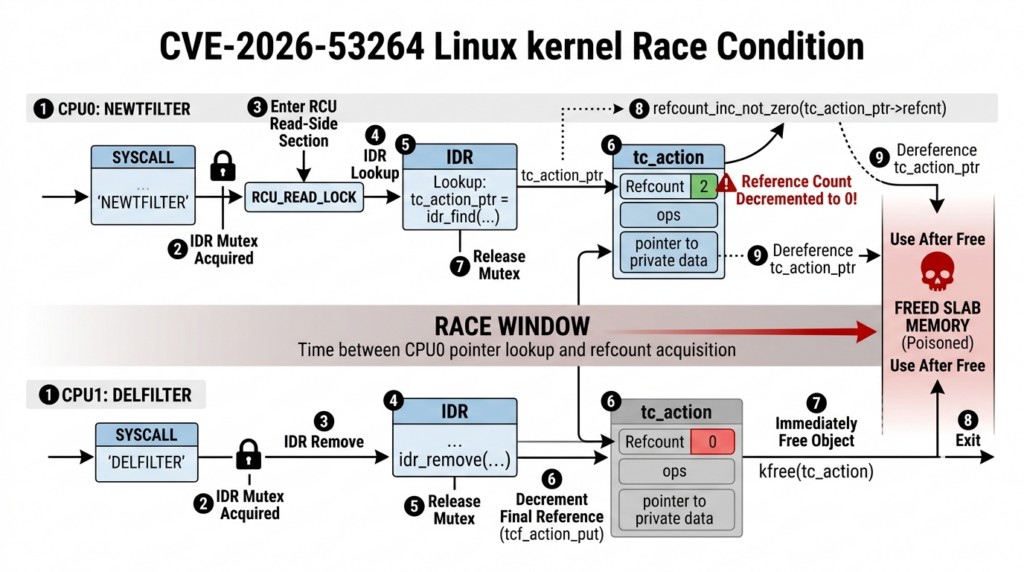
The official description is unusually valuable because it presents the interleaving directly. Rewriting it as a lifecycle timeline makes the failure easier to reason about:
| 단계 | CPU0, filter creation | CPU1, filter deletion | Object state |
|---|---|---|---|
| 1 | Acquires the IDR mutex and enters an RCU read-side section | - | Action is indexed and live |
| 2 | Calls idr_find and obtains pointer p | - | CPU0 can see p |
| 3 | Releases the IDR mutex before taking a reference | - | CPU0 still holds the address, but no new reference has been secured |
| 4 | - | Decrements the reference count from one to zero while acquiring the mutex | Object is entering final teardown |
| 5 | - | Removes the action from the IDR | New lookups should no longer find it |
| 6 | - | Releases the mutex, cleans up the action, and immediately calls kfree | Memory backing p is reclaimed |
| 7 | Calls refcount_inc_not_zero through stale pointer p | - | Use-after-free occurs |
The key mistake occurs between steps three and seven. CPU0 has completed a lookup, but its future access is not yet protected by an owned reference. CPU1 correctly makes the object unreachable to new IDR lookups and correctly observes a zero reference count, but it treats those facts as permission to reclaim the allocation immediately. That conclusion ignores the RCU reader that can still hold the old pointer.
It is tempting to ask why refcount_inc_not_zero does not solve the problem. That helper prevents resurrection of an object whose live reference count has already reached zero. It can return false when the object remains allocated and the counter is legitimately zero. It cannot make a freed allocation valid. The CPU must read and update the counter’s memory to perform the check. Once kfree has released the tc_action, even looking at the counter is an access through a dangling pointer.
This distinction is important in code review. A refcount operation can be locally correct yet globally unsafe if the code has no lifetime guarantee covering the interval between pointer lookup and reference acquisition. Kernel concurrency reviews therefore ask two separate questions:
- Is the reference count transition correct for a live object?
- What guarantees that the object remains live until the transition is attempted?
CVE-2026-53264 fails the second question. The reader’s RCU section protects access only if the writer follows the corresponding RCU reclamation rule. A writer that removes the object and immediately frees it breaks the promise that makes lockless or partially locked reads safe.
The result observed during testing may vary. A kernel built with KASAN can report a use-after-free close to the invalid access. A production kernel without a memory sanitizer may continue, crash later, corrupt unrelated state, or appear unaffected in a particular run. Race conditions are sensitive to scheduling, CPU count, allocator state, interrupts, and background activity. A failed reproduction is not strong evidence of safety, especially when the code and package provenance show that the fix is absent.
The reverse is also true. A KASAN report demonstrates a real memory-safety violation, but it does not automatically prove a reliable privilege-escalation primitive on every supported distribution. Exploitability requires controlled reuse and a path from memory corruption to a security-relevant outcome. Defenders should not collapse “bug reproduced,” “root exploit demonstrated,” “portable exploit available,” and “active exploitation observed” into one status.
Why RCU Is the Right Repair
Read-copy update is designed for structures where readers need inexpensive access while writers occasionally remove or replace objects. The central rule is simple in concept: a writer may stop publishing an object immediately, but it must delay destruction until all readers that could have seen the old pointer have completed. Linux documentation describes this as separating removal from reclamation and waiting through an RCU grace period before freeing the retired object. (Linux Kernel Archives)
For CVE-2026-53264, the repaired lifecycle becomes:
- CPU1 decrements the final reference and acquires the update lock.
- CPU1 removes the action from the IDR, so new lookups cannot discover it.
- CPU1 schedules deferred freeing through RCU rather than immediately reclaiming the allocation.
- CPU0 either performs a lookup after removal and receives no object, or it still holds a pointer obtained before removal.
- If CPU0 holds the old pointer, the memory remains valid while that RCU read-side critical section is active.
- The reference increment fails because the reference count is already zero, but it fails against allocated memory rather than freed memory.
- After the grace period confirms that pre-existing readers have exited, the callback performs final cleanup and freeing.
The official patch adds struct rcu_head to the action structure and introduces the deferred-free path. The NVD description notes both call_rcu and the simplified kfree_rcu approach used in the modernized implementation. The upstream commit changes only the action API header and implementation, but the behavioral change is a full lifetime guarantee: stale readers can no longer race with immediate reclamation. (NVD)
| Property | Vulnerable lifecycle | Fixed lifecycle |
|---|---|---|
| Object removed from IDR | 예 | 예 |
| New readers can find object after removal | 아니요 | 아니요 |
| Pre-existing reader may still hold pointer | 예 | 예 |
| Final reference can reach zero | 예 | 예 |
| Memory freed immediately after removal | 예 | 아니요 |
| Memory survives existing RCU readers | Not guaranteed | 예 |
refcount_inc_not_zero on stale pointer | Can touch freed memory | Can safely fail while memory remains allocated |
| Security result | UAF possible | Reclamation waits until reader lifetime ends |
This fix also shows why patch size is a poor measure of vulnerability seriousness. Concurrency defects often hinge on one missing ordering or lifetime primitive. A small diff can restore a deep invariant, while a large refactor can leave the same invariant broken. The correct review question is not “How many lines changed?” It is “Does every path that publishes, removes, references, and frees the object now obey the same ownership model?”
RCU does not make the object usable forever. After the grace period, it will be freed. Nor does RCU replace the reference counter. The refcount still determines whether a new long-lived owner can retain the object. RCU protects the short interval in which a reader has observed a pointer but has not yet established that ownership. The two mechanisms compose: RCU keeps the memory alive long enough to inspect the refcount safely, and the refcount decides whether the reader may continue beyond the RCU-protected lookup.
Affected Kernels and the Danger of Version-Only Triage
The kernel CNA traces the affected lineage to commit d7fb60b9cafb, which removed the earlier tcfa_rcu mechanism. NVD’s current affected configurations extend back to the 4.14 line and cover multiple later stable series until the corresponding fixed release. The upstream stable fixes are represented by separate backport commits because each maintained branch may need a patch adapted to its code state. (NVD)
The first fixed upstream releases recorded for the relevant stable branches are:
| Stable line | First fixed upstream release |
|---|---|
| 5.10.y | 5.10.259 |
| 5.15.y | 5.15.210 |
| 6.1.y | 6.1.176 |
| 6.6.y | 6.6.143 |
| 6.12.y | 6.12.94 |
| 6.18.y | 6.18.36 |
| 7.0.y | 7.0.13 |
| Mainline | Original repair merged for 7.1 development |
These numbers are useful for upstream kernels, but they are not a universal vulnerability scanner. Enterprise distributions routinely backport security fixes while preserving an older-looking kernel release and ABI. A RHEL-derived kernel with a vendor release suffix may contain the fix even though its base version appears lower than an upstream threshold. A custom kernel can also carry only selected commits. Conversely, a host can have a fixed package installed on disk while still running the old vulnerable image because no reboot occurred.
A defensible assessment must therefore answer three questions separately:
| 질문 | Evidence source | 중요한 이유 |
|---|---|---|
| Does the source lineage contain the bug? | Upstream CNA record and fix commits | Establishes the generic affected code history |
| Has this vendor backported the repair? | Distribution CVE page, errata, package changelog, or support notice | Resolves vendor-specific patch status |
| Is the repaired kernel active now? | uname -r, boot records, package inventory, and reboot evidence | Proves runtime remediation rather than package installation alone |
Debian’s tracker illustrates the value of package-specific evidence. At the current snapshot, it records 5.10.259-1 as fixed in the Bullseye security repository, 6.1.176-1 as fixed for Bookworm, 6.12.94-1 as fixed for Trixie, and later fixed packages for Forky and Sid. Those package versions are actionable for Debian systems in a way that a generic CPE range is not. (Debian Security Tracker)
Ubuntu’s CVE page, updated July 21, 2026, rates the issue High and lists status separately across Ubuntu releases and kernel variants. At that snapshot, several main kernel packages remained marked vulnerable or work in progress, while older releases and specialized variants had differing states. The page is a status service, not a permanent table: teams should query it again when making a production decision because package publication can change after an article is written. (우분투)
SUSE’s page provides another useful lesson. It lists product-specific package states and currently applies a lower SUSE score than the kernel.org CNA’s 7.8. That does not justify ignoring the issue. It means the product vendor has made a different severity assessment for its supported context. Security teams should preserve both values in evidence records rather than silently overwriting one with the other: the CNA score describes the vulnerability record, while the vendor rating helps prioritize within that vendor’s product estate. (SUSE)
A simple rule prevents many errors: never declare a distribution kernel vulnerable or fixed from the first three fields of uname -r alone. Use the vendor’s advisory and package release. If the vendor has not published a determination, inspect the source package changelog or confirm whether the branch contains one of the listed fix commits. For custom kernels, compare source directly and retain the commit evidence used for the decision.
Exploitability Is a Chain, Not a Binary Flag
A scanner often wants one answer: vulnerable or not vulnerable. CVE-2026-53264 requires a more disciplined model. The code can be affected while the disclosed exploit path is blocked. The disclosed path can be reachable while reliable exploitation still fails. A compensating control can reduce exposure without repairing the kernel. Each layer should be recorded separately.
| Exploitability gate | What must be true for the disclosed path | What can block it | What a defender should verify |
|---|---|---|---|
| Local execution | Attacker can run code as a non-root user or compromised service account | No local foothold and tightly controlled code execution | Workload trust, shell access, package scripts, web-service compromise paths, CI jobs |
| User namespace creation | Process can create a user namespace or already runs in a suitable namespace hierarchy | Distribution or administrator disables unprivileged user namespaces | Relevant sysctls, LSM policy, runtime policy, actual unshare behavior |
| Network namespace access | Process can create or enter a network namespace it can administer | Namespace creation blocked or container profile restricts it | Runtime configuration and namespace ownership |
| Namespace-scoped network capability | Process gains CAP_NET_ADMIN over the new network namespace | Capability unavailable for the target namespace | Capability sets and ownership relationship, not just host-level capsh 출력 |
| Traffic-control functionality | Required qdisc, classifier, and action code is built or loadable | Feature omitted, module unavailable, module loading restricted | Kernel config, module metadata, loaded state, vendor configuration |
| Concurrent filter operations | Attacker can drive the add and delete paths in a useful interleaving | Serialization in an alternative path, syscall filtering, missing classifier | Code path and test-lab behavior |
| Useful memory reuse | Freed allocation can be reclaimed with attacker-influenced data | Allocator hardening, layout differences, timing instability | Kernel-build-specific research, never a generic assumption |
| Control-flow or data impact | Corruption can be converted into privilege escalation | CFI, build differences, unavailable gadgets, hardening mitigations | Exact kernel image, symbols, hardening, and exploit portability |
| Persistence beyond reboot | Attacker can modify durable state or credentials | Rapid containment and trusted rebuild | Incident-response evidence, not CVE presence alone |
The most important first gate is local code execution. A public web server is not directly reachable through this bug merely because it has an IP address. But if a web application vulnerability yields a shell as www-data, the kernel issue can become a second-stage privilege-escalation candidate. The same applies to malicious dependency scripts, compromised build jobs, hostile notebooks, untrusted plugins, browser renderer compromise, and tenant-controlled workloads.
User namespaces are a frequent pivot because they allow a process to become privileged relative to newly created namespace resources without becoming root in the initial user namespace. The capability is scoped, but the kernel code it exercises is shared. This is why namespace-enabled features have historically expanded the reachable kernel attack surface for unprivileged callers. Disabling unprivileged user namespaces can remove a disclosed path in some environments, but the control has compatibility costs and does not remove the vulnerable code. (man7.org)
Container status is not a simple yes or no either. Containers share the host kernel. A container process might be unable to create user namespaces, might lack CAP_NET_ADMIN, and might be tightly confined by seccomp and an LSM. Another container might run privileged, use host networking, receive broad capabilities, or operate under a runtime configuration that exposes exactly the needed path. The same worker can therefore host workloads with different exploitability gates, while all remain dependent on the same kernel patch state.
Kernel configuration checks also require care. CONFIG_NET_CLS_FLOWER=y means flower is built in. =m means a module exists and may be loaded. A missing symbol in /boot/config-$(uname -r) may mean the feature is absent, or it may mean the running system does not expose the configuration file. A loaded cls_flower module proves the code is present and active, but absence from lsmod does not prove it cannot be loaded later. Configuration evidence should modify exposure confidence, not replace vendor patch evidence.
What Public Exploit Research Establishes
STAR Labs disclosed a detailed technical analysis on July 27, 2026. The researchers describe using AI assistance during bug discovery, KASAN reproducer development, and race refinement, while emphasizing that human judgment remained necessary for exploitation decisions. Their work moves the issue beyond a theoretical race: it shows that, on the environment they studied, the UAF could be converted into local root. (STAR Labs)
At a safe, non-operational level, the demonstrated chain had four conceptual phases:
- Reach traffic-control filter and action management from a low-privileged process through a namespace arrangement.
- Race filter creation and deletion so one execution path retains a pointer while another releases the final reference and frees the action.
- Reuse the freed kernel allocation with data that gives the attacker influence over the stale object’s interpreted fields.
- Adapt a kernel-build-specific control-flow chain to turn that memory corruption into elevated privileges.
The publication contains substantially more detail, including allocator choices, race widening, disclosure-specific offsets, and a privilege-escalation payload. Reproducing those details is unnecessary for defensive validation and creates avoidable risk. A defender needs to understand the prerequisites, the lifetime failure, the fixed versions, and the observable consequences. Production validation does not require a working root shell.
The researchers reported ten successful runs out of ten on their tested CentOS Stream 9 laptop, with completion times ranging from seconds to under two minutes. That is a useful result for the named build and setup, but it is not an independent benchmark and should not be generalized. The exploit used hardcoded information tied to a particular kernel environment. Kernel heap behavior, structure layout, symbol placement, control-flow protections, and available code sequences vary across vendor builds and updates. (STAR Labs)
Four claims should therefore remain separate:
| Claim | What evidence supports it | What it does not establish |
|---|---|---|
| The race exists | Upstream fix and official CVE description | Reliable privilege escalation everywhere |
| The race can cause UAF | KASAN reproduction and code analysis | Stable control over freed memory on every build |
| A root exploit works on a tested environment | Researcher’s disclosed implementation and results | Cross-distribution portability or broad automation |
| Public exploit material exists | Public research and CISA SSVC PoC designation | Confirmed widespread exploitation in the wild |
CISA’s Known Exploited Vulnerabilities catalog should be checked separately during triage because it is intended to identify vulnerabilities with evidence of active exploitation. Public exploit code is an important risk accelerator, but it is not a substitute for that evidence category. Even when a CVE is not known to be exploited, shared execution hosts may still warrant immediate patching because the cost of a successful local kernel escalation is high and the attacker may already have a foothold through another weakness. (CISA)
Safe Validation Without Running a Root Exploit
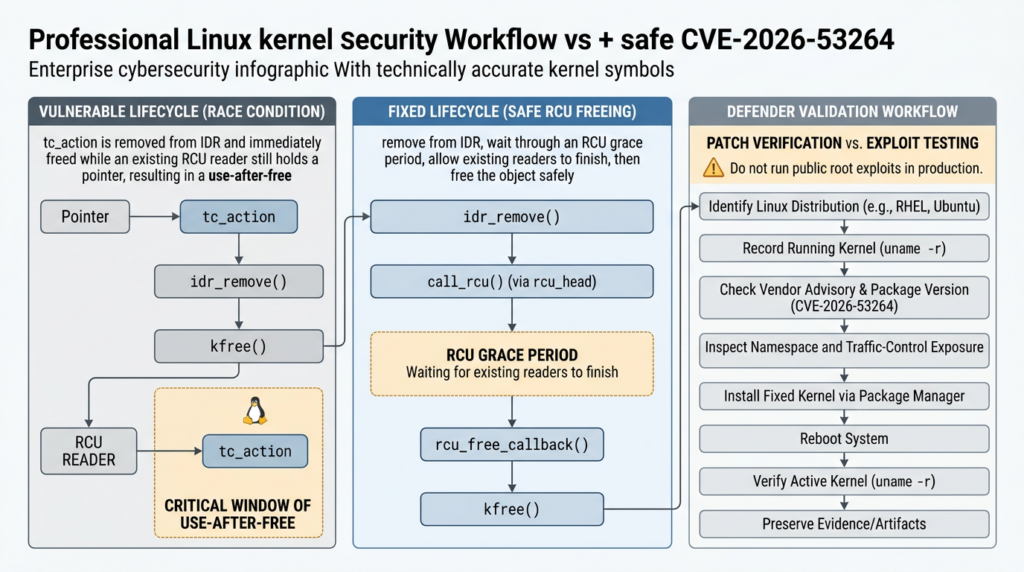
Safe validation answers operational questions with low-risk evidence. It does not attempt to prove that a hostile exploit can obtain root on a production host. For CVE-2026-53264, the strongest non-destructive conclusion normally comes from combining vendor package status, the running kernel, relevant configuration, and the host’s local-code exposure.
A practical workflow has eight stages.
Establish the Asset and Trust Boundary
Record the hostname, asset identifier, owner, business function, distribution, cloud or physical location, and whether the system is a shared kernel boundary. A Kubernetes worker and a single-purpose appliance may run the same kernel package but carry very different urgency. Also record which parties can execute code: only administrators, application service accounts, developers, CI jobs, tenants, customers, browser content, plugins, or arbitrary container images.
The trust question is more useful than asking whether a server is “internet-facing.” CVE-2026-53264 is local, so the relevant exposure is the probability that an attacker can obtain or already has local execution. An internet-facing application with a credible command-execution path can be a high-priority host. An internal server that executes unreviewed build jobs can be equally important.
Capture the Running Kernel Before Changing Anything
사용 uname -r, uname -v, and distribution release data. Keep the output with a timestamp. Do not infer fixed status yet. The running version is an identifier that must be resolved through vendor metadata.
Also capture the boot time or boot ID. This helps prove whether the host restarted after a fixed kernel was installed. On systemd hosts, journalctl --list-boots 그리고 /proc/sys/kernel/random/boot_id provide useful evidence. A package transaction timestamp without a later boot is a common sign that remediation is incomplete.
Resolve Vendor Package Status
For Debian and Ubuntu systems, inspect installed linux-image, linux-headers, and metapackages with dpkg-query 또는 apt-cache policy. For RHEL, Fedora, CentOS Stream, Rocky Linux, AlmaLinux, and related systems, inspect installed kernel packages and vendor errata with RPM and DNF tooling. For SUSE, use the SUSE CVE page and zypper patch metadata. For cloud kernels, consult the cloud vendor’s specific stream rather than assuming the generic distribution package applies.
The evidence hierarchy should be:
- A vendor advisory or tracker explicitly naming CVE-2026-53264 and the affected product stream.
- A vendor erratum that identifies the fixed package.
- A package changelog or source diff containing the relevant backport.
- Direct source comparison with the upstream fix commit when no vendor determination exists.
- Generic upstream version comparison only as a provisional fallback.
A vulnerability scanner that reports solely from CPE ranges may be useful for discovery, but it can produce both false positives and false negatives on backported enterprise kernels. The scanner result should open an investigation, not close it.
Inspect Reachability Conditions
Check whether the running kernel configuration includes traffic-control support, flower classification, the relevant generic action, namespaces, and user namespaces. Examine whether modules are built in, available, or loaded. Record unprivileged user-namespace policy and container-runtime restrictions.
Do not change these settings during evidence collection. Do not load a missing module merely to see whether the system becomes exploitable. The goal is to observe the production state without expanding attack surface.
A benign unshare -Urn true check can test whether the current account can create a private user and network namespace, but even that command should follow local policy. It creates an isolated namespace and exits immediately; it does not configure traffic control. A successful result means one prerequisite may be reachable. A failure may reflect sysctl policy, LSM rules, seccomp, container restrictions, or a lack of kernel support. Neither result determines patch state.
Rate Local Execution Exposure
Assign a qualitative rating backed by facts:
| Exposure rating | Example conditions | Typical response |
|---|---|---|
| Critical boundary | Multi-tenant CI, mixed-trust Kubernetes node, shared shell service, hostile code sandbox | Accelerated patch and controlled reboot |
| 높음 | Developer workstation with sensitive credentials, internet-facing service with credible code-execution paths, build host running third-party scripts | Patch promptly and reduce namespace exposure until reboot |
| 보통 | Single-tenant server with limited service accounts and no routine untrusted code | Standard urgent security maintenance, informed by vendor rating |
| Lower but not zero | Isolated appliance with no user shell and tightly controlled software | Patch within vendor-supported window; verify assumptions and supply-chain paths |
The rating is not a replacement for the CVSS score. It is an environmental overlay. A local High vulnerability can be operationally more urgent than a remote bug on a service that is disabled everywhere.
Install the Vendor Fix and Schedule the Reboot
Use the supported package channel. Do not replace a vendor kernel with an arbitrary upstream build merely to meet a version threshold unless the organization already maintains that model. Kernel packages integrate drivers, signing, live-patching support, bootloader entries, and vendor testing.
Some organizations use live patching. A live-patch service may cover a CVE, but coverage must be verified explicitly for the exact running kernel. Do not assume that an active live-patch agent means every kernel CVE is remediated. If the provider does not list CVE-2026-53264 or the relevant function change, plan a normal kernel update and reboot.
Verify the Post-Reboot Runtime
After reboot, repeat uname -r, package inventory, boot ID, and vendor advisory checks. Confirm that the bootloader did not fall back to an older image. On clustered systems, validate every node rather than sampling one. For immutable or autoscaled infrastructure, verify the image or launch template and replace existing instances; patching a base image alone does not update already running nodes.
Preserve Evidence and Retest Controls
Store the before-and-after records with the advisory link, fixed package, change ticket, asset owner, reboot time, and exception status. If an interim control such as disabling unprivileged user namespaces was applied, decide whether to keep it after patching based on compatibility and broader hardening goals. Do not silently remove a control that other kernel-risk decisions now depend on.
Authorized automation can help normalize this evidence across many hosts, but the automation should collect and compare facts rather than execute a root exploit. In an approved security workflow, 펜리전트 can be used alongside asset inventory and change-management processes to organize validation tasks and evidence; the authoritative determination for a vendor kernel must still come from the vendor advisory, package provenance, and the running post-reboot state.
A Read-Only Evidence Collection Script
The following Bash script is designed for a host you own or are authorized to assess. It gathers local evidence and makes no traffic-control changes. It does not create filters, race kernel objects, load modules, spray allocations, or attempt privilege escalation. It deliberately avoids printing a final “vulnerable” verdict because that decision requires vendor context.
Run it as an ordinary user first. Some package and log queries may return more information under an approved administrative account, but the script does not require root for its core inventory.
#!/usr/bin/env bash
# cve-2026-53264-evidence.sh
# Read-only evidence collection for authorized systems.
# This is not an exploit and does not modify traffic-control state.

set -u

section() {
  printf '\n===== %s =====\n' "$1"
}

section "Timestamp and identity"
date -u +'%Y-%m-%dT%H:%M:%SZ'
printf 'hostname: '
hostname 2>/dev/null || true
printf 'boot_id: '
cat /proc/sys/kernel/random/boot_id 2>/dev/null || true
printf 'uid: '
id 2>/dev/null || true

section "Operating system and running kernel"
cat /etc/os-release 2>/dev/null || true
uname -a 2>/dev/null || true
printf 'kernel_release: '
uname -r 2>/dev/null || true
printf 'kernel_version: '
uname -v 2>/dev/null || true

section "Recent boots"
if command -v journalctl >/dev/null 2>&1; then
  journalctl --list-boots --no-pager 2>/dev/null | tail -n 10 || true
else
  who -b 2>/dev/null || true
fi

section "Installed kernel packages"
if command -v dpkg-query >/dev/null 2>&1; then
  dpkg-query -W \
    -f='${binary:Package}\t${Version}\t${db:Status-Abbrev}\n' \
    'linux-image*' 'linux-modules*' 2>/dev/null | sort -u || true
fi

if command -v rpm >/dev/null 2>&1; then
  rpm -qa --qf '%{NAME}\t%{VERSION}-%{RELEASE}\t%{ARCH}\n' \
    'kernel*' 2>/dev/null | sort -u || true
fi

section "Vendor advisory metadata if locally available"
if command -v dnf >/dev/null 2>&1; then
  dnf -q updateinfo info --cve CVE-2026-53264 2>/dev/null || true
fi
if command -v zypper >/dev/null 2>&1; then
  zypper --non-interactive lp --cve CVE-2026-53264 2>/dev/null || true
fi

section "Kernel configuration evidence"
config_file=""
for candidate in \
  "/boot/config-$(uname -r)" \
  "/proc/config.gz"; do
  if [[ -r "$candidate" ]]; then
    config_file="$candidate"
    break
  fi
done

if [[ -z "$config_file" ]]; then
  echo "No readable running-kernel config found. Treat as unknown."
elif [[ "$config_file" == *.gz ]]; then
  zgrep -E '^(CONFIG_NET_SCHED|CONFIG_NET_CLS|CONFIG_NET_CLS_FLOWER|CONFIG_NET_ACT_GACT|CONFIG_USER_NS|CONFIG_NAMESPACES|CONFIG_KASAN)=' \
    "$config_file" 2>/dev/null || true
else
  grep -E '^(CONFIG_NET_SCHED|CONFIG_NET_CLS|CONFIG_NET_CLS_FLOWER|CONFIG_NET_ACT_GACT|CONFIG_USER_NS|CONFIG_NAMESPACES|CONFIG_KASAN)=' \
    "$config_file" 2>/dev/null || true
fi

section "Namespace policy"
for key in \
  /proc/sys/kernel/unprivileged_userns_clone \
  /proc/sys/user/max_user_namespaces \
  /proc/sys/user/max_net_namespaces; do
  if [[ -r "$key" ]]; then
    printf '%s=' "$key"
    cat "$key"
  fi
done

section "Relevant module metadata"
for module in cls_flower act_gact sch_clsact; do
  echo "--- $module ---"
  if command -v modinfo >/dev/null 2>&1; then
    modinfo "$module" 2>/dev/null | \
      grep -E '^(filename|name|version|vermagic|description):' || \
      echo "No modinfo result. The feature may be built in, absent, or unavailable."
  fi
  if [[ -d "/sys/module/$module" ]]; then
    echo "loaded_or_built_visible=yes"
  else
    echo "loaded_or_built_visible=no_or_unknown"
  fi
done

section "Loaded traffic-control modules"
if [[ -r /proc/modules ]]; then
  grep -E '^(cls_flower|act_gact|sch_clsact|act_|cls_)' /proc/modules || true
fi

section "Benign namespace creation check"
if command -v unshare >/dev/null 2>&1; then
  echo "This creates a private user and network namespace and exits immediately."
  if unshare -Urn true 2>/dev/null; then
    echo "unprivileged_private_user_and_net_namespace=yes"
  else
    echo "unprivileged_private_user_and_net_namespace=no_or_blocked"
  fi
else
  echo "unshare command not installed"
fi

section "Kernel messages related to memory safety or traffic control"
if command -v journalctl >/dev/null 2>&1; then
  journalctl -k --no-pager --since '-7 days' 2>/dev/null | \
    grep -Ei 'KASAN|use-after-free|slab-use-after-free|net/sched|act_api|tc_action|general protection fault' | \
    tail -n 200 || true
elif command -v dmesg >/dev/null 2>&1; then
  dmesg 2>/dev/null | \
    grep -Ei 'KASAN|use-after-free|slab-use-after-free|net/sched|act_api|tc_action|general protection fault' | \
    tail -n 200 || true
fi

section "Interpretation reminder"
cat <<'NOTE'
This output does not prove vulnerability or safety.
Resolve the running kernel against the distribution's CVE advisory and fixed
package. Configuration and namespace results describe reachability conditions,
not whether the patch is present. After updating, reboot and collect this
record again to prove the fixed kernel is active.
NOTE
The script intentionally reports uncertainty. For example, No modinfo result can mean a feature is built directly into the kernel, omitted, or simply inaccessible through the current module metadata. A successful namespace check shows that one low-privilege path exists, not that the traffic-control race is exploitable. A lack of suspicious kernel logs is weak negative evidence because production kernels may not include KASAN, a race may not have been triggered, and successful exploitation need not leave a clean diagnostic string.
For fleet use, emit the results as structured JSON and attach the vendor advisory decision outside the host. Do not encode a static rule such as “kernel lower than 6.6.143 equals vulnerable” across mixed distributions. The rule should instead map distribution, release, package name, package build, and running kernel to the vendor’s current status. Keep the mapping date because advisories evolve.
Safe PoC, Modeling the Lifetime Failure in User Space
The following demonstration is a safe educational model of the lifetime bug class. It is not an exploit for CVE-2026-53264. It does not open a netlink socket, invoke tc, create a namespace, interact with the Linux traffic-control subsystem, access kernel memory, or attempt to change privileges. It runs entirely in user space and uses AddressSanitizer to show why immediate freeing is unsafe when a reader already holds a pointer.
The program offers two modes. In vulnerable mode, a reader records a pointer, a deleter unpublishes and frees the object, and the reader then accesses the stale allocation. The synchronization makes the invalid order deterministic for teaching purposes. In fixed mode, the deleter unpublishes the object but waits until the pre-existing reader is finished before freeing it. That wait is only a conceptual stand-in for an RCU grace period; it is not an implementation of kernel RCU.
// lifetime_model.c
// Educational user-space model only.
// It does not interact with Linux traffic control or CVE-2026-53264 code.

#include <pthread.h>
#include <stdio.h>
#include <stdlib.h>
#include <string.h>

struct demo_object {
    int refcount;
    char label[32];
};

static struct demo_object *published;
static pthread_mutex_t lock = PTHREAD_MUTEX_INITIALIZER;
static pthread_cond_t changed = PTHREAD_COND_INITIALIZER;
static int reader_has_pointer;
static int object_unpublished;
static int reader_finished;
static int fixed_mode;

static void *reader_thread(void *unused)
{
    (void)unused;

    pthread_mutex_lock(&lock);
    struct demo_object *local = published;
    reader_has_pointer = 1;
    pthread_cond_broadcast(&changed);

    while (!object_unpublished)
        pthread_cond_wait(&changed, &lock);
    pthread_mutex_unlock(&lock);

    /*
     * In vulnerable mode the deleter has already freed local.
     * AddressSanitizer should report this access.
     * In fixed mode reclamation is deferred until this reader finishes.
     */
    printf("reader sees label=%s refcount=%d\n",
           local->label, local->refcount);

    pthread_mutex_lock(&lock);
    reader_finished = 1;
    pthread_cond_broadcast(&changed);
    pthread_mutex_unlock(&lock);
    return NULL;
}

static void *deleter_thread(void *unused)
{
    (void)unused;

    pthread_mutex_lock(&lock);
    while (!reader_has_pointer)
        pthread_cond_wait(&changed, &lock);

    struct demo_object *retired = published;
    published = NULL;
    object_unpublished = 1;

    if (!fixed_mode) {
        free(retired);
        pthread_cond_broadcast(&changed);
        pthread_mutex_unlock(&lock);
        return NULL;
    }

    /*
     * Conceptual grace period: wait for the reader that could have observed
     * the old pointer. Real kernel RCU provides a scalable formal mechanism.
     */
    pthread_cond_broadcast(&changed);
    while (!reader_finished)
        pthread_cond_wait(&changed, &lock);

    pthread_mutex_unlock(&lock);
    free(retired);
    return NULL;
}

int main(int argc, char **argv)
{
    if (argc != 2 ||
        (strcmp(argv[1], "vulnerable") != 0 &&
         strcmp(argv[1], "fixed") != 0)) {
        fprintf(stderr, "usage: %s vulnerable|fixed\n", argv[0]);
        return 2;
    }

    fixed_mode = strcmp(argv[1], "fixed") == 0;
    published = calloc(1, sizeof(*published));
    if (published == NULL) {
        perror("calloc");
        return 1;
    }

    published->refcount = 1;
    snprintf(published->label, sizeof(published->label), "tc_action model");

    pthread_t reader;
    pthread_t deleter;

    if (pthread_create(&reader, NULL, reader_thread, NULL) != 0 ||
        pthread_create(&deleter, NULL, deleter_thread, NULL) != 0) {
        fprintf(stderr, "pthread_create failed\n");
        return 1;
    }

    pthread_join(reader, NULL);
    pthread_join(deleter, NULL);
    return 0;
}
Compile it in a disposable local development environment:
cc -O0 -g -fsanitize=address -fno-omit-frame-pointer \
  -pthread lifetime_model.c -o lifetime_model
Run the intentionally unsafe model:
./lifetime_model vulnerable
AddressSanitizer should report a heap-use-after-free at the reader’s access. Exact output varies by compiler and sanitizer version. Then run the deferred-free model:
./lifetime_model fixed
The fixed mode should print the object’s label and exit without a sanitizer UAF report. The lesson maps directly to the kernel repair at the level of principle: removing an object from publication does not invalidate pointers that existing readers already obtained. Reclamation must wait until those readers are done. (Linux Kernel Archives)
This toy program should not be used as an exposure test. It will behave the same on a patched and an unpatched Linux kernel because the bug is deliberately implemented in the user-space example. Its purpose is to make the lifetime invariant visible without touching the vulnerable subsystem.
Detection and Incident Response
CVE-2026-53264 does not come with a single reliable network indicator. The vulnerable operations are local rtnetlink traffic, and the underlying features are legitimate administration mechanisms. Network engineers, container platforms, service meshes, observability agents, and policy systems may all create qdiscs, filters, or actions. A rule that alerts on every tc operation will be noisy, while a rule that looks only for the tc command can miss programs that construct netlink messages directly.
Detection should therefore combine four layers: memory-safety symptoms, unusual control-plane behavior, process and namespace context, and post-escalation consequences.
Kernel Memory-Safety Symptoms
The highest-confidence technical symptom is a kernel report that names a use-after-free near the affected action lifecycle. Useful strings include KASAN, slab-use-after-free, tcf_idr_check_alloc, tcf_action, act_api, general-protection faults, corrupted slab metadata, and faults in traffic-control action cleanup or reference handling. The exact stack can differ by branch and optimization level, so a detection rule should not demand one fixed instruction address.
KASAN is primarily a testing and debugging facility. Most production distribution kernels do not run with the same sanitizer instrumentation because of cost. Its absence is normal and does not make the issue unimportant. A production exploit can also avoid a visible crash. Treat a matching KASAN report as strong evidence requiring immediate investigation, but treat silence as unknown rather than clean.
Preserve the complete kernel log, not only the first matching line. Memory corruption can surface later in a different subsystem. Record the running kernel, loaded modules, boot ID, CPU topology, relevant process tree, and recent package changes before rebooting an affected host, when incident-response policy permits.
Traffic-Control and Namespace Behavior
The official race involves concurrent filter creation and deletion. A telemetry source capable of parsing rtnetlink can look for unusually dense RTM_NEWTFILTER 그리고 RTM_DELTFILTER activity, especially when it occurs in a newly created network namespace and originates from a low-privileged process that is not part of an approved networking service. The sequence is more meaningful than any single message.
Potential contextual signals include:
- A user or service account with no normal networking-administration role repeatedly creating short-lived user and network namespaces.
- Rapid creation and removal of
clsactqdiscs, flower filters, and generic actions. - High-frequency filter add and delete loops distributed across threads or CPUs.
- Direct netlink activity from a process whose executable, parent, container image, or working directory is unexpected.
- Namespace activity followed by kernel faults, abrupt process termination, or a new root-owned process outside normal service management.
- Module loading for traffic-control components immediately before suspicious namespace and filter activity on a host that does not normally use them.
These are hypotheses for local baseline testing, not vendor-provided exploit signatures. Public exploit implementations can change, and legitimate software can generate overlapping activity. Before deploying an audit, eBPF, or endpoint rule fleet-wide, test whether the sensor can see network-namespace-scoped netlink operations and measure the event volume on representative nodes.
Linux Audit can record selected process execution and namespace-related syscalls, but syscall-only rules may not expose enough netlink semantics to distinguish filter creation from ordinary socket use. An eBPF sensor can provide richer visibility into rtnetlink handlers or selected net/sched functions, but probes into unstable kernel internals create maintenance and compatibility risks. Use CO-RE where supported, validate symbol availability, and avoid attaching experimental probes to critical nodes without performance testing.
Post-Escalation Behavior
A local kernel exploit is valuable because it can change the attacker’s authority. Detection should therefore look beyond the trigger. High-value signals include an unprivileged process unexpectedly transitioning into a root-owned descendant, modifications to authentication files, new setuid binaries, altered systemd units, cron persistence, unexpected kernel-module actions, changed SSH keys, credential access, container-runtime socket access, security-tool tampering, and changes to boot or init configuration.
None of those outcomes is unique to CVE-2026-53264. That is a strength rather than a weakness: consequence-oriented detections can catch multiple local privilege-escalation techniques. A highly specific trigger rule may expire when an exploit changes; a rule that notices a web-service account spawning an unexplained root process remains valuable.
Incident-Response Sequence
When telemetry suggests attempted or successful exploitation, use a kernel-compromise response posture rather than treating the event as an application-only incident.
- Isolate the host from untrusted networks and workload scheduling while preserving access for responders.
- Capture volatile evidence appropriate to the organization’s forensic capability, including process state, namespaces, mounts, network connections, kernel logs, loaded modules, and the exact running kernel.
- Preserve the suspected executable, container image, job artifact, script, or dependency that initiated the activity.
- Review recent
tc, netlink, namespace, capability, and module events, but do not assume their absence clears the host. - Check for root-level persistence, credential theft, security-control changes, container-runtime access, and lateral movement.
- Rotate credentials and tokens that were accessible from the host, including cloud instance credentials, CI secrets, cluster credentials, signing material, and developer tokens.
- Rebuild from a trusted image with the vendor-fixed kernel. A package update alone is not sufficient after suspected kernel compromise.
- Confirm the new running kernel after reboot and hunt for the same initial foothold across comparable assets.
A successful kernel privilege escalation undermines confidence in user-space evidence collected after the event. Attackers with kernel-level control can interfere with processes, files, logging, and security agents. Where the impact justifies it, rely on external telemetry, immutable logs, cloud control-plane records, and trusted rebuilds rather than attempting to clean the host in place.
Mitigation Options and Their Tradeoffs
The complete repair is the vendor kernel update containing the RCU lifetime fix, followed by a reboot into that kernel. Every other control is conditional risk reduction. Temporary mitigations can be useful when a reboot cannot happen immediately, but they should have an owner, compatibility assessment, and expiry date.
Patch and Reboot First
Use the distribution-supported package, verify its CVE status, install it through normal change control, and reboot. In a cluster, cordon or drain nodes according to workload policy and rotate through the fleet. Confirm the running image on every node. In autoscaled environments, update the base image and replace existing instances. In developer fleets, make reboot compliance visible because laptops frequently install a kernel update and continue running the old image for weeks.
If a vendor’s status is pending, do not substitute a random mainline kernel on a production estate unless that is already the supported operating model. Reduce exposure, open a vendor case, and monitor the relevant package stream. A locally compiled backport should go through the organization’s kernel build, signing, regression, and rollback process.
Restrict Unprivileged User Namespaces Where Appropriate
Disabling or limiting unprivileged user namespaces can block a common route by which low-privileged code obtains namespace-scoped capabilities needed to configure traffic control. The control is most attractive on headless servers that do not rely on user namespaces for sandboxing or rootless containers.
The tradeoff is real. Browsers, desktop sandboxing, rootless container tools, build systems, developer workflows, package isolation, and security products may depend on user namespaces. A global sysctl change can break applications or push teams toward less secure workarounds. Test the setting on the exact workload and document exceptions. Also remember that a process already running with broader capabilities may not need the unprivileged user-namespace route.
Reduce Container Privilege
피하기 --특권, host networking, broad device access, and unnecessary capability grants. In particular, do not give CAP_NET_ADMIN to workloads merely because a setup guide uses it as a convenient default. Separate networking components that genuinely need the capability from application containers. Use runtime policies to prevent arbitrary namespace creation where compatible, and keep seccomp and LSM confinement enabled.
These controls reduce reachable attack surface but do not convert a vulnerable kernel into a fixed one. A different foothold, a privileged workload, or another kernel path can bypass the assumed barrier. Shared kernel hosts should still be patched.
Minimize Untrusted Code on Shared Kernels
Use ephemeral, isolated runners for external pull requests. Separate trusted and untrusted CI workloads. Avoid executing arbitrary customer code on nodes that also hold sensitive control-plane credentials. Apply admission policy to prevent privileged pods and uncontrolled capability additions. Treat developer workstations as sensitive because they combine third-party code execution with source, signing credentials, cloud tokens, and production access.
Consider Feature Reduction Carefully
If a system has no legitimate need for specific traffic-control classifiers or actions and the vendor supports a configuration without them, reducing available functionality can narrow attack surface. Runtime module blacklisting may help only when the feature is modular, not already loaded, and not required by networking software. Built-in code cannot be removed by blacklisting. Unloading modules on a live production system can disrupt networking and should not be improvised as a CVE test.
Do Not Overclaim Seccomp or Live Patching
A seccomp profile can block namespace or socket operations used by a known path, but filters are workload-specific and may not cover helper processes or alternative paths. Live patching can remediate some kernel defects without reboot, but only if the provider explicitly supports the CVE for the exact running kernel. Verify coverage rather than treating either control as a generic shield.
Related Linux Kernel Flaws That Clarify the Risk
CVE-2026-53264 belongs to a broader family of local kernel vulnerabilities in which ordinary subsystems become privilege-escalation surfaces after an attacker obtains limited execution. Comparing it with related CVEs helps prevent two mistakes: assuming every local-root bug works the same way, and reusing an unrelated validation method because the outcome sounds similar.
| CVE | Subsystem and root cause | Typical prerequisite | Why it is relevant | Primary repair or mitigation |
|---|---|---|---|---|
| CVE-2026-53264 | net/sched action lifecycle race; immediate free violates an RCU reader’s lifetime | Local code plus reachable namespace and traffic-control path | Shows how lookup, refcounting, and reclamation can become unsafe when composed incorrectly | Vendor kernel containing deferred RCU free; reboot |
| CVE-2026-43074 | eventpoll object could be freed while a concurrent path still used it | Local execution able to exercise affected eventpoll concurrency | Closest conceptual parallel: the fix also defers final free through RCU | Apply the fixed kernel and reboot |
| CVE-2026-46331 | Traffic-control pedit path could violate copy-on-write expectations and corrupt page-backed data | Local access to the affected packet-editing path under a vulnerable kernel | Same net/sched neighborhood, but a different memory-integrity failure and validation model | Vendor kernel with the pedit COW correction; reduce access to the path until patched |
| CVE-2024-1086 | nf_tables use-after-free or double-free condition in netfilter | Local execution and reachable nftables path, often affected by namespace policy | Demonstrates why namespace-reachable networking code is a recurring local-root concern; CISA added it to KEV | Patched kernel; restrict unprivileged namespaces as a temporary measure where appropriate |
| CVE-2022-0847 | Dirty Pipe allowed writes into page-cache-backed data because pipe buffer state was improperly initialized | Local execution with access to readable files and a vulnerable kernel | Shows a different route from local code to powerful file modification without relying on traffic control | Upgrade to a fixed kernel; reboot and investigate modified files if exploitation is suspected |
CVE-2026-43074 is especially instructive because its repair also changes immediate kfree behavior into RCU-delayed reclamation. The subsystem is different, but the invariant is the same: a writer cannot reclaim an object while a concurrent reader can still legally dereference it. (NVD)
CVE-2026-46331 is close in code location but not in root cause. It concerns partial copy-on-write handling in the traffic-control packet editor and the risk of altering page-cache-backed data. A detector or test built for the CVE-2026-53264 action-lifetime race would not validate that flaw. The distinction is discussed in the related CVE-2026-46331 analysis, while the vulnerability facts should be resolved against the official record and vendor packages. (NVD)
CVE-2024-1086 is a useful operational comparison because it also turned namespace-reachable kernel networking functionality into a local privilege-escalation risk, and CISA later included it in the Known Exploited Vulnerabilities catalog. Its exploitation history should not be projected onto CVE-2026-53264, but it demonstrates why defenders should not dismiss a kernel flaw merely because CVSS begins with AV:L. (NVD)
Dirty Pipe, CVE-2022-0847, did not depend on traffic-control actions or an RCU race. It arose from improperly initialized pipe-buffer flags and could permit unauthorized modification of page-cache-backed files under affected conditions. Its relevance is strategic: local kernel flaws can turn a limited account into a system-integrity event through very different primitives, so a generic local privilege-escalation scanner is not a substitute for root-cause-specific evidence. (CISA)
Common Validation Mistakes
Treating an Upstream Version Threshold as a Vendor Verdict
Backports invalidate simple comparisons. Record the complete package build and use the distribution tracker. For custom kernels, compare commits or source. A version string is evidence, not a conclusion.
Installing the Package Without Proving the Reboot
The old image remains the active kernel until the system boots into the new one, unless an explicitly verified live patch covers the CVE. Post-change evidence must include the running kernel and a new boot ID.
Running a Public Root Exploit in Production
A kernel exploit intentionally corrupts privileged memory. Failure can crash the host; success gives the test process kernel-level authority and can alter system state. Neither outcome is appropriate for ordinary vulnerability management. Use vendor evidence and an isolated lab when exploit research is genuinely necessary.
Declaring Safety Because User Namespaces Are Disabled
That setting can block the disclosed low-privilege route, but it does not remove the bug, cover privileged services, or prove that another namespace and capability arrangement cannot reach the path. Treat it as a compensating control with scope.
Declaring Vulnerability Because a Module Exists
cls_flower 또는 act_gact availability indicates reachability components, not missing patch state. A fully patched kernel can expose the same legitimate modules.
Treating No Crash as a Negative Test
Races may fail thousands of times before a harmful interleaving occurs. Production kernels also lack sanitizer visibility. Package provenance is stronger than a failed reproduction.
Confusing Public PoC With Confirmed Active Exploitation
Public code lowers the research barrier and can accelerate weaponization. It does not by itself prove that attackers are using the CVE broadly. Track public exploit status, KEV status, threat intelligence, and internal telemetry as separate signals.
Ignoring Shared Execution Systems
CI runners, container workers, developer machines, research servers, and browser hosts are precisely where a local kernel flaw can matter most. Prioritize by who can run code and what the host protects, not only by inbound network exposure.
Frequently Asked Questions
Is CVE-2026-53264 Remotely Exploitable?
- The official CVSS vector uses
AV:L, meaning the vulnerability requires local access rather than a direct remote network request. - An attacker generally needs a prior way to execute code on the Linux host, such as a compromised service, malicious build job, low-privileged account, hostile container workload, or another exploit.
- Remote compromise can still form the first stage of a chain. A web RCE followed by CVE-2026-53264 would be a remote-to-local escalation chain, but the kernel CVE itself remains the local second stage.
- Do not expose public exploit code to production merely to confirm this distinction. Vendor package and runtime evidence are safer and stronger.
Which Linux Versions Are Affected by CVE-2026-53264?
- The kernel CNA maps affected upstream lineages back to 4.14 and records fixes across maintained stable branches.
- First fixed upstream releases include 5.10.259, 5.15.210, 6.1.176, 6.6.143, 6.12.94, 6.18.36, and 7.0.13, with the original mainline repair in the 7.1 development line. (NVD)
- Distribution kernels may backport the fix without adopting those upstream version numbers. Check Ubuntu, Debian, Red Hat, SUSE, cloud-vendor, or appliance-vendor status for the exact package.
- Confirm the running kernel after remediation. A fixed image installed on disk does not protect a host still booted into an older image.
How Can I Check CVE-2026-53264 Safely?
- Record the distribution, full running kernel release, boot ID, and installed kernel packages.
- Resolve that package against the vendor’s CVE advisory or erratum. Use source or commit comparison only when vendor guidance is unavailable.
- Collect relevant kernel configuration and namespace-policy evidence to understand exposure, but do not use those conditions as a substitute for patch status.
- Install the supported fixed kernel, reboot, and collect the same evidence again.
- Use the read-only script in this article or equivalent inventory tooling. Do not run a root exploit on production systems.
Does Disabling Unprivileged User Namespaces Fully Mitigate the Flaw?
- It can block an important low-privilege route used by the disclosed research, particularly the creation of a private environment where the process gains namespace-scoped networking capabilities.
- It does not patch the use-after-free and may not protect against callers that already possess relevant capabilities or operate inside a different trusted namespace arrangement.
- The setting can break browsers, rootless containers, sandboxing, developer tools, and other applications. Test compatibility and document exceptions.
- Use it as a temporary risk-reduction measure when appropriate, not as a permanent substitute for the fixed kernel.
Are Containers Vulnerable to CVE-2026-53264?
- Containers share the host kernel, so a vulnerable host kernel is relevant to every container on that node.
- Actual reachability depends on the runtime profile, user-namespace policy, seccomp, LSM enforcement, granted capabilities, network mode, and available kernel functionality.
- A tightly confined container may not reach the disclosed traffic-control path. A privileged container or one with excessive networking capabilities may have a much larger attack surface.
- Patch the host kernel. Container restrictions reduce exposure but do not repair the shared kernel.
What Should Defenders Monitor For?
- High-confidence signals include KASAN or kernel reports naming a use-after-free around
net/sched,act_api,tc_action, or related reference and cleanup functions. - Contextual signals include bursts of filter creation and deletion, short-lived user and network namespaces, unexpected traffic-control activity from low-privileged processes, and unusual module loading.
- Monitor consequences such as unexplained root-owned descendants, credential access, persistence, security-control tampering, and container-runtime access.
- Expect false positives from legitimate network-management tools. Baseline by process, namespace, host role, and event rate rather than alerting on every
tcoperation.
How Urgently Should I Patch and Reboot?
- Prioritize shared kernel boundaries that execute untrusted or semi-trusted code: CI runners, Kubernetes workers, shared shell hosts, developer workstations, browser-heavy endpoints, and sandbox services.
- Accelerate action where public-facing applications can plausibly yield local code execution, even though the CVE itself is local.
- Follow the distribution’s severity and package guidance, but add environmental context rather than relying on CVSS alone.
- Reboot promptly after installing the fixed kernel and verify the active version. If a reboot must be delayed, apply tested compensating controls and give the exception a short expiry.
Closing Judgment
CVE-2026-53264 is a real Linux kernel lifetime failure, not a generic remote Linux takeover. Its core mistake is precise: one path could free a traffic-control action immediately after removing it from the IDR while an RCU reader still held the old pointer and had not yet attempted to acquire a reference. The upstream repair restores the missing reclamation rule by deferring final freeing until existing readers have completed. (NVD)
The risk becomes highest where low-privileged or untrusted code already runs against a shared host kernel. Public research demonstrates that the flaw can support local root on a tested environment, but exploit portability remains a separate question from bug existence. Defenders do not need to answer that question by corrupting a production kernel.
Use distribution-specific package evidence, inspect reachability as context, deploy the fixed kernel, reboot, and prove the repaired image is active. That process is safer, more repeatable, and more useful than treating a public exploit as a vulnerability scanner.

 Korean
  English
  German
  French
  Spanish
  Portuguese
  Japanese
  Hindi
Hindi  Arabic
  Turkish
  Hebrew