
Last updated: November 4, 2026.
Thick client penetration testing evaluates the trust decisions made by a desktop application and the services around it. The executable, local files, inter-process communication, update mechanism, operating-system integration and backend APIs can each expose a different control failure.
A desktop client runs on a device the user may control. Sensitive authorization decisions should therefore be enforced by the server or another trusted boundary. Local tampering may still matter when it exposes credentials, weakens update integrity, changes another user’s data or reaches a privileged service.
For the assessment framework, consult OWASP Desktop App Security Top 10 and map the relevant guidance to the actual environment and authorized scope.
Inventory client and server components
Record supported operating systems, architectures, installers, update channels, local services, protocol handlers, plugins, file formats and backend endpoints. Include enterprise deployment and privilege assumptions.
| 레이어 | Tests | 증거 |
|---|---|---|
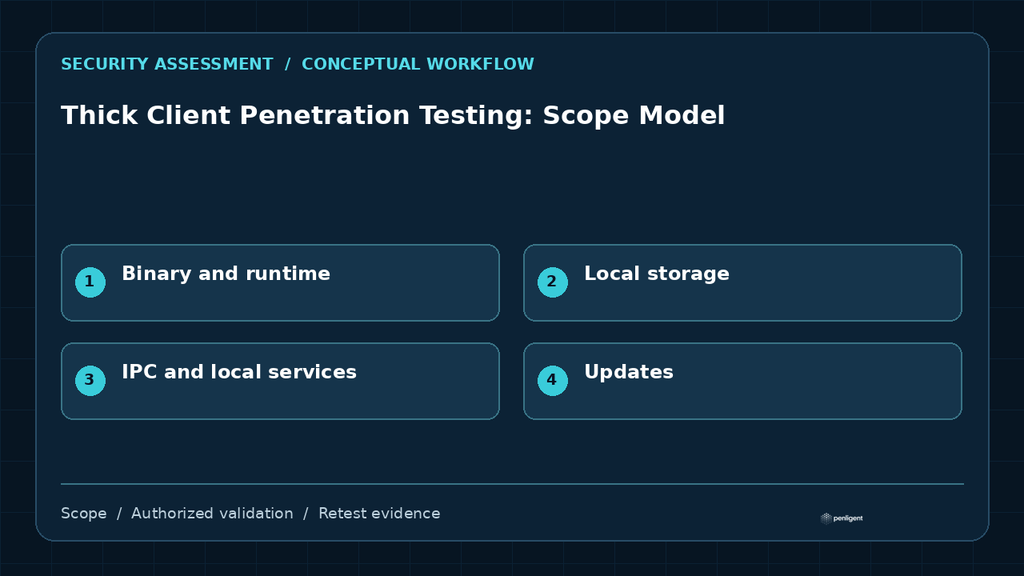
| Binary and runtime | Hardening, loading, debug and trust behavior | Build identity and observed control |
| Local storage | Tokens, secrets, logs, databases and permissions | Path, ACL and sanitized data |
| IPC and local services | Named pipes, sockets, RPC and privilege boundaries | Caller identity and authorized operation |
| Updates | Transport, signature, rollback and installer privilege | Package provenance and validation result |
| Backend APIs | Authentication, authorization and business logic | Requests, roles and server response |
Turn the scope into testable evidence
Define an authorized target, validate meaningful attack paths, and keep the evidence connected to remediation and retesting.
Test local secrets and privilege boundaries
Determine whether stored tokens or keys are necessary, scoped and protected by the operating system. Evaluate whether low-privilege users can influence privileged services, file locations, plugin loading or update behavior. Avoid copying real secrets when metadata or a synthetic account is sufficient.
Treat updates as a supply-chain boundary
Confirm that the client verifies update authenticity and handles downgrade or rollback decisions appropriately. Review installer privilege and file permissions. A secure transport alone is not enough if the package identity is not validated at the trusted install point.
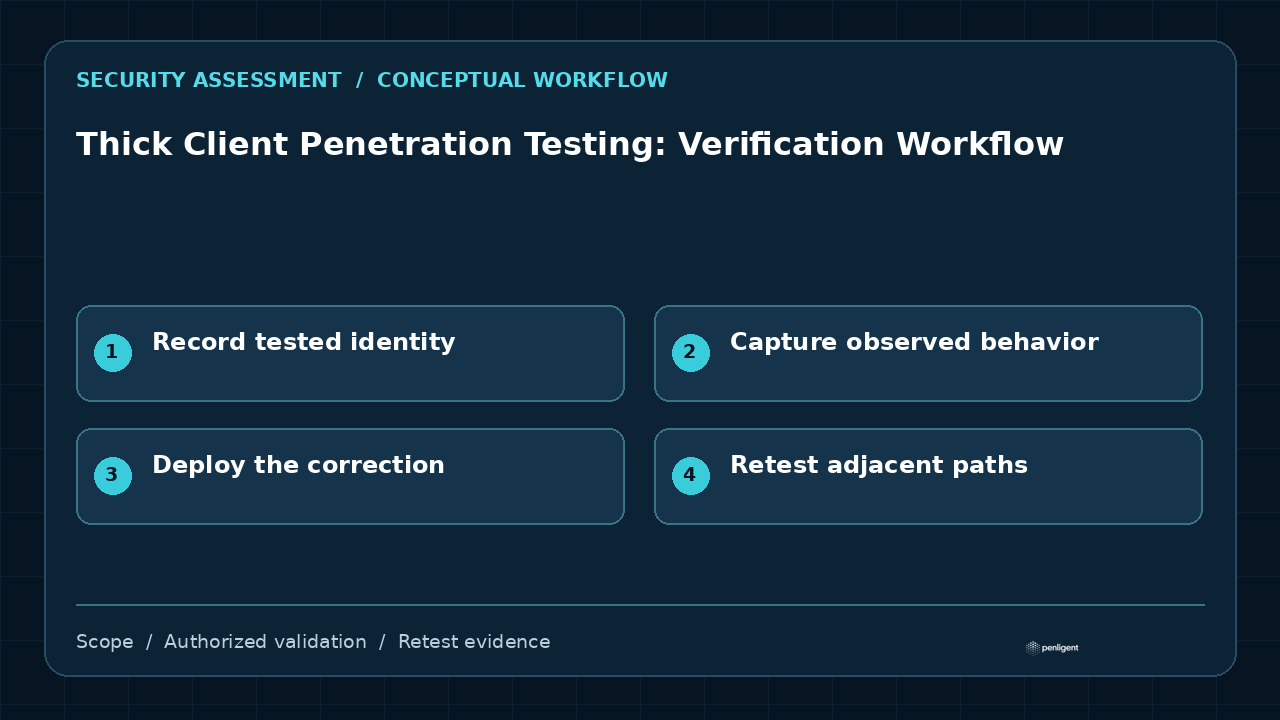
Retest client and server together
A client-side change may not fix a server authorization problem, and a server fix may leave local credential exposure. Retest the corrected build, update path and backend behavior with the same role and operating-system assumptions.
Turn the scope into testable evidence
Define an authorized target, validate meaningful attack paths, and keep the evidence connected to remediation and retesting.
Questions buyers should ask
- Which operating systems, installers and update channels are supported?
- Are local services and enterprise deployment tools in scope?
- Which decisions are enforced by the backend rather than the client?
- Will retesting cover the corrected binary and server API?
결론
Desktop application security depends on the boundary between a user-controlled client and trusted local or remote services. Test storage, IPC, updates and APIs as one system, and require evidence tied to an exact build and runtime environment.
 Korean
 English
 German
 French
 Spanish
 Portuguese
 Japanese
 Hindi
 Arabic
 Turkish
 Hebrew