
CVE-2026-126299 affects the CCG lexicon parser in NLTK. The maintainer advisory describes quadratic CPU consumption in fromstring when parsing wide bracket bodies and operator chains. Its structured fields list NLTK through 3.10.3 as affected and 3.10.4 as patched. The operational question is whether untrusted data reaches that parser in an application and whether the running worker actually imports the corrected library.
The advisory's prose still says the problem is unfixed and calls 3.10.3 the latest version, while its updated structured fields identify 3.10.4. That is a source inconsistency. The official release and code change provide additional evidence for the correction; copying the stale sentence would misstate the current available fix.
Reconcile the advisory with the release
The official NLTK v3.10.4 release names CCG parser changes and the associated pull request. The PyPI 3.10.4 metadata identifies the same version and requires Python 3.10 or newer. The linked correction replaces repeated string-tail slicing with a cursor-based parse and adds an input-length bound.
Taken together, those primary sources support using the listed corrected release rather than describing the issue as universally unfixed. They do not prove that a distributor's older-looking backport is vulnerable or that a particular application has deployed 3.10.4. Retain the supplier's determination for a backported package and resolve Python compatibility before a production rollout.
| Evidências | Conclusion supported | Conclusion it cannot support alone |
|---|---|---|
| Advisory structured fields | Upstream affected and first-fixed boundary | Which artifact an application worker loaded |
| Official release notes | Published correction in 3.10.4 | Compatibility with every application dependency |
| Corrective commit | Mechanism and limits of the implementation change | Measured performance of a reader's deployment |
| PyPI metadata | Published version and Python requirement | That an environment installed or activated it |
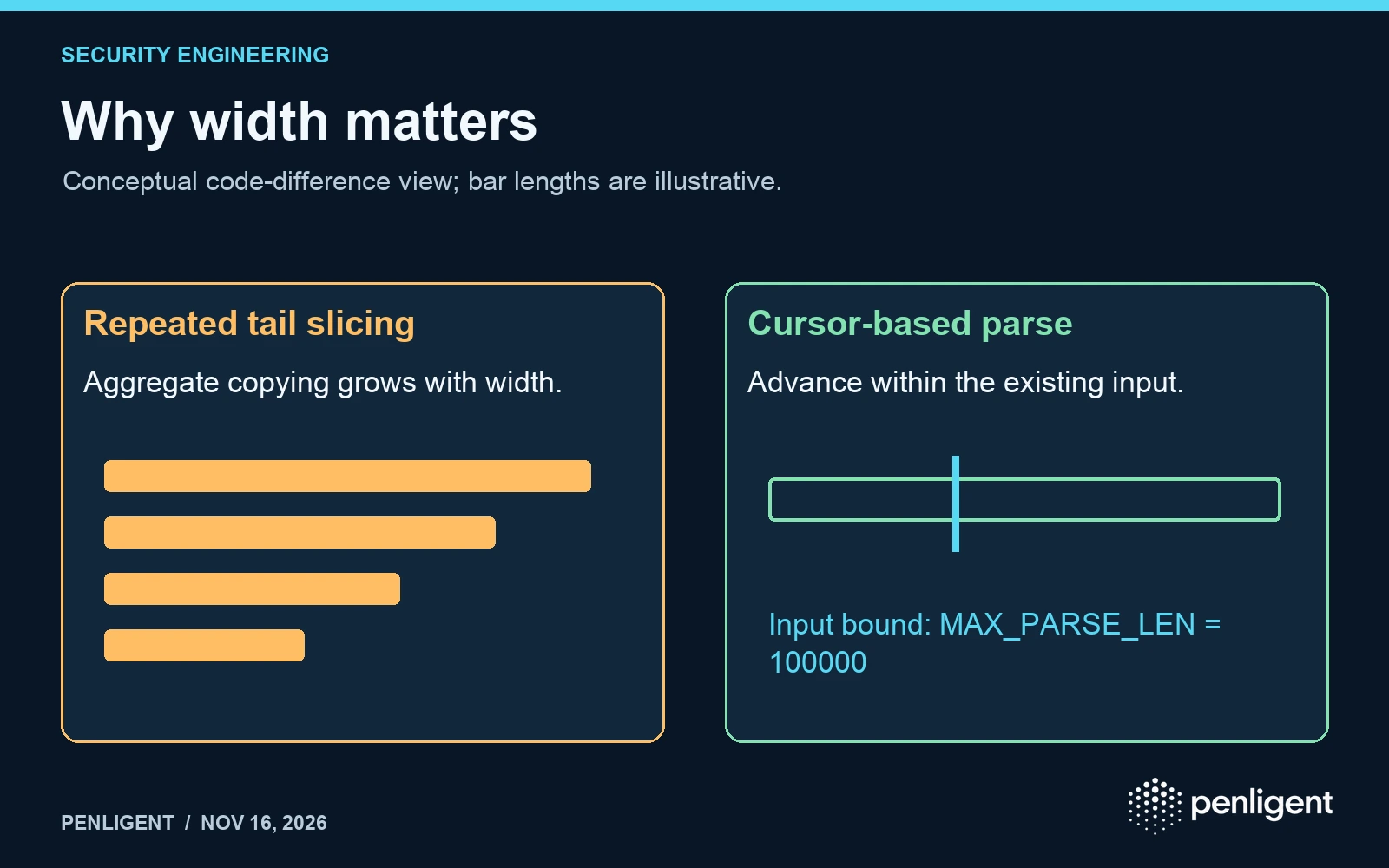
Width matters as well as nesting depth
The patch is relevant to repeated copying during parsing. Moving through an input with repeated tail slices can create growing aggregate copying work as input size increases. A cursor lets the parser advance through the existing string without rebuilding the remaining tail each time. This is a code-difference explanation, not a benchmark measured by Penligent.
A depth limit alone does not bound the work needed for a wide expression or a long operator sequence. Likewise, calling the issue a regular-expression denial of service can lead the response toward regex timeouts while leaving the string-copying mechanism unaddressed. Review the exact CCG entry point and correction rather than applying a generic text-processing label.
The correction adds MAX_PARSE_LEN of 100000 to bound parse length. Treat this as the implementation's guard, not an application service-level target. A service may need a lower request or field limit based on worker memory, concurrency and business requirements. Rejecting an oversized input should produce a controlled application result, with no need to expose parser internals to the caller.
Establish reachability before calling it remote exposure
NLTK can be installed for tokenization, datasets or other tasks without an application ever accepting a CCG lexicon from an untrusted party. A dependency inventory is the first step in review, not proof of a remotely reachable denial of service.
| Application path | Evidence to establish | Practical disposition |
|---|---|---|
Untrusted lexicon reaches CCG fromstring de forma síncrona | Handler, parser call and worker ownership | Prioritize correction and bounded request handling |
| Background import accepts an external lexicon | Queue source, job identity and resource limits | Include worker availability and retry behavior |
| Only an administrator supplies fixed lexicons | Provenance and change permissions | Document the restricted input boundary; still maintain the dependency |
| NLTK present but CCG path unused | Code and runtime dependency review | Record why this CVE path is not reached |
| Call path cannot be determined | Owner and tracing plan | Keep exposure unknown rather than marking it safe |
Tracing should use application-owned representative data in staging. Do not submit deliberately expensive lexicons to a shared service or infer reachability from the public presence of an NLTK dependency file.
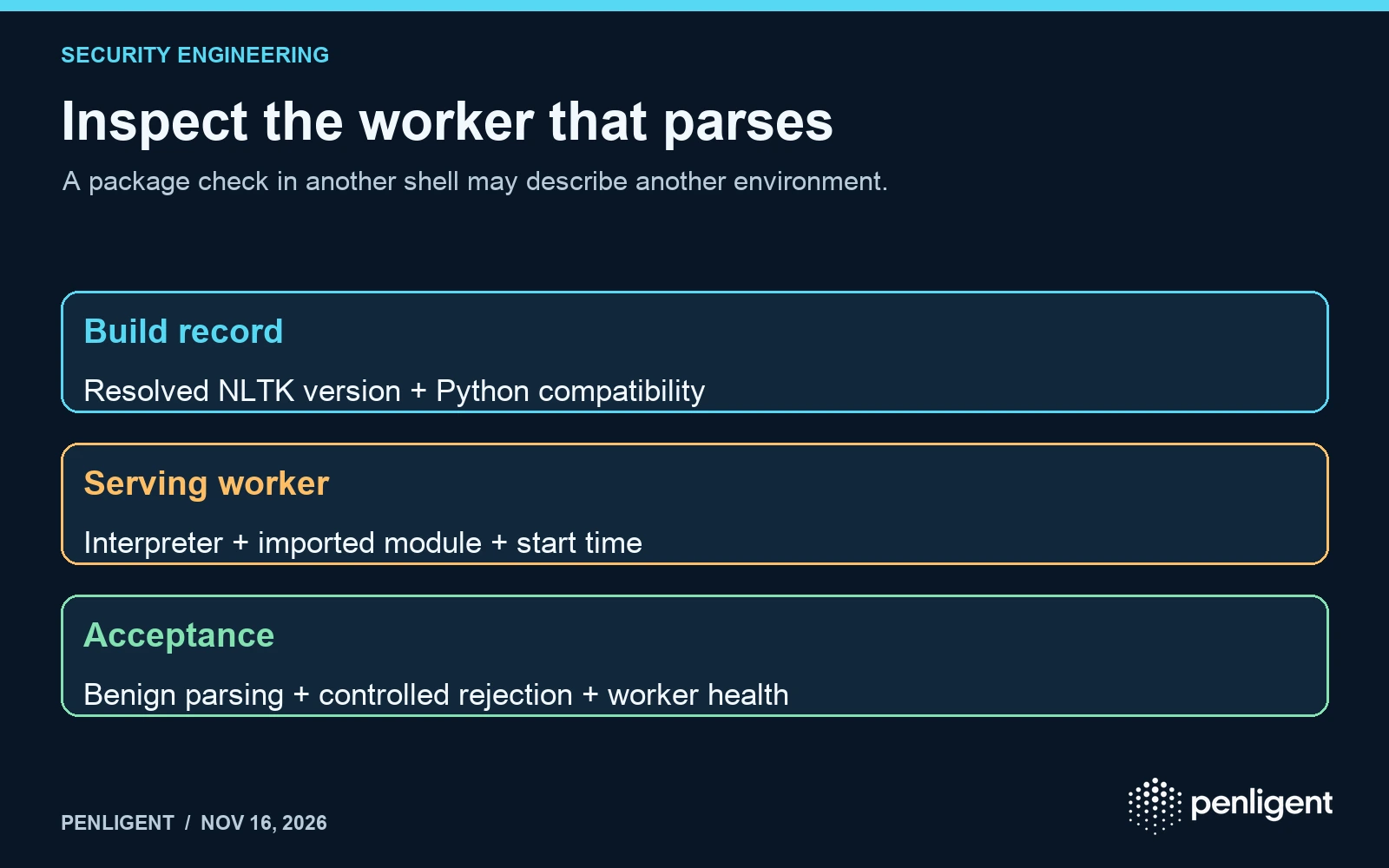
Verify the library inside the serving worker
A package-manager result from an administrator's shell can describe a different Python environment. Record the interpreter, resolved NLTK distribution version, module location, container or environment identity and worker start time from the same execution context that serves the application. Use the existing diagnostic mechanism; avoid exposing detailed environment paths through a new public endpoint.
Then connect that runtime evidence to the lockfile or image build and the supplier's fix statement. An image pushed to a registry is not proof that a long-lived worker restarted. Include background workers, scheduled tasks and replacement images where they process the same input.
If the application cannot move to a compatible corrected dependency immediately, its owner should restrict the untrusted parser path and enforce bounded work in the actual execution context. Worker isolation, input bounds and queue controls can reduce availability risk, but do not label them equivalent to applying the parser correction without a deployment-specific analysis.
Define a bounded acceptance test
Use a small, benign set of valid and invalid lexicons selected by the application maintainer. Check normal parsing, controlled rejection, request timeout handling and worker health in staging. Establish resource and duration ceilings before testing; stop if they are reached. This verifies ordinary behavior and containment without publishing a high-cost denial-of-service recipe.
The maintainer's scaling tests are evidence about its patch review, not performance figures from this article. Capacity claims for a production service require its own measurements, concurrency model and limits. A successful small functional test supports compatibility; it does not independently establish an asymptotic bound.
Close the dependency issue with the corrected supplier artifact, runtime import evidence, activation across affected workers and the normal-service result. Keep unexplained historical outages in a separate investigation. The advisory alone does not establish malicious exploitation or attribute a past CPU spike.
Method: AI-assisted analysis checked November 16, 2026 against NLTK's advisory, release, corrective commit and PyPI metadata. The code-difference explanation and reachability worksheet are proposed defensive analysis. No parser benchmark, exploit payload or customer service was executed.
For the wider remediation handoff, use the patch verification workflow. The NLTK-specific observation remains the library imported by the serving worker, together with bounded parser acceptance results.
General product workflow
The official Penligent 3.0 video illustrates general authorized testing. It is not an NLTK benchmark or proof of a corrected parser deployment.
 Portuguese
 English
 German
 French
 Spanish
 Japanese
 Korean
 Hindi
 Arabic
 Turkish
 Hebrew