
CVE-2026-132779 is an NGINX availability issue with a specific configuration gate: TLS 1.3 early data must be enabled with ssl_early_data on. A crafted TLS 1.3 connection can drive a worker into a tight loop repeatedly retrying a send without progress. F5’s CNA record says the worker can still accept new connections and handle existing ones while one CPU core is pinned at 100%. The record describes data-plane availability impact only. Locate the actual TLS endpoint, establish its effective configuration and running build, then verify the mitigation and worker recovery.
The CVE was published on November 23, 2026. O mainline changelog e stable changelog record fixes in Open Source 1.31.10 e 1.30.8 on that date. The security index lists the affected span as 1.21.4–1.31.9, with explicit fixed-branch exceptions at 1.31.10+ and 1.30.8+. Use the supplier’s fixed-build mapping for packages and appliances; F5 says end-of-technical-support versions were not evaluated.
The exposure is a three-part intersection
The useful exposure test combines three conditions: a vulnerable NGINX build, a client reaching its TLS 1.3 listener, and effective ssl_early_data on. O directive documentation specifies off by default and allows http ou server context. It also cautions that the default server’s value can be used. A search that finds an off line for an application hostname can therefore miss the setting used during the handshake.
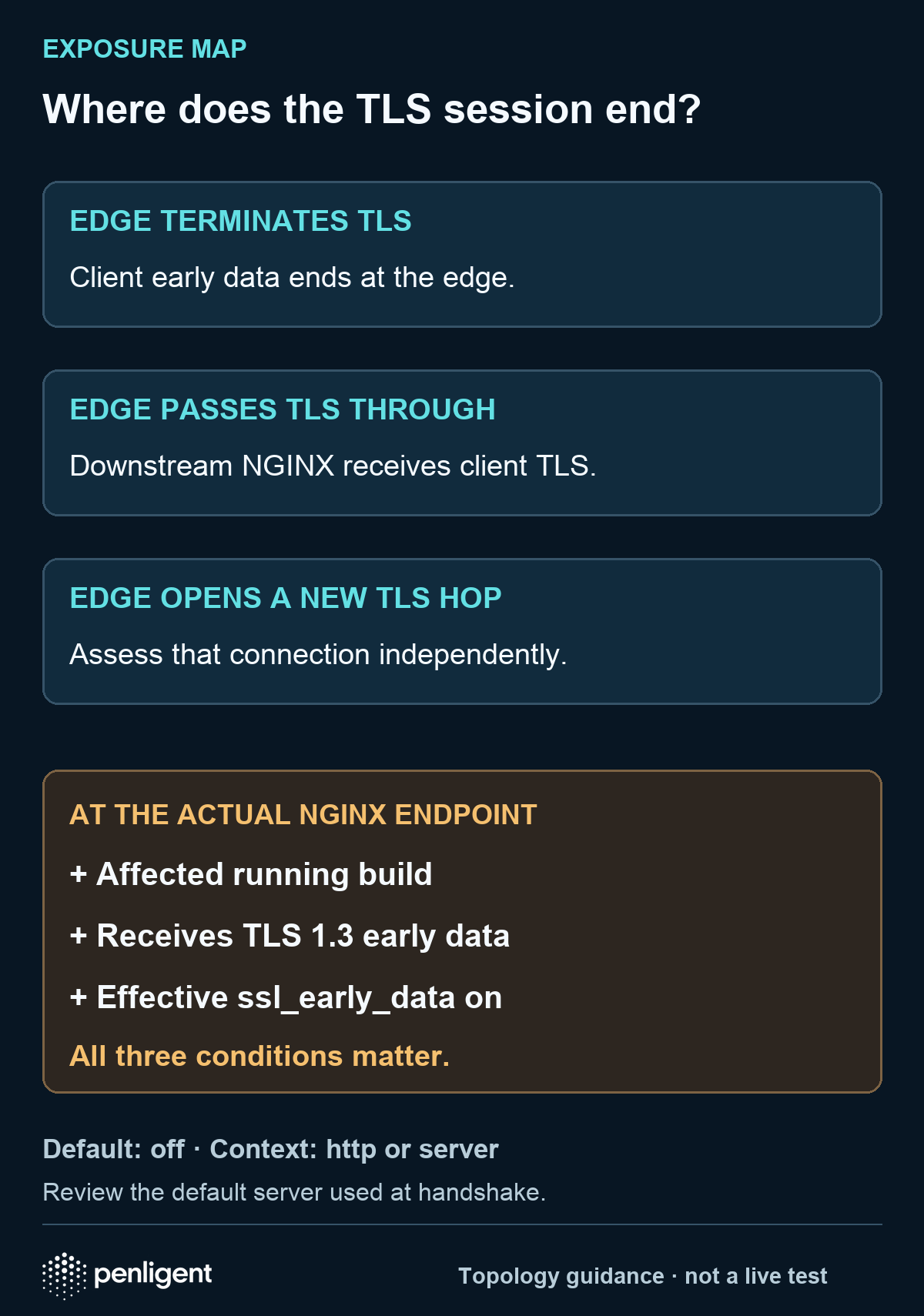
Trace the client’s TLS connection hop by hop. If a CDN or load balancer terminates client TLS and forwards ordinary HTTP to NGINX, client early data is negotiated at the upstream terminator; verify whether it independently uses a vulnerable NGINX listener. If that device passes TLS through, the downstream NGINX may be the TLS endpoint. If it opens a new TLS connection to NGINX, assess that separate connection and its configuration. These are deployment-topology deductions: the CVE advisory does not describe every proxy layout. Record the protocol and TLS termination behavior at each hop instead of inferring it from a diagram or product name.
Match the running build to a fixed line
| Product or line | Version assessment | Remediation destination |
|---|---|---|
| NGINX Open Source 1.31 | 1.31.0–1.31.9 affected | 1.31.10 or a later fixed release |
| NGINX Open Source 1.30 | 1.30.0–1.30.7 affected | 1.30.8 or a later fixed release |
| Earlier releases | The upstream affected span begins at 1.21.4; EoTS builds were not evaluated by F5 | A supported vendor/package build containing the fix |
| NGINX Plus or repackaged distributions | Check the separate F5 or distributor version mapping | The supplier’s fixed build for that product |
The first two rows follow the CNA’s branch ranges and NGINX’s fixed versions. Plus has separate ranges; consult F5 advisory K000163947 for the applicable product release. For a distribution that backports fixes, retain the supplier bulletin and installed package revision. An upstream-looking version string alone cannot establish the patch status of a repackaged artifact.
Inventory every TLS-terminating replica and alternate listener. Run version/configuration inspection in the actual service context, accounting for its binary path, container, prefix, and configuration file. NGINX documents -v, -V, -te -T for version, build parameters, configuration testing, and configuration dumping. A newly installed binary reporting a fixed version does not establish that existing workers have been replaced. Keep dumped configuration restricted and redact sensitive values before sharing it.
Disable early data, then plan the upgrade
O vendor workaround é ssl_early_data off;. Review the included configuration and relevant http/server settings, especially the listener’s default server. NGINX’s virtual-server selection documentation explains that a connection begins in the default context and can change selection during the handshake. Validate the intended configuration with nginx -t before applying it through the service’s normal rollout procedure.
| Checkpoint | Evidence to retain | What it does not prove alone |
|---|---|---|
| Exposure mapped | Node/image inventory, binary version, TLS termination map, selected virtual server, effective early-data setting | That no worker was already affected |
| Mitigation loaded | Reviewed configuration, successful nginx -t, reload record, process list showing new workers | That draining old workers have exited |
| Upgrade complete | Per-node package/image digest, running binary version, vendor fixed-build mapping | That every alternate endpoint or replica received the change |
| Service recovered | Worker CPU and PID observations, ordinary traffic checks, stable resource use after rollout | A historical incident conclusion without separate log and incident review |
A configuration reload is also different from replacing the running executable. Use the package or container upgrade procedure to activate the fixed build. NGINX’s process-control documentation says a successful configuration reload starts new workers and gracefully drains old workers, which continue serving existing clients. Consequently, a reload acknowledgment cannot establish that every old worker has exited. If a previously pinned worker remains, use the service owner’s controlled recovery procedure and verify its PID is gone. This is operational guidance derived from the documented lifecycle, not a claim that reload always fails to recover this CVE.
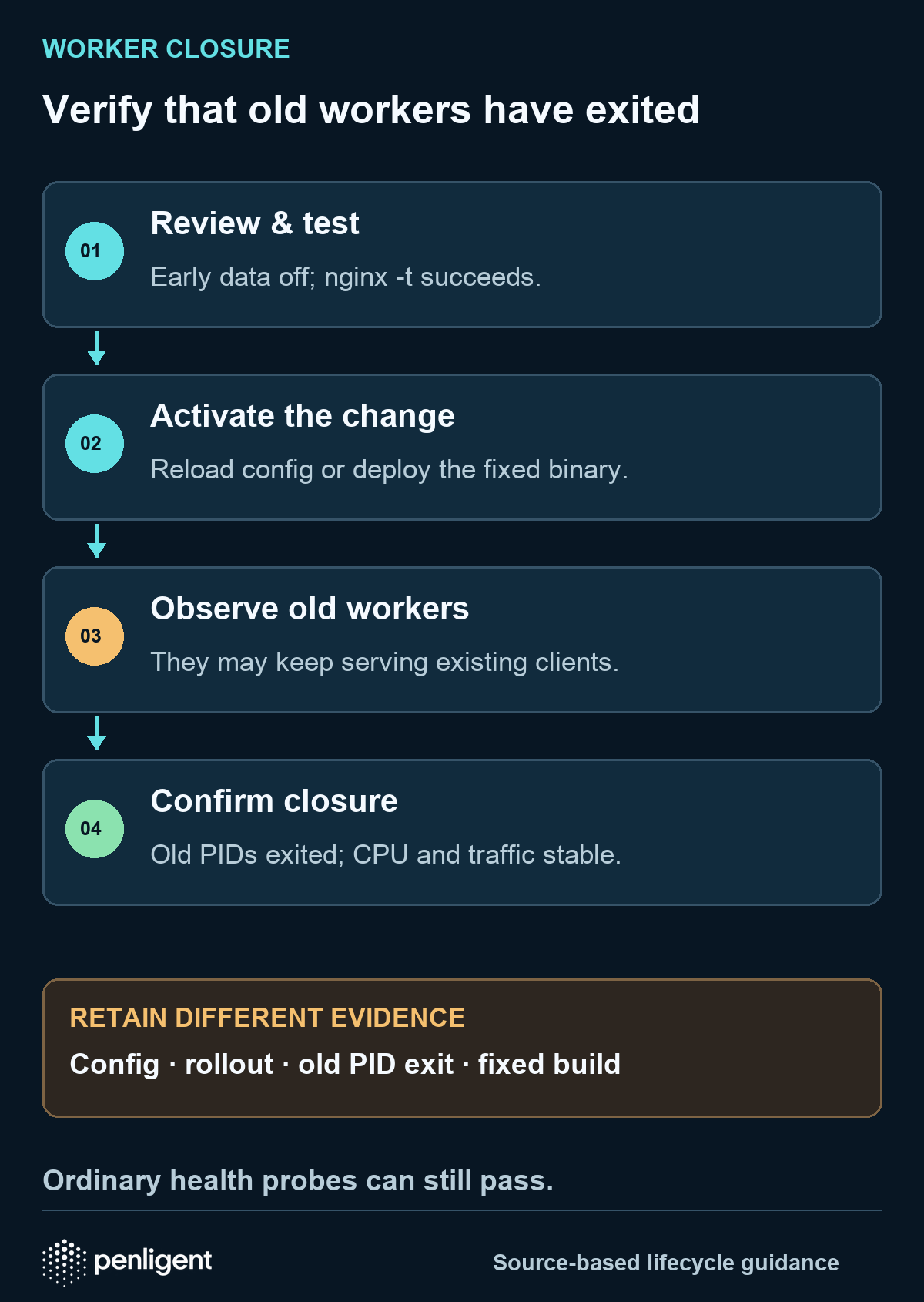
The one-core symptom is consistent with the vendor description, but it is not a unique fingerprint. Because F5 says the worker keeps handling connections, an ordinary availability probe can pass during degradation. Compare worker CPU, PIDs, rollout times, and normal request behavior before assigning a cause. The CNA describes degradation persisting until worker restart. It does not establish that every CPU spike is exploitation.
Close with per-node evidence
For each exposed endpoint, retain five facts: the process or image that accepts TLS; the running version and supplier fix mapping; whether early data is effectively enabled; when the mitigation or fixed build reached that node; and whether the old workers exited. This provides a concrete closure record for an issue that can degrade a single worker while the rest of the service still responds.
The sources reviewed for this article establish the vulnerability and its fix but do not establish in-the-wild exploitation. The article uses the F5 CNA description, NGINX security advisory, changelogs, and module/process documentation. No crafted connection, exploit, or live NGINX instance was tested.
Teams that need to organize authorized security assessments and evidence collection can view this Penligente overview. It is general workflow context and does not demonstrate CVE-2026-132779 or claim that the product detects this condition.
Method and scope: Prepared with AI assistance from the F5 CNA record and NGINX’s official security, release, SSL module, command-line, and process-control documentation, checked November 27, 2026. The diagrams explain configuration boundaries and validation evidence. No exploit, crafted TLS connection, or live-system test was run.
 Portuguese
 English
 German
 French
 Spanish
 Japanese
 Korean
 Hindi
 Arabic
 Turkish
 Hebrew