
Last updated: November 4, 2026.
AWS penetration testing should focus on resources and configurations the customer is authorized to assess. The most valuable engagements connect IAM decisions, exposed applications, workload identities, storage permissions and network paths instead of treating each service as an isolated checklist.
AWS publishes a penetration-testing policy that identifies permitted customer testing and prohibited activity. The engagement owner remains responsible for scope, safety, third-party authorization and compliance with the current policy. Confirm the policy immediately before testing because service coverage and conditions can change.
For the assessment framework, consult AWS Customer Support Policy for Penetration Testing and map the relevant guidance to the actual environment and authorized scope.
Create an account and workload scope map
Record accounts, organizations, regions, environments and owners. Then map internet-facing endpoints, APIs, compute, containers, serverless functions, storage, secrets, identity providers and administrative paths.
| Camada | Exemplos | Primary question |
|---|---|---|
| Identidade | IAM roles, users, federation, workload identities | Can a principal obtain permissions beyond its task? |
| Application | Web apps, APIs, ALB, API Gateway, CloudFront | Can an external or authenticated user cross a business boundary? |
| Workload | EC2, ECS, EKS, Lambda | Can code or metadata expose credentials or higher-trust paths? |
| Dados | S3, databases, queues, backups | Are access, encryption and tenant rules enforced? |
| Network | VPCs, security groups, peering, private endpoints | Does segmentation match the intended trust model? |
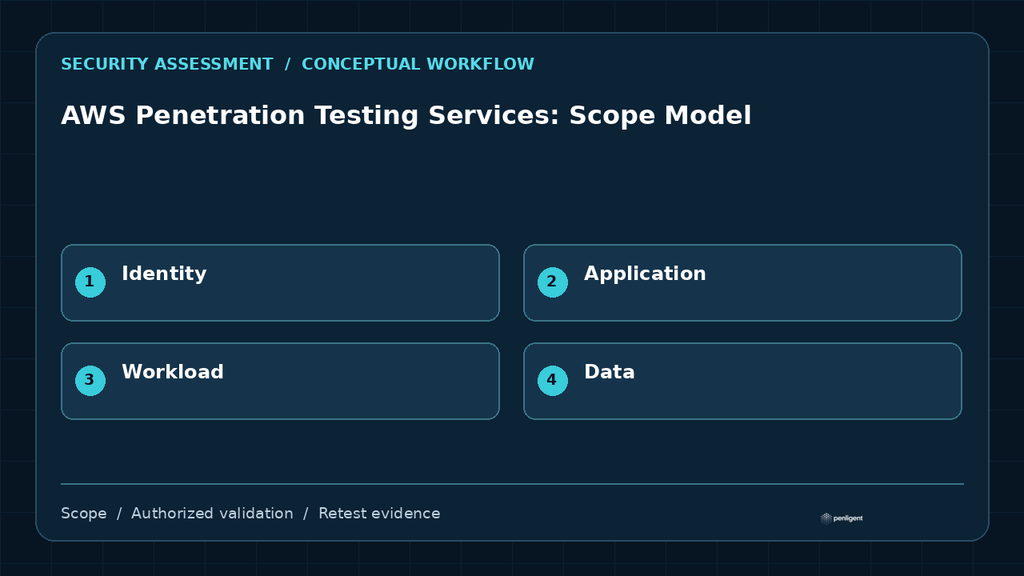
Turn the scope into testable evidence
Define an authorized target, validate meaningful attack paths, and keep the evidence connected to remediation and retesting.
Test IAM paths with business context
An IAM permission is not automatically exploitable, and a small permission can become material when combined with another service. Test effective permissions, trust policies, pass-role paths, resource policies, workload credentials and access to sensitive actions. Keep proof minimal and use approved test resources whenever possible.
Separate cloud configuration from application logic
A secure security group does not fix broken authorization in an API, and an application patch does not remove an over-privileged role. Report findings by control owner while preserving the chain that joins them. This lets platform, application and identity teams remediate their part without losing the combined impact.
Retain cloud-native evidence
Useful evidence includes the tested principal, account and region; relevant policy or resource configuration; sanitized requests; CloudTrail or application events; and the observed permission or data outcome. Retesting should confirm the corrected policy and check alternative principals or paths that could recreate the issue.
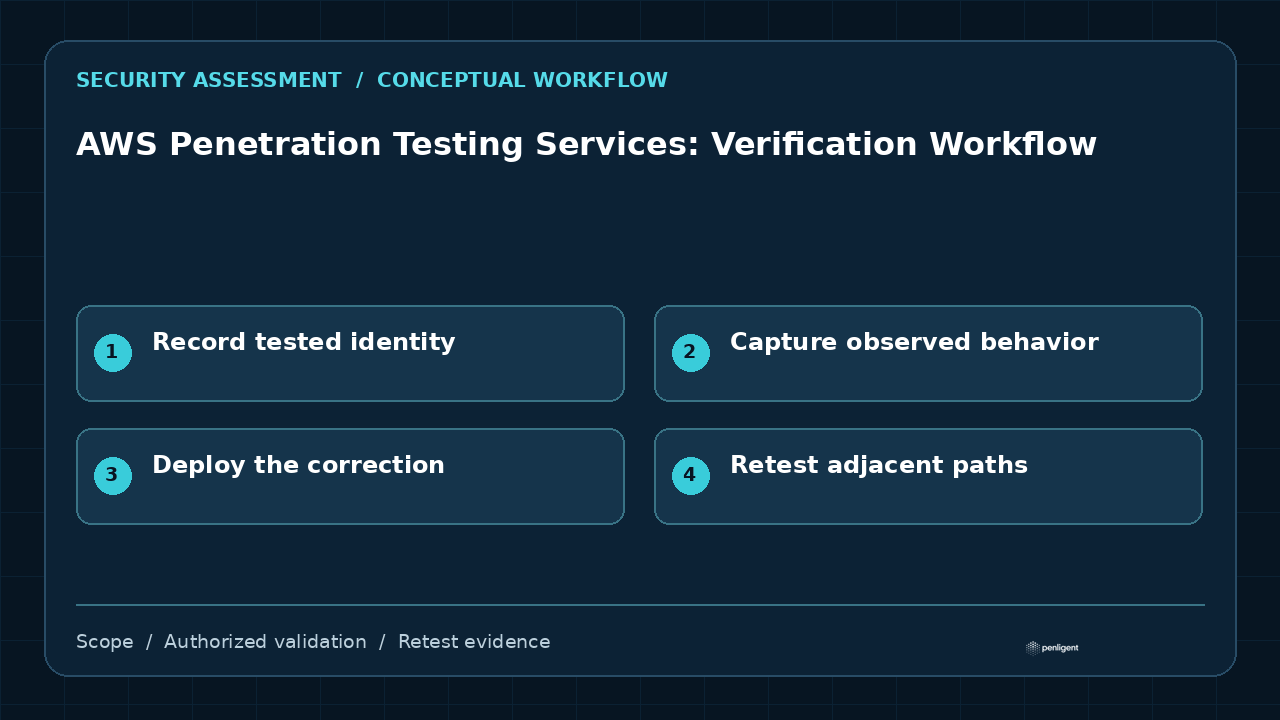
Turn the scope into testable evidence
Define an authorized target, validate meaningful attack paths, and keep the evidence connected to remediation and retesting.
Questions buyers should ask
- Which accounts, organizations, regions and third-party services are authorized?
- Does the scope cover IAM, application logic and workload identities together?
- How will testing avoid destructive or policy-prohibited activity?
- Will the report identify the principal, resource, region and evidence source for each finding?
Conclusão
An AWS pentest is strongest when it follows a realistic path across identity, applications, workloads and data while remaining inside explicit authorization. Require evidence that can be replayed by the owning team and a retest that proves the effective permission or application behavior changed.
Sources and standards
- AWS Customer Support Policy for Penetration Testing
- AWS Well-Architected Security Pillar
- NIST SP 800-115
 Portuguese
 English
 German
 French
 Spanish
 Japanese
 Korean
 Hindi
 Arabic
 Turkish
 Hebrew