
CVE-2025-5777 is a critical memory-disclosure vulnerability in customer-managed NetScaler ADC and NetScaler Gateway appliances configured as a Gateway or an Authentication, Authorization, and Auditing virtual server. A remote attacker does not need an account to reach the vulnerable authentication path. Under the wrong input conditions, the appliance can return memory that was never meant to leave the process.
That description sounds narrow until the location of the flaw is considered. A NetScaler Gateway often sits directly in front of enterprise VPN access, Citrix virtual applications, remote desktops, identity services, and internal systems. Its memory may temporarily contain user input, HTTP requests, authentication state, cookies, and active session material. A small disclosure at this boundary can become an identity incident rather than a conventional information leak.
Security researchers gave CVE-2025-5777 the nickname “CitrixBleed 2” because its operational consequences resemble CVE-2023-4966, the original CitrixBleed vulnerability. Citrix has stated that it found no evidence that the two vulnerabilities are technically related. Both statements can be true: the flaws do not need to share an identical root cause to create a similar session-exposure problem. The defensible wording is that CVE-2025-5777 belongs to the same operational risk pattern, not that Citrix has confirmed a direct code lineage. See NetScaler’s official security update discussion.
The response requirements are no longer theoretical. CISA added CVE-2025-5777 to its Known Exploited Vulnerabilities Catalog on July 10, 2025 and assigned a remediation deadline of July 11, 2025 for affected U.S. Federal Civilian Executive Branch agencies. GreyNoise later reported that it had observed exploitation attempts beginning on June 23, almost two weeks before public technical reproduction details appeared. In July 2026, Huntress disclosed a group of investigations in which it assessed CitrixBleed 2 as the most likely initial-access method in a repeatable intrusion chain that sometimes ended in DragonForce ransomware. The NVD record for CVE-2025-5777 consolidates the vulnerability description, scoring, references, and known-exploitation status.
That history changes the response model. Installing a fixed build is essential, but patching alone does not prove that an appliance was never exploited, invalidate every session that may already have been exposed, or remove an attacker who used a stolen session to reach downstream systems. A responsible response has three separate goals:
- Close the memory-disclosure path.
- Invalidate session state that may have escaped before the upgrade.
- Investigate whether the identity edge or connected environment was used during the exposure window.
CVE-2025-5777 at a Glance
| Campo | Confirmed or defensible assessment |
|---|---|
| Vulnerabilidade | CVE-2025-5777 |
| Common nickname | CitrixBleed 2 |
| Vendor description | Insufficient input validation leading to memory overread |
| Products | NetScaler ADC e NetScaler Gateway |
| Required configuration | Gateway role such as VPN virtual server, ICA Proxy, CVPN, or RDP Proxy, or an AAA virtual server |
| Attacker authentication | Not required for the publicly analyzed vulnerable path |
| Citrix CNA CVSS v4 | 9.3 Critical |
| NVD CVSS v3.1 | 7.5 High |
| Primary security effect | Disclosure of process memory |
| Operational consequence | Possible exposure and replay of active session material |
| CISA KEV date added | July 10, 2025 |
| CISA deadline | July 11, 2025 |
| Official configuration workaround | None published as a substitute for upgrading |
| Post-upgrade action | Terminate active ICA and PCoIP sessions after all HA or cluster members are updated |
| Incident-response requirement | Depends on exposure period, logging, session evidence, and downstream activity |
The difference between the 9.3 Citrix CVSS v4 score and the 7.5 NVD CVSS v3.1 score is not evidence that one source considers the vulnerability harmless. The assessments use different CVSS generations and different impact modeling. NVD’s v3.1 vector focuses on unauthenticated, network-reachable confidentiality loss. Citrix’s v4 vector incorporates severe vulnerable-system impacts and subsequent-system effects. Neither score should override the stronger operational fact that the vulnerability was placed in KEV with an unusually short deadline.
The Timeline Matters
Citrix published its initial bulletin on June 17, 2025. That first record incorrectly referred to the NetScaler management interface. On June 23, the description was corrected to state that the vulnerability applies when NetScaler is configured as a Gateway or AAA virtual server. The correction is important because a team that relied on the original wording could have searched only for exposed management interfaces and missed the actual authentication-facing attack surface. The corrected scope and version table are available in Citrix security bulletin CTX693420.
The same date later became significant for another reason. GreyNoise reported that its retrospective telemetry identified exploitation attempts beginning on June 23. The activity targeted sensors that emulated Citrix NetScaler appliances rather than indiscriminate generic web services, which GreyNoise interpreted as deliberate targeting. The first public technical analysis and reproduction material appeared on July 4, meaning hostile probing was visible before broadly available public instructions. GreyNoise documented this sequence in its report on pre-PoC CitrixBleed 2 exploitation.
That sequence weakens a common vulnerability-management assumption: that defenders have a meaningful safety window until public PoC code appears. For internet-facing identity infrastructure, attackers may reverse engineer a patch, obtain private research, independently find the bug, or begin testing based on sparse advisory language. Public exploit availability is an escalation point, not necessarily the beginning of the exploitation period.
On July 10, CISA added CVE-2025-5777 to KEV. The catalog entry required application of vendor instructions, applicable cloud-service guidance, or discontinuation of the product if remediation was unavailable. The deadline was July 11. A one-day federal deadline is a strong indication that normal monthly maintenance timing was considered inadequate.
On July 15, NetScaler published specific log-review guidance. It described a possible exploitation artifact involving rejected-authentication log entries containing non-ASCII bytes and also recommended reviewing session events for changes in client IP. The vendor explicitly warned that these checks would not identify every possible exploit and that local logs might contain only a few days of history. The detection guidance is described in NetScaler’s article on evaluating logs for attempted exploitation.
The longer-term consequences became clearer on July 9, 2026. Huntress reported that it had investigated roughly half a dozen related intrusions during the first half of 2026. Huntress assessed with high confidence that an initial access broker was using CVE-2025-5777 against exposed NetScaler environments. The recurring sequence included user-session access, local privilege escalation, creation of rogue administrator accounts, deployment of legitimate remote-management software, and, in the most advanced case, DragonForce ransomware.
Huntress was transparent that it did not recover a stolen session cookie in every case, so the initial-access conclusion is an incident-response assessment supported by recurring evidence rather than direct packet-level proof in every victim. That distinction matters when describing real-world cases: high-confidence attribution to a likely entry path is not the same as recovering the exact leaked token from network traffic. Huntress published the investigation in its report on CitrixBleed 2 and DragonForce ransomware.
| Date | Development | Defensive significance |
|---|---|---|
| June 17, 2025 | Citrix publishes the initial bulletin | Begin emergency version and configuration inventory |
| June 23, 2025 | Citrix corrects the affected surface to Gateway and AAA roles | Re-scope assets based on actual role, not management exposure |
| June 23, 2025 | Earliest exploitation attempts later identified by GreyNoise | Treat pre-PoC exposure as potentially meaningful |
| July 4, 2025 | Public technical analysis appears | Expect rapid growth in scanning and reproduction |
| July 10, 2025 | CISA adds CVE-2025-5777 to KEV | Move from risk-based patching to confirmed-exploitation response |
| July 11, 2025 | Federal remediation deadline | Normal change windows are no longer an adequate default |
| July 15, 2025 | NetScaler publishes log-analysis guidance | Hunt for malformed authentication artifacts and session anomalies |
| July 9, 2026 | Huntress publishes multi-incident ransomware-linked analysis | Continue hunting for long-tail exploitation and downstream persistence |
Affected Products and Fixed Builds
Citrix’s bulletin lists the following supported branches as affected:
| Product branch | Affected builds | Minimum build containing the CVE-2025-5777 fix |
|---|---|---|
| NetScaler ADC and NetScaler Gateway 14.1 | Earlier than 14.1-43.56 | 14.1-43.56 |
| NetScaler ADC and NetScaler Gateway 13.1 | Earlier than 13.1-58.32 | 13.1-58.32 |
| NetScaler ADC 13.1-FIPS | Earlier than 13.1-37.235 | 13.1-37.235 |
| NetScaler ADC 13.1-NDcPP | Earlier than 13.1-37.235 | 13.1-37.235 |
| NetScaler ADC 12.1-FIPS | Earlier than 12.1-55.328 | 12.1-55.328 |
These are minimum fixed builds, not recommendations to install an old maintenance release in 2026. An organization responding now should use a currently supported release approved for its hardware, licensing, feature requirements, and upgrade path. The minimum thresholds remain useful for historical exposure analysis because they identify when a branch first stopped being vulnerable to CVE-2025-5777.
Standard NetScaler ADC and Gateway versions 12.1 and 13.0 are end of life and remain vulnerable. Citrix does not plan to provide ordinary fixes for those branches. An organization running one of them has a lifecycle problem, not simply a missing hotfix. Network restrictions can reduce immediate exposure, but they do not turn unsupported software into a durable remediation.
The bulletin applies to customer-managed NetScaler ADC and NetScaler Gateway instances. Citrix stated that it updated Citrix-managed cloud services and Citrix-managed Adaptive Authentication itself. Secure Private Access on-premises and hybrid deployments that use customer-controlled NetScaler instances are also in scope and require those instances to be upgraded.
Version alone is not enough to establish exposure. The appliance must also be configured as one of the affected roles:
- A VPN virtual server
- An ICA Proxy
- A clientless VPN or CVPN service
- An RDP Proxy
- An AAA virtual server
A vulnerable build operating only as an internal load balancer with none of the stated roles does not meet the published configuration condition for CVE-2025-5777. That does not make the appliance generally secure or eliminate exposure to other NetScaler CVEs, but it materially changes the assessment for this specific vulnerability.
A practical inventory should combine five fields:
| Inventory field | Por que é importante |
|---|---|
| Exact branch and build | Determines whether vulnerable code is installed |
| Gateway or AAA role | Determines whether the published precondition exists |
| Internet exposure | Determines whether an unauthenticated remote attacker can reach it |
| HA and cluster membership | Identifies every node that must be upgraded |
| Identity and application relationships | Defines the downstream impact of a stolen session |
The highest priority is an internet-facing, customer-managed appliance running an affected build and brokering remote access or authentication to valuable internal resources. An internal-only ADC with no Gateway or AAA role belongs in a different queue for this CVE, although it should still be checked for other security updates.
Why the Nickname CitrixBleed 2 Is Useful but Incomplete
The original CitrixBleed, CVE-2023-4966, disclosed sensitive memory from NetScaler ADC and Gateway appliances configured as Gateway or AAA virtual servers. Attackers used exposed session tokens to hijack authenticated sessions, including sessions protected by MFA. The incident taught defenders that patching the appliance without invalidating session state left a dangerous gap. CISA’s CitrixBleed response guidance describes that earlier operational lesson.
CVE-2025-5777 produced an immediate comparison because it also involves memory disclosure at the NetScaler authentication edge. Public research demonstrated that a malformed login parameter could cause residual memory data to be reflected in an authentication response. Researchers described the apparent coding problem as use of an uninitialized variable: when a parameter existed in a syntactically abnormal form, the corresponding server-side storage was not safely initialized before being used. The technical reproduction was documented by watchTowr in How Much More Must We Bleed.
Citrix’s CNA classification is CWE-125, Out-of-bounds Read. NVD also displays CWE-908, Use of Uninitialized Resource, while CISA-ADP added CWE-457, Use of Uninitialized Variable. Those labels operate at different levels. One describes the security effect of reading memory beyond the intended data boundary. Another describes the programming error that may leave a variable or resource containing stale state. They are not necessarily competing explanations.
Citrix has said it found no evidence that CVE-2025-5777 and CVE-2023-4966 are related. That statement should prevent unsupported claims that the vendor reintroduced the exact same bug. It does not remove the operational comparison. Both incidents demonstrate why unauthenticated memory disclosure on an authentication appliance can become a session-security emergency.
The nickname is therefore useful as an incident shorthand, but a response plan should be anchored to the actual CVE, affected builds, configuration preconditions, and current vendor guidance.
How a Malformed Request Can Expose Memory
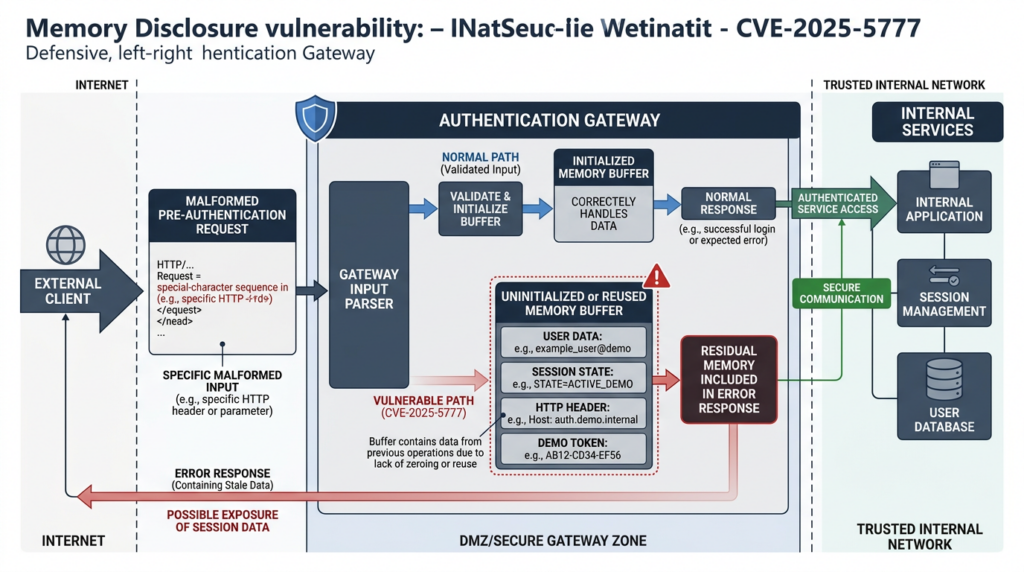
A web authentication handler generally performs a sequence like this:
- Parse the incoming form or request body.
- Locate expected parameter names.
- Validate that each parameter has an acceptable structure and value.
- Copy validated values into initialized storage.
- Perform authentication logic.
- Construct a response using only known, initialized data.
The dangerous state occurs when the parser recognizes enough of a parameter to enter the processing path but does not receive a valid value. Secure code should reject the request or explicitly initialize the destination to an empty value. Vulnerable code may instead continue with a local variable or buffer that contains bytes left from earlier operations.
Process memory is reused constantly. A stack frame or temporary buffer might previously have held part of an HTTP request, a username, a header, a cookie, or unrelated binary data. Memory safety does not require that an application erase every byte immediately after use, provided the program never exposes stale bytes outside the intended boundary. The vulnerability appears when those bytes are treated as valid output.
Public watchTowr research showed that malformed pre-authentication input could cause varying residual data to appear in an XML response. Repeated requests returned different content because memory layout and recent process activity changed between attempts. The researchers also demonstrated that recognizable request data could eventually appear in the leaked bytes.
This does not mean every request yields a complete session token. Memory disclosure is probabilistic:
- The relevant memory must contain useful data at the moment it is read.
- The disclosed region must overlap that data.
- The attacker must recognize and parse the result.
- The token must still be valid.
- The target workflow must accept it without additional binding or verification.
- The attacker must reach the associated application or remote-access service.
Those conditions reduce reliability, but they do not make the vulnerability low risk. An unauthenticated attacker can repeat a low-cost request, collect responses, and search for high-value patterns. The asymmetry favors the attacker: many failed attempts may be acceptable if one response yields reusable session material.
Citrix’s later log guidance uses appropriately cautious language. It says session theft is plausible but not guaranteed and depends on device configuration and the volume and types of traffic processed by the appliance. That qualification is more accurate than either extreme claim that the flaw always leaks sessions or that session theft is speculative.
Why Session Exposure Can Defeat MFA
MFA normally protects the creation of a session. The user presents a password and a second factor, and the authentication system issues a cookie or token representing the successful login. Subsequent requests rely on that session artifact so the user does not need to repeat MFA for every page or remote application launch.
If an attacker steals the already-issued artifact, the attacker may not need to complete the original authentication ceremony. The server sees a session it previously created and may treat the request as authenticated.
This is not a cryptographic break of MFA. It is theft of the result produced after MFA succeeded.
A useful analogy is an airport security checkpoint. MFA is the identity and screening process used to issue an authorized boarding credential. A stolen credential can be dangerous even if the thief could never pass the original identity check. Stronger screening does not help if the credential can be copied and replayed without sufficient binding.
The actual effect depends on session controls:
| Controle | Effect on stolen-session risk |
|---|---|
| Short expiration | Reduces the useful replay window |
| Server-side revocation | Allows rapid invalidation after patching |
| Client or device binding | May prevent reuse from a different device |
| Source-IP binding | Can reduce replay but may disrupt mobile users |
| Continuous risk evaluation | Can challenge abnormal session behavior |
| Application reauthentication | Limits access to sensitive actions |
| Independent backend session | May require another token not present in NetScaler memory |
| Long-lived persistent session | Increases the value of disclosed state |
This is why session invalidation is part of the vendor’s remediation. The fixed build prevents new disclosures through the patched path. It does not retroactively recall bytes that may already have been observed by an attacker.
The Likely Attack Chain
A realistic CVE-2025-5777 intrusion does not end with a strange authentication response. The memory leak is valuable because it can become the first step in a broader identity and endpoint compromise.
| Estágio | Attacker objective | Defender-visible evidence |
|---|---|---|
| Reach exposed NetScaler | Locate Gateway or AAA surface | Scanning, unusual authentication requests, threat-intelligence hits |
| Trigger memory disclosure | Obtain residual process data | Rejected authentication logs with unusual bytes |
| Extract useful material | Identify cookies, tokens, credentials, or requests | Often little or no direct victim visibility |
| Replay a session | Enter without normal user authentication | Session reuse, unexpected source IP, absent user MFA event |
| Access published resources | Reach Citrix desktops or internal applications | New virtual desktop session, unusual application access |
| Enumerate environment | Identify users, groups, hosts, and shares | LDAP queries, ADExplorer, command-line discovery |
| Escalate privileges | Gain administrative or SYSTEM access | Suspicious binaries, service manipulation, privilege-escalation telemetry |
| Establish persistence | Preserve access after session expiration | New accounts, services, scheduled tasks, remote-management tools |
| Achieve final objective | Exfiltration, extortion, or ransomware | Data staging, encryption, security-control tampering |
ReliaQuest reported suspected exploitation indicators in 2025 that included a hijacked Citrix web session, the same session being reused across expected and suspicious IP addresses, LDAP reconnaissance, ADExplorer activity, and Citrix sessions originating from hosting-provider or consumer-VPN infrastructure. These observations do not prove that every such event is CVE-2025-5777, but they show what a session-based initial-access investigation should correlate. ReliaQuest documented the activity in its CitrixBleed 2 threat spotlight.
Huntress’s July 2026 reporting extends the chain. In its cases, the attacker often entered through a session belonging to an ordinary user rather than an administrator. The operator then used a repeatable local privilege-escalation technique, created rogue administrative accounts, installed legitimate remote-access tools such as ScreenConnect or Zoho Assist, and eventually deployed ransomware in one case.
The distinction matters. A stolen low-privilege session is not harmless merely because it lacks domain-admin rights. It places the attacker on a trusted internal desktop, behind the external security boundary, with an authenticated user context and access to whatever that user can reach. Local privilege escalation, misconfigurations, credential theft, and help-desk abuse can expand that foothold.
Why the KEV Listing Changes the Decision
A CVSS score estimates technical severity. KEV answers a different question: whether there is evidence that attackers are exploiting the vulnerability in real environments.
CVE-2025-5777 has both high technical severity and confirmed exploitation status. CISA’s record also describes it as automatable and assigns a total technical impact in its Stakeholder-Specific Vulnerability Categorization data. That does not guarantee successful compromise of every exposed appliance, but it supports prioritizing the issue above similarly scored vulnerabilities with no known exploitation.
A KEV-driven response should use the following order:
- Confirm the asset and role. Determine whether the appliance is customer-managed and configured as a Gateway or AAA virtual server.
- Confirm the build. Map the exact branch and build to the vendor’s affected-version table.
- Establish exposure. Identify when the vulnerable service was reachable from untrusted networks.
- Preserve evidence. Collect appliance logs, external syslog, identity logs, firewall records, EDR telemetry, and relevant configuration before destructive cleanup.
- Upgrade every node. Follow the supported process for standalone, HA, or clustered deployments.
- Invalidate sessions. Execute vendor-required session termination and evaluate additional application and persistent-session state.
- Hunt downstream. Review Citrix hosts, identity systems, remote-management activity, accounts, and privilege events.
- Document residual uncertainty. State what the logs can and cannot prove.
The listing also changes how exceptions should be handled. “The next maintenance window is in two weeks” is not an adequate risk acceptance by itself for an internet-facing KEV-listed identity appliance. A legitimate exception should identify temporary exposure reduction, a named owner, an upgrade date, monitoring coverage, and the business reason the device cannot be fixed immediately.
Emergency Scoping Without Attacking Production
The safest way to determine exposure is through authenticated inventory and configuration review, not by sending a public exploit to production.
Start with internal sources:
- CMDB and network-appliance inventories
- VPN and remote-access domain names
- TLS certificate inventories
- Load-balancer management platforms
- Cloud marketplace deployments
- Firewall and NAT rules
- Secure Private Access architecture records
- Identity-provider and SAML integration documentation
- NetScaler Console
- Backup configurations
For each appliance, record:
Asset ID:
Hostname:
Management address:
Public Gateway address:
Deployment owner:
Product:
Version and build:
Gateway roles:
AAA virtual servers:
HA peer:
Cluster members:
Internet exposure:
External syslog destination:
Identity provider:
Published applications:
Last known upgrade:
Evidence preservation owner:
An authenticated administrator can review the current and saved configuration through supported NetScaler interfaces. NetScaler documentation describes show ns runningConfig for viewing the active configuration and show ns ns.conf for the saved configuration. Access to these outputs should be controlled because they can contain sensitive operational details. The relevant commands are described in NetScaler’s basic operations documentation.
Do not assume that a familiar login page proves a specific build. Fingerprinting based on public HTML, headers, or static files can be incomplete or misleading. Conversely, an asset inventory that lists “ADC” but omits its active authentication role can understate exposure.
For external validation, use methods authorized by the asset owner. Prefer a non-invasive check that confirms product identity and an authenticated build check. Public exploit traffic can expose real memory contents, alter evidence, create legal issues, and make it difficult to distinguish a security-team test from hostile activity.
Patch the Entire Deployment, Not One Node
Citrix strongly advises installing a fixed build and states that no workaround or configuration mitigation replaces the update. Network restrictions may reduce exposure during emergency coordination, but they are temporary controls, not a vendor-supported fix for the vulnerable code.
Before upgrading:
- Preserve external syslog and relevant local logs.
- Save the current configuration through the approved process.
- Record the running build of each node.
- Record HA and cluster health.
- Identify active business-critical sessions.
- Confirm rollback prerequisites.
- Obtain the correct supported package.
- Review release notes for intervening changes.
- Notify identity, Citrix, network, SOC, and application owners.
- Define the post-upgrade test plan.
NetScaler’s official documentation provides separate procedures for standalone appliances and HA pairs. The exact change sequence depends on architecture and branch, so administrators should follow the current product documentation rather than an abbreviated third-party command list. NetScaler maintains a dedicated standalone appliance upgrade procedure.
The security bulletin makes the session-termination order explicit: all appliances in the HA pair or cluster should first be upgraded to fixed builds. Only then should the active ICA and PCoIP sessions be terminated.
kill icaconnection -all
kill pcoipConnection -all
These commands are destructive to active user sessions. They should be executed deliberately, but inconvenience is not a reason to leave potentially stolen sessions active.
The official bulletin specifically names ICA and PCoIP. Third-party incident responders later argued that organizations should also consider RDP, AAA, and load-balancing persistent sessions because the official commands do not address every possible cookie or session type that might pass through a Gateway or AAA deployment. That broader step should be planned according to the organization’s actual NetScaler configuration and application architecture, not copied blindly from an unrelated environment. Arctic Wolf discussed the broader session concern in its follow-up response guidance.
A defensible post-upgrade session plan asks:
- Which sessions are terminated by the two official commands?
- Are RDP Proxy sessions present?
- Are AAA sessions stored independently?
- Do applications behind the Gateway issue their own long-lived cookies?
- Are load-balancing persistence cookies security-relevant?
- Can the identity provider revoke related tokens?
- Do published desktops retain logged-in Windows sessions?
- Are service or API tokens exposed to the same traffic path?
- Which actions can be completed centrally, and which require application owners?
Patching Does Not Equal Incident Closure
A patch changes future behavior. Incident response addresses past exposure.
Suppose an appliance was vulnerable and internet-facing from June 17 through July 12, 2025. The team upgrades it on July 12 and verifies that the new build is running. The vulnerable endpoint no longer discloses memory. That is a successful remediation.
It does not answer:
- Whether exploitation occurred on June 23
- Whether a token was stolen on July 2
- Whether that token was replayed on July 5
- Whether the attacker created a local account
- Whether remote-management software was installed
- Whether the account is still active
- Whether historical logs were retained long enough to investigate
The incident decision should therefore be based on exposure and evidence, not patch status alone.
| Condition | Recommended response level |
|---|---|
| Fixed build installed before any known exploitation window, service never externally reachable | Verify configuration and document low exposure |
| Vulnerable build, but affected Gateway and AAA roles absent | Document role validation and check adjacent NetScaler CVEs |
| Vulnerable affected role, externally reachable, rich historical telemetry available | Patch, terminate sessions, and conduct targeted threat hunting |
| Vulnerable affected role, externally reachable, little or no historical telemetry | Patch and treat absence of evidence as unresolved uncertainty |
| Suspicious session reuse or authentication anomalies | Open an incident and investigate identity plus downstream systems |
| New accounts, RMM tools, privilege escalation, or lateral movement | Full compromise response, containment, eradication, and credential review |
| Unsupported 12.1 or 13.0 deployment | Isolate as needed and migrate to a supported release |
NetScaler Log Detection
NetScaler’s July 15 guidance identifies a possible indicator in unpatched-appliance syslog. Administrators can search for entries containing both AAA Message e Authentication is rejected for, then inspect the associated bytes for non-ASCII characters in the 128–255 range.
For local compressed logs under /var/log, Citrix provided this command:
zcat ns.log.*.gz | awk -v FS='A autenticação foi rejeitada para ' \
'{if($1~/AAA Message/&&$2~/[\x80-\xff]/) print}'
The presence of non-ASCII data can indicate an exploitation attempt. It is not a complete detection method, and a match should be preserved with surrounding context rather than treated as a self-contained verdict.
The first limitation is retention. NetScaler warned that locally stored logs may cover only a few days because older data can be deleted to conserve disk space. External syslog collection is therefore central to retrospective investigation. If no external copy exists, the team should also check SIEM archives, backups, support bundles, network sensors, and log-management snapshots.
The second limitation is encoding. A SIEM or log viewer may escape non-ASCII bytes, replace them, normalize them, or reject malformed input. Search logic must reflect the form stored in the actual platform. Useful representations may include:
- Raw bytes in the range
0x80through0xff - Escaped forms such as
\xNN - Unicode replacement characters
- Base64-encoded raw-message fields
- Parsing failures associated with the authentication event
- Unusually long or binary-looking rejected usernames
The third limitation is that a memory disclosure may succeed without producing the exact artifact described in the advisory. Citrix explicitly says the process will not necessarily detect all possible exploits. No matches means “the published detector did not find a match in the available logs,” not “the device was never exploited.”
Session Analysis
Citrix also recommends manually reviewing client IP addresses in certain session events. Its example uses the SSLVPN TCPCONNSTAT event, where Client_ip would normally be expected to match the source address if the user’s connection path has not changed. A difference may indicate session theft.
That signal has legitimate alternatives:
- A user moves from office Wi-Fi to a home connection.
- A mobile client changes carriers or addresses.
- A corporate proxy changes the visible source.
- A VPN is enabled or disabled.
- NAT pools produce different external addresses.
- DHCP changes an address.
- An IPv4 and IPv6 path differ.
- A secure web gateway terminates and recreates connections.
- The organization lacks reliable
X-Forwarded-Fordata.
A useful detection therefore correlates identity, timing, network ownership, and endpoint context rather than alerting on every IP change.
High-value session anomalies include:
- The same user session appears from two distant networks within an impossible travel window.
- A user’s Citrix session begins without a matching IdP or MFA event.
- A session source belongs to a hosting provider despite the user normally connecting from a residential or corporate ISP.
- A user is active from two unrelated countries at the same time.
- The session accesses resources the user rarely uses.
- The user confirms they were not active.
- The session is followed by LDAP enumeration, credential access, or administrative changes.
- The client hostname or printer-mapping data is inconsistent with the employee’s managed device.
ReliaQuest observed several of these patterns in suspected exploitation cases, including session reuse across multiple IP addresses, authentication without user knowledge, Active Directory reconnaissance, and sessions from data-center infrastructure.
A Safe Defensive Log Analyzer
The following Python example operates only on exported, authorized, text-form logs. It does not send traffic to NetScaler and cannot exploit the vulnerability. It demonstrates two defensive checks:
- Authentication-rejection lines containing non-ASCII bytes.
- A user appearing from multiple client addresses within a short window.
The parser is intentionally generic because organizations often customize syslog formats. Test it on a copy of logs and adjust the regular expressions before relying on its output.
#!/usr/bin/env python3

from __future__ import annotations

import argparse
import re
from collections import defaultdict
from dataclasses import dataclass
from datetime import datetime, timedelta
from pathlib import Path


REJECT_MARKERS = (
    "AAA Message",
    "Authentication is rejected for ",
)

SESSION_RE = re.compile(
    r'(?P<timestamp>\d{2}/\d{2}/\d{4}:\d{2}:\d{2}:\d{2})'
    r'.*?\bUser\s+(?P<user>\S+)'
    r'.*?\bClient_ip\s+(?P<client_ip>[0-9a-fA-F:.]+)'
    r'.*?\bSource\s+(?P<source_ip>[0-9a-fA-F:.]+):\d+'
)


@dataclass(frozen=True)
class SessionEvent:
    timestamp: datetime
    user: str
    client_ip: str
    source_ip: str
    line_number: int


def contains_high_byte(text: str) -> bool:
    return any(ord(char) >= 128 for char in text)


def parse_session(line: str, line_number: int) -> SessionEvent | None:
    match = SESSION_RE.search(line)
    if not match:
        return None

    try:
        timestamp = datetime.strptime(
            match.group("timestamp"),
            "%m/%d/%Y:%H:%M:%S",
        )
    except ValueError:
        return None

    return SessionEvent(
        timestamp=timestamp,
        user=match.group("user"),
        client_ip=match.group("client_ip"),
        source_ip=match.group("source_ip"),
        line_number=line_number,
    )


def analyze(path: Path, window_minutes: int) -> None:
    sessions_by_user: dict[str, list[SessionEvent]] = defaultdict(list)
    suspicious_rejections: list[tuple[int, str]] = []

    with path.open("r", encoding="utf-8", errors="replace") as handle:
        for line_number, line in enumerate(handle, start=1):
            if all(marker in line for marker in REJECT_MARKERS):
                if contains_high_byte(line):
                    suspicious_rejections.append(
                        (line_number, line.rstrip())
                    )

            event = parse_session(line, line_number)
            if event:
                sessions_by_user[event.user].append(event)

    print("Potential malformed authentication artifacts")
    if not suspicious_rejections:
        print("  No matches in the supplied file.")
    else:
        for line_number, line in suspicious_rejections:
            print(f"  Line {line_number}: {line}")

    print("\nPotential short-window source changes")
    threshold = timedelta(minutes=window_minutes)

    for user, events in sessions_by_user.items():
        ordered = sorted(events, key=lambda item: item.timestamp)

        for previous, current in zip(ordered, ordered[1:]):
            time_delta = current.timestamp - previous.timestamp
            changed = {
                previous.client_ip,
                previous.source_ip,
            } != {
                current.client_ip,
                current.source_ip,
            }

            if changed and time_delta <= threshold:
                print(
                    f"  User={user} "
                    f"delta={time_delta} "
                    f"previous={previous.client_ip}/{previous.source_ip} "
                    f"current={current.client_ip}/{current.source_ip} "
                    f"lines={previous.line_number},{current.line_number}"
                )


def main() -> None:
    parser = argparse.ArgumentParser(
        description="Analyze authorized NetScaler syslog exports."
    )
    parser.add_argument("log_file", type=Path)
    parser.add_argument(
        "--window-minutes",
        type=int,
        default=30,
        help="Time window for source-change review.",
    )
    args = parser.parse_args()

    if not args.log_file.is_file():
        raise SystemExit(f"File not found: {args.log_file}")

    analyze(args.log_file, args.window_minutes)


if __name__ == "__main__":
    main()
This script produces leads, not incident conclusions. A user changing networks can look suspicious. An attacker maintaining the same network path may not. Results should be enriched with IdP, MFA, EDR, DHCP, VPN, proxy, and asset-inventory data.
Detection Beyond the Appliance
A NetScaler-only hunt is incomplete because successful exploitation may leave the appliance quickly and continue on a published desktop or internal application.
Identity-Provider Telemetry
Revisão:
- Successful sessions without a corresponding authentication event
- MFA challenges the user denies initiating
- New device or browser attributes
- Impossible travel
- Unusual token refreshes
- Sessions continuing after password changes
- Authentication from infrastructure providers
- Disabled or modified MFA methods
- Unusual SAML or federation activity
The absence of a new MFA event is especially important when a session appears to have started. It may indicate token replay rather than a normal login.
Windows and Citrix Workload Telemetry
Revisão:
- Interactive sessions to published desktops
- Terminal Services session creation
- New local administrators
- Local group membership changes
- New services
- Scheduled tasks
- Process launches from temporary directories
- Password-protected archives downloaded from file-sharing services
- Unsigned executables with generic or business-themed names
- Security-control tampering
- Credential dumping
- Registry manipulation
- Unusual use of system management utilities
Huntress found that printer-mapping and Terminal Services events could help correlate attacker-controlled Citrix clients with individual sessions. In its investigated cluster, repeated client hostnames appeared in application and session logs across unrelated incidents. That is a useful investigative method, but the specific hostnames from one campaign should not be treated as a permanent universal indicator.
Active Directory Telemetry
Revisão:
- Broad LDAP queries
- Queries for privileged groups
- Enumeration of domain controllers
- ADExplorer execution
- Unusual service-account access
- Kerberos ticket anomalies
- Account creation and privilege changes
- Remote access to administrative shares
- Lateral authentication from Citrix hosts
Remote-Management Tools
Legitimate remote access software is commonly abused because it blends with normal administration. Huntress observed ScreenConnect and Zoho Assist in its 2026 investigation set. Other tools may serve the same purpose.
Detection should ask:
- Was the tool previously approved?
- Was it installed during the exposure window?
- Who created the service or account?
- Is the tenant or instance controlled by the organization?
- Does the binary have an expected signature and installation path?
- Which account launched it?
- Did it connect to a new external destination?
- Was it installed after a suspicious Citrix session?
Blocking every remote-management product by name can disrupt legitimate support operations. Asset ownership and installation history provide stronger context.
Incident-Response Workflow
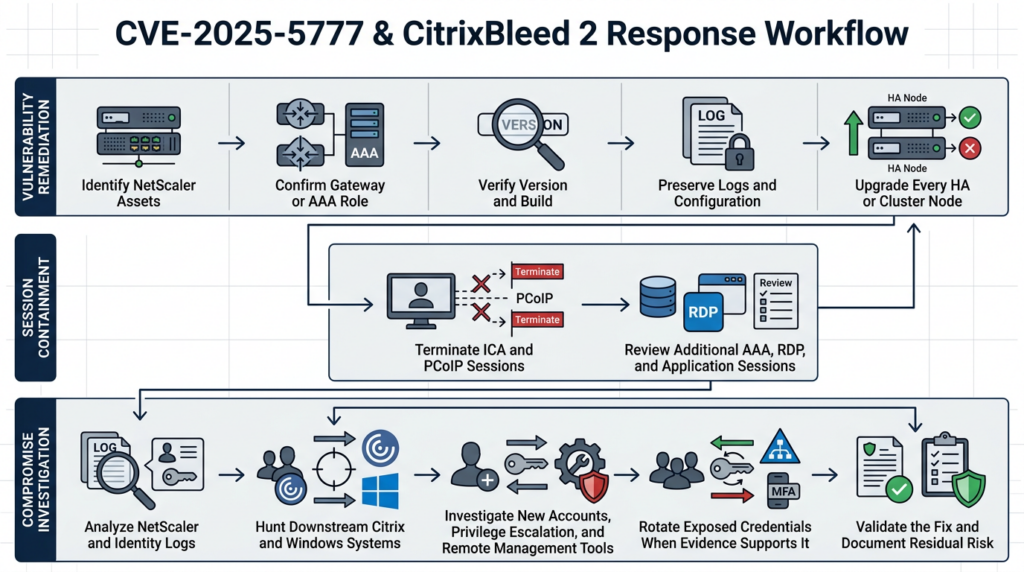
Preserve Evidence Before Destructive Actions
Where business and safety conditions allow, preserve:
- Local NetScaler logs
- External syslog
- Running and saved configuration
- Build information
- HA and cluster state
- Relevant session records
- Firewall and reverse-proxy logs
- Network-flow data
- IdP and MFA logs
- Citrix Delivery Controller and StoreFront logs
- Windows event logs from published desktops
- EDR telemetry
- Account and group change history
- Remote-management software inventory
Session termination and rebooting may be necessary for containment, but they can remove volatile context. The response lead should balance evidence preservation against active risk rather than delaying urgent containment indefinitely.
Define the Exposure Window
The exposure window begins at the earliest point when all of these were true:
- A vulnerable build was installed.
- The affected Gateway or AAA role existed.
- The service was reachable by a potential attacker.
For many organizations, the practical investigation start should be no later than June 23, 2025, because GreyNoise observed exploitation attempts on that date. An earlier start may be appropriate if the appliance was exposed and the organization wants a conservative search window.
The window ends only when:
- Every relevant node is upgraded.
- The vulnerable service is no longer reachable on an affected build.
- Potentially exposed sessions are invalidated.
If an HA secondary remained vulnerable after the primary was upgraded, the exposure window may continue.
Contain the Identity Edge
Containment priorities include:
- Upgrade all affected nodes.
- Terminate affected sessions.
- Restrict unnecessary external access.
- Block confirmed malicious infrastructure where operationally safe.
- Disable confirmed compromised accounts.
- Isolate affected Citrix workloads if downstream compromise is present.
- Remove unauthorized remote-management access.
- Preserve evidence of persistence mechanisms.
- Require reauthentication through a trusted path.
IP blocking can reduce immediate noise but cannot be the primary fix. Attackers can change infrastructure, and previously stolen sessions may be replayed from addresses that were never involved in the original exploitation.
Scope Downstream Access
For every suspicious NetScaler session, identify:
- The user
- Session start and end time
- Source and client addresses
- Client hostname where available
- Published application or desktop
- Backend servers reached
- Files and shares accessed
- Processes launched
- Accounts queried
- Privilege changes
- Remote-management installations
- Data transfers
The investigation should follow the identity and session, not stop at the appliance.
Decide What Credentials and Secrets to Rotate
A memory-disclosure vulnerability raises understandable pressure to rotate everything. An indiscriminate reset can create outages, destroy useful session context, and consume time without prioritizing the most plausible exposures.
Use a scoped approach:
| Secret or credential | Rotation trigger |
|---|---|
| Active user sessions | Invalidate as part of remediation |
| Password of a confirmed hijacked user | Rotate and investigate account activity |
| Privileged account password | Rotate if used through the affected path or exposed in evidence |
| Service-account credential | Rotate if present in traffic or memory reachable by the appliance |
| API token | Revoke if transmitted through the affected workflow and replay is plausible |
| Application signing key | Rotate only if evidence suggests key material could have been exposed |
| IdP signing certificate | Do not rotate solely because a Gateway was vulnerable unless architecture or evidence supports exposure |
| Local NetScaler administrator credentials | Rotate if administrative access or memory exposure could have included them |
| RMM tenant credentials | Rotate if an unauthorized installation or tenant connection is identified |
A vulnerability existing on an appliance does not prove that every credential in the enterprise was exposed. Conversely, the absence of a recovered token does not prove that none was stolen.
Safe PoC — A Local Uninitialized-Memory Model
The following demonstration is intentionally isolated and non-weaponized. It does not reproduce NetScaler’s endpoint, protocol, firmware, request format, or memory layout. It sends no network traffic and cannot be used to test a real appliance.
Its purpose is to show one concept: a program reuses a buffer, fails to initialize it for malformed input, and accidentally returns stale data from an earlier operation.
#!/usr/bin/env python3

from __future__ import annotations

from dataclasses import dataclass


BUFFER_SIZE = 64


@dataclass
class ToyAuthWorker:
    """
    A deliberately unsafe toy model.

    This is not NetScaler code. It only demonstrates how stale bytes
    can escape when a reusable buffer is not cleared.
    """

    reusable_buffer: bytearray

    @classmethod
    def create(cls) -> "ToyAuthWorker":
        return cls(bytearray(BUFFER_SIZE))

    def process_normal_request(self, username: str, session_value: str) -> str:
        sensitive_text = (
            f"user={username};session={session_value}"
        ).encode("utf-8")

        self.reusable_buffer[:] = b"\x00" * BUFFER_SIZE
        copied = sensitive_text[:BUFFER_SIZE]
        self.reusable_buffer[:len(copied)] = copied

        return f"Authentication processed for {username}"

    def process_malformed_request_unsafe(self) -> bytes:
        """
        Vulnerable behavior: returns a buffer that still contains
        data from the previous request.
        """
        return bytes(self.reusable_buffer)

    def process_malformed_request_fixed(self) -> str:
        """
        Safer behavior: reject malformed input without exposing the
        reusable internal buffer.
        """
        self.reusable_buffer[:] = b"\x00" * BUFFER_SIZE
        return "Invalid request"


def main() -> None:
    worker = ToyAuthWorker.create()

    worker.process_normal_request(
        username="demo-user",
        session_value="DEMO_TOKEN_NOT_REAL",
    )

    leaked = worker.process_malformed_request_unsafe()
    print("Unsafe response:")
    print(leaked.rstrip(b"\x00").decode("utf-8", errors="replace"))

    safe_response = worker.process_malformed_request_fixed()
    print("\nFixed response:")
    print(safe_response)


if __name__ == "__main__":
    main()
Expected output:
Unsafe response:
user=demo-user;session=DEMO_TOKEN_NOT_REAL

Fixed response:
Invalid request
The demonstration helps explain four defensive principles:
- Internal buffers must be initialized before use.
- Malformed parameters should be rejected before business logic executes.
- Response construction should use explicit validated lengths.
- Raw internal storage should never be returned merely because parsing failed.
A regression test can enforce the expected property:
def test_malformed_request_never_returns_stale_data() -> None:
    worker = ToyAuthWorker.create()

    worker.process_normal_request(
        username="demo-user",
        session_value="DEMO_TOKEN_NOT_REAL",
    )

    response = worker.process_malformed_request_fixed()

    assert response == "Invalid request"
    assert "DEMO_TOKEN_NOT_REAL" not in response
    assert all(byte == 0 for byte in worker.reusable_buffer)
This PoC is safe because it operates on a local Python object containing a fictional token. It does not identify vulnerable NetScaler appliances, send malformed authentication requests, extract production memory, or provide a weaponized payload.
Validation After the Upgrade
A secure change is not complete when the installer reports success. Validate the security property, deployment state, and business function.
Build Validation
Confirm:
- Every standalone, HA, and cluster member runs the intended fixed release.
- No secondary node remains on an affected build.
- The appliance booted into the expected image.
- Configuration synchronization is healthy.
- The running and saved configuration are consistent.
- The deployed branch remains supported.
Validação de segurança
Confirm:
- Previously active sessions were invalidated as planned.
- Old session artifacts no longer authorize access.
- New authentication requires the expected MFA flow.
- External syslog remains enabled.
- Firewall restrictions introduced during emergency containment are documented.
- No unexpected Gateway or AAA service remains exposed.
- Monitoring rules receive current events.
Functional Validation
Test:
- Gateway login
- MFA
- ICA Proxy
- CVPN
- RDP Proxy where used
- Published applications
- Published desktops
- SAML or other IdP integrations
- Logout
- Session expiration
- HA failover
- Certificate presentation
- Monitoramento e alertas
A common failure mode is validating only the login page. A page returning HTTP 200 does not prove that ICA launch, MFA callbacks, RDP proxying, session revocation, or HA behavior is correct.
Common Remediation Errors
| Error | Why it fails | Better approach |
|---|---|---|
| Checking only product name | The CVE has a role-specific precondition | Verify Gateway and AAA configuration |
| Checking only the primary node | An HA peer may remain vulnerable | Inventory and upgrade every member |
| Applying the minimum old fixed build | It may no longer be the safest supported release | Use a current supported build approved for the platform |
| Patching without killing sessions | Previously exposed sessions may remain usable | Perform vendor-required session termination |
| Killing only ICA and assuming all state is gone | Other persistent or application sessions may exist | Map every session layer in the deployment |
| Waiting for a public exploit before escalating | Exploitation began before public PoC details | Use KEV and exposure evidence |
| Running public PoC against production | It can expose real memory and contaminate evidence | Use authenticated checks and isolated labs |
| Treating no log match as proof of safety | Detection is incomplete and retention may be short | Document telemetry gaps and hunt downstream |
| Treating every IP change as compromise | Legitimate mobility and network changes cause noise | Correlate identity, timing, endpoint, and network context |
| Resetting every enterprise secret immediately | Creates disruption without evidence-based prioritization | Rotate based on plausible exposure and incident scope |
| Investigating only the appliance | Successful access may move quickly to internal hosts | Follow sessions into Citrix workloads and identity systems |
| Mixing CVE-2025-5777 with CVE-2025-6543 | The flaws, impacts, and fixed builds differ | Track each CVE and branch separately |
Related NetScaler Vulnerabilities
CVE-2025-5777 should be understood in the context of repeated security failures at the remote-access and identity edge.
| CVE | Affected condition | Problema principal | Operational lesson |
|---|---|---|---|
| CVE-2023-4966 | Gateway ou servidor virtual AAA | Divulgação de informações confidenciais | Patch plus session invalidation is required |
| CVE-2025-5349 | Access to specific management interfaces | Improper access control | Management-plane isolation remains essential |
| CVE-2025-6543 | Gateway or AAA role | Memory overflow, unintended control flow, and denial of service | Do not conflate availability and memory-disclosure response |
| CVE-2025-5777 | Gateway or AAA role | Memory overread | Treat session exposure as an identity incident |
| CVE-2025-7775 | Specific Gateway or AAA configurations | Memory overflow with RCE or denial-of-service potential | Maintain a repeatable emergency appliance-upgrade process |
| CVE-2026-3055 | NetScaler configured as SAML IdP | Memory overread | Inventory identity roles, not just product names |
CVE-2023-4966
The original CitrixBleed vulnerability showed that memory disclosure from a NetScaler authentication edge could expose session cookies and support MFA bypass through session hijacking. CISA published dedicated response guidance, and the incident established the importance of terminating sessions after patching. CVE-2025-5777 is not confirmed to have the same root cause, but the response lesson directly applies.
CVE-2025-5349
CVE-2025-5349 appeared in the same June 17 bulletin as CVE-2025-5777 but concerns improper access control on the management interface. Its precondition and impact differ. Management interfaces should already be isolated from untrusted networks, but teams must not use management-plane restrictions as evidence that the Gateway-facing memory disclosure is mitigated.
CVE-2025-6543
CVE-2025-6543 involves a memory overflow that may produce unintended control flow and denial of service. Citrix stated that the flaw was exploited in the wild. It was disclosed with different fixed-build thresholds than CVE-2025-5777. Security teams responding to the 2025 NetScaler disclosures had to verify that their chosen release addressed every relevant CVE rather than stopping at the first minimum version listed in an earlier bulletin.
CVE-2025-7775
Citrix later disclosed CVE-2025-7775 as another critical NetScaler memory-overflow issue and reported exploitation of unmitigated appliances. The specific configuration requirements differ, but its appearance reinforces the need for branch-aware inventory, rapid change capability, and lifecycle control for edge appliances.
CVE-2026-3055
CVE-2026-3055 is a later NetScaler memory-overread vulnerability associated with the SAML Identity Provider role. Its configuration precondition differs from CVE-2025-5777, yet both demonstrate that teams must inventory what an appliance actually does. A useful technical comparison is available in Penligent’s analysis of NetScaler SAML IdP memory-overread risk, which separates confirmed vendor facts from broader CitrixBleed comparisons.
The 2026 Huntress Cases Change the Long-Term Risk Picture
The July 2026 Huntress report is important because it shows the long tail of an edge-appliance vulnerability. A CVE disclosed in June 2025 was still assessed as an initial-access path in incidents investigated during the first half of 2026.
Huntress described a repeatable pattern across unrelated organizations:
- An exposed NetScaler environment was the suspected entry point.
- The attacker obtained access associated with a normal Citrix user.
- The operator escalated privileges locally.
- A rogue administrative account was created.
- Legitimate remote-management tools established durable access.
- Additional discovery and control followed.
- One mature intrusion ended in DragonForce ransomware.
The report is valuable partly because it states its uncertainty. Huntress did not recover a leaked session cookie in every case, and NetScaler log rotation made historical visibility difficult. The researchers based their conclusion on the repeated attack sequence, known vulnerability behavior, external reporting, victim exposure, and matching operator tradecraft.
That distinction should shape incident reports. A responder can write:
The appliance met the affected configuration and version conditions, and downstream activity matched a known CitrixBleed 2 intrusion pattern. CVE-2025-5777 is assessed as the most likely initial-access vector.
That is more accurate than claiming:
Packet captures prove the attacker extracted a specific session token.
The first statement communicates a high-confidence assessment. The second requires direct evidence that may not exist.
The ransomware outcome also demonstrates why session exposure should not be categorized as “confidentiality only” in operational planning. CVSS may describe the immediate software effect as memory disclosure, but an authenticated foothold on a remote desktop can lead to privilege escalation, persistence, lateral movement, data theft, and business disruption.
Detection Engineering Should Favor Correlation
No single log pattern provides complete coverage. A stronger analytic joins multiple weak or moderate signals.
A useful correlation might require several of the following within a defined window:
- Um
AAA Messagerejected-authentication event containing binary or non-ASCII data - A threat-intelligence match for the source address
- A Citrix session with an unexpected client or source IP
- No corresponding MFA event
- A new interactive Windows session
- LDAP or group enumeration
- Execution of ADExplorer or similar tooling
- Creation of a local administrator
- Installation of ScreenConnect, Zoho Assist, or another unapproved RMM agent
- A suspicious executable launched from a temporary directory
- Security-control modification
- Connections to file-sharing or remote-management infrastructure
Each signal has false positives. Their combination is far stronger.
| Sinal | Standalone confidence | Useful enrichment |
|---|---|---|
| Non-ASCII rejected-authentication log | Médio | Source reputation, appliance build, request volume |
| Client and source IP mismatch | Low to medium | User location, NAT, VPN, DHCP, IdP logs |
| Missing MFA event | Médio | Token age, IdP availability, application behavior |
| Hosting-provider source | Médio | User baseline, approved VPN providers |
| ADExplorer execution | Médio | Administrator activity, execution account |
| New local admin | Alta | Change ticket, creator process, source session |
| New RMM service | Medium to high | Approved inventory, tenant ID, installer source |
| Ransomware behavior | Crítico | EDR, file modifications, command history |
Detection logic should also survive future changes. Hard-coding one attacker hostname or one IP list creates brittle coverage. Behavioral rules around unauthorized sessions, local privilege escalation, account creation, and RMM deployment remain valuable even when the initial access vector changes.
Automated Validation and Evidence Collection
Large NetScaler estates make manual response error-prone. The most valuable automation is not unauthenticated exploit spraying. It is reliable coordination across inventory, configuration, patch state, logs, and evidence.
A mature workflow should be able to:
- Import every known NetScaler asset
- Associate public addresses with internal owners
- Identify Gateway, AAA, and SAML IdP roles
- Compare builds with current vendor advisories
- Detect mismatched HA members
- Preserve pre-change evidence
- Track upgrade completion
- Verify post-change builds
- Record session-termination actions
- Re-run safe functional tests
- Correlate appliance, identity, and endpoint alerts
- Generate an auditable response report
AI-assisted security validation can help organize these steps, especially when asset records, vendor advisories, command output, and logs are fragmented across teams. The system should preserve source evidence and require human approval for disruptive actions such as session termination or production changes. An agent should not replace vendor guidance with an inferred exploit or treat a generated conclusion as proof.
Plataformas como Penligente are most relevant here when they are used for authorized, evidence-driven validation: mapping a known CVE to a controlled target, selecting non-destructive checks, preserving tool output, repeating post-patch verification, and producing a report that distinguishes confirmed findings from uncertainty. The useful outcome is not “AI exploited a box.” It is a repeatable record of which assets were in scope, which checks ran, what changed, and what still requires human incident judgment.
What Not to Conclude
The appliance is patched, so there was no breach
False. The patch prevents future exploitation of the corrected path. It does not answer what happened before installation.
We found no non-ASCII log lines, so exploitation did not occur
Unsupported. Citrix says the check cannot detect all exploitation, and local retention may be only a few days.
Every client-IP change proves token theft
False. Users change networks, and proxies, NAT, VPNs, DHCP, and mobile connections alter addresses.
MFA prevents CitrixBleed 2
Misleading. MFA can protect session creation, but a valid session artifact may be replayed after authentication.
CVE-2025-5777 affects every NetScaler ADC
False. The published condition requires a Gateway or AAA role, although other CVEs may affect other roles.
CVE-2025-5777 and CVE-2023-4966 are the same bug
Not established. Citrix says it found no evidence that they are related. They have similar operational consequences.
The official two session commands invalidate every application token
Not guaranteed. They terminate ICA and PCoIP connections. Organizations must map other session layers in their own deployment.
Public PoC testing is the fastest way to determine exposure
Usually not for production. Authenticated build and role validation is safer, more deterministic, and less likely to leak sensitive memory.
PERGUNTAS FREQUENTES
Is CVE-2025-5777 Really CitrixBleed 2?
- “CitrixBleed 2” is a community nickname, not the formal vendor name.
- The comparison is based on memory disclosure and possible session theft at the NetScaler authentication edge.
- Citrix says it found no evidence that CVE-2025-5777 is technically related to CVE-2023-4966.
- It is accurate to describe similar operational risk, but not an identical confirmed root cause.
Are All NetScaler ADC Appliances Vulnerable?
- No.
- The appliance must run an affected build.
- It must also be configured as a Gateway, including VPN virtual server, ICA Proxy, CVPN, or RDP Proxy, or as an AAA virtual server.
- Customer-managed instances require direct action.
- Citrix stated that it updated Citrix-managed cloud services and Citrix-managed Adaptive Authentication itself.
- Other NetScaler CVEs may apply even when CVE-2025-5777’s role condition is absent.
What Versions Fix CVE-2025-5777?
- NetScaler ADC and Gateway 14.1-43.56 or later
- NetScaler ADC and Gateway 13.1-58.32 or later
- NetScaler ADC 13.1-FIPS and 13.1-NDcPP 13.1-37.235 or later
- NetScaler ADC 12.1-FIPS 12.1-55.328 or later
- Standard versions 12.1 and 13.0 are end of life and should be migrated.
- Organizations responding now should select a current supported release, not automatically deploy the oldest build that first contained the fix.
Do Sessions Still Need to Be Terminated After Patching?
- Yes.
- Citrix instructs customers to upgrade all appliances in an HA pair or cluster and then run the ICA and PCoIP termination commands.
- The reason is that patching does not automatically make previously exposed session artifacts unusable.
- Organizations should also identify RDP, AAA, application, and persistent sessions that are not covered by those two commands.
- User disruption should be planned, but it should not override the security requirement.
Why Can a Stolen Session Bypass MFA?
- MFA is normally performed when the session is created.
- The resulting token tells the application that authentication already succeeded.
- If an attacker steals and replays a valid token, the application may not request the password or second factor again.
- Token expiration, revocation, client binding, reauthentication, and risk-based controls can reduce this risk.
- The flaw does not break the MFA algorithm; it can expose post-authentication state.
How Can a Team Check Exposure Safely?
- Verify the exact version and build through an authorized administrative method.
- Confirm whether the appliance runs a Gateway or AAA virtual server.
- Identify every HA and cluster member.
- Determine when the affected service was internet reachable.
- Review external syslog and identity telemetry.
- Avoid sending public exploit requests to production or systems you do not own.
- Use an isolated lab for technical reproduction and a toy model for developer education.
Does a Clean Log Search Prove the Appliance Was Not Exploited?
- No.
- Citrix states that its suggested checks will not necessarily detect every exploit.
- Local appliance logs may retain only a few days.
- SIEM parsing can alter malformed or non-ASCII data.
- Successful memory disclosure may not leave the exact published artifact.
- A clean result should be recorded as “no match in available telemetry,” not “confirmed unexploited.”
When Should CVE-2025-5777 Trigger a Full Incident Response?
- The appliance ran an affected build and role while internet exposed.
- Historical logging is missing or incomplete.
- A Citrix session appears without a corresponding user authentication or MFA event.
- A session is reused from suspicious or unrelated networks.
- The user denies the activity.
- Active Directory reconnaissance follows the session.
- New administrators, services, scheduled tasks, or RMM tools appear.
- EDR detects privilege escalation, credential access, lateral movement, or ransomware.
- Any of these stronger signals should expand the investigation from appliance remediation to identity and endpoint compromise response.
Closing Assessment
CVE-2025-5777 is an unauthenticated memory-overread vulnerability on a high-value identity and remote-access boundary. The technical defect is serious, but the larger risk comes from what may be present in memory and what a stolen session can reach.
The correct response is not limited to installing a firmware build. Teams must identify every affected Gateway and AAA deployment, upgrade all HA or cluster members, terminate potentially exposed sessions, preserve and review logs, and follow suspicious identities into downstream systems.
CISA’s KEV listing established that exploitation was not merely hypothetical. GreyNoise showed that activity preceded public PoC details. Huntress’s 2026 investigations showed how the same vulnerability could remain relevant long after disclosure and potentially support an intrusion chain ending in ransomware.
The most durable lesson is procedural. Identity-edge appliance vulnerabilities require role-aware inventory, rapid supported upgrades, session-aware containment, external logging, and evidence-driven investigation. Organizations that institutionalize those capabilities will be better prepared not only for CitrixBleed 2, but for the next NetScaler vulnerability that places authentication state at risk.

 Portuguese
  English
  German
  French
  Spanish
  Japanese
  Korean
  Hindi
Hindi  Arabic
  Turkish
  Hebrew