
Status checked November 29, 2026. Hex.pm says an attacker ran commands on six web servers using an unauthenticated Erlang-term parser flaw. The team found no unauthorized package changes, but missing read-access logs prevent it from ruling out access to database or private-package data. The patch closes the parser entry point by rejecting decoded structs; the incident response leaves a separate question for users: what did the integrity checks establish, and what remains unknown?
What CVE-2026-129514 affects
The Erlang Ecosystem Foundation’s CVE record describes an unauthenticated remote code execution flaw in the application/vnd.hex+erlang request parser. It assigns CVSS 10.0 and lists the affected component as the hexpm/hexpm server project, with the fixed commit 379b0a29bcc95164249f38ad7d772a37a8ff9533. This is a server-side code range, not a statement that every application that downloads dependencies from Hex has a vulnerable local package. The distinction matters when teams decide whether to rebuild their own dependencies or verify the registry service’s trust transition. (CVE-2026-129514)
The attack took place on November 23, 2026. Hex reported 69 malicious requests between 18:16 and 18:29 UTC. Commands ran on six web servers, and the full fleet had been replaced with a patched build by 18:31 UTC. (Hex incident report)
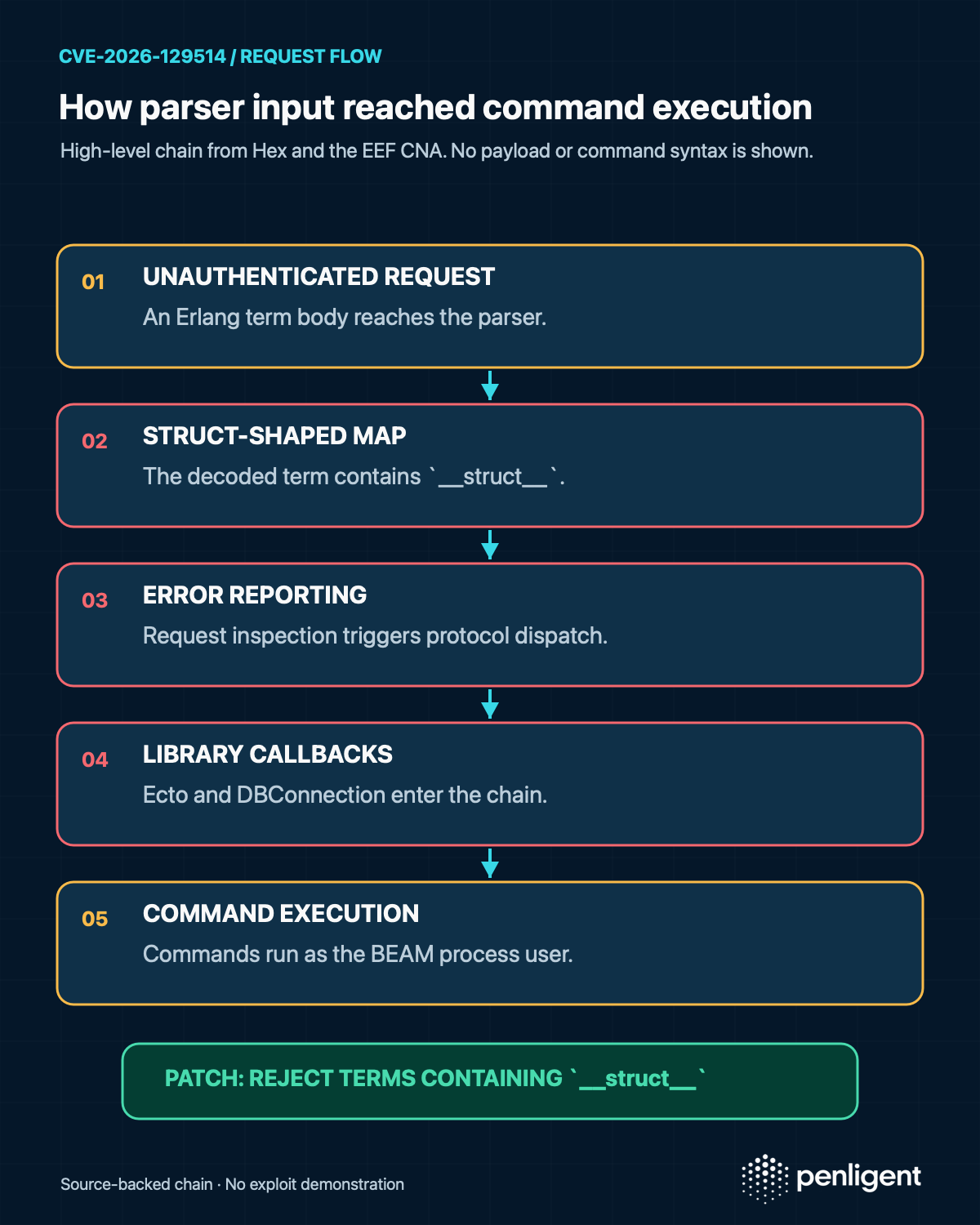
How safe term decoding reached command execution
Hex’s endpoint accepted Erlang external-term request bodies and decoded them with Plug.Crypto.non_executable_binary_to_term/2 using the :safe option. That option blocked functions and new atoms, but the resulting term could still contain maps with a __struct__ key. In Elixir, protocol dispatch can treat such a map as a struct-shaped value. The parser ran before routing and authentication, so an unauthenticated request could reach it on any route. (CVE technical analysis)
The exploit chain depended on what happened after parsing. A malformed request entered the error-reporting path, which inspected request data. Inspection dispatched through the forged struct’s Inspect implementation; an Ecto.Query.DynamicExpr value led to enumeration of a forged DBConnection.Stream. Its :log option then reached a callback invocation. Hex says the attacker used this chain to execute operating-system commands as the BEAM process user. The chain crossed parser, framework, database-library, and logging boundaries; the :safe decoder flag by itself did not make arbitrary decoded structs inert. (Hex incident report; CVE-2026-129514)
What the patch changes
O fix commit adds a recursive check after decoding. It searches maps, their keys and values, lists, and tuples for __struct__. If the decoded term contains one, the parser returns an error that becomes an HTTP 400 response; ordinary maps without that key remain accepted. The tests cover nested struct-shaped data, struct-shaped map keys, lists, and a valid nested map. Because the check sits in the one decoder for this content type, it blocks the struct-shaped input before application routes or error reporting can process it. Hex says its own local reproduction confirmed that the old build ran the command and the fixed build rejected the request; Penligent did not independently reproduce the issue. (Fix commit 379b0a2; Hex incident report)
This is a boundary fix, not proof that every unsafe deserialization pattern across the ecosystem has disappeared. Hex said it was also pursuing defense-in-depth changes in Plug.Crypto, Plug, Ecto, and DBConnection. The related CVE-2026-133555 record explicitly says the DBConnection issue is not exploitable in that library alone; the risk arises when downstream software builds and processes structs from untrusted decoded input. Hex also reported a similar class of issue in Ash pagination cursors, fixed in Ash 3.38.0. Those are related hardening findings, not evidence that the same Hex.pm exploit affected every application using these libraries. (Hex incident report; CVE-2026-133555)
What the incident checks prove—and what they do not
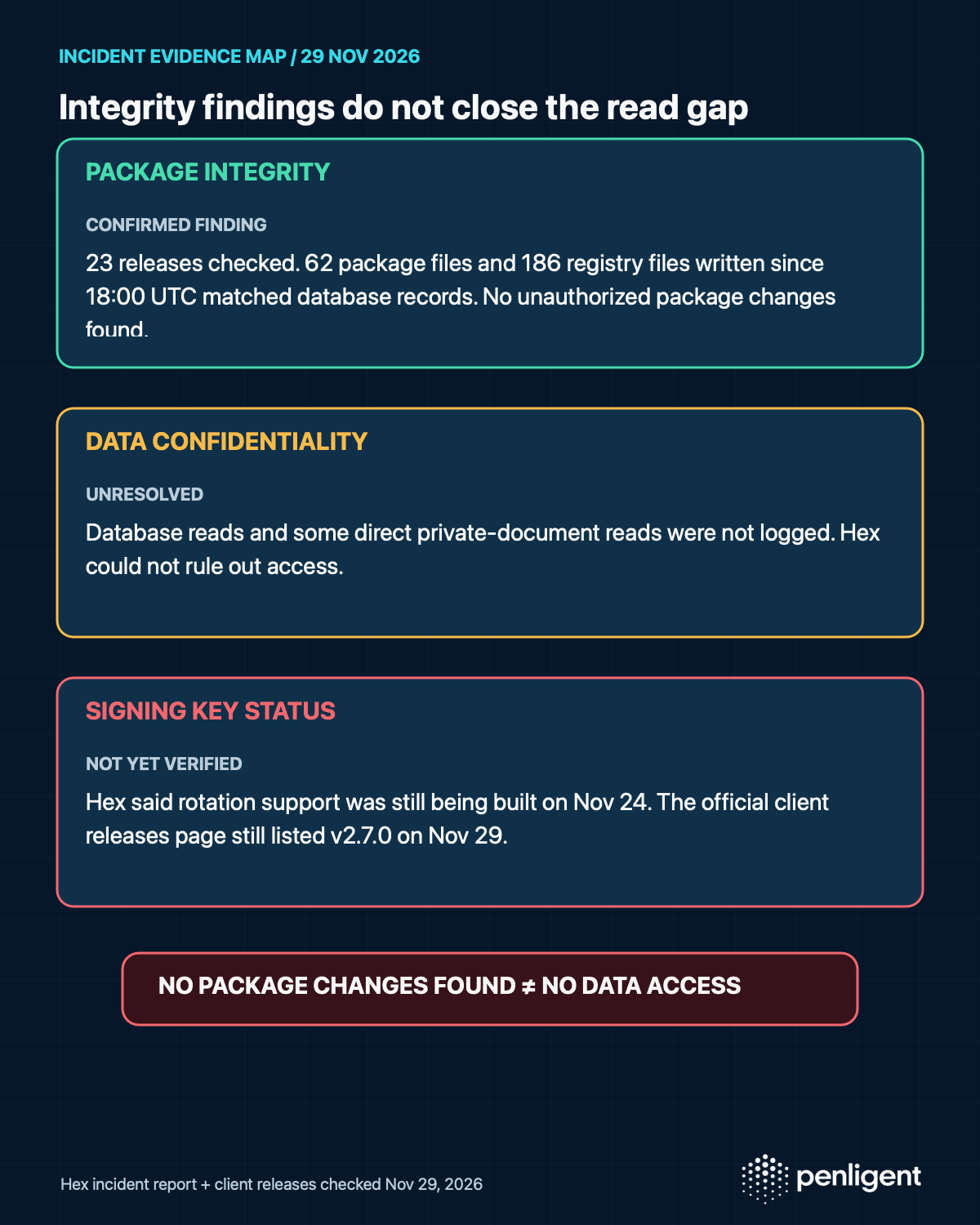
Hex’s report separates package-write integrity from data-read confidentiality. That distinction is useful for downstream teams reviewing their exposure.
| Pergunta | What Hex reported | What remains open |
|---|---|---|
| Were packages changed? | All 23 releases published during the incident matched audit-log entries. All 62 package files and 186 registry files written during the window matched database contents; no older release was found to have changed. | This supports the package-integrity review, but does not resolve whether data was read. |
| Did the attacker change the database or remain on the servers? | Hex found no unexplained database row changes, no shells on affected hosts before replacement, and no evidence of new keys or accounts from attacker addresses. | These checks found no evidence of persistence or database writes; they do not establish that no information was read. |
| Could database or private data have been read? | Hex reviewed access logs and found no attacker-attributed requests to private documentation through the CDN. | Database reads, environment-variable reads, shell commands, and direct private-document storage reads were not fully logged, so access cannot be ruled out. |
| Was the registry signing key rotated? | Hex said it rotated credentials and token-signing keys, with the registry signing key among the exceptions as of November 24 because a rotation-capable signing system was still being built. | The official Hex client release page still listed v2.7.0, released November 6, when checked November 29; I could not verify a client release carrying the new signing system. |
These are Hex’s published investigation results, not an independent audit by Penligent. “No evidence of package modification” is a meaningful integrity finding. It should not be expanded into “no data was accessed,” because the company says its logs cannot answer that second question. (Hex incident report; Hex client releases)
Actions by user type
- Teams that install public packages: Hex said to fetch only from
repo.hex.pmand avoid third-party mirrors until it releases the new signing system. Check the official Hex client releases for that release; the page showed v2.7.0 as latest at the November 29 check. Do not treat this as evidence that application dependencies were altered. - Hex account holders: Hex asked users to change their password and reset 2FA, and the incident logged users out of Hex.pm and Hex clients. Reauthenticate your CLI client using the documented
mix hex.user authourebar3 hex user authflow as applicable. Treat unexpected Hex-branded email cautiously and check that links lead tohex.pm. The company said its API keys are 128-bit random values stored as HMAC-SHA256 hashes and did not recommend rotating them solely because those hashes might have been read; that assessment does not cover keys exposed elsewhere. (Hex incident report) - Organizations with private packages or documentation: Hex said it would contact affected organizations directly. Because direct storage reads were not fully logged, review the sensitivity of private package contents and documentation accessed during the incident window, and preserve relevant organizational records.
- Operators of self-hosted
hexpm/hexpm: compare the deployed source with the fixed commit and verify that the parser recursively rejects struct-shaped terms. A version label alone is insufficient when deployments are built from Git revisions or local patches.
The practical lesson: keep integrity and confidentiality separate
The Hex.pm response shows why package-registry incident reviews need two distinct evidence tracks. File checksums and publication logs can provide strong evidence about whether packages were changed. Read-access telemetry is needed to bound what an attacker may have viewed. In this incident, the first track produced a detailed result; the second remained incomplete.
For package consumers, follow the signing-system transition and the official mirror guidance. For organizations using private Hex repositories, treat confidentiality as unresolved until Hex’s follow-up clarifies the scope. For registry operators, include database and object-store reads in incident telemetry before an intrusion occurs; without those records, an investigation may be unable to distinguish “not accessed” from “not observable.”
For teams assessing their own web applications, an authorized security assessment can trace how untrusted data moves through parsers, error handlers, and library callbacks. Penligente provides a general security-testing workflow; this article does not claim that Penligent tested Hex.pm or reproduced this CVE.
The video below is a general Penligent 3.0 workflow demonstration. It does not demonstrate CVE-2026-129514, Hex.pm exploitation, or remediation.
Method and scope
This analysis maps the Hex incident report, the Erlang Ecosystem Foundation CNA record, the public fix commit, and the official Hex client release page into a reader-focused evidence and response matrix. No exploit was run, no Hex.pm account or registry was accessed, and the patch was not independently tested. Status was checked November 29, 2026; follow Hex’s incident post and release page for changes.
 Portuguese
 English
 German
 French
 Spanish
 Japanese
 Korean
 Hindi
 Arabic
 Turkish
 Hebrew