
CVE-2026-23871 is an IP-disclosure issue in WhatsApp for Android and WhatsApp Business for Android. Meta says incomplete validation of an external ad-reply URL could expose a target’s IP information when attacker-controlled media was rendered from a crafted Click to WhatsApp ad-reply message. The CVE record lists versions before 2.26.17.4 as affected.
This is not described as remote code execution. The CVE record assigns CVSS 3.1 LOW (3.5) and requires user interaction. Meta says the issue may have been abused alongside specific spam messages, but it does not publish a reproducible exploit, campaign scope, or affected-user count. Treat that statement as a reason to verify app versions, not as proof that every device received a malicious message.
What the record establishes
| Verificar | CVE record |
|---|---|
| Products | WhatsApp for Android; WhatsApp Business for Android |
| Affected range | 2.20.198.3 through versions before 2.26.17.4 |
| Reported impact | Target device may reveal IP information |
| Trigger described | Crafted Click to WhatsApp ad-reply message displays media from an attacker-controlled URL |
| CVSS 3.1 | 3.5 LOW; AV:N, PR:L, UI:R, C:L |
| iOS in affected-product list | Não |
The CVE lists Android products only. Do not extend the advisory to iOS or other messaging clients without a vendor statement. The record does not say that the issue exposes message contents, grants account access, or executes code.
Understand the documented trigger
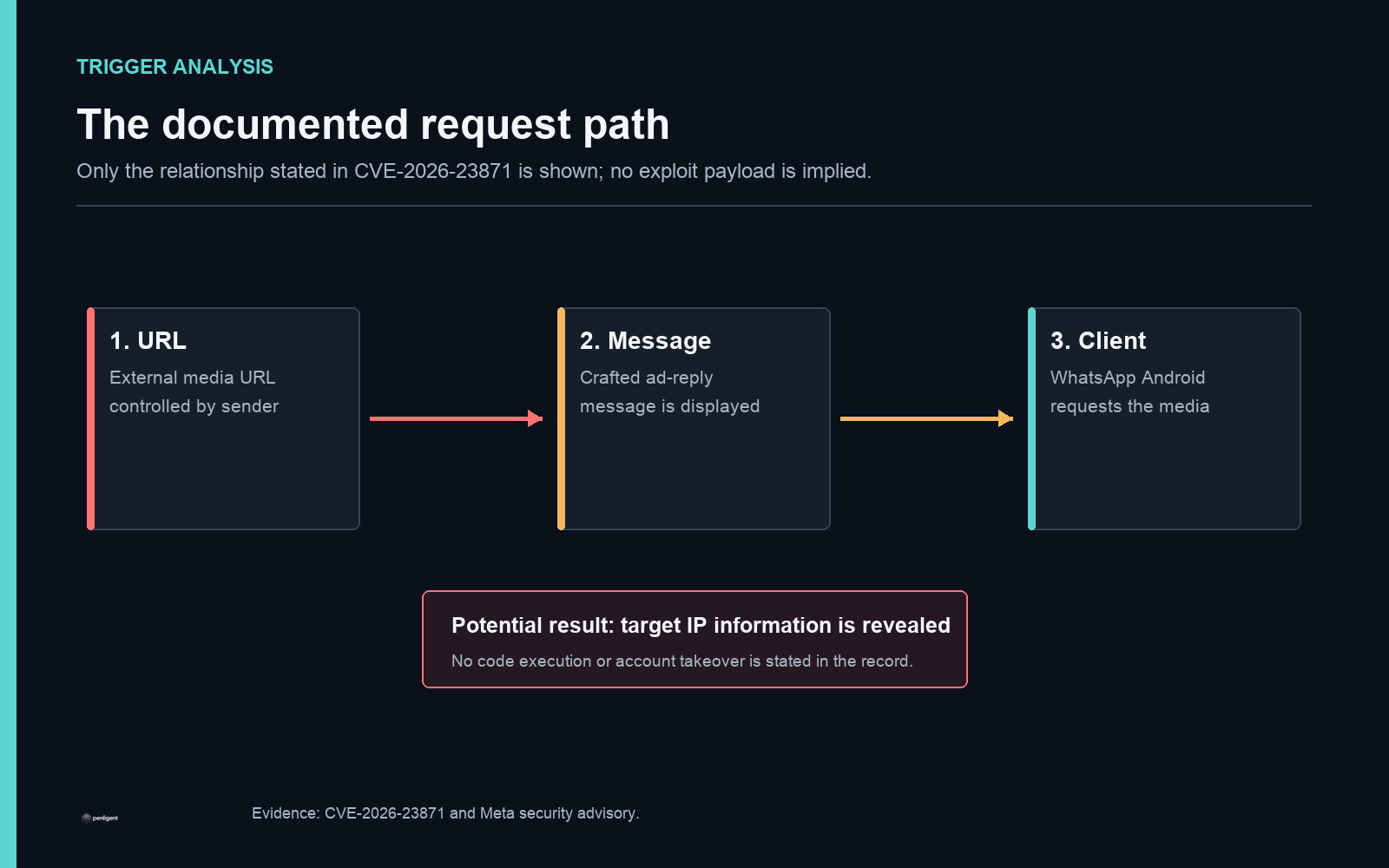
The public description ties the potential disclosure to a specific sequence: a crafted ad-reply message is displayed in a thread, the message contains media from an attacker-controlled URL, and the client renders that media. The diagram summarizes that relationship from the CVE record; it is not an exploit recipe or a Penligent reproduction.
Prioritize devices by version and exposure
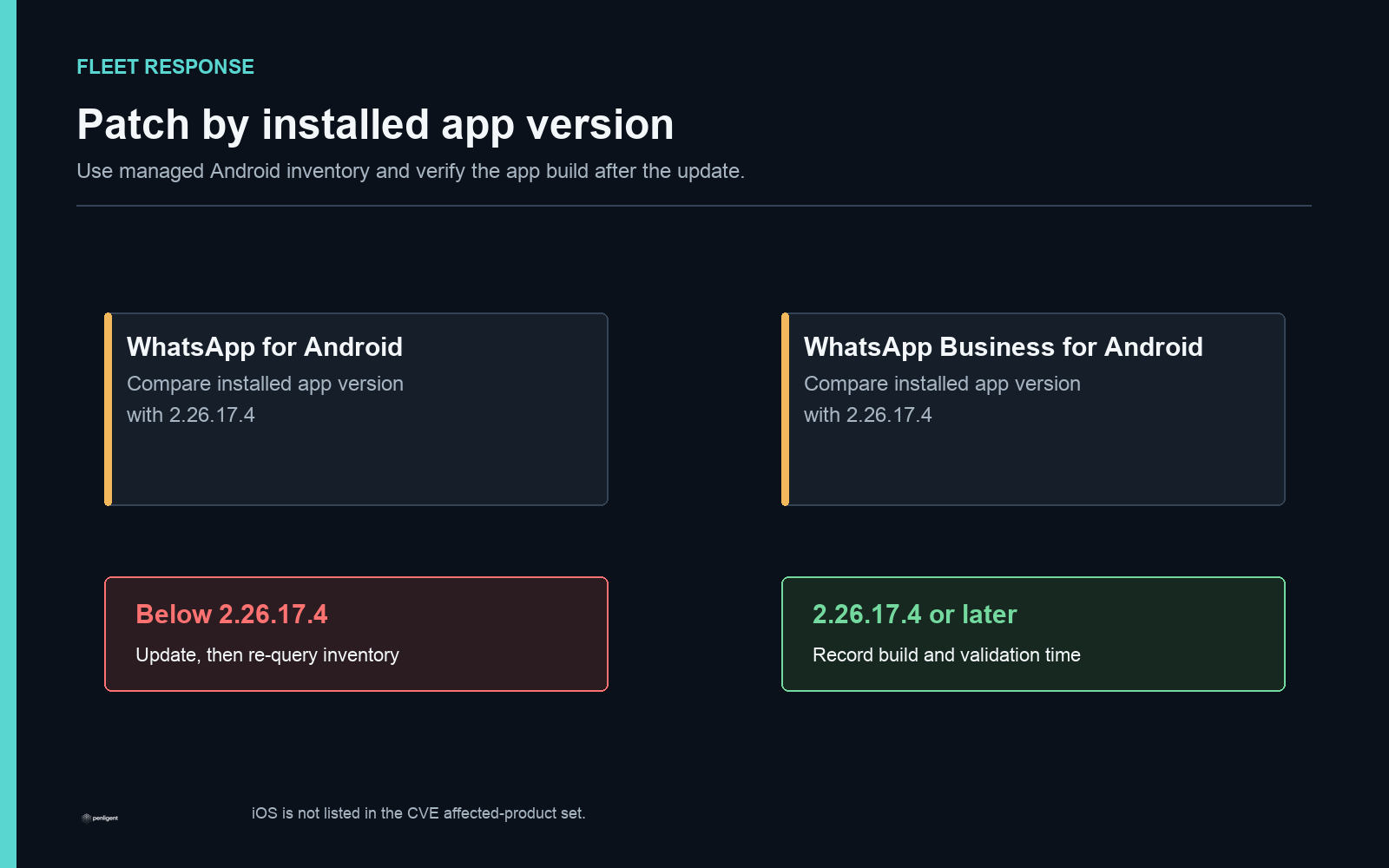
Start with managed Android inventory for both named apps. Capture the app package, displayed version, device owner, and inventory timestamp. Compare each app version with 2.26.17.4; do not infer it from the Android OS build or from a different WhatsApp installation channel.
For a device below the threshold, update through the organization’s managed app catalog or the official store available to that device. Refresh inventory and record the resulting app version. If immediate updating is not possible, document the owner, business need, compensating restrictions, and due date. The advisory does not provide a server-side switch that substitutes for updating the client.
Close the verification loop
- Query managed Android inventory for WhatsApp and WhatsApp Business.
- Flag versions earlier than 2.26.17.4 for update.
- Re-query after remediation and retain version evidence.
- Route suspicious ad-reply messages with external media to incident response; preserve message and device context without replaying the message as a test.
- Keep iOS and unrelated products out of the affected-device count unless Meta expands the scope.
Report the number of in-scope Android installations, versions observed, installations updated to 2.26.17.4 or later, and devices still below threshold. For suspected exposure, whether the message was displayed and whether it contained externally hosted media are useful triage facts, but do not independently prove exploitation.
Sources and limitations
CVE-2026-23871 record | Meta security advisory | WhatsApp security advisories
Method: AI assisted organization of the article. Material claims were checked against the CVE record and linked Meta advisories. Penligent did not reproduce the issue or assess real-world campaign activity. The procedures above are proposed defensive checks, not reported test results.
The video below is a general Penligent product workflow demonstration. It is not evidence for CVE-2026-23871.
 Portuguese
 English
 German
 French
 Spanish
 Japanese
 Korean
 Hindi
 Arabic
 Turkish
 Hebrew