
Git LFS 3.8.1 fixes four vulnerabilities affecting repository configuration, submodule configuration parsing, HTTP redirects, and SSH command construction. The shared remediation is a corrected Git LFS client on every machine that performs LFS operations, including CI runners. A patched Git hosting service does not establish that those clients are fixed.
The dates matter: the maintainer release and repository advisories were published on October 22, 2026. GitHub’s global advisory database added the reviewed entries on November 20. This November 21 assessment addresses that renewed visibility; it does not describe 3.8.1 as a release first issued today. The release states that the issues apply across supported operating systems.
Map the four issues before choosing a temporary control
| CVE | Affected starting version | Boundary and reported consequence | Fixed release |
|---|---|---|---|
| CVE-2026-105803 | 1.3.0 | A repository’s .lfsconfig can incorrectly select a custom transfer command executed by the client. | 3.8.1 |
| CVE-2026-105802 | 0.6.0 | Control characters in submodule configuration can be misread as additional options, leading to client command execution. | 3.8.1 |
| CVE-2026-69261 | 0.5.0 | Cookie headers can follow an HTTP redirect to an unintended origin. | 3.8.1 |
| CVE-2026-69260 | 0.5.0 | An SSH URL path can change remote command interpretation where the receiving service passes it to a shell without sanitization. | 3.8.1 |
The listed starting versions come from the maintainer advisories for repository configuration, submodule configuration, redirected headerse SSH URLs. Affected 3.x releases extend through 3.8.0; the advisories identify 3.8.1 as corrected. Use a supported release containing these fixes, or documented distributor backport evidence.
Why the configuration parser change matters
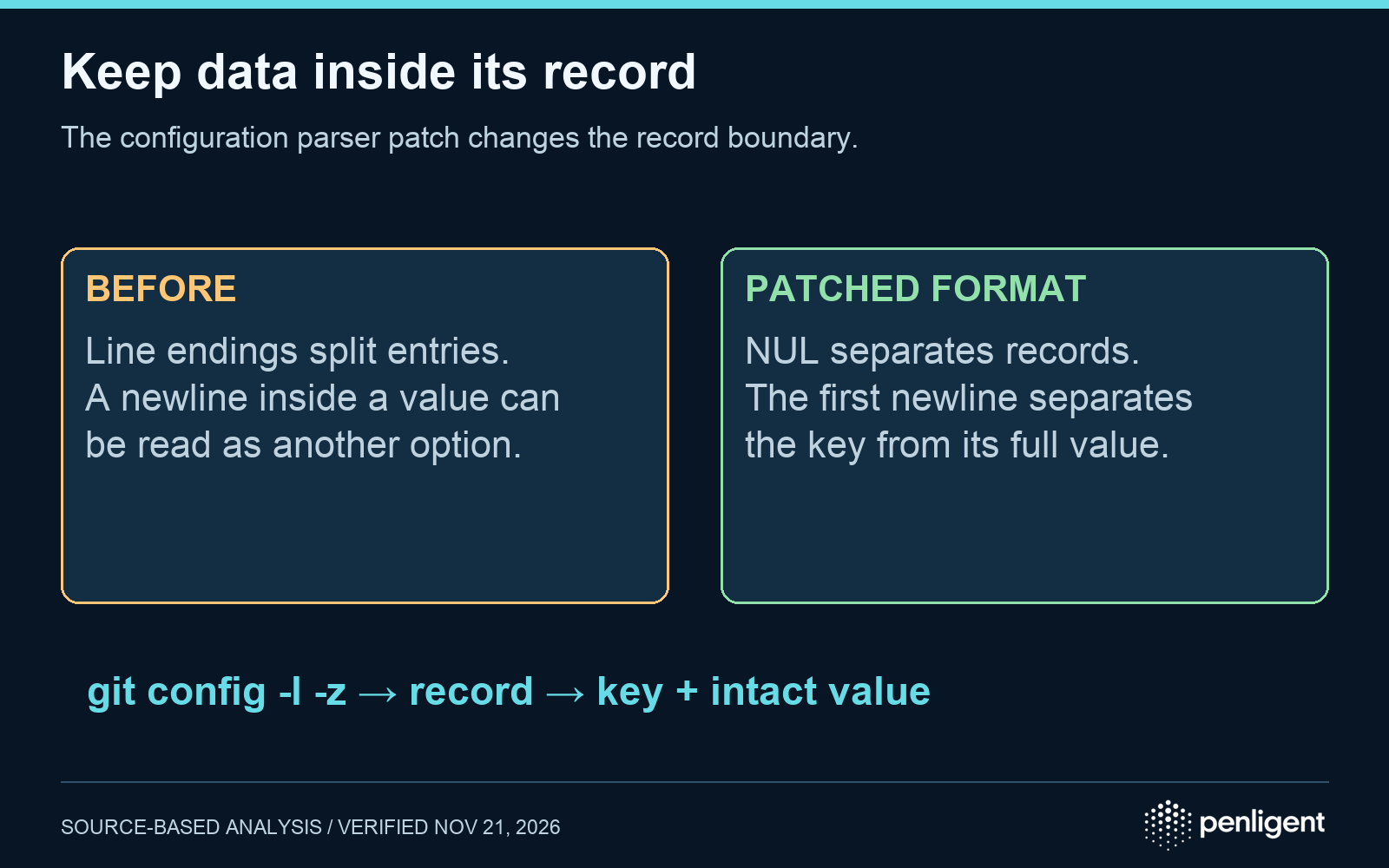
CVE-2026-105802 crosses a data boundary: a line ending inside a configuration value can be mistaken for the beginning of a separate option. The official parser patch adds the -z option when reading Git configuration. It splits output into NUL-delimited records, then separates each key from its value at the first newline. Additional newlines remain within that value.
This is useful review evidence for a backported package: inspect both how configuration is emitted and how it is parsed. Changing only one side is not evidence of the same correction. The upstream change also covers configuration read from a file, a revision, and the active configuration source. Its regression tests exercise newline-containing values and submodule-derived configuration. These are upstream tests inspected as source, not tests run by Penligent.
CVE-2026-105803 needs a separate conclusion. Its defect is insufficient filtering of repository-controlled .lfsconfig keys. The maintainer fix restricts custom object-transfer command configuration to local Git configuration sources. A finding about newline parsing does not establish that this key-filtering boundary is repaired.
Cookie protection follows the origin, not just the hostname
For CVE-2026-69261, the maintainer explicitly says that Authorization headers were not forwarded to inappropriate hosts; Cookie headers are the reported gap. Avoid turning that statement into a generic claim that all authentication headers leaked.
O redirect patch excludes Cookie alongside Authorization when a redirected request changes scheme, host, or port. Same-origin redirects retain those headers. The commit leaves other header forwarding unchanged, so a proprietary header containing a secret needs an independent review.
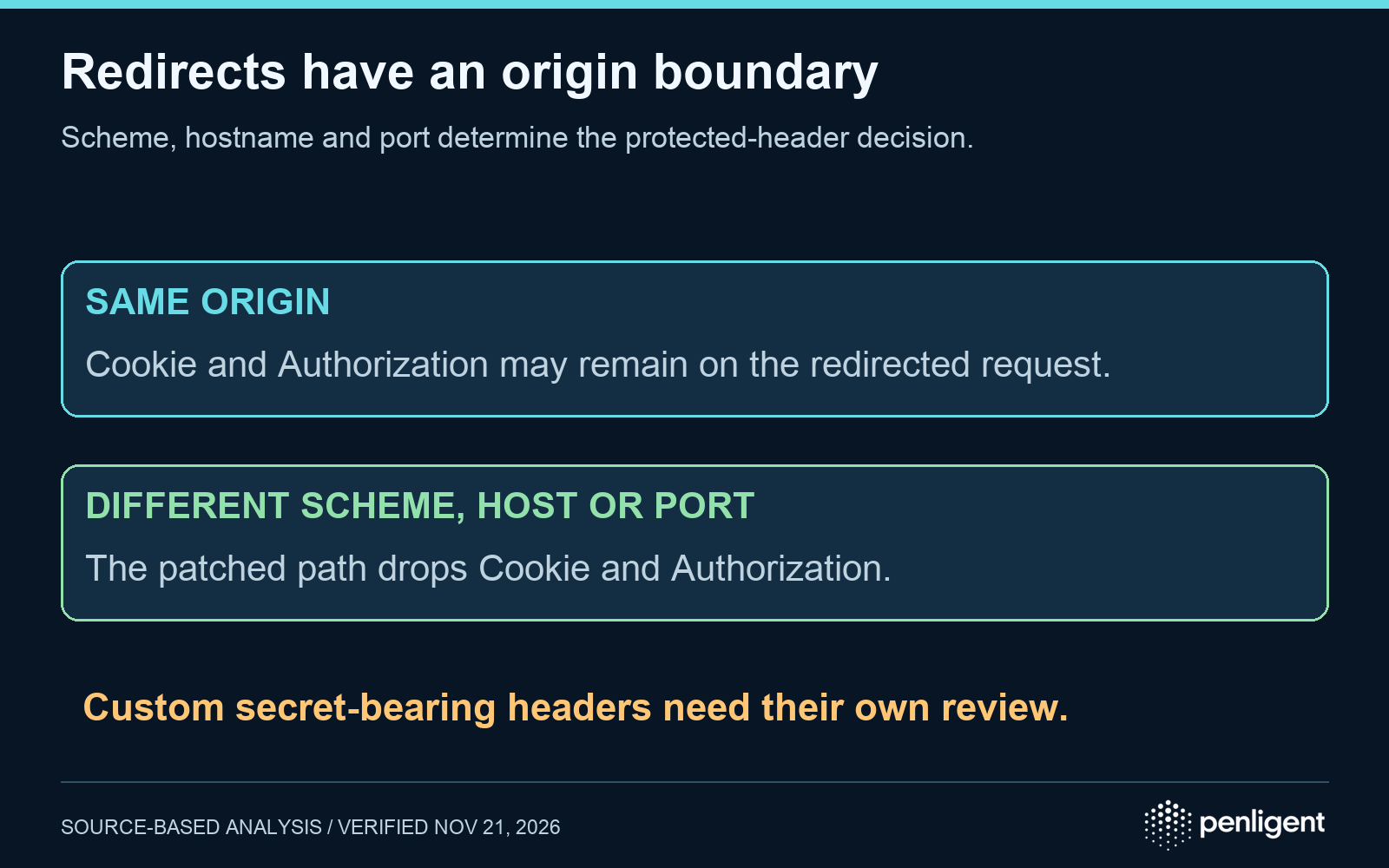
A safe acceptance design uses an isolated pair of owned HTTP endpoints and synthetic header markers. Check a same-origin redirect as a positive control, then changes of hostname, port, and scheme. Record whether the intended source receives the marker and whether the redirected destination receives it. Use dummy values only. This design tests header routing; it is not a reproduction of client command execution or evidence about previously exposed credentials.
Temporary measures cover different subsets
For the submodule issue, the maintainer recommends preventing submodule initialization: disable fetch.recurseSubmodules e submodule.recurse, avoid git submodule init, and handle already initialized submodules as described in that advisory. Those restrictions do not repair the separate .lfsconfig filtering issue.
Setting lfs.sshTransfer para nunca suppresses SSH object transfers, but the SSH advisory warns that authentication requests can still use SSH. The receiving service still needs to sanitize commands. For the repository-configuration issue, the vendor lists no single workaround other than disabling Git LFS entirely. Prefer the corrected client over combining partial controls and assuming complete coverage.
Verify the executable that the job actually uses
Run the following inventory checks inside the trusted execution environment used by the workflow, before processing an untrusted repository:
git --version
git lfs version
The first command identifies Git; the second identifies Git LFS. Retain the executable location from the operating system’s command-resolution tools as well. A developer shell, a GUI application’s bundled tools, a container image, and a self-hosted runner can resolve different executables.
| Execution surface | Evidence to retain | Reopen the finding when |
|---|---|---|
| Developer workstation | LFS version and resolved path under the actual user account | A GUI or alternate shell uses another bundled copy |
| CI job container | Image digest, job-time version output, and corrected package provenance | The job resolves an older image or installs its own tooling |
| Self-hosted runner | Runner identity, service-account path, and LFS version | An older worker rejoins the pool |
| Distributor backport | Vendor advisory mapping the exact package build to all four CVEs | Only a broad upstream version or one CVE is documented |
Finish with a known-good internal LFS workflow to confirm ordinary object handling still works. Do not fetch a public exploit repository as a validation step. If an affected client previously processed untrusted content, preserve relevant job and process records and investigate suspicious child processes or secret use separately; successful updating does not answer the historical incident question.
For authorized assessments using Penligente, keep client provenance, configuration evidence, and regression outcomes together. The following video is a general product workflow demonstration, not a reproduction of these Git LFS vulnerabilities.
Method: AI assisted organization. Material claims were checked against Git LFS maintainer advisories, release notes, and the linked source diffs. The acceptance checks are proposed defensive procedures; no first-hand exploitation or deployment remediation is claimed.
 Portuguese
 English
 German
 French
 Spanish
 Japanese
 Korean
 Hindi
 Arabic
 Turkish
 Hebrew