
Last updated: November 4, 2026.
Penetration testing and bug bounty programs solve different security operating problems. A pentest provides a scheduled assessment against an agreed scope, methodology and deliverable. A bug bounty program creates an ongoing channel for independent researchers to report eligible vulnerabilities under defined rules and incentives.
Organizations often benefit from both. The decision should follow the product’s maturity, attack surface, remediation capacity, disclosure process and need for formal evidence.
For the assessment framework, consult NIST SP 800-115 and map the relevant guidance to the actual environment and authorized scope.
Compare the operating models
The table highlights typical differences; actual engagements and programs vary.
| Dimensão | Penetration test | Bug bounty |
|---|---|---|
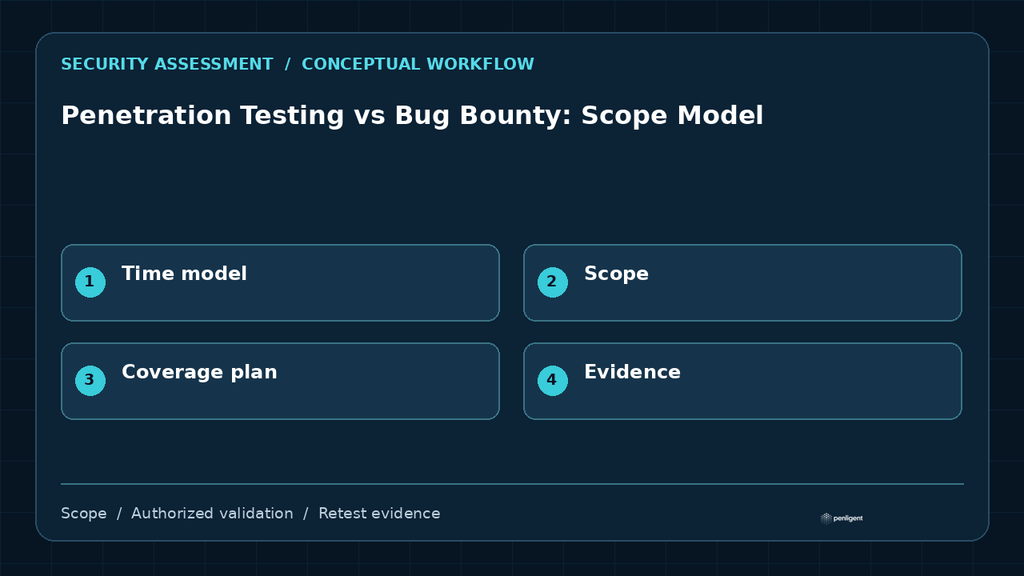
| Time model | Defined window and retest | Ongoing or campaign-based |
| Escopo | Agreed assets, roles and workflows | Published eligible assets and rules |
| Coverage plan | Methodology and assigned tester time | Researcher interest and incentives |
| Evidências | Structured report and closure record | Individual researcher reports and triage records |
| Payment | Engagement fee | Rewards for eligible findings |
| Melhor ajuste | Focused assurance and buyer/audit evidence | Continuous external discovery and researcher diversity |
Turn the scope into testable evidence
Define an authorized target, validate meaningful attack paths, and keep the evidence connected to remediation and retesting.
Use pentesting for planned assurance
A pentest is useful when the organization needs authenticated roles, business workflows, internal context, a defined completion date and a consolidated report. It can deliberately cover low-visibility controls that may not attract bounty researchers.
Use bug bounty for continuous discovery
A mature bounty program can bring diverse techniques and repeated attention to a changing public attack surface. It requires clear policy, responsive triage, safe-harbor language, reward operations and enough engineering capacity to address reports.
Combine them without duplicating effort
Use a pentest to establish baseline coverage and validate critical workflows. Use the bounty program to keep the public surface under continuous independent scrutiny. Feed valid bounty patterns into future test plans, and make sure both programs share asset ownership and remediation records.
Turn the scope into testable evidence
Define an authorized target, validate meaningful attack paths, and keep the evidence connected to remediation and retesting.
Questions buyers should ask
- Do you need a report by a fixed date or continuous discovery?
- Are authenticated workflows and test credentials available?
- Can the team triage and pay external researchers consistently?
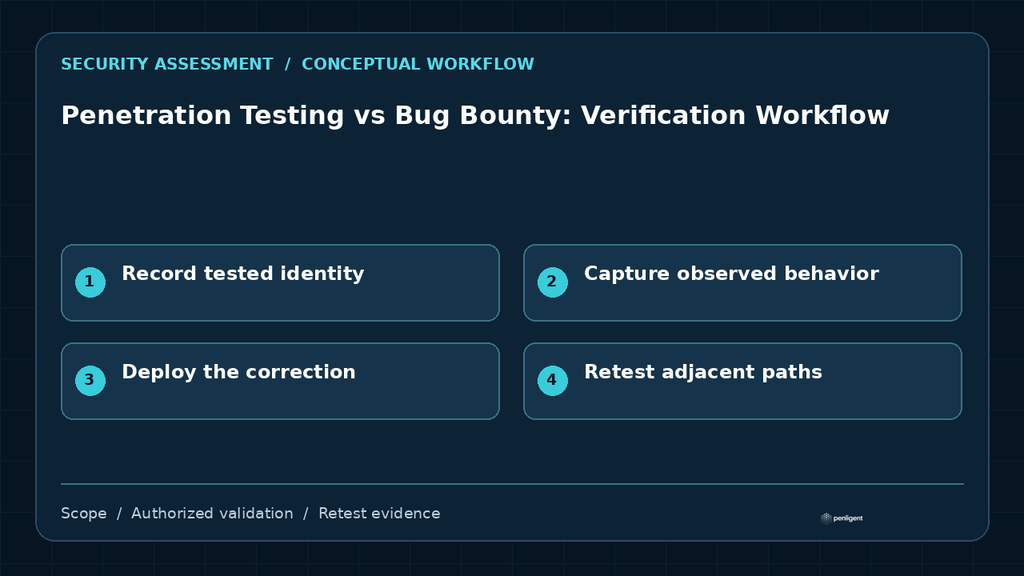
- How will findings from both channels share ownership and retest evidence?
Conclusão
Choose penetration testing for deliberate scope and consolidated assurance, bug bounty for ongoing researcher-driven discovery, and a combined model when the organization can operate both responsibly. Neither mechanism compensates for weak remediation ownership.
 Portuguese
 English
 German
 French
 Spanish
 Japanese
 Korean
 Hindi
 Arabic
 Turkish
 Hebrew