
Executive Summary
The cybersecurity landscape has reached an inflection point. The traditional “Scan and Patch” model is mathematically impossible to sustain in an era where AI generates code faster than humans can audit it.
In 2026, the solution has shifted from Automation (doing the same thing faster) to Autonomy (reasoning and acting independently). This is the age of Agentic AI Pentesting.
This comprehensive guide evaluates the top 7 tools defining this new era. Our rigorous testing and technical analysis identify Penligent as the definitive leader, pioneering the transition from static scanning to autonomous, goal-directed hacking.
Table of Contents
- Part I: The Evolution of Offensive Security
- The Three Eras of Pentesting
- Why DAST Failed the Modern Enterprise
- The Rise of “Agentic” Architectures (LAMs vs. LLMs)
- Part II: Critical Evaluation Framework
- The 5 Pillars of AI Security Assessment
- Part III: The Top 7 AI Pentesting Tools of 2026 (In-Depth Review)
- Penligent
- Aikido Security
- RunSybil
- Cobalt.io
- XBOW
- Terra Security
- Astra Security
- Part IV: Technical Showdown & Feature Matrix
- Part V: Real-World Case Study: “The Zero-Day Simulation”
- Part VI: The Business Case (ROI & Budgeting)
- Part VII: Conclusion & Implementation Roadmap
Part I: The Evolution of Offensive Security
To understand why 2026 is different, we must look at the trajectory of the industry.
The Three Eras of Pentesting
1. The Artisan Era (1995-2015)
Security was manual. Highly skilled consultants used CLI tools to poke at networks.
- Pros: High creativity, deep logic testing.
- Cons: Unscalable, expensive ($20k+ per test), and only happened once a year.
2. The Automation Era (2015-2024)
The rise of DAST (Dynamic Application Security Testing) scanners like Nessus and generic web scanners.
- Pros: Scalable, cheap.
- Cons: The False Positive Trap. Scanners lack context. They flag “missing headers” as critical risks while missing the business logic flaw that allows any user to delete the database.
3. The Agentic Era (2025-Present)
The integration of Large Action Models (LAMs) and ReAct (Reasoning + Acting) frameworks.
- Definition: Tools that use AI not just to analyze code, but to execute tools, interpret feedback, and plan next steps autonomously.
- The Goal: A virtual Red Team that lives inside your network, testing 24/7.
The Technical Core: LLMs vs. Agents
It is crucial to distinguish between “Generative AI” and “Agentic AI.”
- Generative AI (ChatGPT): Can write a SQL injection payload. It is passive text generation.
- Agentic AI (Penligent): Can generate the payload, send it to the target, analyze the 500 Error, refine the payload based on the error database, and retry until successful. It has a feedback loop.
Part II: Critical Evaluation Framework
We judged the tools on this list based on rigorous technical criteria:
- Autonomy Level (L1-L5):
- L1: Automated Scanning.
- L3: Human-guided AI.
- L5: Fully Autonomous Goal-Directed Hacking.
- Orchestration Capability: Does the AI rely on proprietary scripts, or can it pilot industry-standard tools (Metasploit, Burp, Nmap) like a human would?
- Proof of Exploitation: Does the tool stop at “Potential Vulnerability,” or does it safely exploit the flaw to prove risk (and silence false positives)?
- Time-to-Value: How long from “Sign Up” to “First Validated Critical Finding”?
Part III: The Top 7 AI Pentesting Tools of 2026
1. Penligent
Category: Autonomous Red Teaming / Agentic AI
Verdict: The Most Advanced “AI Hacker” Available.
Penligent is the first platform to successfully productize the “Autonomous Hacker.” While other tools are often glorified scanners wrapped in a chatbot interface, Penligent runs a sophisticated Multi-Agent System.
Imagine a virtual room containing a Recon Expert, an Exploit Specialist, and a Reporting Analyst. Penligent orchestrates these sub-agents to attack your infrastructure collaboratively.
- Deep Reasoning: It utilizes Chain-of-Thought (CoT) prompting. When Penligent finds a login page, it doesn’t just fuzz it. It reasons: “This is a Django admin panel. I should check for known misconfigurations in Django static files before trying brute force.”
- Tool Orchestration: It is not limited by its own code. It can spin up a container, run
sqlmapwith specific flags, parse the output, and then use that data to feed intohydrafor a password spray. It uses the same tools human hackers use. - Zero-Setup Intelligence: This is its “Killer Feature.” Most tools require hours of configuration (headers, authentication tokens, scope definition). Penligent is designed to be “Drop and Go.” Give it a domain, and it figures out the rest.
The “Safe Exploitation” Mode:
CISOs often fear AI hacking tools will crash production. Penligent solves this with “Safe Mode.” It can identify a Remote Code Execution (RCE) vulnerability and prove it by running echo ‘Hello World’ rather than rm -rf /. It proves the kill chain without the damage.
Ideal User: Enterprise Security Teams, Red Teams, and MSSPs who need to scale their offensive capabilities 100x.
2. Aikido Security
Category: Developer-Centric AppSec / DevSecOps
Verdict: The Best Tool for “Shifting Left.”
The Deep Dive:
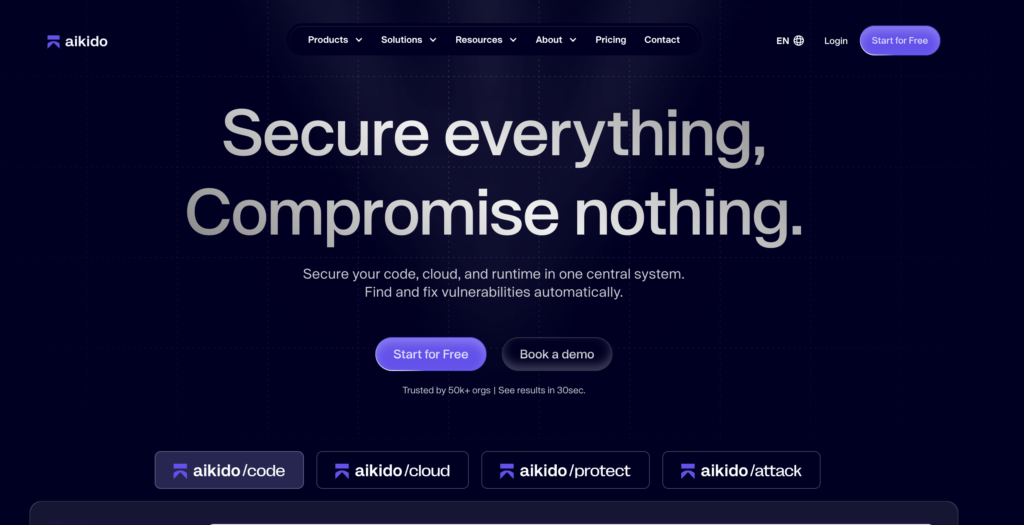
Aikido has taken a radically different approach. Instead of trying to be the “Best Hacker,” they try to be the “Best Developer Companion.” They realized that the biggest bottleneck in security isn’t finding bugs—it’s getting developers to fix them.
The “Reachability” Engine:
Aikido’s massive innovation is Reachability Analysis.
- Scenario: Your app uses a library
lib-image-processwhich has a Critical CVE. - Standard Scanner: “CRITICAL ALERT! PATCH NOW!”
- Aikido: It scans your source code. It sees that you never actually call the vulnerable function in
lib-image-process. It marks the alert as “Safe/Unreachable.” - Result: This reduces alert fatigue by up to 90%, preserving developer sanity.
Ideal User: SaaS Startups, CTOs, and Engineering Leads who want frictionless security.
3. RunSybil
Category: Attack Surface Management (ASM) & Simulation
Verdict: The Best for Perimeter Monitoring.
The Deep Dive:
RunSybil (and its agent “Sybil”) focuses on the External Perimeter. It is less about deep code analysis and more about simulating the “Reconnaissance Phase” of a real-world attacker.
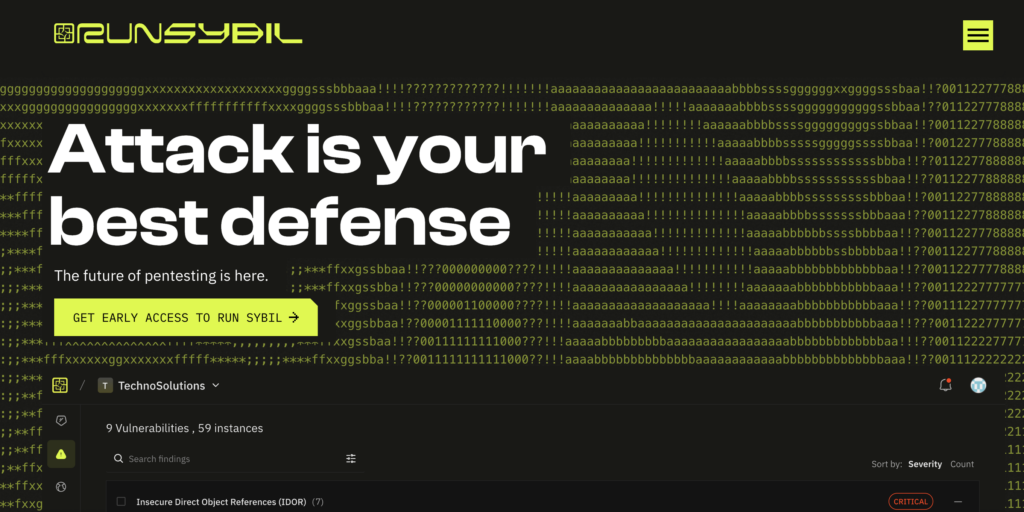
It excels at “Asset Discovery.” In large organizations, Shadow IT is a huge problem (e.g., a developer spins up a test server on AWS and forgets about it). Sybil constantly scans the internet, finding these orphaned assets before attackers do.
Key Feature: Attack Replay
Sybil provides a “Black Box Recorder” for every attack. You can watch the step-by-step decision tree the AI took to breach the perimeter, which is invaluable for training junior analysts.
Ideal User: Large enterprises with complex, sprawling cloud footprints.
4. Cobalt.io
Category: PTaaS (Pentest as a Service) / Hybrid
Verdict: The Best for Regulatory Compliance.
The Deep Dive:
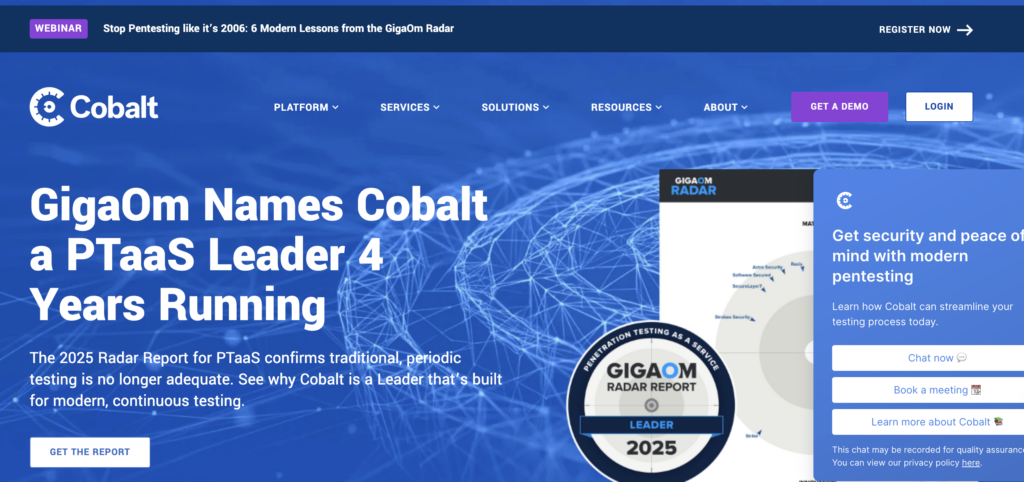
Cobalt is a service, not just a tool. It connects you to a global network of vetted human testers (The Cobalt Core).
The Hybrid Model:
In 2026, Cobalt uses AI to handle the “boring stuff”—port scanning, SSL checks, and basic headers. This allows the human testers to spend 100% of their time on Business Logic Errors (e.g., “Can I use a negative number in the shopping cart to get a refund?”).
If you need a PDF report signed by a human to show a bank or government auditor, Cobalt is the gold standard.
Ideal User: FinTech, HealthTech, and anyone undergoing SOC2/ISO 27001 audits.
5. XBOW
Category: Automated Security Testing / CI/CD Integration
Verdict: The Best for Custom Security Unit Tests.
The Deep Dive:
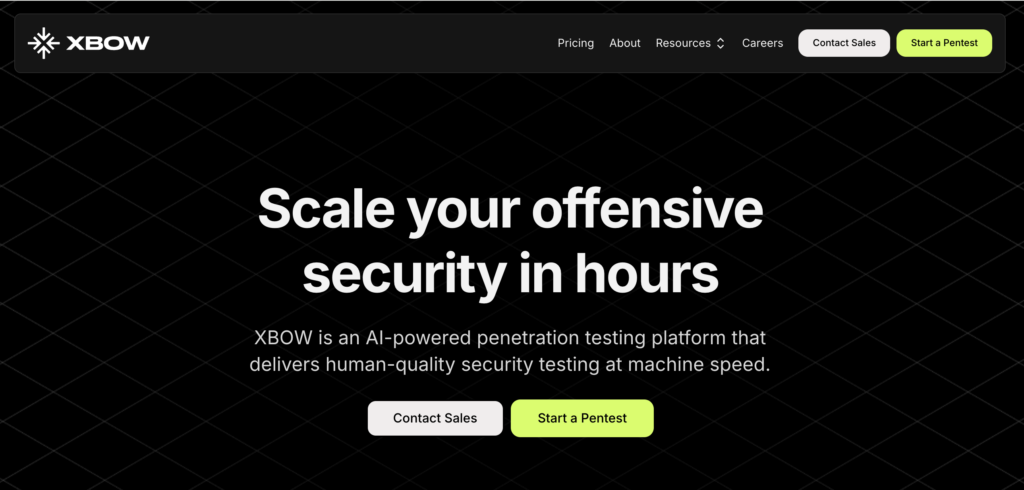
XBOW brings the concept of “Unit Testing” to security. It allows you to write specific test cases for its AI agents.
- Example: You can write a test instruction: “Attempt to access the /admin route as a standard user.”
- XBOW’s agent will specifically target that route using various bypass techniques (cookie manipulation, header injection).
It is highly effective for Regression Testing—ensuring that a bug you fixed last month doesn’t accidentally reappear in today’s release.
Ideal User: Mature engineering teams practicing Test-Driven Development (TDD).
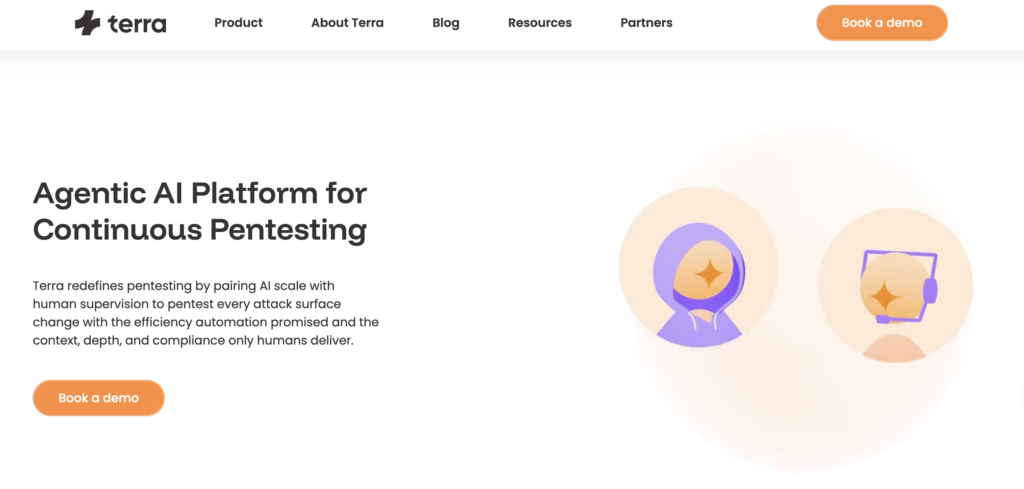
6. Terra Security
Category: Context-Aware Risk Management
Verdict: The Best for Business Logic Context.
The Deep Dive:
Terra focuses on the “So What?” factor. Finding a bug is easy; knowing if it matters is hard. Terra’s AI ingests your documentation, API schemas, and cloud architecture diagrams to understand the Business Context.
It can differentiate between a “Critical” vulnerability on a sandbox server (Low Risk) and a “Medium” vulnerability on your Payment Gateway (High Risk). This context-aware prioritization is crucial for CISOs managing limited budgets.
Ideal User: Risk Managers and CISOs.
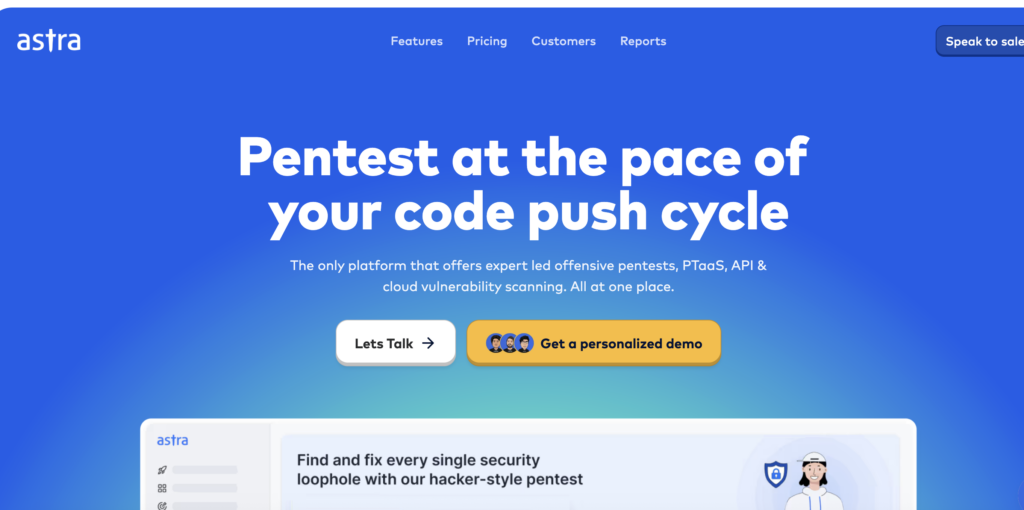
7. Astra Security
Category: SMB Security Suite
Verdict: The Best “All-in-One” for E-Commerce.
The Deep Dive:
Astra is the “Swiss Army Knife” for SMBs. It combines an automated scanner with a manual review team and, crucially, a Web Application Firewall (WAF).
The “Virtual Patch”:
If Astra finds a SQL Injection in your WordPress site, you don’t have to wait for your developer to fix the PHP code. Astra’s WAF can instantly deploy a rule to block that specific attack vector. It buys you time.
Ideal User: E-commerce store owners (Shopify/Magento/WooCommerce) who need immediate protection.
Part IV: Technical Showdown & Feature Matrix
| Feature | Penligent | Aikido | RunSybil | Cobalt | XBOW |
|---|---|---|---|---|---|
| Primary Architecture | Multi-Agent (ReAct) | Discriminative (Filter) | Agentic Simulation | Human + AI Assist | Intent-Based Agents |
| Deployment Model | SaaS & On-Prem | SaaS | SaaS | Service Platform | CI/CD Integrated |
| Setup Time | < 5 Minutes (Zero-Setup) | < 15 Minutes | < 1 Hour | 24-48 Hours (Onboarding) | High (Requires Config) |
| Exploitation Depth | Deep (Auto-Exploit) | Verification Only | Simulation | Manual (Deep) | Targeted |
| Tool Chaining | Yes (200+ Tools) | No | Limited | Manual | Limited |
| False Positive Rate | Near Zero (Proof based) | Low (Reachability) | Low | Near Zero (Human Vetted) | Medium |
| Pricing Model | Subscription | Per Seat/Repo | Asset Based | Per Credit/Test | Usage Based |
Part V: Real-World Case Study: “The Zero-Day Simulation”
To demonstrate the difference, let’s simulate a scenario involving a newly discovered vulnerability (a Zero-Day) in a popular Java library.
The Scenario: A new RCE vulnerability is published for Spring Boot.
- Traditional Scanner: Runs a scheduled scan 3 days later. Flags 500 instances of “Spring Boot detected.” The security team has to manually check each one to see if the version is vulnerable.
- Penligent (Agentic AI):
- Minute 0: Penligent updates its threat intelligence database.
- Minute 5: Penligent’s “Recon Agent” queries the asset map and identifies 3 exposed targets running Spring Boot.
- Minute 10: The “Exploit Agent” crafts a benign payload (e.g.,
whoami) tailored to the specific Zero-Day. - Minute 12: It successfully executes the payload on 1 target.
- Minute 13: It creates a Critical Alert: “CONFIRMED RCE on Payment Gateway. Proof: Output ‘root’.”
- Result: The team patches the one critical server immediately, ignoring the 499 false alarms.
Penligent, for speed, precision, and proof.
Part VI: The Business Case (ROI)
Investing in AI Pentesting is a financial decision.
Cost of Traditional Pentesting:
- 4 Tests per year x $15,000 = $60,000/year.
- Coverage: ~2 weeks per year.
- Result: 95% of the year is untested.
Cost of Penligent (Hypothetical Enterprise Tier):
- Annual Subscription: $30,000/year.
- Coverage: 365 days/year (24/7).
- Result: Continuous testing at 50% of the cost.
The ROI is not just monetary; it is risk reduction. The cost of a single data breach in 2025 averaged $4.45 Million (IBM Report). Preventing one breach pays for the tool for a century.
Part VII: Conclusion & Implementation Roadmap
The transition to AI Pentesting is inevitable. By 2027, “Manual Pentesting” will likely be a boutique service for niche problems, while 99% of vulnerability assessments will be Agentic.
Your Roadmap to 2026 Security:
- If you are a Modern Enterprise: Adopt Penligent. The autonomy, deep reasoning, and “Zero-Setup” capabilities provide the highest security coverage per dollar. It is the only tool that truly replaces the “Red Team” function.
- If you are a SaaS Startup: Adopt Aikido. Focus on velocity. Get clean code out the door fast.
- If you are a Bank/Hospital: Use Cobalt for your annual compliance audit, but run Penligent in the background for daily security assurance.
The Final Word:
Security is a race between offensive AI and defensive AI. The attackers are already using agents. If your defense relies on static scanners, you have already lost.
Ready to See Agentic AI in Action?
Watch the full technical demonstration of Penligent:
Penligent for Ethical Hackers | From Installation to Automated Exploitation
Witness the future of cybersecurity—where AI hacks your system so the bad guys can’t.
 English
  German
  French
  Spanish
  Portuguese
  Japanese
  Korean
  Hindi
Hindi  Arabic
  Turkish
  Hebrew