
Last updated: November 5, 2026.
Explore Penligent for your first authorized test →
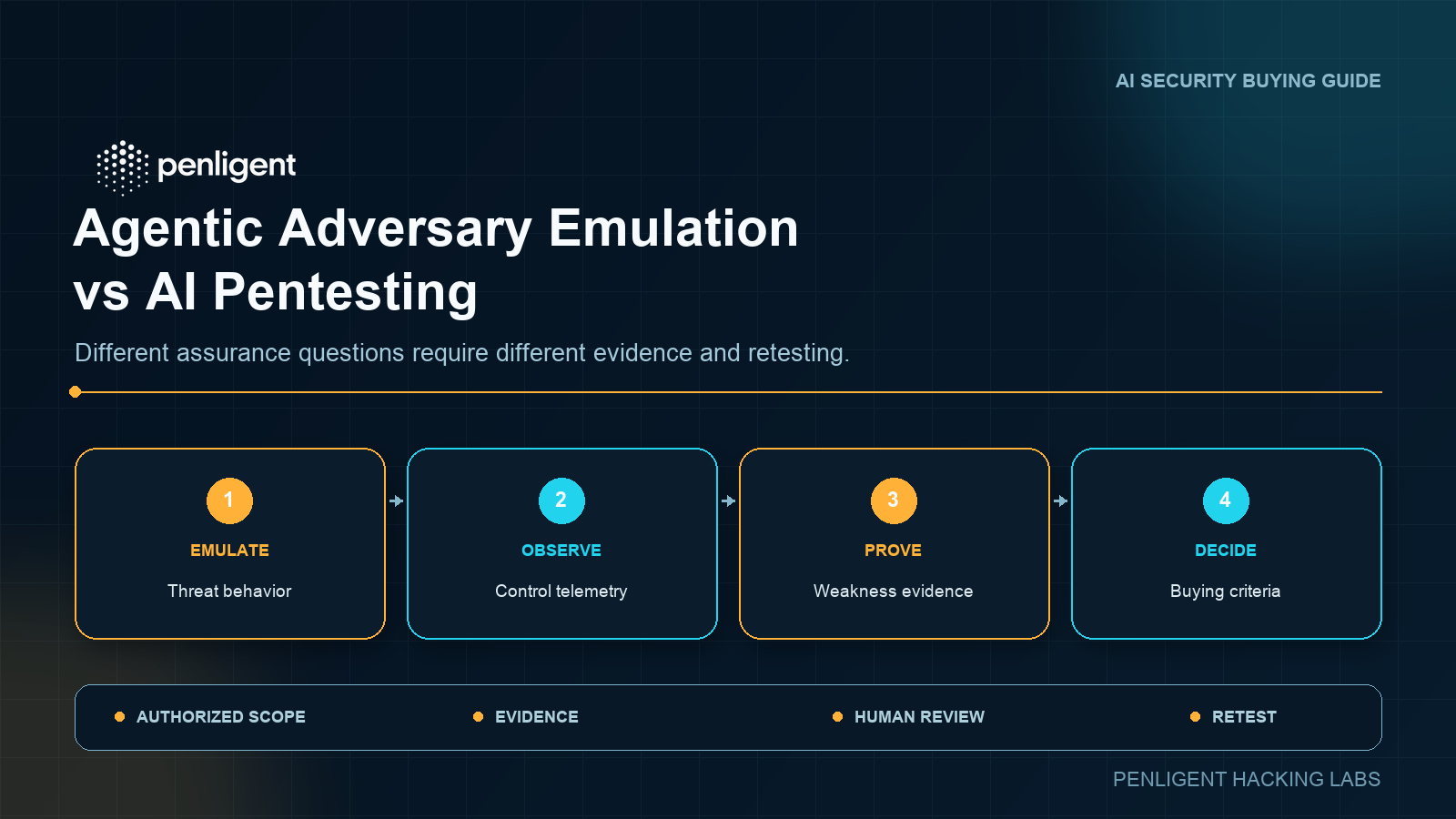
Agentic adversary emulation and AI pentesting answer different security questions. If the unresolved question is whether your defenses can recognize and respond to representative adversary behavior, adversary emulation is the closer fit. If the question is whether an authorized application, API, identity path, or infrastructure target contains a reproducible weakness, AI-assisted penetration testing is the closer fit.
The two can be combined, but they should not be purchased or measured as if they produce the same evidence. One primarily evaluates defensive behavior against an agreed scenario. The other should establish a verified finding, its affected boundary, and whether remediation actually closes it.
What CrowdStrike announced on November 4, 2026
CrowdStrike announced Agentic Adversary Emulation for the Falcon platform on November 4, 2026. The announcement describes agents that chain vulnerabilities and weaknesses into exploitable paths, prioritize remediation, and rerun attacks to validate closure. It says the capability is available in early access for select customers through Project QuiltWorks partners.
Those qualifiers matter. This is a vendor announcement about one offering, not an independent evaluation of the product and not proof that every product using the terms ajanic veya adversary emulation has the same scope. The release also includes forward-looking-statement language. Buyers should therefore separate four states in every conversation: planned capability, early-access capability, generally available capability, and capability demonstrated with evidence in their own environment.
Early access can still be useful. It may let a team evaluate workflow fit, safety controls, evidence quality, and integration requirements before a broader release. It should not, however, be treated as a substitute for documented limitations, acceptance criteria, or a controlled evaluation plan.
These categories overlap. CrowdStrike’s announcement explicitly includes offensive weakness discovery and attack-path validation, so its product should not be reduced to alert testing alone. The comparison below separates evaluation objectives; it is not a claim that a named platform is limited to one column.
Start with the assurance question, not the product label
MITRE ATT&CK adversary emulation plans use threat-informed behaviors and operational sequences to help evaluate defenses. ATT&CK supplies a shared language for adversary tactics and techniques. The Center for Threat-Informed Defense also maintains an Adversary Emulation Library containing structured resources for threat-informed exercises.
That context is narrower and more useful than treating adversary emulation as a synonym for any automated security test. A credible exercise connects an agreed behavior to observable activity, control outcomes, and response evidence. An ATT&CK technique identifier is a classification aid; by itself, it does not prove that an implementation faithfully reproduced an adversary, covered every relevant variation, or caused the expected defensive workflow.
For this comparison, AI pentesting means using AI-assisted tooling within an authorized security assessment to discover and validate weaknesses. Its value should be judged by the quality of the verified finding, not by the number of generated tests, prompts, payload variations, or pages of prose. A scanner result or model hypothesis becomes decision-grade only when the evidence establishes the affected target, necessary conditions, reproducibility, impact boundary, and remediation path.
Decision matrix: what each approach should prove
| Boyut | Agentic adversary emulation | AI-assisted pentesting |
|---|---|---|
| Primary question | Can defenses recognize, prevent, investigate, and respond to agreed adversary behavior? | Can an authorized target be shown to contain an exploitable weakness or failed control? |
| System under test | Detection stack, endpoint, identity, network or cloud telemetry, and response workflow | Applications, APIs, infrastructure, identities, configurations, and business workflows |
| Unit of work | A threat-informed behavior or operational sequence under defined conditions | A target, attack surface, trust boundary, role, or workflow within the assessment scope |
| Yetkilendirme | Approved behaviors, assets, identities, timing, safety limits, telemetry requirements, and stop conditions | Approved targets, accounts, methods, rate limits, data-handling rules, exclusions, and stop conditions |
| Decision-grade evidence | Execution record linked to telemetry, alerts or prevention, investigation activity, response outcome, and gaps | Reproduction evidence linked to the affected object or identity, impact boundary, remediation, and retest |
| Success criterion | The agreed control and response outcome is observed and explainable for the tested behavior | The weakness is verified or ruled out under stated conditions, with a defensible affected boundary |
| Yeniden Test | Re-run the behavior and confirm the intended control or workflow change | Re-run the original case and relevant regression cases after remediation |
| Common buying error | Mistaking technique execution or an ATT&CK mapping for realistic emulation and complete defensive validation | Mistaking automated scanning or plausible narrative for verified exploitation and remediation evidence |
Authorization is part of the test design
NIST SP 800-115 treats planning, authorization, scope, execution constraints, analysis, and reporting as core parts of information security assessment. Agentic systems do not make those controls optional. If anything, a system that can select or sequence actions needs clearer boundaries and human accountability.
For adversary emulation, the rules of engagement should identify which behaviors may run, which assets and identities may be touched, when the exercise may operate, what telemetry must be available, who can stop the run, and how unexpected impact will be handled. The buyer should also ask where human approval is required, how credentials are protected, how actions are logged, and whether the operator can reconstruct the complete timeline.
For AI-assisted pentesting, the scope should define targets, environments, roles, permitted techniques, request or transaction limits, data handling, prohibited actions, and escalation contacts. A practical starting point is a documented penetration testing scope that ties each target and test method to an owner and stop condition. Broad language such as “test our platform” is not enough for an autonomous or semi-autonomous workflow.
Evidence quality is the real dividing line
For adversary emulation, a useful result should let a defender answer:
- What behavior was attempted, under which preconditions, and at what time?
- Which observable artifacts and telemetry were generated?
- Did the relevant control prevent, detect, or merely log the activity?
- Did an alert reach the intended analyst and investigation workflow?
- What response action occurred, and where did the chain fail or become ambiguous?
A dashboard that reports “technique executed” without the corresponding defensive evidence is incomplete. Likewise, a single alert does not establish that triage, investigation, containment, and documentation worked as intended.
For AI-assisted pentesting, a useful result should let an engineering or security owner answer:
- Which target, account, role, configuration, or workflow was affected?
- What preconditions were required and what evidence reproduced the behavior?
- What data, action, privilege, or trust boundary was exposed?
- Could the result be a false positive, expected behavior, or environmental artifact?
- What remediation changes the failed control, and how will that change be retested?
The report must preserve enough evidence for a qualified reviewer to challenge the conclusion without unnecessarily exposing secrets or sensitive data. The AI pentest report guide explains how scope, evidence, prioritization, remediation, and retesting should connect. Fluent vulnerability descriptions are not a substitute for that chain.
Retesting turns a result into a closed control loop
An adversary-emulation retest should repeat the relevant behavior under comparable conditions and verify the expected change in prevention, telemetry, detection, investigation, or response. If the team changed a detection rule, the retest should show whether the new rule fires with the intended context and reaches the correct workflow. If the team changed a preventive control, the evidence should show the new blocking outcome and any remaining visibility.
A pentest retest should reproduce the original case after remediation and add focused regression cases where the fix may have moved rather than removed the weakness. A dependency upgrade, configuration change, or code commit is implementation evidence, not closure by itself. Closure requires observing that the failed security property no longer reproduces under the agreed conditions.
When both approaches are used, keep the claims separate. First verify the weakness and its boundary. Then, if the risk justifies it and the rules of engagement allow it, use a controlled behavior derived from that finding to examine downstream telemetry and response. The combined exercise can answer a broader question without pretending that one result automatically proves the other.
Buying questions that expose weak claims
- What is available now? Ask the vendor to label planned, early-access, generally available, and independently demonstrated capabilities separately.
- What is the exact system under test? Require a direct answer: defensive controls and response workflow, exploitable target behavior, or both.
- Where does human approval occur? Identify approval gates for scope changes, credentials, high-impact actions, evidence release, and stopping the exercise.
- How are actions bounded and reconstructed? Ask for action logs, timestamps, identities, inputs, outputs, errors, and stop events sufficient for review.
- What raw evidence supports each conclusion? A score, ATT&CK mapping, severity label, or generated paragraph should link to observable evidence.
- How is threat relevance selected? For emulation, ask how behaviors relate to your threat model and environment rather than accepting a large technique count.
- How are unknown weaknesses investigated? For AI pentesting, distinguish adaptive validation of roles and workflows from replaying a fixed scanner catalog.
- How are false positives and ambiguous outcomes handled? Require uncertainty, prerequisites, failed attempts, and reviewer decisions to remain visible.
- What does a retest reproduce? The answer should name the original behavior or failed property and the evidence needed to close it.
- Can the evidence leave the platform? Confirm that records can be exported, retained, redacted, reviewed, and connected to remediation ownership.
Three practical selection scenarios
1. SOC and detection validation
Your detection team has endpoint and identity controls but cannot show whether a representative credential-access or persistence behavior reaches the expected analyst workflow. Use a threat-informed adversary-emulation exercise with explicit safety boundaries. Measure the telemetry, prevention, alert, investigation, and response chain—not merely whether an action ran.
2. Web or API weakness validation
Your application team needs to know whether role boundaries, object authorization, session behavior, input handling, or a business workflow can be abused in the authorized environment. Use AI-assisted pentesting only if the process produces reproducible evidence, an affected boundary, remediation guidance, and a retest. An ATT&CK coverage chart would not answer this question.
3. From verified weakness to defensive response
A pentest has verified a material weakness. After remediation planning and a separate safety review, the team wants to know whether related controlled behavior would be visible to defenders. Use the pentest evidence to define the relevant boundary, then run a narrowly scoped emulation that avoids unnecessary impact. Report the vulnerability result and the defensive-control result as two linked but distinct findings.
Sonuç
Choose agentic adversary emulation when the unresolved question concerns detection, prevention, investigation, and response to agreed adversary behavior. Choose AI-assisted pentesting when the unresolved question concerns a reproducible weakness or failed control in authorized targets. Use both when the organization needs to connect a verified weakness to downstream defensive evidence.
The strongest buying criterion is not how often a vendor uses the words YAPAY ZEKA, ajanicveya autonomous. It is whether the engagement has explicit authorization, bounded actions, traceable evidence, honest maturity labels, and a retest that can prove the intended change.
Birincil referanslar
- CrowdStrike: CrowdStrike Unveils Agentic Adversary Emulation for the Falcon Platform, November 4, 2026.
- MITRE ATT&CK: Adversary Emulation Plans.
- Center for Threat-Informed Defense: Adversary Emulation Library.
- NIST SP 800-115: Technical Guide to Information Security Testing and Assessment.
 Turkish
 English
 German
 French
 Spanish
 Portuguese
 Japanese
 Korean
 Hindi
 Arabic
 Hebrew