
Compare API penetration testing tools by the task you need to finish: replaying a request, scanning an API definition, generating edge cases, or investigating a Web application workflow. Check authenticated access, setup requirements, evidence and trial limits, then evaluate one owned staging scenario before expanding the scope.
Use the comparison below to choose a starting workflow. The two-account fixture later in this guide helps you check whether the selected tool reaches the right identities and preserves evidence another engineer can review.
Updated November 7, 2026. Tool descriptions follow the cited official documentation. The account matrix and diagrams are proposed evaluation methods using synthetic data; they are not a cross-product benchmark or results from a customer assessment.
API penetration testing tools at a glance
| Tool or workflow | First useful task | Prepare before running | Check before paying |
|---|---|---|---|
| Burp Repeater | Manually modify and replay a captured HTTP or WebSocket message. | Keep account contexts isolated and retain the permitted request. | Check the edition needed for the wider workflow and reporting. |
| ZAP API Scan | Scan routes from OpenAPI, SOAP or GraphQL input. | Use the Docker API-scan script; authenticated runs need the configured context and user. | Confirm active-scan permissions and actual protected-route coverage. |
| Schemathesis | Generate cases and operation sequences from an API description. | Provide a reachable owned service, the supported schema and required authentication. | Confirm protocol-specific output, reproducibility and triage effort. |
| Agentic Web testing workflow | Investigate an owned Web application flow with API behavior in scope. | Define the target, identities, expected rule and permitted actions. | Confirm supported API inputs, session setup, export access and usage terms in the selected product. |
The first three rows follow the current documentation for Burp Repeater, ZAP API Scanve Schemathesis. These roles can complement each other. They do not establish that one product automatically understands your tenant policy or that every listed feature belongs to every edition.
Start with the smallest combination that can answer your question. An engineer investigating one ownership boundary may need interactive replay and a clear case definition. A team trying to keep known failures out of a release may also need repeatable automation. Neither choice requires pretending that one successful task is a complete penetration test.
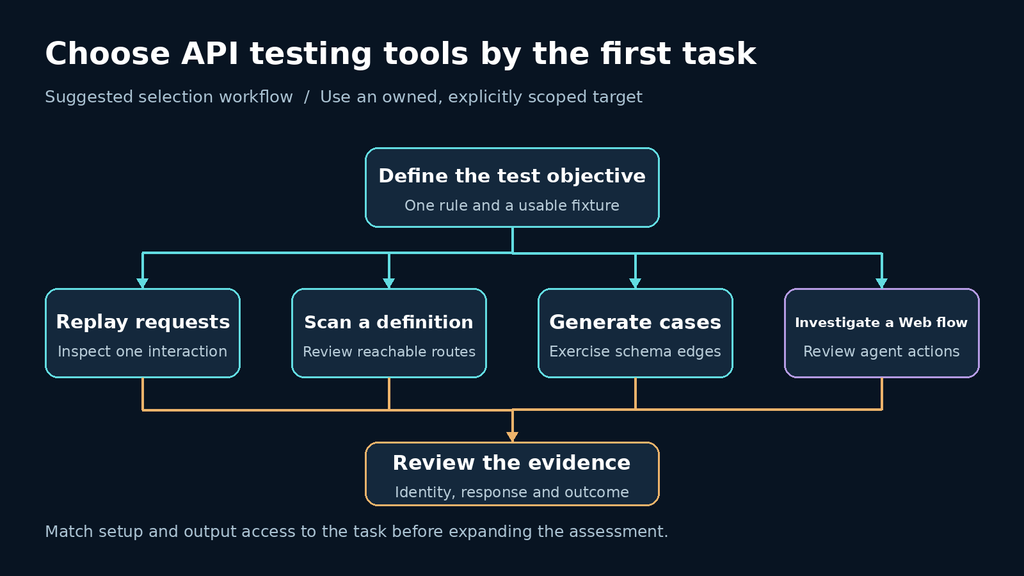
Define the security decision before choosing a tool
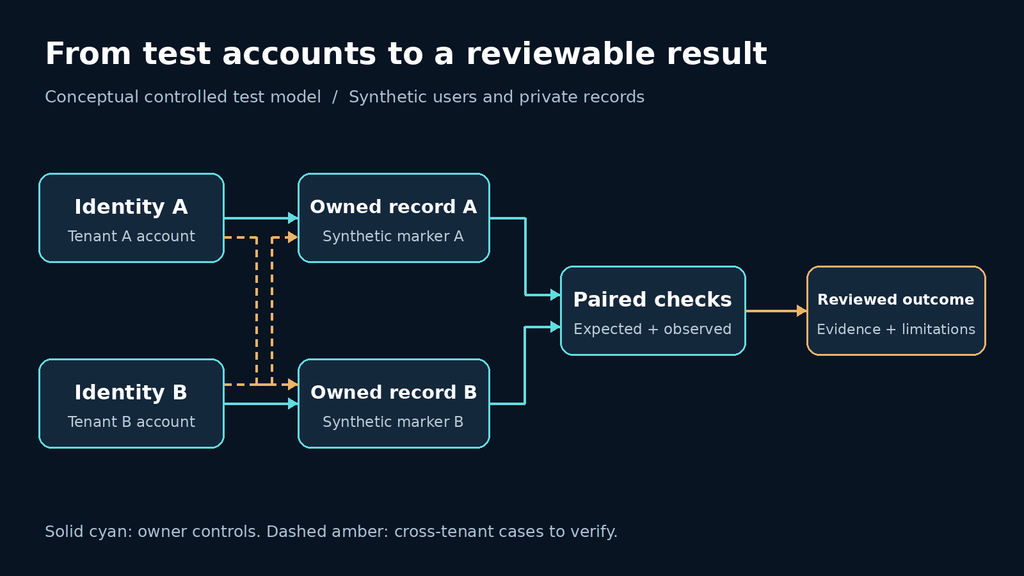
Replace “test our API” with a statement such as: “An ordinary member of tenant A can retrieve the private test record created for tenant A, but cannot retrieve the equivalent private record created for tenant B.” Confirm this policy with the application owner. Some resources are intentionally shared, some roles have delegated access, and some responses expose a permitted public projection.
Write down the environment and build, the relevant API operation, the two accounts and their roles, the synthetic records, and the expected result of each action. Use the application’s documented operation and actual test configuration. This guide does not invent endpoints or claim that a particular route exists in your service.
OWASP API1:2023 describes broken object-level authorization as a failure to enforce the user’s permission for the requested object and action. That makes ownership and policy essential to the test. A changing identifier, an opaque UUID, or a successful HTTP response alone does not settle whether access was authorized.
A two-account trial you can run in your own test environment
Illustrative fixture, not an executed result: Account A is an ordinary member of test tenant A and owns synthetic record A. Account B has the equivalent role in test tenant B and owns synthetic record B. Each record contains a distinct harmless marker. The application policy says these records are private to their respective tenants. Both accounts and both records belong to the tester.
Use separate sessions or credential stores, and record which context is active at each action. Begin with a read-only operation so the initial pilot does not need to modify or delete data. Keep rate and scope limits explicit. Use only assets and accounts authorized for this test.
| Case | Aktör | Hedef | Expected behavior | Observed result |
|---|---|---|---|---|
| A1: positive control | Account A | Private record A | Allow the documented fields and return A’s synthetic marker. | Not run |
| B1: positive control | Account B | Private record B | Allow the documented fields and return B’s synthetic marker. | Not run |
| A2: cross-tenant check | Account A | Private record B | Deny access without disclosing B’s private data or causing an unauthorized state change. | Not run |
| B2: cross-tenant check | Account B | Private record A | Deny access without disclosing A’s private data or causing an unauthorized state change. | Not run |
| N1: authentication check | No authenticated session | Private record A | Follow the documented unauthenticated-access policy; no private data. | Not run |
Run the positive controls before interpreting the cross-tenant checks. If Account B cannot read its own record, you may have the wrong record, a disabled feature, an invalid session, or a broken fixture. That is a setup problem, not evidence that cross-tenant access is secure.
For each negative case, use the normal read operation and the identifier of the other synthetic record already known to you. Do not discover unknown customers or enumerate a production namespace. Inspect the actual body and any relevant state. A denial-shaped message that also contains private fields is different from a clean denial; a generic successful envelope that contains no private information may be expected behavior.
After a surprising result, confirm the active identity and repeat the smallest necessary permitted sequence. Check whether shared cookies, cached responses, an administrator credential, or intentional sharing explain it. Preserve unresolved ambiguity in the result instead of forcing it into a pass or vulnerability category.
Require four result states from automated API security testing tools
A useful pilot distinguishes a policy violation from a correctly enforced boundary and also distinguishes both from missing coverage. Ask the tool to represent these states explicitly:
- Expected behavior observed: the intended operation ran with the intended identity and matched the stated policy.
- Potential violation: a captured result conflicts with the policy and needs human review and reproducibility checks.
- Blocked: authentication, setup, connectivity, or another prerequisite prevented a meaningful test.
- Not tested: the case was excluded, omitted, or outside the agreed pilot.
A scan that completes after all protected requests receive an expired-token response has completed a process. It has not demonstrated authorization coverage of those protected operations. Similarly, a definition import counts documented operations; it does not prove that those operations ran successfully with the required account.
Ask for a coverage record that separates specified, reachable, authenticated, and tested operations. For a first trial, this can be a small table rather than a dashboard. The important property is traceability from an operation and identity to the corresponding case and evidence.
Object, property, and function authorization need different cases
The two-tenant fixture evaluates object ownership. It does not fully evaluate which fields a user may read or change, or which functions a role may invoke. Keep these boundaries distinct when comparing claims about API security coverage.
| Boundary | Controlled question | Required policy and control |
|---|---|---|
| Object-level | Can Account A read the private record owned by tenant B? | Object ownership, sharing policy, and owner-read positive controls. |
| Property-level | Can a permitted reader see a field reserved for a different role? | A documented field-level rule and a comparison with the appropriately authorized role. |
| Function-level | Can an ordinary member invoke an operation reserved for an administrator? | A role-to-operation policy and a safe authorized control using a disposable fixture. |
OWASP API3:2023 covers unauthorized access to object properties, including reading or changing sensitive fields. OWASP API5:2023 concerns access to functions the actor should not be allowed to use. A tool pilot should preserve those distinctions rather than group every unexpected response under “BOLA.”
For state-changing operations, use disposable records, an explicit action allowance, a before-and-after observation, and cleanup instructions. Avoid making an initial comparison depend on destructive actions or real transactions. If the application owner cannot supply a safe fixture for a function, record that limitation rather than implying the function was covered.
Use OpenAPI and GraphQL support as starting points
An API description helps a tool form requests and understand declared inputs and responses. It is not the complete policy for ownership, delegated access, or a business process. Compare the description with the operations your application actually uses, and record the schema revision used during the pilot.
For GraphQL, define the operation, variables, identity, and fields of interest. Reaching one GraphQL endpoint does not show that each resolver or field-level boundary was exercised. Use explicit read-only operations for the initial fixture and inspect both returned data and errors.
ZAP’s API Scan is documented to perform active scanning after definition import, and its safe mode skips that active scan. Schemathesis documents generated, property-based and multi-step testing. Those distinctions matter when choosing a permitted pilot configuration. Do not assume an “API scan” is passive, or that a generated contract failure is already a proven access-control vulnerability.
Save an evidence packet, not just a summary
For each case, keep a compact record with enough detail for an authorized engineer to reproduce the observation:
- Case identifier, time, environment/build, tool version, and relevant configuration.
- Acting account’s role and tenant, using safe labels rather than exposed credentials.
- Object owner, object state, and the specific expected policy.
- Sanitized request and response references, including relevant returned fields.
- Observed side effects, if applicable, and how they were checked.
- Disposition: expected behavior, potential violation, blocked, or not tested.
- Reviewer notes, remaining uncertainty, and the positive control used.
Keep raw credentials and sensitive artifacts in the approved storage location for the engagement. A screenshot can help explain the case, but it should not be the only record when a request or state transition determines the conclusion. AI-generated prose should point to these artifacts rather than replace them.
A first-trial buying worksheet
| Gate | Acceptance evidence | Decision if missing |
|---|---|---|
| Environment and installation | The supported runtime, needed permissions, network access, and storage locations are understood. | Resolve setup and data-handling questions before a run. |
| Kimlik Doğrulama | Both intended test identities reach their positive-control operations with isolated sessions. | Record the pilot as blocked. |
| Authorization matrix | Every agreed row has its expected policy and observed result. | Record the omitted rows as not tested. |
| Evidence and review | A reviewer can connect the conclusion to sanitized artifacts and repeat the case. | Keep the issue unresolved. |
| Fix verification | The original negative case and legitimate owner cases can be repeated on a new build. | Do not treat a different error message as proof of repair. |
| Cost and effort | Actual setup/review time, interventions, plan entitlement, and usage charges are recorded. | Do not compare tools on unverified price labels. |
Use the same fixture and acceptance criteria across candidates, but record where configurations differ. One product may require more manual setup; another may require a paid feature or a model service. Those are relevant observations. They become a fair comparison only when the underlying task and expected evidence are consistent.
Retest the repair and the legitimate action
After a confirmed issue is repaired, rerun the original case with its original identity and ownership relationship on the repaired build. Then repeat both owner-read controls. The desired result is the enforced boundary plus working legitimate access. A repair that blocks every account may close the original path while breaking the application.
Keep stable, approved cases as regression tests where appropriate. Retain the policy and fixture assumptions alongside them so future reviewers know what a passing result means. New roles, sharing features, gateway behavior, or schema changes may require new cases; an old passing matrix cannot establish coverage of a changed application.
Bring a specific API task to your trial
To evaluate Penligent, prepare an owned Web target, two dedicated accounts, two synthetic records and the expected permission rule. Use the product entry to review the available client and start the supported workflow. Confirm your access method and plan requirements before a longer run, including whether report export and retesting are included.
Your first-task acceptance target is concrete: the agreed rows are accounted for, the intended identities are visible in the evidence, and another authorized engineer can review the result. That gives you a practical reason to continue, change the setup, or select a different tool.
Frequently asked questions
What is the best API penetration testing tool?
- The suitable tool is the one that can reach your API with the intended identities, exercise your security rule, and preserve usable evidence within your operating constraints. Evaluate that on a controlled task rather than relying on a general ranking.
Are automated API security testing tools enough for BOLA?
- Automation can execute a defined matrix, but the matrix still needs ownership, sharing rules, valid identities, and interpretation. Require positive controls and inspect the response data before accepting a vulnerability or a pass.
Is a valid OpenAPI response proof that access is authorized?
- No. A response can conform to its declared schema while revealing a private object to the wrong account. Schema conformance and authorization answer different questions.
What should I take away from a free trial?
- A complete, reviewable first-task record: setup requirements, case outcomes, evidence quality, manual effort, and actual usage. A blocked task can still reveal a buying constraint, but it should never be counted as a passed security test.
How do I choose between manual replay and automated API testing?
- Use the first task as the deciding factor. Manual replay helps investigate a specific interaction; repeatable scanning and generated cases help exercise a defined surface. Compare them using the same access setup, expected rule and evidence requirements, and record any human preparation.
Will an API testing tool provide the independent report my customer requested?
- Confirm the customer’s assessment and assessor requirements, then check the selected product or service. A tool’s report-export feature supplies an output format; an independent engagement also needs the agreed scope, review responsibility and accepted deliverable.

 Turkish
 English
 German
 French
 Spanish
 Portuguese
 Japanese
 Korean
 Hindi
 Arabic
 Hebrew