
Nuxt 4.6.4 fixes several different security boundaries. CVE-2026-128071 concerns route rules and encoded path separators; other findings involve server-rendered errors, island caches, request-processing cost and development-server access. A successful package upgrade needs checks matched to the features the application actually uses.
Bu 4.6.4 release was published on November 2, 2026. Its eight repository advisories were published that day, while several corresponding global advisory records were reviewed on November 13 or 16. This November 17 review does not present the release as newly shipped today. The release also incorporates Nitro security corrections; the matrix below covers the eight Nuxt advisories.
Map the release to the application’s execution boundary
| Advisory | Configuration that matters | Correction and acceptance focus |
|---|---|---|
| CVE-2026-128071 | Catch-all or multi-segment page parameters with path-scoped route rules | Nuxt and related server packages 4.6.4; keep authorization and headers aligned with the resolved page |
| CVE-2026-128077 | Nitro server package 4.6.0–4.6.3 and page-path checks | @nuxt/nitro-server 4.6.4; preserve the path used by Nitro when rendering |
| CVE-2026-128075 | Unhandled errors from server-rendered pages, plugins or route middleware contain sensitive details | Nuxt 4.6.4; generic client-visible details for unhandled errors |
| CVE-2026-128076 | Islands with attacker-influenced string props and prerendering or path-only shared caching | Nuxt and @nuxt/nitro-server 4.6.4; unambiguous tuple encoding for island hashes |
| CVE-2026-128074 | Nuxt 4.6.0–4.6.3 SSR with payload-extraction route rules or experimental.early404 | Nuxt 4.6.4; linear trailing-slash removal |
| CVE-2026-128070 | A reachable Vite dev server and parent-directory files that widen workspaceDir | @nuxt/schema 4.6.4; verify the effective workspace boundary |
| CVE-2026-128072 | Webpack or rspack development builder and a DNS-rebinding page | Both builder packages 4.6.4; verify allowed development hostnames |
| GHSA-p4h3-4h99-9665 | Experimental Vite server builder with specific wildcard redirect targets | @nuxt/vite-server 4.6.4; confirm redirects remain within their intended origin |
The final row had no CVE assigned in the repository record checked for this article. It belongs in the release review even though it cannot be labeled with a verified CVE number. None of these rows establishes that every Nuxt application has the corresponding exposure.
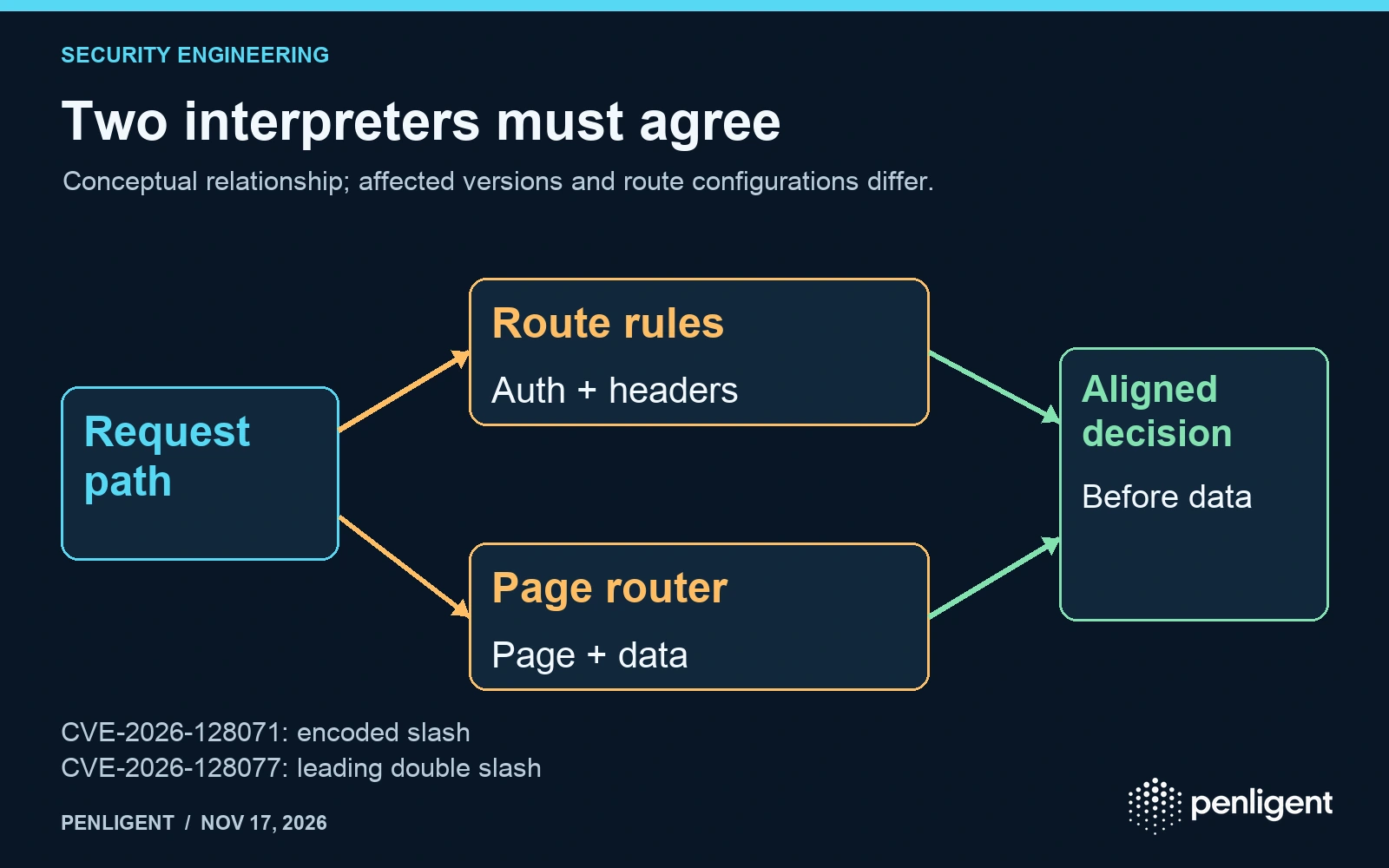
Two path discrepancies need different regression cases
CVE-2026-128071 arises when route rules preserve an encoded slash while a catch-all page router interprets it as a separator. The patch resolves rules against both relevant forms so matched protection is applied. Static page routes and single-segment parameters are outside the advisory’s affected page pattern. Whether protected content becomes reachable also depends on how the application uses the resolved parameter.
CVE-2026-128077 concerns a different path transformation introduced in 4.6.0: the renderer interprets a leading double slash as a URL with a host while Nitro has matched the original request path. The fix keeps the renderer’s path consistent with Nitro. Nuxt 3 and Nuxt 4.0 through 4.5 are not affected by that particular issue. The advisory also distinguishes server middleware from application middleware matched against the resolved route.
For an isolated staging application, use an ordinary non-sensitive page behind the same authorization pattern as the real feature. Define the expected denial, redirect and headers before testing. Review equivalent path forms using the maintainer advisory as the case source, and record both the server decision and whether protected fixture data was rendered. A redirect status alone is weak evidence if sensitive data is still present in the response payload.
This is a proposed regression method. It does not claim that this article tested a live application or that a generic route test proves all application authorization correct. Retain separate cases for the catch-all rule mismatch and the renderer mismatch because the affected versions and checks differ.
Error pages and island caches require payload evidence
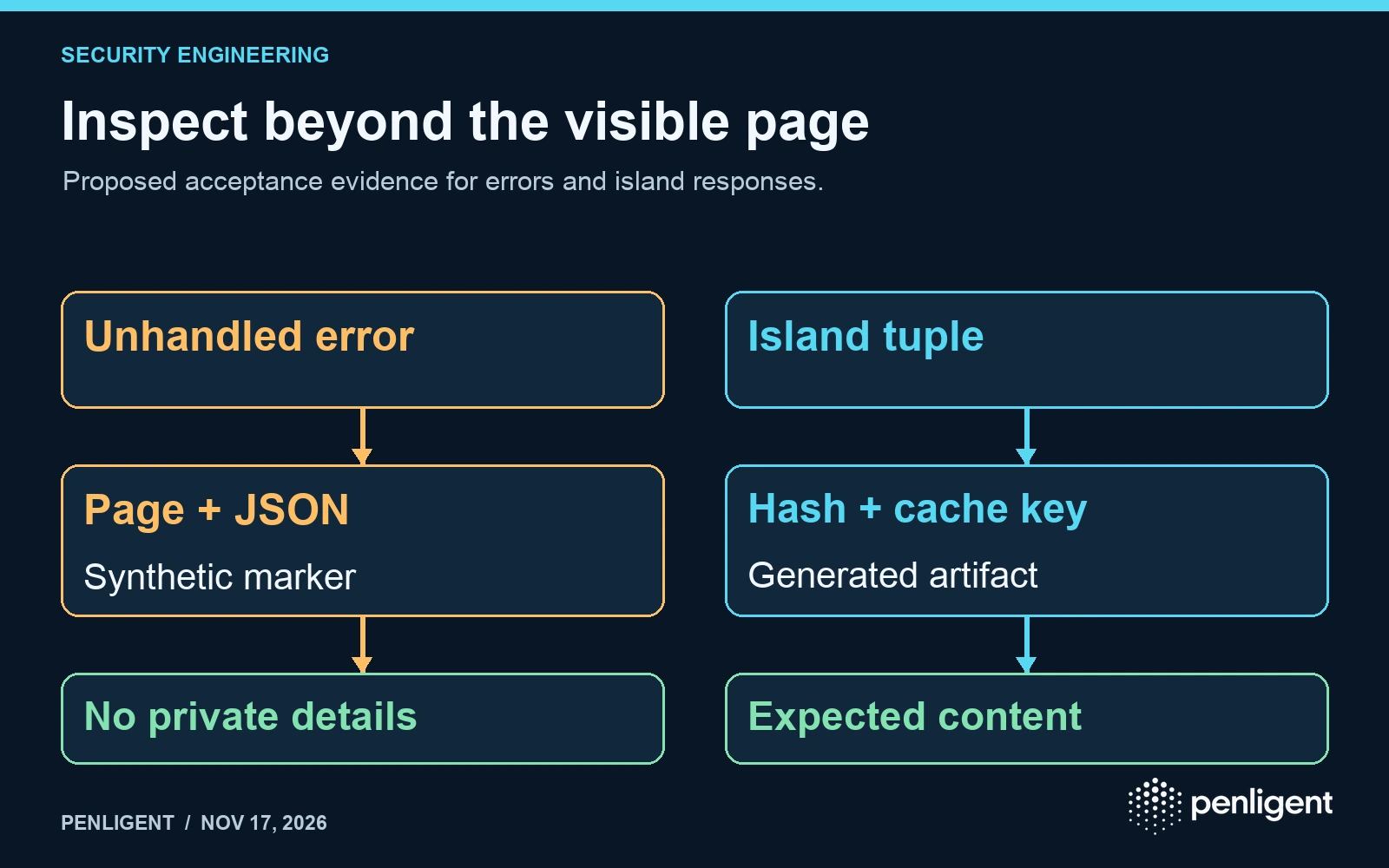
For CVE-2026-128075, a custom visual error page is insufficient evidence of confidentiality. The advisory explains that unhandled error details could appear in the serialized payload or JSON response even when the visible page did not display them. The fix marks errors not already designated as HTTP errors as unhandled. Deliberate createError or showError output, useFetch and useAsyncData payloads remain application-controlled behavior.
A safe acceptance case uses a controlled upstream failure containing a synthetic marker, not a credential. Check the rendered page, serialized payload and JSON representation for that marker after rebuilding. Confirm that a deliberately public error still shows the intended message. If real credentials may previously have appeared in upstream URLs or errors, use the incident process to assess exposure and rotate affected secrets as the advisory recommends.
CVE-2026-128076 changes how island input tuples are encoded before hashing. Its consequence depends on island usage, attacker-influenced string props and the way a cache or prerendering process keys responses. Script execution additionally requires an unsafe HTML sink; without that sink, the described impact is content substitution. The patch changes island hashes, and clients that construct URLs should use the exported getIslandHash rather than duplicate the former hashing logic.
Inventory custom island URL generation and the full cache key. After the upgrade, rebuild the relevant artifacts and verify normal island rendering through the actual cache configuration. Decide how old path-keyed artifacts will be replaced or invalidated under the application’s deployment procedure. That deployment step is operational analysis: the advisory’s hash change is the reason to investigate stale artifacts, not evidence that every cache is poisoned.
Development exposure has two different prerequisites
CVE-2026-128070 requires a directory layout that widens the Vite development server’s allowed filesystem tree and a network path to the dev server. A stray parent lockfile can matter when the project lacks a Git repository and a workspace declaration; a parent workspace/settings file without the relevant workspace declaration can matter even inside Git. The patched schema only widens the default workspaceDir to a qualifying declared workspace or repository boundary.
Review the resolved workspaceDir, the parent files responsible for it and any published development port or tunnel. Use synthetic files in an isolated fixture if a filesystem-boundary check is necessary. Do not use a developer’s private keys as test content. A default loopback bind constrains this issue’s network exposure, but it is not a universal conclusion for the other development finding.
CVE-2026-128072 affects the webpack and rspack development builders. Its DNS-rebinding scenario can involve a loopback-bound server when a developer visits an attacker-controlled page. The default Vite builder is not affected by this specific Host-check issue, and production builds are outside its scope. The 4.6.4 builders enforce allowed hostnames before the existing origin-related checks.
Record the actual builder and intended development hostname, then verify normal development access and rejection of unapproved hostnames in an isolated test. Avoid setting allowedHosts to true merely to restore a broken tunnel: the advisory states that this permits any host. Add the specific expected hostname and confirm the development workflow instead.
Close the upgrade against deployed artifacts
Several advisories explicitly state that Nuxt 3 has reached end of life and will not receive a fix. Those statements apply to the issues whose Nuxt 3 branches are affected; the 4.6-only path, CPU-cost and Vite-server findings must retain their own scope. Do not describe a 3.x application as exposed to all eight issues merely because its branch is unsupported.
For each deployed service, retain the resolved Nuxt and relevant subpackage versions, lockfile revision, build artifact identity and running deployment revision. Select the regression cases above from the application’s actual configuration. Rebuild and redeploy through the supported workflow, then retain ordinary application-health evidence alongside the security cases. A changed package manifest alone does not establish what code the service is running.
Source review: November 17, 2026. Prepared with AI assistance and verified against the official release, repository advisories and patch records. Configuration mapping and acceptance methods are proposed engineering analysis; no exploit reproduction or customer application testing is claimed.
The official Penligent 3.0 video below demonstrates the general product workflow. It does not demonstrate exploitation or certify remediation of these Nuxt findings.
 Turkish
 English
 German
 French
 Spanish
 Portuguese
 Japanese
 Korean
 Hindi
 Arabic
 Hebrew