
CVE-2026-133469 is an actively exploited authentication bypass in Xen Orchestra. Responders need two separate records: whether the deployed management service includes the correction, and whether an attacker used its authority before containment. Updating Xen Orchestra addresses the vulnerable code; it does not establish that managed hosts, stored credentials, or backups remain trustworthy.
Vates published VSA-2026-062 on November 10, 2026. Bu CVE record was published on November 23, and CISA added the issue to KEV on November 25. These dates describe different events. The November 25 prioritization signal is not the original disclosure or patch date. The CNA assigns CVSS 3.1 9.8; Vates rates the issue Critical and confirms exploitation in the wild.
Match the release channel before comparing versions
Xen Orchestra product versions and xo-server package versions use different numbering. The vendor pairs the fixes as follows. Record both identifiers and the selected channel in the change ticket; comparing a 5.x package directly with a 6.x product threshold cannot establish patch status.
| Deployment channel | Fixed Xen Orchestra release | Fixed xo-server package |
|---|---|---|
| Stable | 6.9.2 | 5.211.2 |
| Latest | 6.10.1 | 5.213.1 |
| Installed from source | Vendor recommends updating to current master | Record the deployed revision and inclusion of the fix |
Bu CNA affected ranges are more precise than “everything below the latest version”: Xen Orchestra below 6.9.2, plus 6.10.0 through versions before 6.10.1; xo-server below 5.211.2, plus 5.213.0 through versions before 5.213.1. Use the paired channel fix from Vates when choosing the supported update. Do not infer the status of an unlisted intermediate build solely from these ranges.
For an appliance, preserve the update result and verify the version actually serving the management interface afterward. For a source deployment, a checkout containing the correction is only part of the record: establish which built code the running service uses. A screenshot of a downloaded release, or a new revision on disk, is weaker evidence than the deployed service identity. These are operational verification steps, not claims that Penligent tested a particular installation.
The boundary is token type, not password strength
The vendor describes a parsed cookie reaching token authentication as an object where a token identifier should be a string. A collection lookup can then interpret that object as a query rather than an exact identifier. The vulnerable path can select the first stored token and authenticate its owner if that token has not expired. No request payload is needed to understand the defect: attacker-controlled input changes meaning as it crosses the parsing, authentication, and collection boundaries. Source: Vates summary.
That owner condition matters. The mechanism does not prove that every malformed request deterministically selects an administrator on every installation. Separately, Vates identifies administrative actions as a possible impact and warns that compromise can extend to arbitrary code execution on managed pools and root takeover of an XCP-ng node. Treat the management service as the entry point to a wider trust review, rather than claiming that every managed VM was automatically compromised.
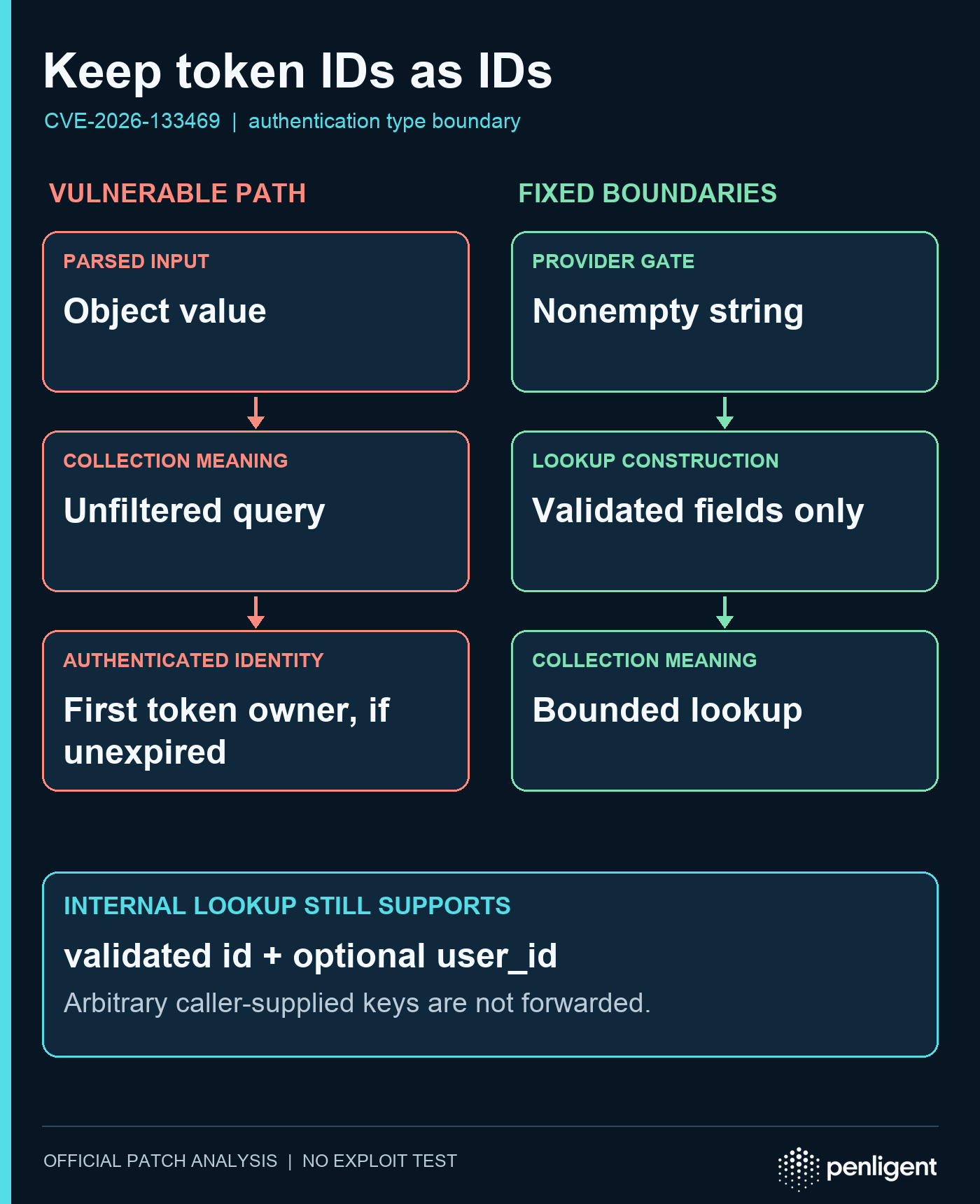
Bu official correction strengthens two boundaries. The token authentication provider admits only a nonempty string. The token lookup validates the identifier and optional user identifier, then constructs its query from those fields. It no longer forwards arbitrary caller-supplied objects to the collection. This distinction preserves legitimate internal lookups that constrain both token ID and user ID; “all objects are forbidden everywhere” would misdescribe the implementation.
The same change includes tests for rejected input types, legitimate string tokens, bounded internal lookups, expired tokens, and token owners that no longer exist. REST regression tests check rejection without reading or updating the token collection. Those are upstream tests inspected in source, not tests executed by Penligent. Their useful acceptance criterion is that invalid authentication input stops before a broad lookup—not simply that one known request returns an error.
Scope the management authority that was exposed
Begin with the routes by which clients could reach Xen Orchestra before the correction: direct public access, a reverse proxy, administrative VPN access, or a management network. Vates recommends removing internet exposure and using a dedicated management network. Restricted reachability reduces who can attempt access; it does not repair the type-validation defect or retrospectively exclude compromise.
| Review area | Evidence to collect | Decision it supports |
|---|---|---|
| XO entry point | Deployment versions, proxy routing, network access and exposure dates | Which service and time window require investigation |
| Managed infrastructure | Connected pools and hosts; privileged identities available to XO | How far the trusted management relationship could extend |
| Stored integration secrets | Configured backup remotes, proxies and other integrations | Which credential owners need to participate in recovery |
| Administrative changes | Available account, VM, configuration and host activity records | Whether observed changes have an authorized explanation |
The review table is an incident-scoping framework derived from the vendor impact and credential guidance. It is not a list of assets confirmed stolen or altered. Separate “available through the compromised management relationship” from “observed accessed.” That distinction lets responders expand scope without presenting a hypothetical consequence as evidence.
Missing campaign indicators cannot close the case
Vates says successful unauthenticated access through this path does not produce a corresponding log that detects that access. Its published detection guidance instead includes HTTP observations and campaign-associated artifacts on Xen Orchestra and XCP-ng hosts. The advisory explicitly limits those indicators to the campaign known to the vendor. Other operators may use different infrastructure or leave different artifacts. Source: vendor detection guidance.
Check available historical telemetry rather than relying only on monitoring enabled after the patch. Record whether proxy requests, network observations, host logs, and VM configuration history existed during the exposure window, along with their retention limits. A negative result in a source that did not collect the relevant event is an evidence gap. It should not become a “no compromise” finding.
Use the current advisory for the indicator list and its context. An unexpected VM, persistence artifact, or connection warrants correlation with asset ownership and authorized changes. A network block against a known campaign destination is containment evidence for that destination; it does not prove that credentials remain secret or that all attacker access has ended. Preserve available evidence before destructive cleanup when the incident process allows it.
Close patching and recovery as separate workstreams
The patch workstream ends with a supported fixed deployment and verified management access controls. The recovery workstream addresses what may already have happened. Vates recommends rotating passwords and secrets across Vates VMS after confirmed Xen Orchestra compromise, including relevant proxy, backup, host, pool, account, OTP, and mail configuration secrets. For confirmed compromise it recommends full reinstallation, because cleanup cannot guarantee removal of every backdoor. Source: Vates mitigation and recovery guidance.
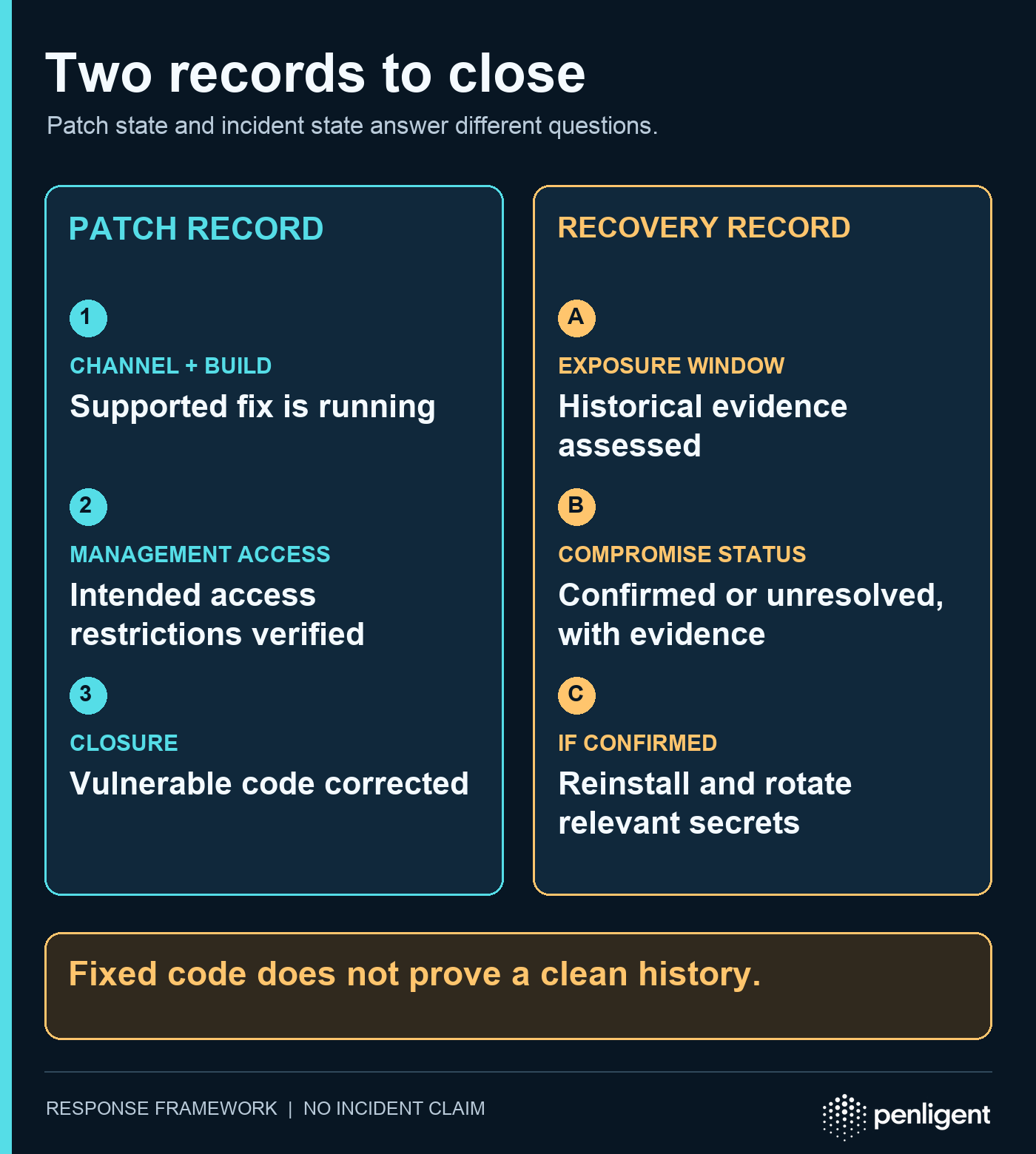
Coordinate rotation with the owners of connected systems and restore dependent services deliberately. Replacing a password only inside a rebuilt management appliance does not invalidate the corresponding old credential at its issuing system. Likewise, restoring a configuration can restore obsolete secrets or unwanted settings. These are recovery-planning implications, not vendor claims that every backup is contaminated. Document which secrets were replaced, where they were revoked, and which trusted configuration was restored.
Maintain separate conclusions for “fixed version verified,” “exposure investigated,” and “recovery completed where required.” If evidence is insufficient to resolve compromise, retain that uncertainty with an owner and next action. A fixed version does not justify erasing the investigation status; an investigation in progress is not a reason to leave the vulnerable management service exposed.
For teams organizing authorized validation evidence, the following Penligent product demonstration provides general workflow context. It is not a reproduction of CVE-2026-133469 or proof that a Xen Orchestra installation has been remediated.
Method and scope: Prepared with AI assistance from the Vates advisory, CVE record, CISA KEV entry, and official patch, retrieved November 26, 2026. The patch discussion is source analysis. No exploit, live authentication probe, upstream test suite, or incident cleanup was performed for this article.
 Turkish
 English
 German
 French
 Spanish
 Portuguese
 Japanese
 Korean
 Hindi
 Arabic
 Hebrew