
CVE-2026-43499 is a Linux kernel local privilege escalation vulnerability in the rtmutex and priority-inheritance futex requeue path. Public research names it GhostLock. The short version is precise: a low-privileged local process can reach a kernel cleanup path where the kernel updates state for the wrong task, leaving a stale pointer behind. In the right conditions, that stale pointer becomes a use-after-free condition in a core locking subsystem. The upstream kernel.org CNA score is 7.8 High with local attack vector, low attack complexity, low privileges required, no user interaction, unchanged scope, and high impact to confidentiality, integrity, and availability. (NVD)
That “local” label is important, but it is easy to misread. CVE-2026-43499 is not a standalone unauthenticated remote code execution bug against a listening network service. It does not mean a random internet client can directly hit an SSH port and become root. It means that once an attacker has any way to run code as a low-privileged local user, inside a container, inside a CI job, inside a developer workstation session, inside a browser sandbox chain, or inside a shared shell environment, the kernel boundary may become the next target. That is why a local kernel bug can become a fleet-level incident even when the first foothold came from a completely different vulnerability.
The confirmed root cause is narrow. The vulnerable code is in kernel/locking/rtmutex.c. The affected logic is remove_waiter(), which is used by ordinary slow-lock paths and also by proxy-lock rollback in rt_mutex_start_proxy_lock() when invoked from futex_requeue(). In the proxy-lock rollback case, the actual waiter task is not the same task as current. The vulnerable logic operated on current for the dequeue and priority-inheritance cleanup. The official CVE text describes three consequences: an rbtree dequeue without the waiter task’s pi_lock, a pi_blocked_on field left uncleared on the real waiter task, and priority-chain adjustment against the wrong top-priority waiter task. The practical result is a dangling pointer “primed for UAF.” (NVD)
Public exploit research has gone further than the short CVE record. Nebula Security’s write-up says GhostLock was introduced with the Linux 2.6.39 rtmutex rework, fixed in Linux 7.1, and reachable through FUTEX_WAIT_REQUEUE_PI ve FUTEX_CMP_REQUEUE_PI behavior without special capabilities or user namespaces. The same research says the team turned the bug into a 97% stable local privilege escalation and container escape in their testing and received a Google kernelCTF reward. Those exploit details are useful for risk prioritization, but defenders do not need to reproduce the exploit chain to act. They need to know whether their running kernel contains the vulnerable lineage, whether their distribution shipped a fixed kernel, whether the host runs untrusted code, and whether the machine has been rebooted into the fixed kernel. (Nebula Security)
What is confirmed, what is operational inference, and what should not be claimed
| Question | Current best answer | Neden önemli |
|---|---|---|
| What component is affected | Linux kernel rtmutex logic, specifically kernel/locking/rtmutex.c | This is a kernel boundary issue, not an application package bug. (NVD) |
| What kind of bug is it | A use-after-free risk caused by incorrect task selection during waiter cleanup | The danger is stale kernel state, not a normal permission misconfiguration. (NVD) |
| Is it remote by itself | No authoritative source describes it as a standalone remote network exploit | It requires local code execution, but many real attack chains obtain local execution first. |
| What is the CVSS score | 7.8 High under the kernel.org CNA vector AV:L/AC:L/PR:L/UI:N/S:U/C:H/I:H/A:H | The score reflects local attack vector, not low business impact. (NVD) |
| Is public exploit research available | Yes, public reporting and Nebula’s write-up describe a working exploit chain | Defenders should assume exploit development is practical, but should not run weaponized code on production. (The Hacker News) |
| Is exploitation in the wild confirmed | Public reporting on July 8, 2026 stated that no known in-the-wild exploitation had been reported at that time | Absence of public exploitation evidence is not a reason to delay patching high-risk shared hosts. (The Hacker News) |
| Is every Linux distribution fixed | No. Vendor status varies by release, package stream, and backport policy | Fleet owners must check vendor advisories and the running kernel, not only upstream version numbers. (Security Tracker) |
The most common mistake is to treat all of those cells as one headline. “Linux kernel root bug” is directionally true but incomplete. “Remote root on every Linux box” is wrong. “Only local, therefore low priority” is also wrong. A realistic reading sits between those extremes: CVE-2026-43499 is a local kernel privilege escalation vulnerability that deserves urgent attention on machines where untrusted local execution is part of the operating model.
The futex and rtmutex background behind GhostLock
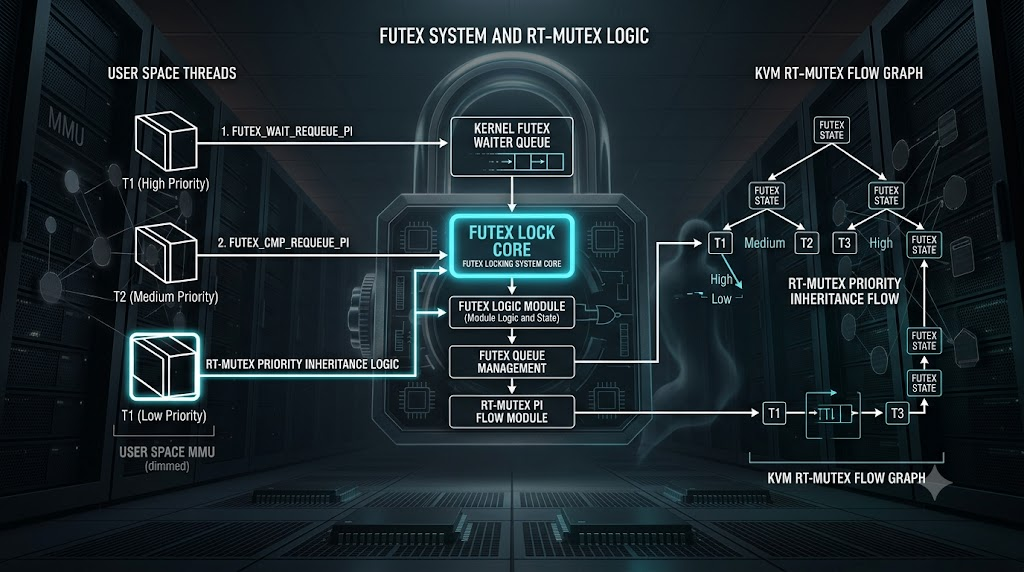
A futex is a fast user-space mutex primitive. In the common uncontended case, a program can handle synchronization in user space. When contention happens, the program enters the kernel through the futex() system call so the kernel can put waiters to sleep, wake them, or manage more complex lock semantics. Priority-inheritance futexes are special because they impose a policy agreement between user space and the kernel about the futex word: unlocked is represented as zero, an owned lock contains the owning thread ID, and a contended lock sets the FUTEX_WAITERS bit with the owner’s thread ID. When PI futex callers enter the kernel, they deal with an RT-mutex, the kernel mechanism that implements priority inheritance. (man7.org)
Priority inheritance exists to solve priority inversion. If a high-priority task blocks on a lock owned by a low-priority task, the low-priority owner temporarily inherits the higher priority so it can run, release the lock, and stop blocking the higher-priority work. Linux kernel documentation describes RT-mutexes as mutexes with priority-inheritance support, used to support PI futexes and pthread mutexes with PTHREAD_PRIO_INHERIT. It also explains that the top waiter and priority-inheritance trees are ordered by priority, with task-level state protected by the task’s pi_lock. (docs.kernel.org)
The relevant API surface for CVE-2026-43499 is not ordinary FUTEX_WAIT. It is the PI requeue pair. FUTEX_WAIT_REQUEUE_PI lets a waiter sleep on a non-PI futex and later be requeued onto a PI futex. FUTEX_CMP_REQUEUE_PI is the matching operation used by another task to requeue waiters from the source futex to the PI target futex. The Linux man pages describe the pair as support for priority-inheritance-aware POSIX condition variables, with the waiter pre-specifying the requeue target so user space and the kernel remain in sync. (man7.org)
The kernel documentation for Futex Requeue PI makes the design challenge clearer. The requeue code cannot simply wake a waiter and let it acquire the target RT-mutex later, because that would create a race window. Instead, helper routines such as rt_mutex_start_proxy_lock() ve rt_mutex_finish_proxy_lock() allow the requeue code to acquire an uncontended RT-mutex on behalf of the waiter or enqueue the waiter on a contended RT-mutex. That “on behalf of” detail is the key to understanding GhostLock: the task executing the rollback path can be different from the task represented by the waiter. (docs.kernel.org)
The bug in kernel terms
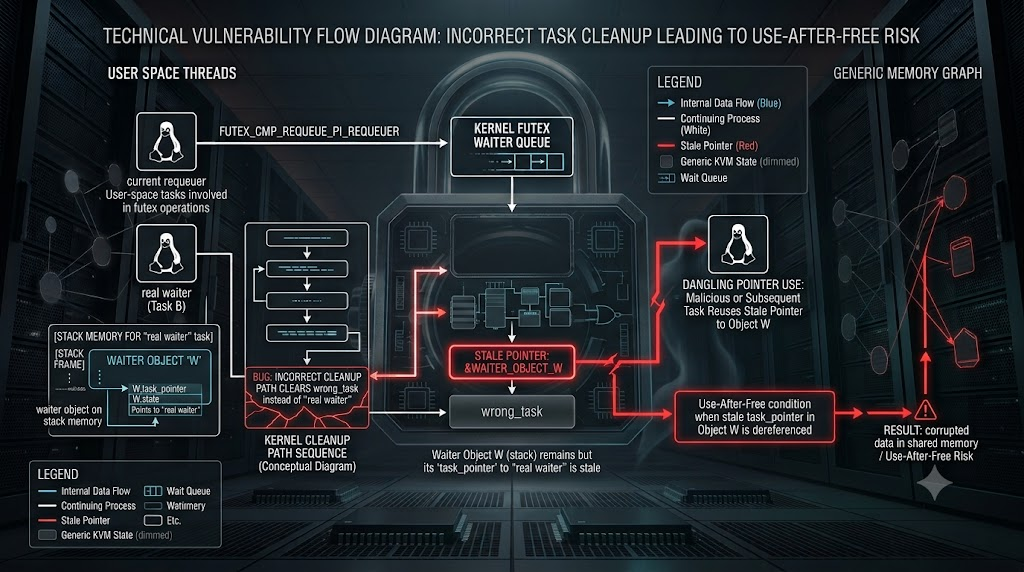
The vulnerable logic is a task identity bug inside cleanup. On the normal RT-mutex slow path, a task blocks, owns a waiter object on its own stack, and later the same task participates in cleanup. In that case, using current looks natural. The current macro points to the task currently executing on the CPU, and on the normal path that is usually the blocked task being cleaned up.
The proxy-lock rollback path breaks that assumption. During PI futex requeue, one task can operate on behalf of another. If the proxy-lock attempt needs to roll back, remove_waiter() must clean up the waiter task, not the requeuer task. The CVE record states that remove_waiter() operated on current for the dequeue operation even though, in this path, waiter::task is not current. That caused the wrong lock context and wrong task state to be used. (NVD)
The subtlety is the waiter object’s lifetime. Kernel documentation notes that an RT-mutex waiter is a structure stored on the stack of a blocked process, and that it holds a pointer to the task and mutex involved in the wait. Stack allocation is safe only if every pointer to that object is cleared before the stack frame goes away. CVE-2026-43499 violates that assumption by leaving the real waiter task’s pi_blocked_on state pointing at a waiter object that can stop existing when the waiter returns to user space. (docs.kernel.org)
From a defender’s point of view, the most important mental model is not “futex magic.” It is “stale privileged state.” The kernel is tracking relationships among tasks, locks, waiters, priority trees, and stack-resident objects. If cleanup updates the wrong task, the true owner of a pointer can keep a reference to memory that no longer has the same meaning. Later code that trusts that pointer may read or write through a false view of kernel state. That is exactly the class of bug that has repeatedly mattered in modern Linux local privilege escalation: one stale pointer, one wrong lifetime assumption, or one confused owner can collapse a security boundary.
Why local code execution is enough to make this urgent
CVE-2026-43499 requires local execution. That means the first stage of an intrusion has already happened. The first stage could be a web application RCE, a malicious dependency script, a compromised GitHub Actions job, a stolen low-privileged SSH account, a browser renderer exploit, a malicious desktop app, a sandbox escape attempt, or an attacker-controlled container workload. The kernel bug is the second stage that turns limited execution into root.
That pattern is common enough that security teams should not dismiss it. A CI runner often executes code from pull requests, build scripts, test harnesses, package managers, and container images. A Kubernetes worker executes containers from multiple teams or tenants. A developer workstation executes IDE extensions, package install scripts, local AI tooling, browser content, test binaries, and command-line utilities downloaded during debugging. A shared Linux research server may intentionally give many users shell access. In all of those places, the kernel is the shared enforcement boundary.
Containers do not make CVE-2026-43499 irrelevant. Containers share the host kernel. Namespaces, cgroups, seccomp, AppArmor, SELinux, dropped capabilities, read-only filesystems, and user namespace policy can reduce exploitability or limit post-exploitation impact, but they do not change the fact that kernel code is shared. A kernel local privilege escalation that can be reached from inside a container can become a container escape if the exploit succeeds and the environment’s hardening does not stop the chain.
The same reasoning applies to browser and mobile sandbox chains. A browser memory corruption bug may only produce code execution inside a renderer sandbox. A local kernel privilege escalation may then become the step that escapes the sandbox. Public reporting connected GhostLock to Nebula’s broader IonStack chain, where a Firefox flaw provided code execution and CVE-2026-43499 carried the chain toward root in a demonstrated scenario. That does not make CVE-2026-43499 a remote bug by itself, but it does show why “local only” is a weak comfort in chained exploitation. (The Hacker News)
Affected versions and vendor status are not the same thing
The upstream version picture is broad. NVD’s affected-configuration data lists Linux 2.6.39 as affected and versions before 2.6.39 as unaffected. It also lists fixed or unaffected states for stable streams such as 6.1.175, 6.6.140, 6.12.86, 6.18.27, 7.0.4, and the original fix line at 7.1. It also links the stable commits used across supported branches. That does not mean every distribution package with a lower-looking version is vulnerable, because distribution vendors backport fixes into their supported kernel streams. It also does not mean every system with a nominally new kernel is safe if it is still booted into an older vulnerable kernel. (NVD)
Debian’s tracker shows why distribution status must be checked directly. For CVE-2026-43499, Debian lists bookworm package linux 6.1.170-3 as vulnerable while bookworm-security 6.1.176-1 is fixed. It lists trixie 6.12.86-1 as fixed, trixie-security 6.12.95-1 as fixed, forky 7.0.13-1 as fixed, and sid 7.1.3-1 as fixed. It also shows some bullseye entries as vulnerable while a linux-6.1 bullseye security stream is fixed at 6.1.176-1~deb11u1. (Security Tracker)
Ubuntu’s status page, last updated July 7, 2026, marks CVE-2026-43499 as High with CVSS 7.8. At that time, Ubuntu listed the linux package for 26.04 LTS as fixed at 7.0.0-27.27, while 25.10 was shown as vulnerable, 24.04 LTS as vulnerable with work in progress, and 22.04, 20.04, 18.04, 16.04, and 14.04 as vulnerable for the shown linux package rows. That page may continue to change as Ubuntu publishes updates, so it should be treated as a live vendor source rather than a static global truth. (Ubuntu)
Amazon Linux’s security center listed CVE-2026-43499 as Important with CVSS 7.8 and, as of the page opened here, showed pending fixes for Amazon Linux 2 kernel streams and Amazon Linux 2023 kernel streams including kernel, kernel6.12ve kernel6.18. SUSE’s CVE page listed the issue as pending with important severity and a 7.8 CVSS score. Those differences are normal in kernel patching. Cloud distributions, enterprise distributions, LTS distributions, and rolling distributions do not ship the same kernel package at the same time. (Explore Alas)
The operational rule is simple: do not rely on a generic scanner result alone. Check the vendor advisory for the exact distribution and release. Check the installed kernel package. Check the running kernel. Confirm whether live patching is active and covers this specific CVE. Then reboot or otherwise activate the fixed kernel. A patched package sitting on disk does not protect a host still running the old kernel image.
Safe exposure checks for Linux fleets
The following commands are defensive inventory checks. They do not trigger CVE-2026-43499. They do not prove exploitability. They help determine which systems need vendor-specific patch review.
# Identify the running kernel and distribution.
uname -a
uname -r
cat /etc/os-release

# Show the boot time, useful for confirming whether a reboot happened
# after the fixed kernel package was installed.
who -b 2>/dev/null || uptime -s

# Show recent kernel messages that may indicate instability or suspicious crashes.
dmesg -T 2>/dev/null | egrep -i 'oops|BUG:|KASAN|general protection|kernel panic|futex|rtmutex' | tail -50
On Debian and Ubuntu systems, check both installed packages and the running kernel. The package database may show that a fixed image is installed while uname -r still shows an older kernel because the machine has not been rebooted.
# Debian and Ubuntu package inventory.
dpkg-query -W 'linux-image*' 2>/dev/null | sort

# Show running kernel.
uname -r

# Show available security upgrades.
apt list --upgradable 2>/dev/null | egrep 'linux-image|linux-generic|linux-headers|linux-modules' || true

# If using Ubuntu Pro Livepatch, check status.
canonical-livepatch status 2>/dev/null || true
On RHEL-family, Fedora, Amazon Linux, AlmaLinux, Rocky Linux, and similar RPM-based systems, check the installed kernel packages and the booted kernel separately.
# RPM-based package inventory.
rpm -qa 'kernel*' | sort

# Running kernel.
uname -r

# Recent security advisories visible to the local package manager.
dnf updateinfo list security 2>/dev/null | egrep -i 'kernel|CVE-2026-43499' || true
yum updateinfo list security 2>/dev/null | egrep -i 'kernel|CVE-2026-43499' || true
On SUSE-family systems, use zypper and the running kernel check together.
# SUSE package and patch context.
uname -r
rpm -qa 'kernel*' | sort
zypper list-patches --category security 2>/dev/null | egrep -i 'kernel|CVE-2026-43499' || true
zypper lp --cve=CVE-2026-43499 2>/dev/null || true
The output of these commands should be attached to remediation tickets because it gives reviewers something stronger than “patched.” A good ticket states the affected host, distribution, running kernel before remediation, fixed package version, reboot or livepatch confirmation, and post-remediation running kernel.
Patch priority should follow execution trust, not only internet exposure
A public web server that never lets untrusted users run shell commands may still be at risk if the application has an RCE, plugin upload, template injection, deserialization flaw, CI deployment path, or local service account compromise. But the highest priority systems are those where untrusted local execution is routine.
| Environment | Why CVE-2026-43499 matters | Suggested priority |
|---|---|---|
| Multi-tenant CI runner | Build scripts, tests, dependency hooks, and container jobs may execute attacker-controlled code | Çok yüksek |
| Kubernetes worker with mixed-trust workloads | Containers share the host kernel, so a kernel LPE can threaten the host boundary | Çok yüksek |
| Shared shell server | Any low-privileged account may become a host-level threat | Çok yüksek |
| Developer workstation | Package scripts, browser content, IDE extensions, local tools, and test binaries create many local-code paths | Yüksek |
| Browser sandbox or app sandbox host | Kernel LPE may be the second stage after sandboxed code execution | Yüksek |
| Internet-facing application server | Risk depends on whether an app compromise can create a local process | Orta ila yüksek |
| Single-tenant internal server | Priority depends on data sensitivity, local access policy, and lateral movement risk | Orta |
| Appliance managed by vendor | Follow vendor firmware or kernel update process and track exposure exceptions | Vendor-dependent |
The point is not to underpatch lower-priority systems. The point is to patch the systems that collapse the largest trust boundary first. A CI runner that stores cloud credentials and executes untrusted pull request code is a better first target than an isolated single-purpose server with no user accounts and no dynamic workload, even if both have the same CVSS score.
Safe PoC, a toy model of the wrong-task cleanup bug
The following PoC is intentionally not an exploit. It does not call futex(). It does not touch kernel memory. It does not attempt privilege escalation. It does not reproduce CVE-2026-43499. It is a local user-space toy model that illustrates the defensive idea: if cleanup operates on the current actor instead of the true waiter, the true waiter can keep a stale pointer to an object whose lifetime has ended.
Use it only as a teaching artifact for code review and incident discussion. It helps explain why a one-line-looking task selection bug can become a serious lifetime bug in kernel code.
/*
 * ghostlock_toy_model.c
 *
 * Safe educational model:
 * - Does not call futex()
 * - Does not interact with the Linux kernel rtmutex implementation
 * - Does not exploit CVE-2026-43499
 * - Demonstrates the logic error class: cleaning up "current" instead of
 *   the actual waiter task can leave stale state behind
 *
 * Build:
 *   cc -Wall -Wextra -O2 ghostlock_toy_model.c -o ghostlock_toy_model
 *
 * Run:
 *   ./ghostlock_toy_model
 */

#include <stdio.h>
#include <stdlib.h>
#include <string.h>

struct waiter {
    const char *name;
    int still_valid;
};

struct task {
    const char *name;
    struct waiter *pi_blocked_on;
};

/* Vulnerable pattern: cleanup assumes current_task is the actual waiter. */
static void remove_waiter_wrong(struct task *current_task)
{
    current_task->pi_blocked_on = NULL;
}

/* Correct pattern: cleanup uses the task stored in the waiter relationship. */
static void remove_waiter_right(struct task *waiter_task)
{
    waiter_task->pi_blocked_on = NULL;
}

static void print_state(const char *label, struct task *t)
{
    printf("%s: task=%s pi_blocked_on=%s\n",
           label,
           t->name,
           t->pi_blocked_on ? t->pi_blocked_on->name : "NULL");
}

int main(void)
{
    struct task requeuer = { .name = "requeuer", .pi_blocked_on = NULL };
    struct task real_waiter = { .name = "real_waiter", .pi_blocked_on = NULL };

    struct waiter *stack_like_waiter = malloc(sizeof(*stack_like_waiter));
    if (!stack_like_waiter) {
        perror("malloc");
        return 1;
    }

    stack_like_waiter->name = "waiter_object";
    stack_like_waiter->still_valid = 1;

    /*
     * The real waiter is blocked on waiter_object.
     * The requeuer is merely performing a rollback-like operation.
     */
    real_waiter.pi_blocked_on = stack_like_waiter;

    print_state("before wrong cleanup, requeuer", &requeuer);
    print_state("before wrong cleanup, real_waiter", &real_waiter);

    /*
     * Wrong cleanup clears the current actor. The true waiter still points
     * to the waiter object.
     */
    remove_waiter_wrong(&requeuer);

    print_state("after wrong cleanup, requeuer", &requeuer);
    print_state("after wrong cleanup, real_waiter", &real_waiter);

    /*
     * Now simulate the waiter object's lifetime ending.
     * In the real kernel bug, the relevant object is stack-resident.
     * Here we use malloc/free only to make the lifetime visible in user space.
     */
    stack_like_waiter->still_valid = 0;
    free(stack_like_waiter);

    if (real_waiter.pi_blocked_on != NULL) {
        puts("stale state remains: real_waiter.pi_blocked_on was not cleared");
    }

    /*
     * Repair the model state the way correct cleanup should have done.
     * Do not dereference the stale pointer.
     */
    remove_waiter_right(&real_waiter);
    print_state("after correct cleanup repair, real_waiter", &real_waiter);

    return 0;
}
The model deliberately avoids dereferencing the freed pointer after free(). Real exploitation research is about turning stale state into a useful primitive. Defensive understanding does not require that. The useful lesson is the identity mismatch: the cleanup target must be the task represented by the waiter relationship, not merely the task currently executing rollback code.
Why the official fix is conceptually small but operationally big
The official description says the fix is to use waiter::task yerine current in all related operations in remove_waiter(). Conceptually, that is a direct correction: operate on the task represented by the waiter, because the proxy-lock rollback path may not be executing in that task’s context. In a code review, this sounds like an owner/reference bug. In a kernel, it changes the safety of task PI trees, waiter trees, and stack-resident waiter lifetime. (NVD)
Small kernel fixes can still need careful rollout. Public reporting stated that early remediation had follow-up concerns, including a separate crash issue in nearby futex requeue handling. NVD’s entry for CVE-2026-53166 describes a NULL pointer dereference in remove_waiter() on self-deadlock when FUTEX_CMP_REQUEUE_PI requeues a non-top waiter that already owns the target PI futex, causing task_blocks_on_rt_mutex() to return -EDEADLK before setting waiter->task. That does not change the need to patch CVE-2026-43499; it reinforces the need to take the current vendor kernel update, not a hand-picked partial patch. (NVD)
For production teams, the safest patch instruction is not “apply commit X manually.” It is “install the current vendor-supported kernel update for your release, confirm the advisory says CVE-2026-43499 is addressed, and boot into that kernel.” If a vendor provides live patching, confirm the live patch explicitly covers this CVE and any required follow-up fixes. If a system cannot reboot, document the exception, owner, compensating controls, and deadline. Kernel exceptions without expiration dates tend to become permanent risk.
Detection strategy, watch behavior instead of public exploit filenames
Kernel local privilege escalation detection is hard because successful root compromise can alter evidence. Detection still matters, especially for triage during the exposure window, but it should not be based only on public PoC filenames, hashes, command-line strings, or GitHub repository names. Once exploit code is public, trivial rewrites break those brittle detections.
Better detections focus on behavior and context. For CVE-2026-43499, defenders should think in layers:
| Signal class | Example signal | Interpretation |
|---|---|---|
| Kernel instability | oops, BUG, KASAN, general protection fault, panic lines mentioning futex or rtmutex | May indicate failed exploitation, fuzzing, stress testing, or unrelated kernel bugs |
| Local syscall pattern | Unusual futex-heavy behavior by untrusted processes, especially in CI, containers, or shared shells | Weak signal alone, stronger when correlated with privilege transition |
| Privilege transition | Low-privileged process lineage suddenly reaches UID 0 without normal sudo, su, service manager, or package manager path | Stronger signal for investigation |
| Container boundary anomaly | Container process followed by host-level root behavior, kernel logs, or unexpected namespace changes | High priority on Kubernetes and container hosts |
| Post-root behavior | Credential access, sysctl changes, module loading, suspicious setuid file changes, new root-owned startup entries | Treat as possible compromise, not just vulnerability scanning |
| Patch drift | Fixed kernel package installed but old kernel still running | Common remediation failure |
Auditd can help capture some of the post-exploitation and suspicious transition evidence, though it cannot reliably detect the vulnerable condition itself. The exact rules must be tested on each distribution because high-volume syscall logging can create performance and storage issues.
# Example: track privilege-relevant process execution by normal login users.
# Test carefully before fleet-wide deployment.
-a always,exit -F arch=b64 -S execve -F auid>=1000 -F auid!=4294967295 -k user_exec

# Track attempts to load kernel modules.
-w /sbin/insmod -p x -k module_load
-w /sbin/modprobe -p x -k module_load
-w /usr/sbin/insmod -p x -k module_load
-w /usr/sbin/modprobe -p x -k module_load

# Track writes to sysctl configuration paths.
-w /etc/sysctl.conf -p wa -k sysctl_config
-w /etc/sysctl.d/ -p wa -k sysctl_config

# Track changes to common persistence locations.
-w /etc/systemd/system/ -p wa -k systemd_persistence
-w /etc/cron.d/ -p wa -k cron_persistence
-w /etc/sudoers -p wa -k sudoers_change
-w /etc/sudoers.d/ -p wa -k sudoers_change
For quick triage, pair kernel logs with authentication and privilege logs.
# Kernel anomalies in the suspected exposure window.
journalctl -k --since "2026-07-01" \
  | egrep -i 'futex|rtmutex|oops|BUG:|KASAN|general protection|panic'

# Privilege transition review.
journalctl --since "2026-07-01" \
  | egrep -i 'sudo|su:|session opened for user root|uid=0|pam_unix|setuid'

# Recently changed root-owned setuid files.
find / -xdev -perm -4000 -type f -printf '%TY-%Tm-%Td %TH:%TM %u %m %p\n' 2>/dev/null \
  | sort | tail -50
These commands are not proof of exploitation or non-exploitation. They are starting points. If a high-value host was vulnerable and ran untrusted code during the exposure window, absence of obvious logs should not be treated as conclusive. Once root is possible, log integrity becomes part of the incident question.
Remediation checklist for production systems
The primary remediation is to install the vendor-fixed kernel and boot into it. For CVE-2026-43499, configuration-only mitigations should be treated as risk reducers, not replacements for the fix. Public reporting noted that there is no complete workaround because the triggering operations are routine for local processes. It also mentioned kernel build options such as RANDOMIZE_KSTACK_OFFSET ve STATIC_USERMODE_HELPER as exploit hardening factors, not as full remediation. (The Hacker News)
A practical remediation checklist should look like this:
- Identify all Linux assets by distribution, release, kernel package stream, running kernel, workload type, and local-code exposure.
- Pull the current vendor advisory for each distribution and release.
- Install the fixed kernel package or verified live patch.
- Reboot into the fixed kernel unless a live patch explicitly covers the issue.
- Confirm
uname -rafter reboot. - Preserve pre- and post-remediation evidence in the ticket.
- Prioritize investigation for hosts that ran untrusted code while vulnerable.
- Rotate secrets on high-risk shared hosts if there is evidence or strong suspicion of compromise.
- Review container hosts, CI runners, and developer endpoints separately from ordinary servers.
- Remove temporary exceptions after the maintenance window.
Do not close a remediation ticket only because a package manager says “nothing to do.” The package manager may be looking at one repository while the host runs a custom kernel, cloud-optimized kernel, vendor appliance kernel, real-time kernel, or manually pinned image. For kernel CVEs, asset owners need a reliable mapping between booted kernel and vendor fix status.
Hardening that reduces blast radius
Patch first. Then reduce the odds that a future local kernel bug becomes a full compromise.
For CI, use short-lived runners for untrusted jobs. Do not run untrusted pull request code on long-lived machines with broad cloud credentials. Separate trusted release pipelines from untrusted test pipelines. Avoid sharing the same runner between high-trust deployment jobs and arbitrary external contributions. Use workload identity with short token lifetimes, and assume runner compromise if a kernel LPE was reachable during a job that executed untrusted code.
For Kubernetes, patch nodes before focusing on ordinary containers. Enforce Pod Security Standards or equivalent policies. Drop unnecessary capabilities. Use seccomp profiles. Avoid privileged containers except where absolutely required. Use AppArmor or SELinux where supported. Keep hostPath mounts rare, narrow, and documented. Treat nodes that ran high-risk workloads during the vulnerable period as possible credential exposure points, especially if service account tokens, image pull secrets, or cloud metadata credentials were reachable.
For developer workstations, control package install scripts and local execution sources. Dependency ecosystems can execute code during installation. IDE extensions and local AI tools often run with broad filesystem access. Developers also carry high-value secrets: SSH keys, cloud credentials, source code, API tokens, browser sessions, and deployment keys. A kernel LPE on a developer machine can be more damaging than the same bug on a low-value server.
For shared Linux systems, minimize shell access, segment users, enforce MFA for access, monitor unusual privilege transitions, and avoid storing global secrets on the host. Shared research servers and jump boxes are especially sensitive because “local user” is not a rare condition; it is the business model of the machine.
Related vulnerabilities that explain the risk pattern
CVE-2026-43499 belongs to a broader operational pattern: local privilege escalation bugs matter when local execution is common or chained. Comparing it with adjacent CVEs helps teams avoid overfocusing on one subsystem.
| CVE | Bileşen | Bug shape | Why it is relevant |
|---|---|---|---|
| CVE-2026-43499, GhostLock | Linux rtmutex and PI futex requeue | Wrong task cleanup leaves stale waiter state and UAF risk | Shows how a subtle synchronization cleanup bug can become root from local code |
| CVE-2024-1086 | Linux netfilter nf_tables | Use-after-free and double-free behavior in hook verdict handling | NVD describes local privilege escalation and includes CISA KEV references, showing that local kernel LPE can become real-world exploitation priority. (NVD) |
| CVE-2023-3269, StackRot | Linux memory management VMA handling | Incorrect lock handling leading to UAF | Ubuntu described possible arbitrary kernel code execution, container escalation, and root privileges. (Ubuntu) |
| CVE-2021-4034, PwnKit | polkit pkexec | Incorrect argument handling in a privileged setuid utility | Demonstrates why a “local” privilege escalation in widely deployed default software can require urgent patching. (NVD) |
| CVE-2026-46242, Bad Epoll | Linux eventpoll | Race-condition use-after-free in epoll cleanup | Another 2026 Linux kernel object-lifetime bug where low-privileged local code can threaten the host boundary. (Penligent) |
The common lesson is that the first foothold and the privilege escalation step are often different vulnerabilities. A web RCE may get a low-privileged shell. A malicious dependency may get a CI job. A browser exploit may get renderer code execution. A kernel LPE then determines whether the attacker stays contained or becomes root.
Why safe validation beats exploit-based validation
Security teams often ask one dangerous question during a kernel LPE disclosure: “Can we just run the PoC and see if it works?” On production systems, the answer should usually be no. A working local privilege escalation PoC can crash the host, corrupt memory, change permissions, create root-owned artifacts, trigger EDR containment, violate policy, or leave responders unable to distinguish a test from an attack.
Safer validation asks narrower questions:
| Validation question | Safe evidence | Unsafe shortcut |
|---|---|---|
| Is the host in an affected release family | Vendor advisory, package stream, release metadata | Guessing from upstream version alone |
| Is the fixed kernel installed | Package manager output, advisory fixed version | Assuming patch tools updated everything |
| Is the fixed kernel running | uname -r, boot time, livepatch status | Closing ticket before reboot |
| Does the host run untrusted code | Workload inventory, CI policy, Kubernetes labels, user access records | Treating all servers the same |
| Was there suspicious activity during exposure | Kernel logs, auth logs, EDR telemetry, container runtime logs, file integrity changes | Running public exploit code to “confirm” |
| Are compensating controls documented | Seccomp, SELinux, AppArmor, runner isolation, credential rotation | Claiming containers are enough |
This is also where controlled automation can be useful if it stays inside authorized boundaries. A platform such as Penligent can support evidence-driven security validation workflows by turning CVE context into scoped checks, collecting command output, preserving proof of patch state, and producing retestable reports for humans to review. The useful part is not “AI runs an exploit.” The useful part is repeatable evidence collection across assets, clear scope control, and a record that shows why a host was considered fixed or still exposed. Penligent’s public materials describe agentic AI pentesting and reporting workflows, and its related discussion of accelerated vulnerability disclosure makes the same practical point: kernel local privilege escalation validation should rely on controlled lab reproduction or vendor-provided checks, not public exploit code on production systems. (Penligent)
Incident response when a vulnerable host ran untrusted code
If a vulnerable host only hosted a single trusted workload and had no evidence of compromise, patching and rebooting may be enough. If a vulnerable host ran untrusted code, especially during the period after public exploit details became available, response should be more cautious.
For CI runners, identify jobs that ran while the host was vulnerable. Review whether those jobs had access to deployment credentials, cloud tokens, package signing keys, container registry credentials, or internal source code. Rotate secrets if untrusted code ran with meaningful access. Rebuild long-lived runners from trusted images rather than treating a patched kernel as proof that the prior runtime state was clean.
For Kubernetes worker nodes, identify pods scheduled during the exposure window. Pay attention to privileged pods, pods with hostPath mounts, pods with broad service account tokens, and workloads that could reach cloud metadata services. If suspicious activity exists, cordon and drain the node, preserve forensic data where possible, rebuild the node, and rotate credentials that may have been accessible from affected pods.
For developer machines, review local credentials, SSH agent forwarding, browser sessions, package manager tokens, cloud CLIs, and source repositories. A local root compromise can steal long-lived secrets that remain valid after patching. Endpoint detection should focus on persistence, credential access, unusual root-owned files, new launch agents or systemd units, modified shell profiles, and unexpected changes to security tools.
For shared shell systems, assume any user could have attempted exploitation once public code exists. Review login history, command history where trustworthy, process accounting if enabled, file integrity monitoring, setuid file changes, cron changes, systemd changes, and outbound connections. If the system holds sensitive data or credentials, rebuilding may be cheaper than trying to prove a negative.
Common mistakes during CVE-2026-43499 remediation
The first mistake is patching but not rebooting. Kernel packages do not protect the running kernel until the system boots into the fixed image, unless a verified live patch is active. Remediation evidence must include the running kernel after maintenance.
The second mistake is assuming that container isolation solves the problem. Containers reduce exposure only when combined with strong runtime policy, minimal privileges, seccomp, SELinux or AppArmor, and careful secret handling. They still share the host kernel. A kernel LPE reachable from a container is exactly the type of issue that can turn container compromise into host compromise.
The third mistake is treating CVSS 7.8 as routine. CVSS correctly encodes local attack vector and low privileges, but business priority depends on environment. A 7.8 local LPE on a single-user lab machine is not the same as a 7.8 local LPE on a multi-tenant CI platform holding cloud deployment credentials.
The fourth mistake is relying on exploit failure. A public exploit may fail because of kernel configuration, allocator behavior, timing, mitigations, architecture, compiler options, or hardening. That does not prove the host is not affected. Conversely, a successful exploit test on production may create exactly the compromise state the team is trying to avoid.
The fifth mistake is ignoring follow-up kernel updates. Kernel fixes can evolve. Vendor advisories may update package status after initial publication. Nearby futex and rtmutex fixes may be delivered in later packages. Treat the current vendor-supported kernel as the target, not an isolated commit copied from upstream.
Practical mitigation beyond the patch
Kernel hardening should be layered around likely local execution sources. These controls do not replace the fix for CVE-2026-43499, but they reduce the chance that the next local kernel bug becomes a root compromise.
Use seccomp profiles for containers and services. A strict profile can reduce reachable syscall surface. It may not fully block futex usage because futexes are common, but it can restrict other syscalls often used after privilege escalation or in exploit setup. Avoid overly broad “unconfined” settings.
Use SELinux or AppArmor in enforcing mode where operationally possible. Mandatory access control can reduce what a compromised process can read, write, or execute before privilege escalation, and in some cases can reduce post-root damage if policy is strong. Do not count on MAC as a complete defense against kernel compromise, but do count it as useful friction.
Drop capabilities aggressively. Capabilities such as CAP_SYS_ADMIN, CAP_SYS_MODULE, CAP_SYS_PTRACE, and broad device access dramatically increase the damage of a compromised container or service. Many workloads do not need them.
Separate secrets from build and test execution. CI systems often fail here. A low-trust job should not receive production cloud credentials, signing keys, or broad registry write tokens. Short-lived, scoped credentials are safer than long-lived secrets on disk.
Keep kernel telemetry. Centralized logs, EDR, auditd, container runtime logs, and cloud workload logs help reconstruct the exposure window. If logs are local only, root compromise may make them untrustworthy.
Retire long-lived shared hosts where possible. Ephemeral infrastructure is easier to rebuild after a kernel LPE disclosure. A pet CI runner with months of state is a forensic liability.
SSS
What is CVE-2026-43499 in plain terms?
- CVE-2026-43499 is a Linux kernel local privilege escalation vulnerability in the rtmutex and PI futex requeue path.
- Public research calls it GhostLock.
- The core bug is that a cleanup path can operate on the currently executing task instead of the true waiter task.
- That leaves stale priority-inheritance state behind and creates a use-after-free risk.
- A successful exploit can turn low-privileged local code execution into root on affected systems.
Is GhostLock remotely exploitable?
- Not by itself, based on currently available authoritative information.
- The attacker needs a way to run code locally as a low-privileged user or inside a local execution boundary such as a container, CI job, desktop app, or sandboxed process.
- It can still matter in remote attack chains if another vulnerability first gives the attacker local code execution.
- Treat internet-facing systems as higher risk when application compromise could lead to a local process.
How do I know whether my Linux system is affected?
- Check your distribution’s advisory for CVE-2026-43499.
- Check the installed kernel package version and the running kernel with
uname -r. - Confirm whether the system has rebooted into the fixed kernel.
- Do not rely only on upstream version numbers because vendors backport fixes.
- If live patching is used, confirm that the live patch explicitly covers CVE-2026-43499 and any required follow-up fixes.
Does containerization protect against CVE-2026-43499?
- No, not by itself.
- Containers share the host kernel, so a reachable kernel local privilege escalation can threaten the host boundary.
- Seccomp, AppArmor, SELinux, dropped capabilities, read-only filesystems, and non-privileged containers can reduce risk.
- These controls are not substitutes for patching the host kernel.
- Patch Kubernetes workers and container hosts early, especially when they run mixed-trust workloads.
Should I run a public PoC to validate exposure?
- Do not run weaponized or public exploit code on production systems.
- Kernel LPE PoCs can crash hosts, corrupt memory, alter system state, trigger response tools, or create forensic ambiguity.
- Safer validation uses vendor advisories, package checks, running-kernel checks, livepatch status, and controlled lab reproduction.
- If exploit reproduction is required, perform it only in an isolated lab that mirrors the target kernel and contains no production secrets.
- Document the validation boundary so the test cannot be mistaken for production exploitation.
What should defenders monitor after patching?
- Review kernel logs for
oops,BUG,KASAN, panic, general protection fault, futex, or rtmutex anomalies. - Review privilege transitions where low-privileged process lineage reaches UID 0 outside normal administrative paths.
- Review setuid file changes, module loading attempts, sysctl changes, persistence locations, and suspicious root-owned files.
- On CI and Kubernetes hosts, correlate suspicious events with jobs or pods that ran during the vulnerable window.
- Treat logs cautiously if root compromise is plausible, because successful attackers may alter local evidence.
How should teams prioritize patching across a large fleet?
- Patch systems that run untrusted local code first: CI runners, build servers, Kubernetes workers, shared shells, developer workstations, sandbox hosts, and container platforms.
- Patch internet-facing application servers next, especially when application compromise could create a local process.
- Patch sensitive internal servers according to data value, credential exposure, and local access policy.
- Track exceptions with owners and deadlines.
- Confirm remediation by running-kernel evidence, not only package installation.
The practical call
CVE-2026-43499 is not a reason to panic about every Linux machine in the same way. It is a reason to take Linux local privilege escalation seriously wherever local execution is part of the threat model. The vulnerable code sits in a core synchronization path. The official description confirms a stale waiter state that can become use-after-free. Vendor status varies. Public research shows practical exploitability. Public reporting states that exploit code exists, while also noting that in-the-wild exploitation was not known at the time of publication. (NVD)
The right response is disciplined: identify affected kernels, follow vendor advisories, install the current fixed kernel, reboot or verify livepatch coverage, prioritize shared execution environments, avoid production exploit testing, and preserve enough evidence to prove remediation. The word “local” should shape the threat model, not lower the priority by default. In modern infrastructure, local code execution is often already part of the attacker’s path. The kernel decides whether that path stops at a sandbox or becomes root.
 Turkish
  English
  German
  French
  Spanish
  Portuguese
  Japanese
  Korean
  Hindi
Hindi  Arabic
  Hebrew