
CVE-2026-84411 is an unauthenticated integer-underflow flaw in the HTTP request-body handling of MikroTik RouterOS’s web management service. CISA describes a crafted request as capable of code execution as root or denial of service. Exposure depends on whether an untrusted source can reach the vulnerable management service and which release is running.
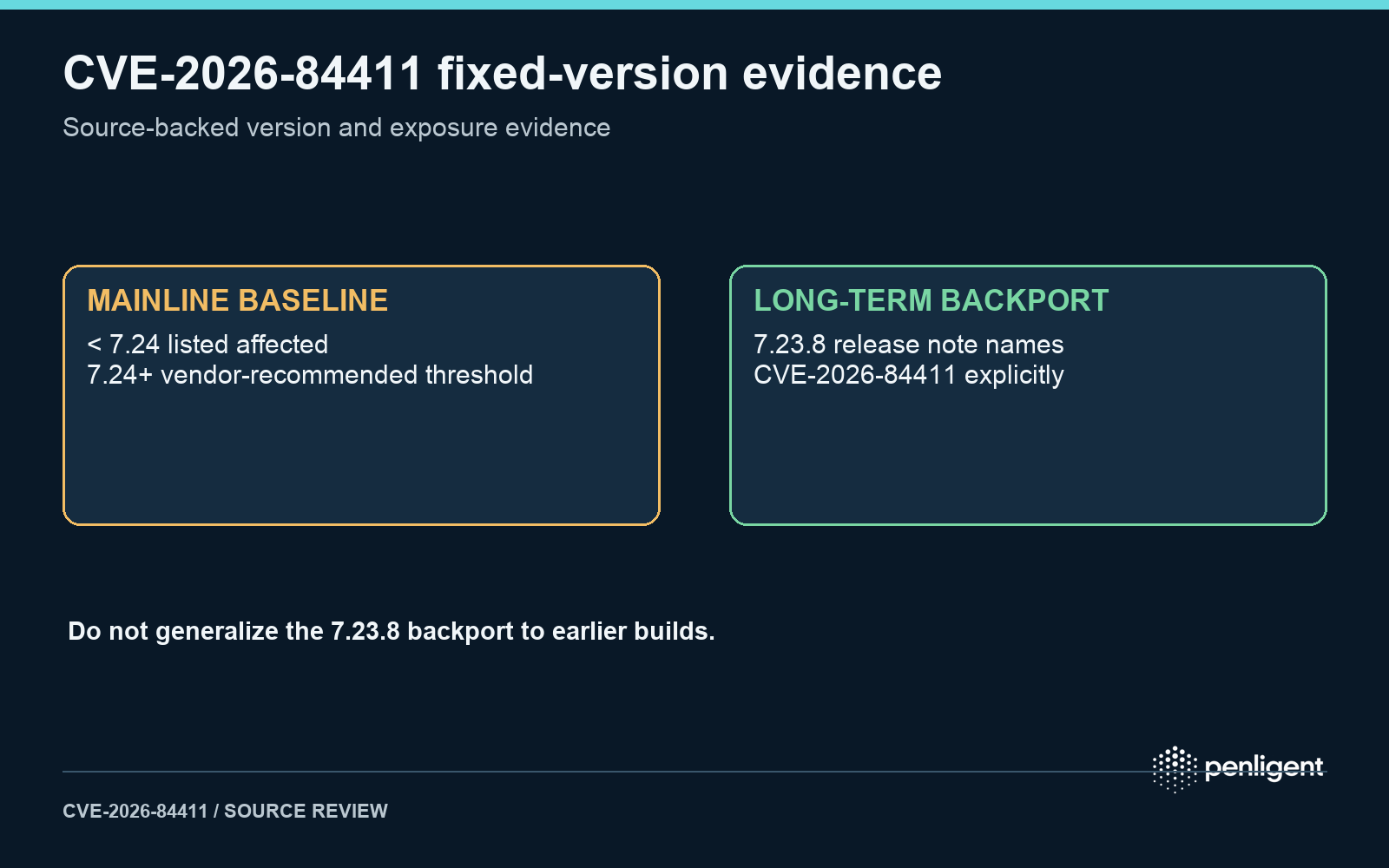
The fixed-version evidence requires branch-aware reading. The CVE record and CISA mark versions before 7.24 as affected. MikroTik separately documents a repair in long-term 7.23.8. That is evidence for a specific backport, not every 7.23.x release. Record the device’s release channel, installed version, and matching vendor release note before closing a finding.
Kaynaklar: CISA ICSA-26-272-06, the CVE record, and MikroTik’s 7.23.8 long-term release note.
Trace the web management path
MikroTik’s IP Services documentation identifies www as WebFig HTTP and www-ssl as WebFig HTTPS. Ports can be changed and services disabled. Inspect active service configuration, firewall policy, upstream NAT and the management network path; common port numbers alone do not establish exposure.
For authorized inventory, the read-only command /ip service print detail reports service state and configured access parameters. Reconcile it with network and firewall rules. MikroTik specifically distinguishes the service address restriction from network-level packet filtering and recommends a firewall for external or untrusted networks. A service restriction should not be assumed to stop traffic before it reaches vulnerable code.
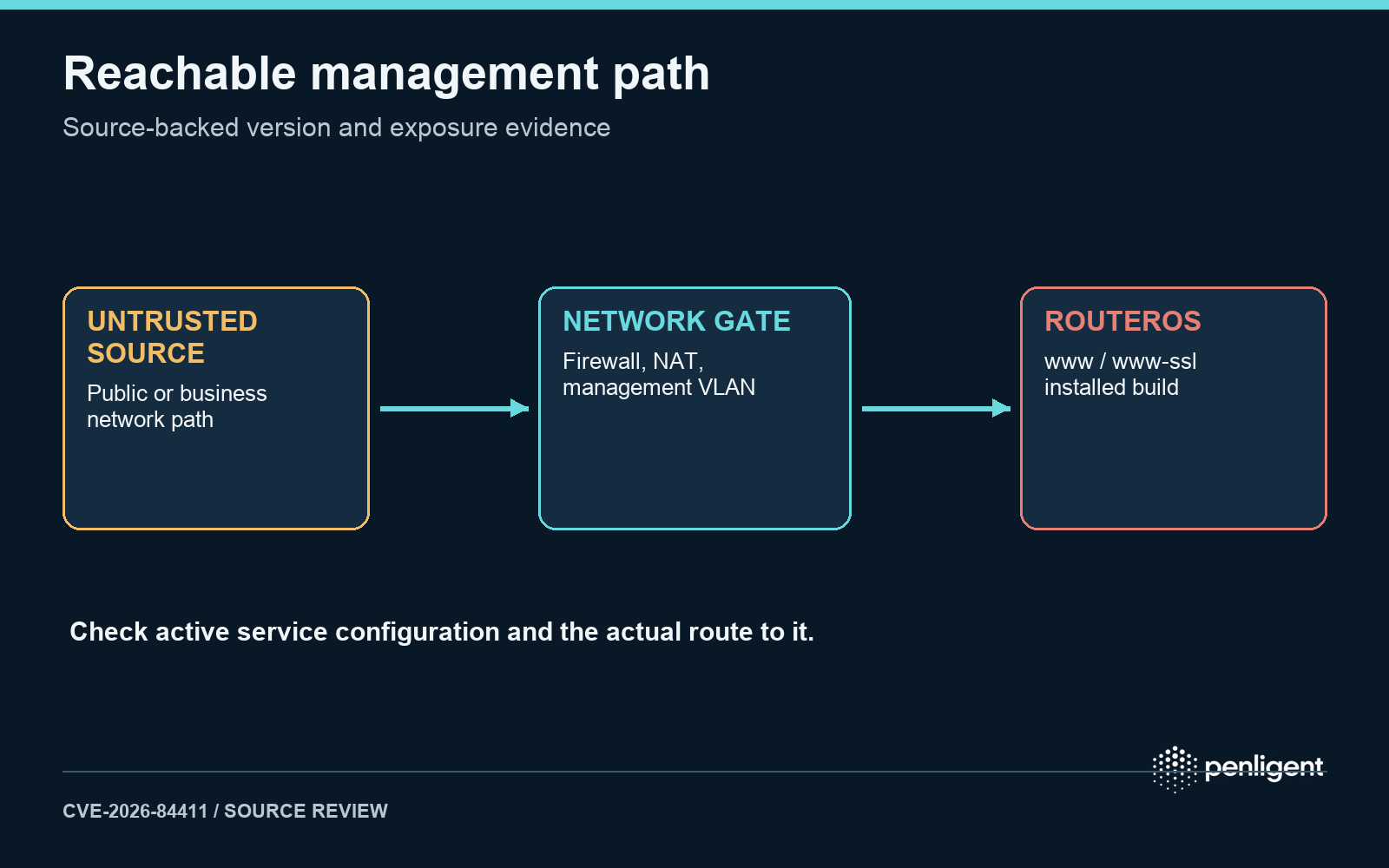
Keep four facts separate: the installed RouterOS build, whether a web service is enabled, the source networks that can reach it, and the management privileges available after a successful compromise. A management-only VLAN reduces exposure compared with a public NAT forward, but a reachable vulnerable service on that VLAN still requires remediation. Confirm an alternate administrative path before changing access controls.
Reconcile the branch-specific fix
The CVE record’s less-than-7.24 range provides the general boundary. The vendor’s October 8, 2026 long-term 7.23.8 release note explicitly says it includes CVE-2026-84411. Preserve that evidence when a scanner flags the lower upstream version. Do not extend this exception to 7.23.7 or infer a fix for an unlisted branch.
| Kanıtlar | Supported conclusion | What to record |
|---|---|---|
| CVE record and CISA advisory | Below 7.24 is listed affected; 7.24 or later is recommended | Installed release and package state |
| MikroTik 7.23.8 long-term note | Specific backport includes this CVE | Exact version, channel and vendor note |
| Other branches or custom images | A numeric comparison alone is insufficient | Supplier-supported remediation evidence |
Use a currently supported fixed release appropriate to the device and channel. The versions above establish historical repair boundaries, not a recommendation to stay on the first fixed build indefinitely. Check the current vendor release guidance during the maintenance window and verify the running version after the upgrade and reboot.
Close with two kinds of evidence
- Record model, full RouterOS version, channel and support status.
- Capture the enabled www/www-ssl services, custom ports, firewall rules, NAT forwards and management-source restrictions.
- Apply the supported fixed update and retain its source and release note.
- Verify the installed version after reboot and recheck authorized management connectivity from the intended network zones.
- Attach the patch evidence and network-path evidence to the same asset record, with validation time.
A successful management login is a compatibility check, not proof of exploit resistance. Restricting access while an update is scheduled is containment rather than a repair. No malformed request or exploit is needed for this inventory-and-patch workflow.
CISA’s September 29 advisory said no public exploitation specifically targeting this vulnerability had been reported to it at that time. The CVE was absent from the CISA KEV feed checked on November 23, 2026. These are bounded observations, not proof that no private exploitation exists. Penligent did not reproduce the vulnerability or test a RouterOS device. AI assisted organization and diagram production; the version reconciliation compares the public CVE record with the vendor’s branch-specific release note.
The following video demonstrates a general Penligent workflow. It does not test or validate CVE-2026-84411.
 Turkish
 English
 German
 French
 Spanish
 Portuguese
 Japanese
 Korean
 Hindi
 Arabic
 Hebrew