
Last updated: November 4, 2026.
Ecommerce penetration testing should verify that every change to price, inventory, entitlement and money is authorized and internally consistent. Checkout security involves more than payment-page scanning. Accounts, carts, discounts, gift cards, loyalty balances, fulfillment, refunds and administrative actions create connected business-logic boundaries.
Use a dedicated merchant sandbox, test payment instruments and synthetic orders where possible. The rules of engagement should prevent real charges, customer notifications, fulfillment or inventory changes unless explicitly approved.
For the assessment framework, consult OWASP Web Güvenliği Test Kılavuzu and map the relevant guidance to the actual environment and authorized scope.
Model the commerce state machine
Document the authoritative source and permitted transitions for cart, order, payment, fulfillment, return and refund state. Then test whether requests can skip, repeat or reorder those transitions.
| Workflow | Security question | Safe evidence |
|---|---|---|
| Account and session | Can another user’s identity, address or order be accessed? | Two test accounts and synthetic records |
| Pricing and discounts | Can price, currency, coupon or eligibility be manipulated? | Sandbox order and expected calculation |
| Payment and checkout | Are amount and order bound to the payment decision? | Test processor IDs and final state |
| Refund and returns | Can value or entitlement be duplicated? | Synthetic refund and ledger linkage |
| Admin and support | Can ordinary or support roles perform excessive actions? | Role matrix and audit event |
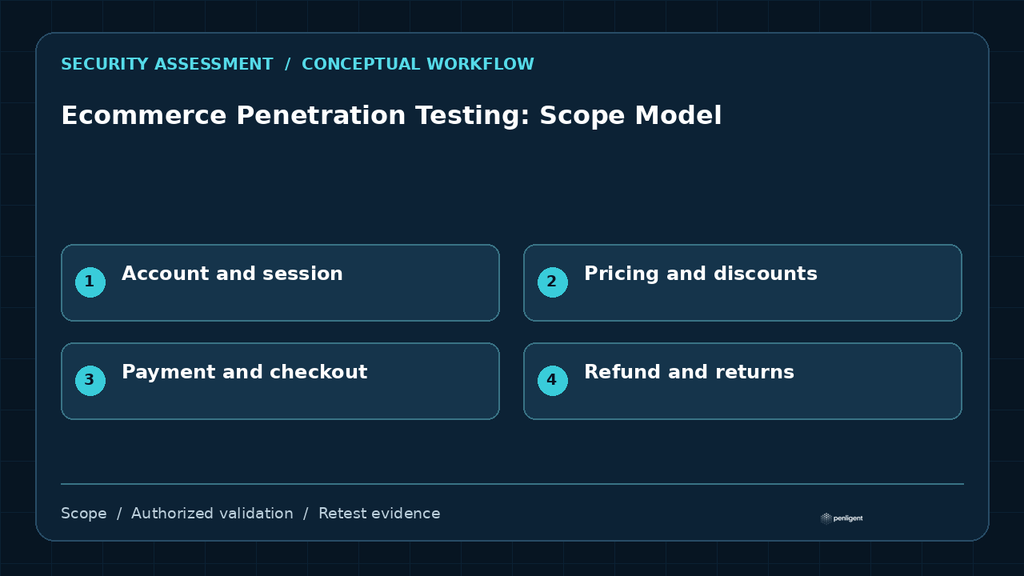
Turn the scope into testable evidence
Define an authorized target, validate meaningful attack paths, and keep the evidence connected to remediation and retesting.
Test APIs, concurrency and retries
Mobile and web clients often share APIs. Test object authorization, hidden fields, idempotency, race conditions and asynchronous webhooks. Keep request volume bounded and use test inventory and accounts.
Include promotions and non-cash value
Gift cards, credits, loyalty points, referral rewards and coupons can become money-equivalent attack surfaces. Validate issuance, redemption, ownership, expiration and reversal rules, including combinations that the user interface does not normally produce.
Retest the invariant, not just the endpoint
A fix should preserve the business rule across web, mobile, API and administrative channels. Retest the original sequence and alternate orderings, then confirm the order, payment and entitlement records remain consistent.
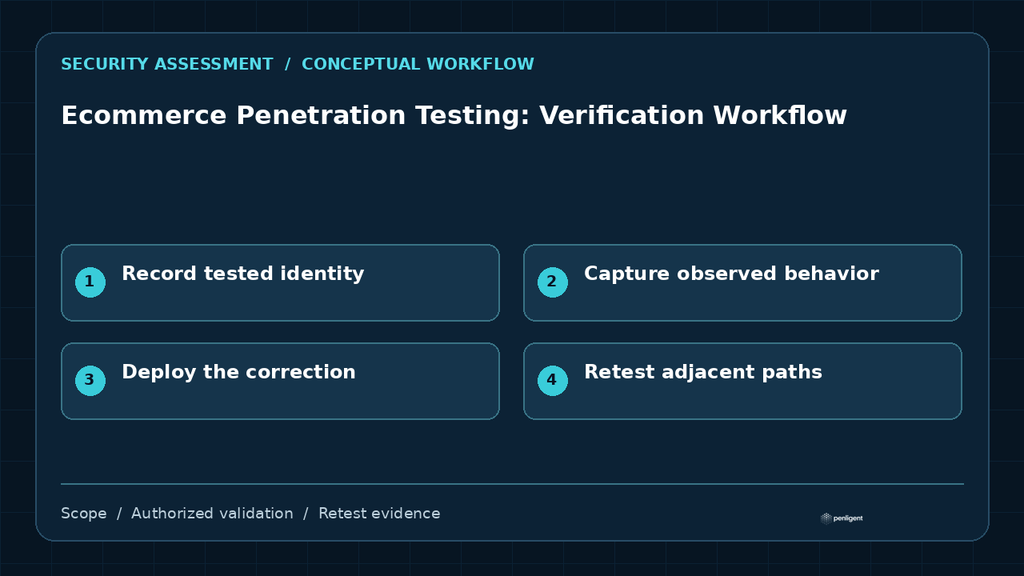
Turn the scope into testable evidence
Define an authorized target, validate meaningful attack paths, and keep the evidence connected to remediation and retesting.
Questions buyers should ask
- Can the engagement use a payment sandbox and synthetic inventory?
- Are web, mobile, API, webhook and support workflows included?
- Which pricing, promotion and refund invariants must always hold?
- Will the retest check alternate channels and request orderings?
Sonuç
Ecommerce security is a state and authorization problem. Map how accounts, orders, money and entitlements change, test the transitions with safe synthetic data and require closure evidence across every channel that can perform the action.
 Turkish
 English
 German
 French
 Spanish
 Portuguese
 Japanese
 Korean
 Hindi
 Arabic
 Hebrew