
A pinned MCP server can run different code without a change to the version in your assistant configuration. The missing control is usually the identity of the complete executable environment: its indirect packages, interpreter, startup behavior, and access to local resources. For a security team approving an AI integration, the useful question is therefore specific: can the next launch introduce executable content that was outside the last review?
Corelight’s November 10 research provides a concrete example. A server tied to one release and commit used 15 dependency sets over five weeks; 23 of its 69 packages changed. The researcher explicitly says the workstation was not compromised. These are observations of changing software inputs, not proof of an attack or an estimate of how many MCP installations are affected. Corelight’s original investigation supplies the measurement and its limits. The subject received renewed attention in a Cloud Security Alliance research note dated November 15.
Move dependency selection into a reviewable build step while preserving a deliberate path for useful updates. Approve an artifact, launch that artifact under restricted authority, and deliberately replace it when a correction is needed. The deployment designs and test cases below are proposed methods, with an entirely local educational demonstration. They are not a report of testing a customer’s environment.
What exactly did the version approval cover?
Imagine an approval ticket containing a repository URL, a release number, and the sentence “read-only ticket search.” Those details tell a reviewer what the integration intends to do. They do not identify all the software that will execute or all the actions its process can perform. A sound review needs to connect the intended function to observable implementation and access decisions.
Separate the approval into five objects. The launch configuration states how the assistant starts the server. The selected top-level package identifies the publisher’s entry point. The resolved dependency graph identifies the other packages selected for that build. The executable artifact includes what was actually installed or built. The effective authority describes the files, network destinations, identities, and resources available when that artifact runs.
Review these objects separately so a change to one does not inherit approval for the others. Updating an API permission can require an access review while leaving the binary unchanged. Rebuilding against a new dependency can require software review even when the API permission stays identical. A new laptop can require launch verification even when it receives an already approved artifact.
| Approval object | Evidence to retain | Question the evidence can answer | Question it cannot answer alone |
|---|---|---|---|
| Launch configuration | Reviewed command, arguments, configuration digest | What did the client request? | Which bytes were selected later? |
| Top-level package | Exact package identity and source mapping | Which server release was intended? | Which indirect packages executed? |
| Dependency graph | Approved lock and resolved inventory | Which package versions were selected? | Was the running environment modified? |
| Executable artifact | Artifact digest and build record | Which packaged output was approved? | What host resources can it access? |
| Effective authority | Runtime identity, mounts, egress and API grants | What is the process permitted to reach? | Is every permitted operation appropriate? |
A deployment can have strong evidence in one row and weak evidence in another. Avoid collapsing the table into a single trusted/untrusted flag. In an incident, the distinction lets responders answer a narrow question promptly: which machines launched a particular artifact, which credentials those processes received, and which services those credentials could affect.
Use identifiers that are useful to the people operating the system. An internal artifact name should lead to its build record; an integration name should lead to an owner. A thirty-line hash inventory with no route to the responsible team is difficult to act on. Conversely, a list of friendly server names with no artifact identity cannot support a reliable exposure investigation. The review should connect both forms of evidence.
Why npx and uvx need a deployment review
Package runners are convenient because they combine locating software and executing it. That convenience is precisely the boundary to examine when a client starts a server automatically. The issue is not the spelling of a command. It is whether that command is allowed to choose new executable inputs while running with a user’s access.
The npm lock must belong to the installation you actually use
Bu npm exec documentation explains that requested packages missing from the local project can be installed in npm’s cache and made available to the executed command. Cache settings affect freshness checks and offline behavior. Consequently, an assessment should not claim that every invocation downloads and reinstalls everything. Inspect the exact launcher version, arguments, working directory, and cache policy before describing its behavior.
There is a separate publication distinction. According to npm’s package-lock documentation, package-lock.json describes a project’s resolved tree, cannot be published, and is ignored outside the root project. npm-shrinkwrap.json can be published and has different deployment semantics. Finding a lockfile in a server’s source repository therefore does not establish that a consumer’s package-runner installation used it.
For your review, ask the owner to demonstrate the actual installation path with a disposable environment and non-sensitive test data. Keep the commands, selected inputs, resulting inventory, and artifact identity together. If the owner instead presents a screenshot of a repository lockfile, the review is still missing the relationship between that document and the running process.
Consider two hypothetical developers using the same approved launch entry. One has a previously prepared environment; the other is starting on a new machine. A test of the first developer’s ordinary startup does not establish the inputs selected for the second. The useful acceptance test includes the new-machine path because that is when an implicit dependency decision becomes visible.
A command may also find an executable through its search path. Record the absolute location of the approved executable and the interpreter chosen for it. This recommendation is about operational clarity: the team should be able to distinguish the intended installation from a stale copy or a differently managed environment. Do not infer that identical command text means identical execution merely because both launches succeed.
uv’s tool cache is not a release approval record
Astral describes uvx environments as disposable caches. Its tool documentation says that a cached tool is normally reused, with changes possible when versions are requested or caches are refreshed or pruned. A removed environment can be recreated automatically. That is different from a persistent organizational decision to approve a specific complete build.
The recommended review question is what happens when the cache is absent. Do not delete a working employee environment to find out. Reproduce the approved launch configuration in a disposable test environment, using synthetic resources and a dedicated test identity. Compare what the launch resolves with the inventory the team intended to approve. If there is no approved inventory, record that as a missing control rather than inventing a baseline from the most convenient machine.
Keep installation modes explicit in documentation. A project synchronized from a reviewed lock, an independently installed tool, and an ephemeral tool invocation are different operating paths. A change request should name which one is being deployed. Otherwise, a precise instruction written for one path may be copied into another and lose the property the reviewer expected.
A successful repeat launch may show only that a previously created environment was reused. The difficult question concerns reconstruction: whether a replacement machine, recovered workstation, or new CI worker receives the intended executable inputs. Design your approval around that question before standardizing a launcher across a fleet.
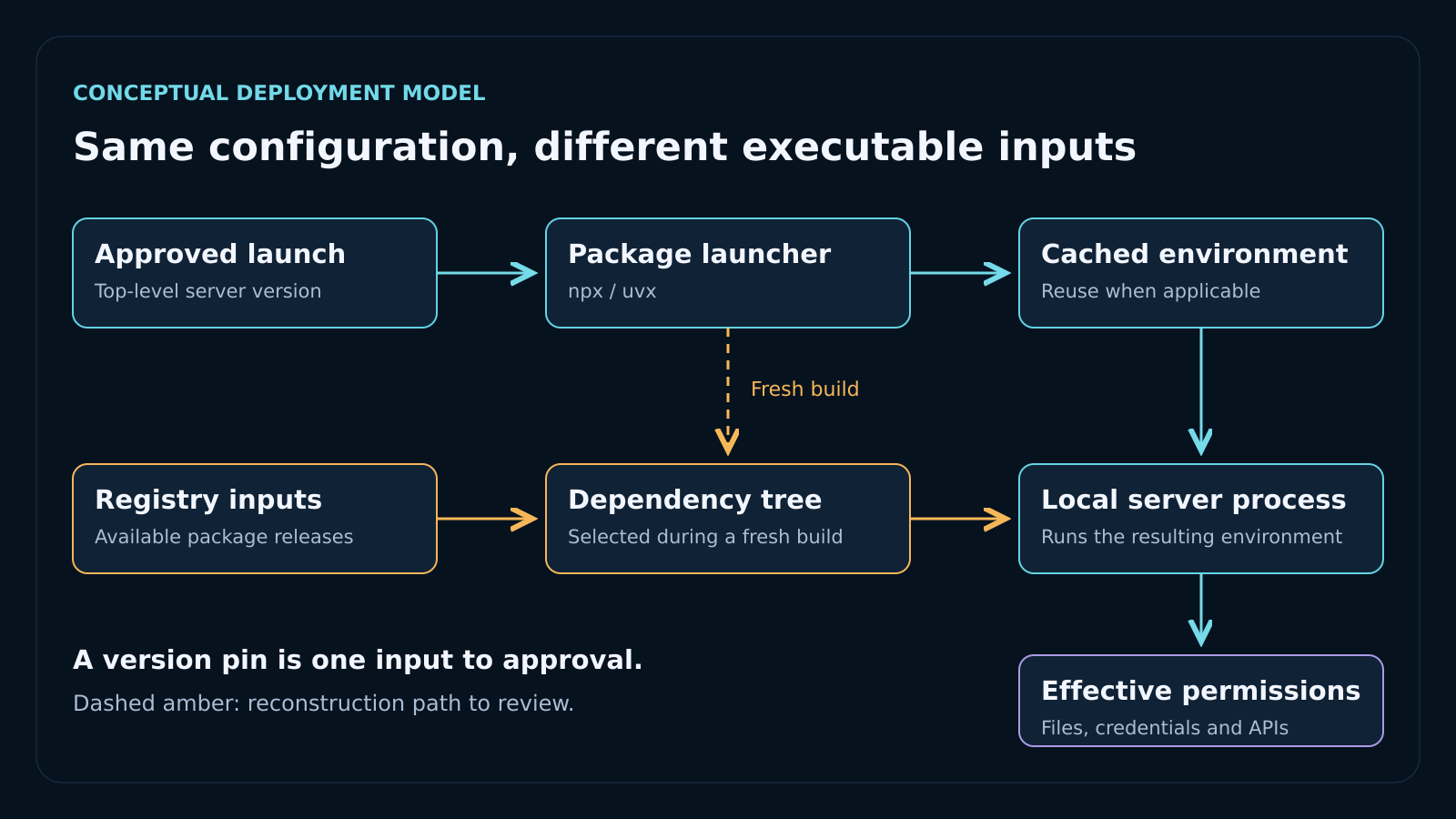
A local demonstration of transitive dependency drift
The following educational model uses Python dictionaries. It makes no network requests, starts no MCP server, installs no packages, and reads no credentials. It represents a deliberately simplified resolver, not npm or uv’s complete algorithms. Run it as an ordinary local Python script in a temporary working directory if you want to inspect the results.
The fictional server is fixed at version 1.4.2. Its fictional dependency rule accepts versions of helper itibaren 2.0.0 up to, but excluding, 3.0.0. Two snapshots contain different available helper releases. The example compares a fresh selection with a previously recorded choice.
# Educational model: synthetic data only; no package installation.
import hashlib
import json

SERVER = "demo-mcp@1.4.2"
DAY_ONE = {"helper": ["2.0.0", "2.1.0"]}
DAY_TWO = {"helper": ["2.0.0", "2.1.0", "2.2.0"]}


def version_tuple(text):
    return tuple(int(part) for part in text.split("."))


def fresh_selection(snapshot):
    choices = [
        value for value in snapshot["helper"]
        if (2, 0, 0) <= version_tuple(value) < (3, 0, 0)
    ]
    return {"server": SERVER, "helper": max(choices, key=version_tuple)}


def locked_selection(snapshot, approved):
    if approved["server"] != SERVER:
        raise ValueError("Unexpected server identity")
    if approved["helper"] not in snapshot["helper"]:
        raise ValueError("Approved dependency unavailable; review required")
    return dict(approved)


def inventory_digest(inventory):
    encoded = json.dumps(inventory, sort_keys=True).encode()
    return hashlib.sha256(encoded).hexdigest()


approved = fresh_selection(DAY_ONE)
rebuilt = fresh_selection(DAY_TWO)
reproduced = locked_selection(DAY_TWO, approved)

assert approved["server"] == rebuilt["server"]
assert approved["helper"] != rebuilt["helper"]
assert inventory_digest(approved) != inventory_digest(rebuilt)
assert reproduced == approved

print("Approved:", approved)
print("Fresh rebuild:", rebuilt)
print("Locked reconstruction:", reproduced)

try:
    locked_selection({"helper": ["2.2.0"]}, approved)
except ValueError as exc:
    print("Unavailable approved input:", exc)
The first assertions demonstrate the identity problem: the server label stays constant while the selected dependency changes. The final branch demonstrates a useful failure property. When an approved input is missing, the model refuses to substitute another version silently. It does not prove that a real tool will behave the same way; that requires testing the deployment path you chose.
Notice what the digest means here. It covers the synthetic inventory text, not downloaded package bytes, compiled output, or runtime configuration. A matching digest proves equality of those modeled fields only. In a real release process, use separate evidence for the lock, the built artifact, and the deployed configuration. Giving all three records the same label would hide their different meanings.
Nothing in the example makes 2.2.0 malicious. It could be an important security fix. The failure is an unreviewed change to the approved execution environment, not the existence of a newer version. This distinction matters when choosing a remedy: stopping all updates forever would preserve the demonstration’s old selection while creating an entirely different maintenance problem.
A team can extend the toy exercise without introducing an exploit. Add an approved inventory for a second operating system, or make the selected helper unavailable and require an explicit exception record. Have a reviewer explain which result is acceptable and why. The exercise is successful when the team can describe its acceptance rule clearly, not when every synthetic case is marked green.
Inventory the authority before choosing what to freeze
Start with one bounded environment: an engineering group, a managed workstation pool, or a CI service. Ask which clients launch local integrations and which team owns each launch configuration. Treat the initial list as a scope statement with known gaps. Do not label it an enterprise inventory until the remaining discovery routes have been checked.
For every entry, record the client, server identity, launch path, configuration location, owner, and business purpose. Add the actual process identity and a reference to its approved artifact. Capture relevant credentials by identifier and scope, never by secret value. A record such as “test ticket reader, project A, expires Friday” is useful. Copying the token into the assessment creates an unnecessary new exposure.
Rank the first reviews by reachable consequence. An integration with permission to change a production firewall deserves earlier attention than a synthetic documentation reader in an isolated exercise. A read-only connector to confidential data may still require urgent attention because reading is the action that exposes the data. Avoid using the tool’s friendly description as a substitute for the service’s permission model.
An owner should be able to answer three practical questions without asking the model. Who can replace the program that will run? Who can change the resources it can reach? Who can stop it and revoke its access if something goes wrong? If different teams own those decisions, record the handoffs. Design the handoffs so an ordinary support shift can perform recovery without the original developer.
Include dormant execution paths. A laptop used for emergency administration, an infrequently started cloud workspace, or a restored VM can reintroduce an old launch method. Give those assets a reconnect requirement: verify the approved deployment before using privileged integrations. A check-in rule is more actionable than an assumption that systems not seen recently are harmless.
Finally, avoid collecting unrelated private material during discovery. Process command lines and configuration files may contain secrets or customer identifiers. Use a collection method that redacts values while preserving the relationship needed for the assessment. Restrict the raw evidence to authorized responders and provide reviewers with the minimum metadata required to reach a decision.
Move dependency selection into the build process
A useful target architecture has a clear boundary between preparing software and using it. The build environment may retrieve approved inputs under a defined policy. The runtime starts the resulting artifact and performs its narrow business task. A developer opening an assistant session should not implicitly become the release manager for a newly selected dependency graph.
Begin by choosing the unit you can maintain. For a small internal integration, that might be a dedicated project with a reviewed lock and a packaged environment. For a fleet with different operating systems, it might be a set of platform-specific artifacts. For a centrally managed service, it might be an image promoted through a registry. Choose the form that gives your operators a stable identity and an achievable update process.
The build record should connect source, lock, toolchain, configuration, and output. Give every record a creation time and an approval reference. The important property is traceability: when an artifact is revoked, the deployment system can identify where it was delivered. Do not make a build log the only place containing that relationship, especially if routine log retention is shorter than the supported lifetime of a deployment.
A controlled npm project
In a reviewed npm project, npm ci requires an existing lock, fails when it disagrees with package.json, and does not rewrite those files. Flags used to create the dependency tree can affect installation and must be consistent. --ignore-scripts suppresses package lifecycle scripts; it does not make the application you later execute harmless. These are installation properties, not an application security verdict.
The following commands are a build-stage illustration for a disposable checkout that you own and have already reviewed. They are not instructions to fetch or execute an arbitrary community server. Confirm that the selected dependency set works without install scripts before using that restriction in your build.
# Run only inside the reviewed deployment project.
node --version
npm --version
npm ci --ignore-scripts
npm ls --all --json > resolved-tree.json
Review the result before packaging it. If an expected native component did not build, the correct response is to design and approve the necessary build step, not to remove restrictions silently until the test turns green. A build exception should name the package, the action, the isolated environment, and the evidence that justifies it. Keep production credentials out of that environment.
The proposed runtime should start the installed entry point from the approved artifact. Document its interpreter path and intended working directory. Avoid a fallback that silently runs a new package resolution when the installed entry point is missing. A missing artifact should produce a visible deployment failure with an owner; replacing it with whatever is currently available changes the approved release.
Separate a dependency inventory from an artifact manifest. The first records package relationships; the second records the files or image actually shipped. Use both when practical. If packaging accidentally omits a file, the dependency inventory alone will not reveal the broken deployment. If an unexpected file is inserted after installation, a source lock alone will not describe that change either.
A controlled uv project
For a uv project, the locking and syncing documentation distinguishes --locked, which rejects an outdated lock, from --frozen, which skips that freshness check. It also documents --no-sync, default exact syncing with uv sync, and options to exclude development dependencies or editable installation. Select these options deliberately; similar-looking commands have different acceptance behavior.
For a disposable reviewed project whose runtime does not need development dependencies, a build-stage example is:
# Run in the reviewed project containing pyproject.toml and uv.lock.
uv --version
uv lock --check
uv sync --locked --no-dev --no-editable
Then package and test the resulting environment through the organization’s chosen deployment method. Avoid treating an arbitrary copied virtual environment as automatically portable across host paths, operating systems, or interpreter installations. The acceptance target is the artifact on its supported runtime, so test that exact combination rather than assuming successful construction guarantees successful relocation.
Keep the lock-generation step separate from the release-install step. A change to the dependency selection should create a reviewable difference before it becomes a deployed artifact. Give the reviewer the old and new inventories, the reason for the change, relevant advisories, functional results, and access-boundary results. A fresh lock generated during every production launch would defeat that division of responsibility.
For teams maintaining several integrations, start with one template that records these decisions consistently. The template should leave room for platform differences and necessary build steps. A rigid checklist that developers must bypass to install required components is a poor control. A documented exception with isolation and an expiry is more useful than a nominal prohibition that nobody can follow.
A container digest identifies an image, not the whole deployment
Docker documents that image tags can move, while a digest selects a specific image. Its build guidance also explains the update tradeoff: a digest pin needs a deliberate mechanism for receiving later fixes. Use that property to identify an approved artifact, while reviewing the rest of the deployment separately.
Review the full launch behavior. Does the entry point download a plugin after startup? Is a writable host directory mounted over the application? Does configuration name another executable outside the image? Can the process contact a package registry during normal operation? Each answer changes what the image identity proves about the code ultimately used.
Consider an image containing a launcher rather than the server’s complete installed environment. Pinning that image can stabilize the launcher while leaving its later selection of application code outside the artifact. The deployment review must examine the entry point and runtime behavior, not just the reference used to pull the image. This is the same approval problem expressed at a different packaging layer.
A clean design keeps runtime downloads out of the normal path unless they are an explicitly governed feature. If a server genuinely requires dynamic plugins, give those plugins their own inventory, approval mechanism, and access restrictions. Do not describe the whole deployment as immutable merely because one component has a digest. Name the mutable component and how its updates are controlled.
Review mounts with equal care. A narrow read-only directory containing synthetic documents is a different capability from a developer’s home directory. A writable application mount also changes the durability of the approved code. Record the exact purpose of each mount, whether writing is needed, and which test demonstrates that unrelated paths remain outside the intended interface.
Plan recovery before promotion. Retain an earlier approved artifact, but verify that it remains an acceptable rollback target. A previous release may contain the issue that triggered the update. In that case, the fallback should be reduced functionality, temporary isolation, or another approved service path. A convenient old image is not automatically a safe rollback plan.
Limit what an approved server can do
Deterministic deployment and restricted authority answer different questions. One controls which program starts; the other controls the consequence if that program behaves unexpectedly. The official MCP local-server security guidance recommends provenance checks and isolated execution, and treats tool definitions as untrusted runtime input. The practical design below applies those principles to a bounded integration.
Start with a service identity for the integration’s business function. Give it access to the minimum resources required for an ordinary successful request. Avoid using a personal administrator identity merely because it is easy to configure. Record who can grant additional scope and which workflow should request it. A model-generated explanation should not become the authorization record for widening that access.
Treat file access, network access, and API permissions as separate controls. A read-only API token does not restrict local filesystem access. A read-only filesystem mount does not limit the actions permitted by a network credential. An egress allowlist does not establish that every operation on an allowed service is appropriate. Each control needs an acceptance test tied to the capability it is supposed to constrain.
Use synthetic fixtures for those tests. Place an approved sample document in the allowed directory and a harmless marker outside it. Create a test project that the service identity can read and another that it cannot. Verify the expected permitted operation and the expected rejection. A successful allowed request is necessary for usability; the rejected request is necessary to show where authority stops.
Define handling for sensitive output. If an integration legitimately reads confidential tickets, the returned text should remain within the approved workflow and audience. A deployment review that stops at the server’s incoming permissions misses the destination of its output. Record whether the client may send that content to another service, store it, or include it in a report, and make the appropriate decision outside the model’s discretion.
Review changes to tool descriptions as a separate event from code updates. A stable executable can present different tool metadata or receive different remote content. A code inventory cannot prove that the model will interpret those inputs correctly. Where a client supports review of changed tools, include that behavior in acceptance testing; where it does not, document the limitation and constrain downstream actions accordingly.
Keep denial behavior understandable. The user should receive a useful explanation that a requested resource or action lies outside the approved scope. Log the policy decision and a correlation identifier without copying the full sensitive request into every system. Clear denials make it easier to distinguish a working control from a broken integration and reduce pressure to grant broad permissions as a troubleshooting shortcut.
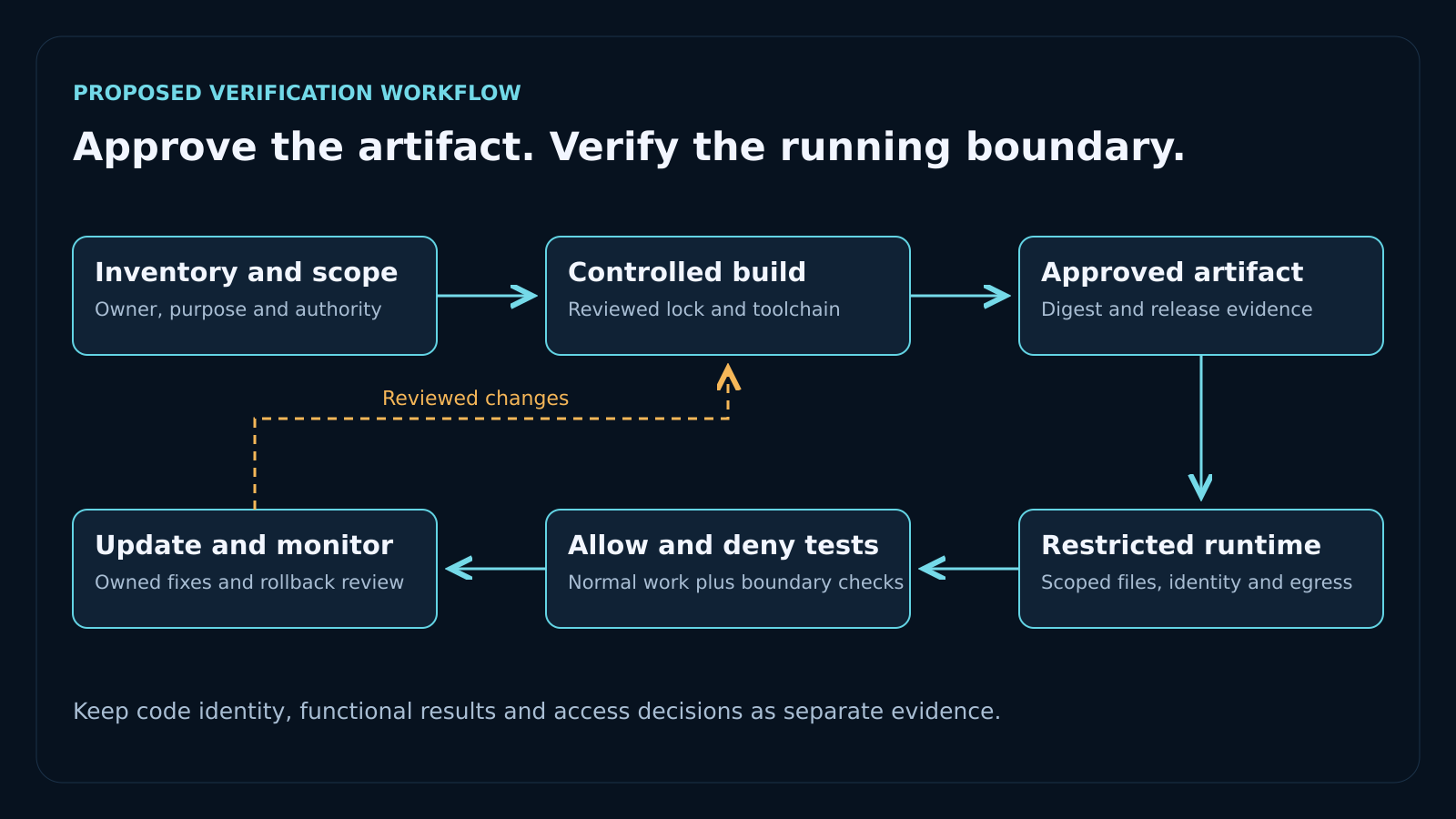
Test reconstruction, permitted work, and rejection separately
An acceptance suite should exercise the transitions that could invalidate the approval. A happy-path request proves very little about reconstruction or access boundaries. Build a small matrix that a reviewer can rerun when the server, toolchain, operating system, or permissions change. The matrix below is a proposed test design, not reported results.
| Case | Controlled setup | Expected observation | Failure interpretation |
|---|---|---|---|
| Warm start | Approved artifact already present | Same artifact identity; normal task works | Runtime differs from approved deployment or has a functional defect |
| New-machine start | Clean disposable environment | Approved artifact is obtained through the controlled route | Undocumented installation or unresolved dependency selection |
| Missing cache | Disposable copy with no launcher cache | Approved deployment works, or fails clearly without substitution | Runtime depends on an ungoverned rebuild path |
| Registry unavailable | Test network denies package registries | Normal runtime does not fetch new packages | Runtime still performs a build or has an undocumented dependency |
| Allowed action | Synthetic resource within approved scope | Required operation succeeds with expected output | Restriction breaks intended work or artifact is incomplete |
| Denied action | Harmless test resource outside scope | Service rejects access and records the decision | Authority boundary is too broad or unenforced |
| Rollback | Previously approved fallback in staging | Defined recovery behavior and consistent identity | Fallback is untested, incompatible, or no longer acceptable |
Decide the success condition before running each case. If the integration needs a remote business API, a network-isolation test should distinguish that service from package registries. Blocking all network traffic and observing failure does not tell you whether dependency resolution occurred. The test needs enough precision to support the conclusion you intend to write.
Record artifacts at both ends of a deployment transition. Before an update, identify the current artifact and the intended replacement. After the update, identify what actually started. If a running process was never restarted, a successful installation task may describe files on disk while the session continues to use an older process. The acceptance evidence should follow the operating state that matters to the integration.
Test the error path with the same care as normal work. An unavailable approved artifact should not result in an automatic fallback to a floating public package. A denied API call should not cause the client to try a different administrative identity. An expired test credential should not be replaced by an unrelated personal token. These are proposed negative tests for the deployment design, not allegations about existing clients.
Include the client in the observation. A server may reject a request correctly while the client presents an unclear message or retries in an unexpected way. Keep the requested action, server decision, and client-visible outcome linked by a test identifier. That relationship helps distinguish a server authorization defect from a client workflow problem and gives the relevant owner something concrete to repair.
Repeat only the tests affected by a change, together with the minimum baseline needed to establish the release. A new dependency graph warrants build and behavior checks. An API permission change warrants scope tests. A new operating system warrants platform acceptance. This keeps the suite maintainable while preventing a cosmetic version change from inheriting unrelated evidence without review.
Collect telemetry that can distinguish a check from a change
A package-registry connection is an investigation lead. It is not enough to conclude that executable content changed or that a host was compromised. Build a collection plan around the question you need to answer: whether a particular launch selected different code, whether that code ran, and whether its available authority was misused.
For a proposed deployment event, retain the host or worker identity, integration identifier, launch time, parent process relationship, executable path, and artifact identifier. Link those fields to the approved release record. Record the time zone and source of the observation. A timestamp without an unambiguous clock or a host name reused across ephemeral workers can frustrate later correlation.
For network activity, retain the destination and the process association available from your authorized telemetry. If the association is missing, say so. Do not convert a host-level connection into a claim that a specific MCP server made it. Browsers, development tools, and unrelated jobs can share the same host, and shared infrastructure can blur source attribution further.
For code changes, compare a captured inventory or artifact identity with the approved baseline. A difference should open an investigation record containing what changed, when it was observed, and which evidence supports execution. Keep an “unknown” state when the necessary history was not retained. A recent clean inventory cannot establish what ran during an earlier session that was never recorded.
Keep the resulting alert narrow enough to be actionable. “Unapproved artifact started for integration A on worker B” gives the owner a concrete response. “AI supply chain risk detected” does not. Include the approved artifact reference, the observed identity, and a route to the responsible team, while keeping tokens, raw customer documents, and unnecessary command-line secrets out of the alert.
Choose retention from the recovery question. If a package is later identified as unsafe, the team needs to reconstruct which deployments contained it and which identities those deployments used. Retaining only the current state makes that question difficult. A compact historical mapping of release, deployment, and access can be more useful than large amounts of unstructured log text.
Respond to unexpected drift without inventing a compromise
When a comparison reveals unapproved software, first preserve the observation and determine which operating state it describes. Was the package present on disk, imported by a running process, or merely available in a registry response? Those distinctions change the response. An inventory mismatch warrants investigation; a conclusion that credentials were stolen requires additional evidence.
For a defensive response, work within the assets and records your team is authorized to handle. Identify the affected integration and owner, stop further unapproved launches where necessary, preserve the relevant artifact and deployment history, and assess the authority available to the observed process. Use the organization’s incident process if evidence indicates malicious execution or unauthorized activity.
Preserve before rebuilding when investigation requires historical evidence. A rapid reinstall may restore a known application state while removing the easiest way to identify the earlier environment. Coordinate containment and evidence collection so that neither depends on leaving a dangerous process running indefinitely. If urgent containment prevents complete collection, document the resulting limitation instead of claiming a complete forensic record.
Investigate access as well as software. If a suspect process had a service credential, determine its scope, lifetime, use history, and revocation path. Replacing a package does not itself invalidate a credential. Resetting a credential does not remove an unauthorized role assignment. Assign these as separate tasks with evidence appropriate to each control and involve the service owner before disruptive actions.
Avoid expanding the investigation through uncontrolled experimentation. Do not reinstall a suspected malicious version on a normal workstation to see what it does. Use established forensic procedures and an authorized isolated environment if deeper analysis is required. For routine closure, a verified approved artifact and well-designed access tests are more useful than replaying a harmful action against a production service.
A restoration record should state what is established and what remains uncertain. It might establish that all identified workers now start an approved artifact, that a former test credential is rejected, and that normal ticket lookup works. It may still be unable to establish what happened on an offline laptop during a missing telemetry interval. Preserve that uncertainty with an owner and a follow-up decision rather than hiding it behind “remediated.”
When communicating the outcome, use the narrowest accurate language. “Dependency drift observed” describes a software-state change. “Unapproved artifact executed” requires execution evidence. “Unauthorized service access confirmed” requires a supported access finding. These are useful stages in an investigation, and moving between them should require new evidence rather than stronger wording in successive status reports.
Freeze releases without freezing maintenance
A controlled artifact needs an update owner from the moment it is approved. Otherwise, the organization has replaced implicit change with unowned stagnation. Set a normal review cadence appropriate to the integration, a route for urgent advisories, and a maximum supported lifetime for exceptions. These are local governance choices; the right interval depends on consequence, exposure, and the team’s ability to deliver tested changes.
For an ordinary update, compare the proposed graph and artifact against the deployed baseline. Ask what changed, why it changed, and which acceptance cases could be affected. A narrow library correction may require a focused test set. A major framework change may require broader functional and permission testing. The review should explain its chosen scope rather than treating every update as either trivial or a complete reapproval.
For an urgent correction, prepare a shorter but explicit path. Identify the affected component, the supported remedy, the at-risk deployments, and the minimum evidence needed to promote a replacement. Run the relevant normal-operation and denial tests, record the exception to the usual timing, and schedule completion of any deferred checks. An emergency path should be practiced before an emergency occurs.
Package-age policies can be part of that design, but do not present an arbitrary waiting period as proof of safety. A delay may give the ecosystem time to identify a problematic release; it can also delay a needed correction. Decide how to handle a security update that should bypass the ordinary delay, who can approve the exception, and which additional observations compensate for reduced waiting time.
A permanent pin with no update channel is particularly awkward for incident response. Investigators may know exactly what is running but have no maintained path to replace it. Include replacement and revocation in the original release design. The deployment system should distinguish “approved,” “superseded,” and “revoked,” so a rebuilt machine cannot restore an artifact that the security team has already withdrawn.
Treat rollback as another release decision. Preserve a known fallback and test it, but reassess it against the reason for the current change. If the fallback is affected by the same issue, it may restore availability while restoring exposure. Define an alternative such as limited read access, a manual workflow, or temporary suspension of the integration. Make that operational choice visible to the business owner.
Measure the process with a few concrete questions. Can the team find every deployment of a revoked artifact? How long does it take to deliver a corrected artifact to an active worker? How are dormant devices handled when they return? Which integrations have no accountable owner? These measures help direct work without turning a count of pinned packages into an unsupported security score.
Work through two deployment decisions
The next two examples are hypothetical. They show how the same deployment principles produce different decisions when the available authority changes. Neither example represents a Penligent customer, a reproduced compromise, or a documented incident at a vendor.
An internal ticket-search server
A development team wants an assistant to summarize tickets from one synthetic project during a pilot. The server needs to read a narrow API and return selected fields. It does not need to modify tickets, access personal home directories, or retrieve packages after launch. That small scope makes the pilot a useful place to establish the release process before expanding the integration.
The team creates an approved build, records its dependency inventory and artifact identifier, and supplies a test service identity with access to the pilot project. It defines a permitted request for one fixture ticket and a denied request for a different fixture project. The client receives only the content necessary for the task. A reviewer records how the resulting text may be stored and shared.
The first acceptance run succeeds on a prepared machine but fails on a clean worker. The team finds that a required component was available only in a developer’s existing environment. That is a packaging defect, not proof of exploitation. The release remains unapproved until the dependency is represented in the controlled build and the clean-worker test succeeds.
Next, the team disables registry access in its test runtime while leaving the synthetic ticket API available. The integration completes the permitted lookup and rejects the cross-project lookup. Those observations support specific claims: the tested startup did not require registry retrieval, and the tested identity lacked access to the second project. They do not establish that every possible input is safe or that an unrelated client behaves identically.
Before broadening the pilot, the owner defines the update path and a revocation procedure for the service identity. The final decision is not simply “server approved.” It is an approval for a named artifact, client configuration, resource scope, and supported runtime, with the stated tests and limits. Changing any of those conditions triggers the relevant part of the review.
A server with administrative write access
An operations team proposes an integration that can modify a security platform. The business value may be clear, but the consequence of a mistaken or unauthorized action is larger. A read-only pilot does not justify granting write access later without reviewing the new action boundary. Begin by separating investigation functions from modification functions and identifying which tasks require a human decision.
For the proposed write path, use a dedicated test environment containing reversible synthetic objects. Define an allowed change with exact arguments and a forbidden change outside the approved scope. Record the approval presented to the operator, the request actually sent, the service’s authorization result, and the final state. A screenshot of a confirmation dialog alone cannot establish that the executed action matched the approved one.
The team discovers that the available credential grants broader platform administration than the intended task needs. The appropriate response is to change the identity design, add a trusted enforcement layer, or restrict the deployment’s scope. A pinned artifact does not repair an overbroad grant. The release should remain conditional until the relevant service control or an accepted compensating design is in place.
Emergency operations need their own plan. If an integration is disabled during an incident, operators still need a documented way to perform essential work. Preserve an independent approved administrative route, with the organization’s normal controls, and test access before relying on it. Otherwise, the pressure to restore service can lead someone to re-enable the unreviewed integration at the worst moment.
The resulting approval may be narrower than the original proposal: perhaps observation is automated while selected writes require review through an established workflow. That is an engineering outcome, not a failed adoption. It makes the allowed authority explicit and gives later expansion a measurable condition, such as a service-side role that can enforce the required resource boundary.
Turn a finding into a reviewable remediation record
A useful finding connects a demonstrated condition to a reachable consequence and a precise correction. “Uses npx” is insufficient. A stronger record identifies the launch path, the evidence that reconstruction selects inputs outside approval, the authority available to that process, and the test that will establish the corrected operating state. The owner should be able to reproduce the evidence without receiving secrets or a weaponized payload.
Separate observation from inference. An assessor may observe that two controlled builds have different inventories under unchanged top-level configuration. The assessor may infer that approval based solely on that top-level configuration is incomplete. A claim that an attacker can reach production data requires additional evidence about permissions and exposure. Keep those propositions distinct in the finding so reviewers can accept the supported parts without accepting an exaggerated conclusion.
The remediation should name a verifiable outcome. For example, require deployment of an approved artifact through the managed route, remove runtime dependency resolution from the normal path, and demonstrate allowed and denied actions with the test identity. Assign an owner to each change. If a service team must narrow API permissions, do not close that requirement because the developer team completed the packaging work.
Use a concise evidence bundle with references to restricted originals. The table below is a proposed deliverable structure for an authorized assessment. Fill it with observed values; empty fields should remain visibly unresolved.
| Evidence item | Minimum useful content | Reviewer decision |
|---|---|---|
| Scope statement | Clients, integrations, environments and exclusions | Does the conclusion apply to the relevant deployment? |
| Reproduction record | Controlled setup and observed inventory difference | Was drift demonstrated without a production exploit? |
| Authority map | Runtime identity and reachable resources | What consequence is plausible within scope? |
| Approved release | Source, lock, toolchain and artifact references | Is the replacement traceable? |
| Runtime results | Actual launched identity and permitted operation | Does the corrected deployment work? |
| Rejection results | Safe denied action and observed service decision | Is the intended access boundary enforced? |
| Maintenance record | Owner, update route, revocation and exceptions | Can the correction remain effective? |
An authorized testing workflow can then verify the application-facing part of the correction. For teams using Penligent, scope that work to the web or API target and test identities they are permitted to assess, and retain the observed results in the finding. Dependency locking, artifact promotion, and host isolation remain separate deployment controls; an application test should not be presented as proof that those controls were implemented.
The video below demonstrates a Penligent testing workflow. It is product context, not evidence that a package, server, or dependency graph has passed the checks described in this article.
Review platform differences without hiding them
Two approved deployments can have legitimate differences. A developer laptop and a Linux CI worker may need different packaged outputs, different filesystem locations, and different process supervisors. The release model should describe those differences explicitly instead of demanding a single inventory that no platform actually runs. Define a supported variant for each environment and compare each deployment with the correct baseline.
Use a small compatibility record alongside the artifact. Name the operating system family, architecture, interpreter or base runtime, required native components, and launch method. Record which acceptance cases were run on that combination. This is a proposed release schema, not a claim that all package managers produce identical outputs across platforms. The schema makes the limits of testing visible before an incident exposes them.
Consider a hypothetical integration that works on a developer’s machine because an optional component is already installed. The CI build may produce a different environment while still reporting the same top-level server version. A controlled release should decide whether that component is required, supported as an option, or prohibited. Leaving the decision implicit makes a functional difference look like unexplained drift and generates noisy investigations.
Separate a legitimate platform variant from an unapproved modification. The former should have an owner, a release identity, and a documented reason for its differences. The latter lacks that approval relationship. A comparison tool can identify a difference, but the release record explains whether it is expected. Do not teach operators to suppress all inventory differences simply because some differences are normal.
Build trust also deserves its own review. An artifact digest can help identify a stored output, but your approval process must decide which builder and inputs are acceptable. Protect the release process from unnecessary credentials and permissions. Record who can modify build definitions, who can promote an output, and how a reviewer can connect the output to the intended source and lock. These are recommended responsibilities, not a guarantee supplied by a digest.
Where build attestations or signatures are used, define the verification policy before collecting them. State which identity or build process is accepted, which artifact the evidence covers, and what happens when verification fails. Merely attaching a signature file to a ticket does not explain why the organization trusts the signer. The reviewer needs a trust decision that can be repeated by the deployment system or an accountable operator.
Test the distribution path as well as construction. A correct build can be delivered to the wrong environment, associated with the wrong integration configuration, or accompanied by broader credentials than intended. A staging acceptance record should bind artifact, configuration, and service identity together. When production differs intentionally, record the difference and test the relevant boundary there with approved synthetic resources.
Finally, include installation failure in the support runbook. If a platform-specific artifact is unavailable, the supported response should be clear: use an approved alternative, suspend that integration, or open a release request. Avoid leaving operators with a vague instruction to install the latest package manually. Reliable recovery depends on a path that preserves the same ownership and evidence requirements under pressure.
The durable control is a release decision that survives the next launch, replacement machine, and urgent update. Identify the software you approved, restrict the authority it receives, and verify the behavior you depend on. Keep those claims separate enough that a reviewer can test each one and an operator can repair the specific boundary that failed.
Methodology: Prepared with AI assistance. The cited original research and official documentation were checked on November 16, 2026. The synthetic Python demonstration was rerun locally; it does not test a real MCP server or a customer environment.
 Turkish
 English
 German
 French
 Spanish
 Portuguese
 Japanese
 Korean
 Hindi
 Arabic
 Hebrew