
Symfony HttpClient’s November 25, 2026 security updates address three different ways outbound requests can violate application policy. One decorator can restore credentials during a cross-origin redirect; another defect can discard restrictive defaults such as certificate pinning; and certain HTTP workers running under PHP’s CLI SAPI can let an inbound header influence the outbound proxy. Identifying the installed package is the start of the assessment. The client’s composition, option sources and runtime determine which conditions apply.
The three advisories list fixes in 5.4.57, 6.4.51, 7.4.24 ve 8.1.12 for the relevant release lines. This review treats the issues separately and does not assume that they form an exploit chain or that every application using HttpClient has all three exposures.
Map the client that sends the request
For each security-sensitive integration, record the concrete client or transport, decorators around it, defaults configured on each layer, request-specific options, and execution environment. Include named or scoped services created through FrameworkBundle and any withOptions() calls. An application-level service name may conceal several layers with different responsibilities.
| Finding | Configuration or runtime to investigate | Security expectation at risk |
|---|---|---|
| CVE-2026-133757 | NoPrivateNetworkHttpClient; DnsResolvingHttpClient since 8.1; credentials in defaults or options; redirects to another origin | Credentials for one origin remain confined to it. |
| CVE-2026-133758 | The same affected decorators around a client with restrictive defaults | Wrapping a client preserves its configured TLS, proxy and redirect policy. |
| CVE-2026-134792 | HTTP worker under CLI SAPI; inbound headers copied into $_SERVER; no explicit proxy option | Request input cannot choose the proxy used for outbound traffic. |
CVE-2026-133757: credentials return on a redirect
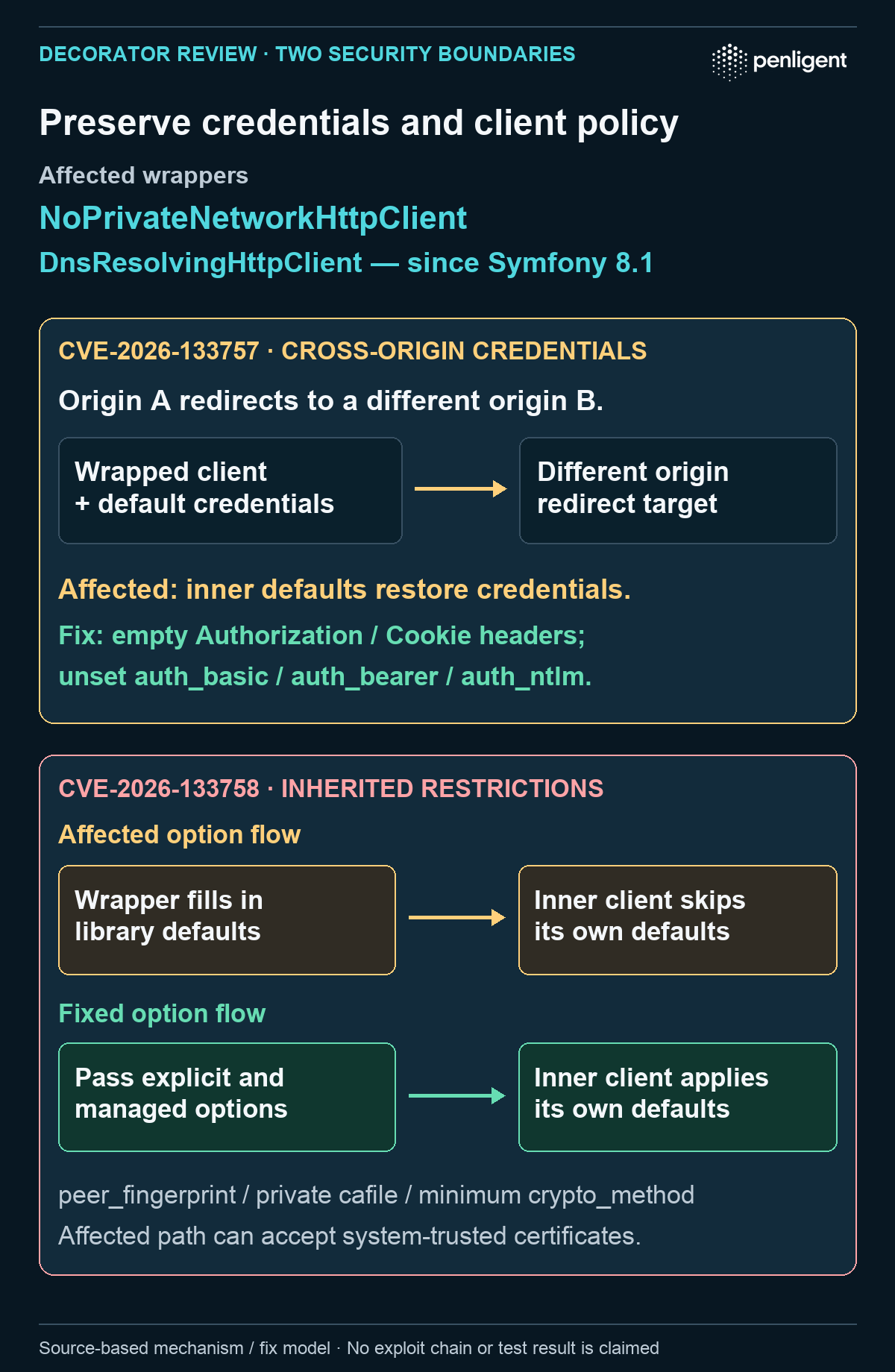
Bu redirect advisory describes NoPrivateNetworkHttpClient following redirects by issuing each hop through the client it decorates. Before a hop to another origin, it removed the Yetkilendirme ve Kurabiye headers it knew about. The inner client could then apply its defaults again, restoring credentials that the decorator had intended to remove.
Affected defaults include auth_basic, auth_bearer, auth_ntlm, and configured Authorization or Cookie headers. Credentials supplied through withOptions() could return through the same mechanism. The advisory distinguishes request-specific options: the decorator removed the credentials passed to request(), except auth_ntlm. Do not flatten these cases into a claim that every credential option behaved identically.
DnsResolvingHttpClient follows the affected redirect pattern starting in Symfony 8.1. For NTLM, the advisory describes a handshake with the other origin that could expose an NTLM response; it does not describe transmitting the account’s plaintext password. The corrected decorators explicitly suppress the relevant headers and authentication options at the cross-origin hop so inner layers cannot restore them.
CVE-2026-133758: restrictive defaults disappear
Bu default-options advisory concerns a different interaction. The decorator prepared requests using library defaults and forwarded those options as already-set values. Consequently, the decorated client did not apply its own defaults. A restriction configured on the inner client could disappear silently when the wrapper was added.
The vendor identifies peer_fingerprint, a private cafile and a minimum crypto_method, along with default proxy ve max_redirects settings. FrameworkBundle’s default_options are relevant because they configure the innermost client. DnsResolvingHttpClient is included starting in 8.1, not across every earlier branch.
This does not mean the defect accepts every arbitrary certificate. The documented scenario loses a more restrictive trust policy: a server certificate accepted by the system trust store may be accepted even though the inner client’s pin or private trust configuration should reject it. Review the intended policy and where it is set, rather than interpreting a successful HTTPS connection as proof that the pin remained effective.
The fix changes what the decorator forwards so the inner client can apply its own defaults. Removing NoPrivateNetworkHttpClient to avoid the bug is not an equivalent correction: it also removes the network restriction the application chose that wrapper to enforce. Preserve the intended controls while updating the implementation.
CVE-2026-134792: request headers influence proxy selection
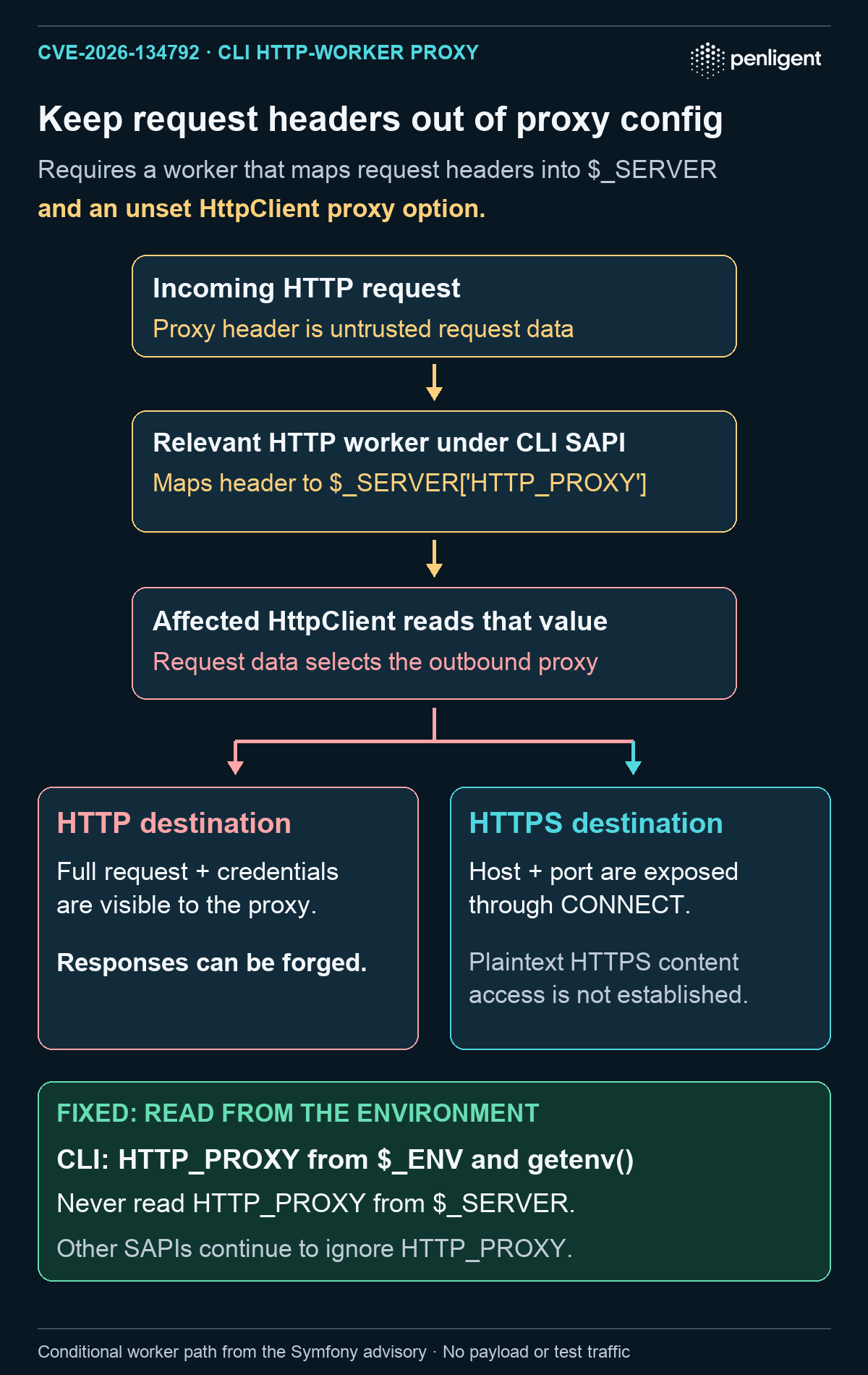
Bu proxy advisory applies when the proxy option is unset and HttpClient derives proxy settings from its environment. Under CLI SAPI, the affected code could read HTTP_PROXY itibaren $_SERVER. Some HTTP workers also place incoming request headers there, allowing the request’s Proxy header to influence outbound requests made while handling it.
The vendor names spiral/roadrunner-http, including its use by the RoadRunner runner of php-runtime, baldinof/roadrunner-bundle ve php-pm. This is a combination of runtime behavior and proxy resolution. The mere presence of a console command or a PHP CLI binary does not establish that an HTTP request can populate this state.
| Outbound URL | Documented consequence at the selected proxy |
|---|---|
http:// | The proxy receives the complete request, including credentials, and can forge the response. |
https:// | The proxy learns the destination host and port through CONNECT. This advisory does not establish decryption of the TLS request body. |
Transport history matters. The advisory dates affected behavior in NativeHttpClient to 4.3.0, AmpHttpClient to 5.1.0, and CurlHttpClient to 4.4.40, 5.4.7 and 6.0.7 on their respective lines. The patch reads CLI HTTP_PROXY itibaren $_ENV ve getenv() yerine $_SERVER; other SAPIs continue ignoring it.
Match installed versions to the affected ranges
All three advisories cover both symfony/http-client and the corresponding monolithic symfony/symfony package. Their shared fixed releases do not imply identical starting points. The table preserves the published package ranges; the proxy transport distinctions above further refine applicability.
| Fixed release | Decorator issues: 133757 / 133758 | Proxy issue: 134792 |
|---|---|---|
5.4.57 | >=5.4.48, <5.4.57 | >=4.3, <5.4.57 |
6.4.51 | >=6.4.16, <6.4.51 | >=6, <6.4.51 |
7.4.24 | >=7.1.9, <7.4.24 | >=7, <7.4.24 |
8.1.12 | >=8, <8.1.12; DnsResolvingHttpClient involvement starts at 8.1 | >=8, <8.1.12 |
Check the package installed in the serving application, including standalone component usage outside a full Symfony application. Select a compatible release containing these corrections; the listed floors are not a claim about the newest release or current support for every old branch. For customized builds, retain the provider’s evidence that each applicable correction is present.
Verify the policy with isolated, harmless cases
Use controlled test services and dummy credentials to verify the application’s actual client composition after updating. A redirect between two test origins can check that a marker credential intended for the first is absent at the second. Use controlled destinations permitted by the configured network policy; a correctly blocked private or loopback address is not a reason to disable the decorator. Do not send production cookies, bearer tokens or NTLM credentials to a collection endpoint.
For restrictive defaults, compare the intended rejection behavior of the configured inner client and the decorated client against a controlled certificate or policy mismatch. Use the HttpClient documentation for the options supported by the deployment. Preserve legitimate matching-server behavior too. A test that merely checks whether HTTPS succeeds does not exercise the security restriction.
For the proxy finding, verify the worker adapter, SAPI and effective proxy source in an isolated instance of the deployment. Observe whether request-derived data can change the chosen outbound route, using only an inert test destination and controlled proxy. Keep established operational proxy configuration intact. These are proposed regression checks, not tests performed for this article or proof that every configuration is covered.
Document the resulting client stack, applicable CVEs, corrected package build and observed policy decisions together. In an authorized assessment using Penligent, those application-specific records should support any conclusion; this article does not assert automatic detection of these CVEs. The following Penligent 3.0 video demonstrates a general product workflow, not a Symfony exploit or remediation test.
Method: this review used AI assistance to reconcile Symfony’s official advisories, CNA records and HttpClient documentation on November 27, 2026. The configuration triage and regression suggestions are derived guidance. No application was tested, no credentials were collected and no exploit chain was demonstrated.
 Turkish
 English
 German
 French
 Spanish
 Portuguese
 Japanese
 Korean
 Hindi
 Arabic
 Hebrew