
Last updated: November 4, 2026.
Vulnerability validation services determine whether a finding is present, reachable, reproducible and material in the organization’s environment. The goal is not to weaponize every alert. It is to give remediation owners enough evidence to prioritize the right work and prove that the correction changes the outcome.
Scanner severity, CVSS, EPSS and threat intelligence are useful signals, but none proves that a specific instance is exposed or that a compensating control works. Validation combines asset identity, version or configuration evidence, access prerequisites, safe trigger evidence and business context.
For the assessment framework, consult NIST SP 800-115 and map the relevant guidance to the actual environment and authorized scope.
Use a five-layer evidence model
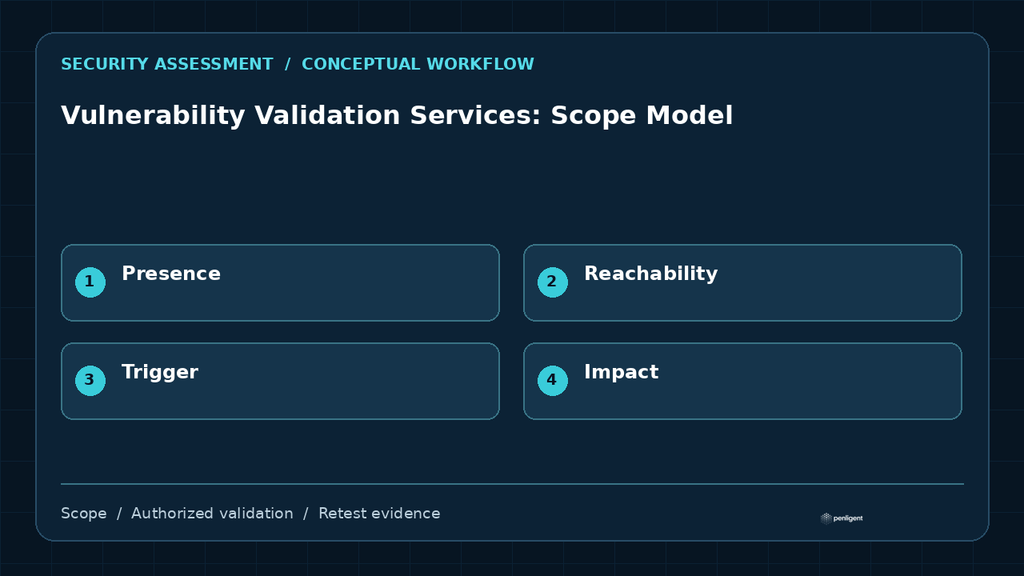
Each layer answers a different remediation question. Stopping at package presence can overstate risk, while stopping at external reachability can miss authenticated or internal attack paths.
| Layer | Question | Evidence |
|---|---|---|
| Presence | Is the affected component or configuration deployed? | Package, build, image or configuration |
| Reachability | Can an authorized test position reach the relevant interface? | Route, listener, identity and control result |
| Trigger | Can the security property fail safely and reproducibly? | Sanitized request, log or non-destructive behavior |
| Impact | What data, privilege or business process is affected? | Controlled object or synthetic outcome |
| Remediation | Did the fix change the original and adjacent cases? | Retest and regression evidence |
Turn the scope into testable evidence
Define an authorized target, validate meaningful attack paths, and keep the evidence connected to remediation and retesting.
Choose the safest useful validation method
Prefer version checks, patch differentials, configuration audits, access-control tests and log evidence when they answer the question. Use a controlled trigger only when it adds decision value and has an approved rollback and stop condition. Avoid public exploit code of uncertain provenance and avoid expanding access after the control failure is proven.
Separate confidence from severity
Confidence describes how strongly the evidence supports the finding. Severity describes consequence and likelihood under stated conditions. A high-severity advisory may have low local exposure, while a medium issue may be urgent when it sits on a critical workflow. Report both without silently collapsing them into one score.
Close the loop with remediation owners
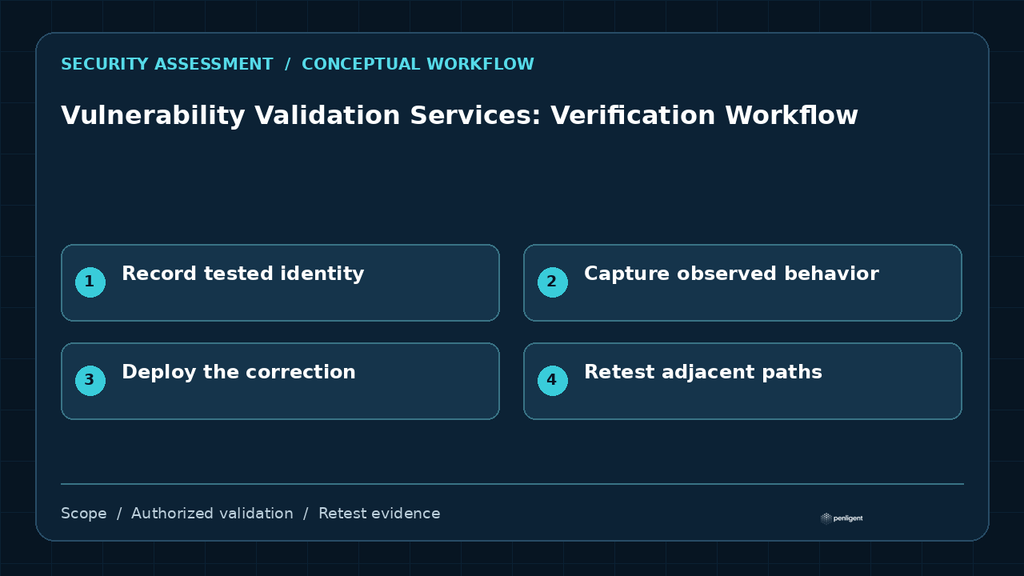
Send the finding to the team that can change the relevant package, configuration, identity or application control. Retest the deployed instance—not only a ticket or source branch—and record the runtime version, image digest, process restart or control response that proves the fix is active.
Turn the scope into testable evidence
Define an authorized target, validate meaningful attack paths, and keep the evidence connected to remediation and retesting.
Questions buyers should ask
- Does the service validate the deployed runtime rather than only a scanner record?
- What safe proof standard is used for each finding type?
- How are confidence, severity and business criticality kept separate?
- Does retesting include stale processes, images and adjacent control paths?
Conclusion
Vulnerability validation turns a finding into a decision. Require evidence for presence, reachability, trigger, impact and remediation, with methods proportionate to operational risk. The result should reduce uncertainty without creating a new incident.
 English
 German
 French
 Spanish
 Portuguese
 Japanese
 Korean
 Hindi
 Arabic
 Turkish
 Hebrew