
A fan receives what looks like a real World Cup ticket confirmation. The branding is clean. The QR code scans. The email uses the right tournament language. The checkout page looks polished. The sender may even follow up through a chat widget or a messaging app. The problem is that none of it proves the ticket exists.
That is the practical change security teams need to understand. World Cup scams no longer depend on broken English, crude web pages, or obviously suspicious email addresses. WIRED reported that AI-generated websites, deepfake videos, fabricated audio, and convincing phishing campaigns are making it easier for criminals to impersonate legitimate organizations around the 2026 FIFA World Cup. The same report said more than 13,000 FIFA-themed domains were registered between January and May 2026, with a portion already identified as suspicious or malicious before the tournament had even started. (WIRED)
The stronger security story is not that the core World Cup infrastructure has been publicly shown to be compromised. Public evidence points to something more common and more operationally useful for defenders: attackers are building around the event. Ticket demand, hospitality packages, travel pressure, resale confusion, mobile ticketing, social media ads, QR codes, fake streams, and multilingual customer support flows have created a temporary digital economy. Any temporary digital economy with high urgency and high payment value becomes a fraud surface.
Group-IB’s GHOST STADIUM research shows how mature that surface already is. The company reported more than 4,300 fraudulent domains impersonating FIFA’s official web presence, six parallel fraud schemes, four independent threat actors, and more than 2,500 FIFA account credential pairs circulating in dark-web markets. It also described a Chinese-speaking, financially motivated actor operating a coordinated phishing campaign across more than 300 domains with a cloned FIFA-style login and checkout experience. (Group-IB)
The main lesson is simple: World Cup scams are no longer just a consumer-awareness issue. They are an identity, payment, brand, and attack-surface problem.
The scam environment is built into the event
The 2026 FIFA World Cup has the right ingredients for high-conversion fraud. It is hosted across the United States, Canada, and Mexico, spans 104 matches across 16 cities, and attracts millions of in-stadium fans. Group-IB cited FIFA estimates of more than six million fans and more than 150 million ticket requests within the first 15 days of the sales window. (Group-IB)
That scale creates scarcity. Scarcity creates urgency. Urgency creates bad security decisions.
A person who would normally inspect a login page may rush when they think a semifinal seat is about to sell out. A traveler who would normally avoid unknown payment links may comply if a fake hotel support agent claims a reservation will be canceled. A family member who would normally ignore a social media ad may click when the offer appears to come from a familiar football page. A sponsor employee may trust a fake vendor invoice because the event gives the invoice a plausible reason to exist.
Reuters reported before the tournament that high ticket and transport costs could increase fans’ exposure to cyber fraud and scams, because supporters looking for cheaper options are more likely to be drawn toward fake bargains. (Reuters) That is not merely a consumer-finance observation. It is part of the threat model.
Attackers do not need to defeat the entire tournament. They can profit by attacking the spaces around it:
| Surface | Typical victim | Likely abuse | Security impact |
|---|---|---|---|
| Ticket and resale pages | Fans, families, travel groups | Fake tickets, cloned checkout pages, credential theft | Payment fraud, account takeover, invalid entry |
| Hospitality offers | VIPs, companies, delegations | Fake packages, fake support, invoice redirection | Wire fraud, PII theft, brand damage |
| Travel and lodging | Tourists, employees, media teams | Fake bookings, smishing, refund scams | Payment loss, identity fraud |
| Social ads and groups | Fans seeking last-minute deals | Paid scam ads, fake endorsements, urgency tactics | High-scale victim acquisition |
| QR codes | Attendees, restaurant customers, venue visitors | Malicious redirects, payment deep links, fake ticket scans | Credential theft, payment fraud, mobile compromise |
| Streaming and betting | Remote viewers, casual fans | Fake subscriptions, malicious apps, gambling scams | Card theft, malware, account abuse |
| Sponsor and vendor email | Businesses, suppliers, finance teams | Spoofed invoices, fake partnership messages | BEC, credential theft, payment diversion |
| Temporary event systems | Contractors, venues, local services | Exposed admin panels, weak access control, unmanaged apps | Initial access, disruption, data leakage |
The most dangerous assumption is that a World Cup scam only matters if a fan loses the ticket price. A fake ticket site can collect credentials, phone numbers, home addresses, payment cards, passport details, session data, and recovery information. That data can be reused long after the match is over.
AI did not invent the scam, it industrialized the workflow
AI-powered World Cup scams are best understood as an efficiency shift. Fake tickets, cloned websites, counterfeit merchandise, fake streams, and social media impersonation existed before generative AI became mainstream. What changed is the cost and speed of producing believable fraud infrastructure.
Attackers can use generative systems to draft natural-sounding English, Spanish, French, Arabic, Portuguese, Korean, Japanese, and other localized messages. They can create many versions of the same lure, each tuned for a team, host city, price tier, or travel scenario. They can generate page copy that sounds like official customer support. They can produce fake refund explanations, fake hospitality confirmations, fake delivery instructions, and fake account verification notices.
AI also helps with visual polish. A scammer no longer needs a strong design team to create a convincing landing page, support page, or promotional graphic. That does not mean every fake page is AI-generated. It means the baseline quality of fraudulent content is rising, and the old visual cues are less reliable.
WIRED’s reporting framed this clearly: the scams themselves have not changed dramatically, but the technology behind them has. The article described AI as a force multiplier for professional-looking emails, convincing fake websites, and broader phishing scale. (WIRED) Microsoft’s 2025 Digital Defense Report makes the same broader point outside the World Cup context, noting that threat actors have quickly developed techniques such as AI-automated phishing and multi-stage attack chains. (Microsoft)
The practical effect is that defenders should stop relying on “does this look fake?” as the primary control. Good grammar is not a trust signal. A clean QR code is not a trust signal. A professional checkout page is not a trust signal. A familiar logo is not a trust signal. A social media ad is not a trust signal. A chatbot that answers questions in fluent English is not a trust signal.
The trust decision has to move to verifiable properties:
| User-facing signal | Why it is weak now | Better verification |
|---|---|---|
| Clean design | Cloned templates and AI-generated pages can look professional | Verify the exact domain and official purchase path |
| Good English | AI removes obvious grammar mistakes | Treat language quality as neutral |
| QR code | It hides the URL until scanned and often moves the user to a personal device | Preview the destination and avoid codes from unknown sources |
| Social proof | Fake comments, ads, and endorsements can be generated or purchased | Check official accounts and official ticketing pages |
| Fast support response | Scam chat widgets and scripted bots can respond instantly | Use contact channels listed on the official domain |
| Low price | Scarcity makes bargains emotionally attractive | Compare against official ticketing and resale channels |
| Familiar logo | Assets can be copied or loaded from legitimate CDNs | Verify domain ownership, not visual branding |
The defensive posture should assume that the average fake page will continue to look better.
The fake FIFA site attack chain
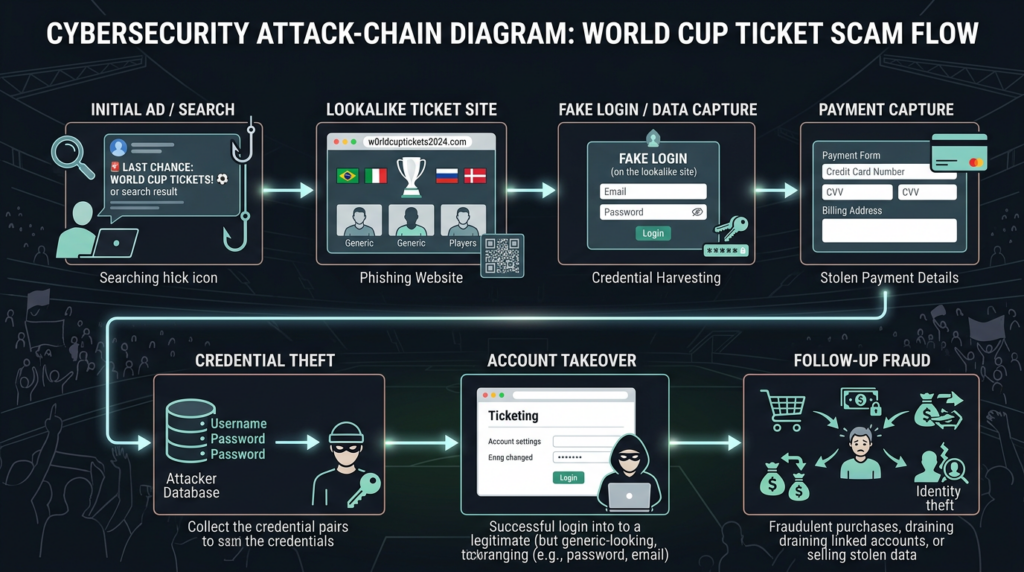
The FBI’s Internet Crime Complaint Center warned in May 2026 that threat actors were creating deceptive versions of legitimate FIFA websites to collect personal information, sell fake World Cup tickets and hospitality products, and possibly support other malicious activity. The FBI specifically called out typo squatting, including minor misspellings such as fiffa[.]com, alternative top-level domains, and fake subdomain-like names such as jobs-fifa[.]com. (ic3.gov)
That attack pattern is straightforward, but the consequences are broader than a single payment loss.
A typical fake ticket flow looks like this:
- The victim sees a search result, paid ad, social post, WhatsApp message, Telegram channel, email, or QR code.
- The link points to a lookalike domain, a redirector, or a fake page using official-looking tournament language.
- The page asks the victim to log in, register, verify an account, choose seats, pay for tickets, or upload travel details.
- The phishing kit captures credentials, payment data, PII, and sometimes account recovery data.
- The victim is redirected to a legitimate page or receives a fake confirmation to reduce suspicion.
- The attacker monetizes the data through fake ticket sales, account takeover, credential stuffing, card fraud, identity theft, or resale of credentials.
Group-IB’s GHOST STADIUM analysis describes a more advanced version of that same chain. The phishing kit was reported to clone FIFA’s web presence with near pixel-perfect fidelity, replicate a single sign-on style flow, request user data beyond credentials, and redirect victims to the real FIFA authentication page after capture so the experience appears normal. (Group-IB)
A defender should map the attack chain to observable evidence:
| Stage | Attacker objective | User sees | Defender can observe |
|---|---|---|---|
| Discovery | Acquire traffic | Ad, search result, social post, QR code, group message | Ad reports, suspicious domains, user reports, proxy logs |
| Landing page | Establish trust | Official-looking ticket or hospitality page | Domain age, TLS certificate, copied assets, page title, tracking IDs |
| Credential capture | Steal account access | Login, SSO, password reset, registration | Form posts, suspicious auth paths, fake SSO parameters |
| Payment capture | Monetize urgency | Card form, payment link, crypto option | Payment processor anomalies, wallet indicators, chargeback patterns |
| Post-capture cover | Reduce suspicion | Redirect to real site, fake receipt, support chat | Redirect chains, cloned page behavior, chat widget reuse |
| Downstream abuse | Increase profit | Account lockout, more messages, resale attempts | Credential stuffing, account recovery abuse, fraud alerts |
The user-facing part of the scam may last only a few minutes. The attacker’s monetization can last for months.
GHOST STADIUM shows why brand impersonation is now infrastructure
Group-IB’s GHOST STADIUM report is useful because it does not treat fake World Cup sites as isolated pages. It frames them as infrastructure.
The report identified more than 4,300 fraudulent domains impersonating FIFA’s official web presence registered since August 2025. Of those, more than 300 were confirmed as actively running fraudulent infrastructure, more than 140 were flagged as suspicious, and roughly 3,800 were parked or dormant for possible activation as tournament demand increased. (Group-IB)
That dormant-domain detail matters. Many organizations only react after a fake site becomes active. For mega-events, defenders need to monitor pre-positioning. A parked lookalike domain can become a phishing page hours before a high-demand match, and the first wave of victims may arrive before takedown workflows begin.
The GHOST STADIUM campaign also shows how modern fraud infrastructure is stitched together:
| Observed element | Why it matters |
|---|---|
| Shared phishing kit | Allows rapid deployment across many domains |
| Similar page structure | Supports fingerprinting and cluster analysis |
| Shared SSL certificate patterns | Helps investigators connect infrastructure |
| Shared Meta Pixel IDs | Indicates common advertising or tracking control |
| Tawk.to live-chat reuse | Adds credibility and creates another cluster indicator |
| Direct use of official-looking assets | Improves visual trust and complicates simple image-hash detection |
| Multilingual interface | Expands victim pool across host nations and traveling fans |
| Redirect to real site after capture | Reduces immediate suspicion |
| Crypto and payment channels | Makes recovery harder and moves funds quickly |
Group-IB also listed six fraud schemes operating in parallel: credential phishing, fake ticket sales, counterfeit merchandise storefronts, fake streaming platforms, fraudulent betting and casino sites, and infostealer-driven credential theft. (Group-IB)
That last item is important. A World Cup scam can begin as a fake ticket search and end as malware-enabled credential theft. Fraud teams, SOC teams, brand-protection teams, and payment-risk teams should not treat these categories as separate queues.
Official tickets and the problem with unofficial channels
FIFA’s own ticketing support page is blunt: tickets purchased from sources other than FIFA.com/tickets are considered unofficial channels, and the risks include fraud, scams, invalid tickets, and cancellation without notice. FIFA also encourages fans to purchase tickets only through FIFA.com/tickets, its official and preferred source. (FIFA World Cup 2026)
That guidance should anchor user education. The exact wording can be adapted for employees, customers, and support teams:
Do not buy from a social media post. Do not trust a screenshot. Do not pay through a private message. Do not assume a QR code proves validity. Do not enter passport or payment data on a domain that is not the official ticketing path. Do not use a password on a ticketing site that you also use for email, banking, travel, or work.
The FTC issued similar consumer guidance in March 2026, warning that fraudsters use paid search results and social media to drive users to scam websites, where they advertise fake tickets or sell the same seat to many people. It also noted that most tickets would be delivered electronically through the FIFA app, making paper tickets or screenshots suspicious. (Consumer Advice)
The Associated Press later reported the same pattern during the tournament: criminals were using social platforms, fake websites, and pressure tactics to target fans looking for last-minute tickets. AP also quoted experts warning that AI was being used to create realistic messages, polished storefronts, and convincing fake endorsements or promotions. (AP News)
For security teams, the message is broader than “fans should be careful.” The official path needs to be clear enough that users do not have to search for it under pressure. If users have to choose among ads, reseller pages, unofficial groups, and lookalike domains, the attacker has already shaped the environment.
Fake tickets are an identity problem
Ticket fraud is often described as payment fraud. That is too narrow.
A fake World Cup ticket page may collect enough information to support several downstream crimes. The ticket payment may be the first monetization event, but the identity data can be more valuable.
| Data collected | Immediate misuse | Follow-on risk | Defensive priority |
|---|---|---|---|
| Email and password | FIFA account takeover | Credential stuffing against email, travel, banking, or work accounts | Password reuse detection, MFA, credential monitoring |
| Full name and phone number | Smishing, voice scams | SIM swap attempts, targeted social engineering | User education, carrier account locks |
| Address and date of birth | Identity fraud | Synthetic identity, account opening, KYC abuse | Fraud monitoring, identity-theft response |
| Payment card | Card-not-present fraud | Card testing, mule purchases, chargebacks | Card freeze, bank notification, transaction review |
| Passport or ID scan | Fake travel or fintech onboarding | KYC bypass, identity resale | Identity-theft reporting, document-monitoring workflow |
| FIFA session or recovery data | Ticket theft, account lockout | Account resale, support fraud | Account reset, session revocation |
| Messaging app contact | Follow-up scams | Family targeting, fake support, payment pressure | Report and block, preserve evidence |
This is why a corporate security team should care even when the victim used a personal phone. Employees traveling to matches may reuse passwords. Executives may receive travel-themed smishing. Media teams may be targeted through fake press credentials. Finance teams may receive hospitality invoices. A stolen personal credential can become a corporate initial-access path if the password is reused or if attackers pivot through social engineering.
The right corporate controls are practical:
| Control | Why it matters during the World Cup |
|---|---|
| Phishing-resistant MFA for corporate accounts | Reduces damage from stolen passwords |
| Password reuse and breach monitoring | Flags employees exposed through personal scams |
| Travel security briefings | Makes ticket, hotel, rideshare, and SIM scams concrete |
| High-risk user monitoring | Protects executives, finance staff, media teams, and traveling employees |
| Easy suspicious-link reporting | Increases early visibility without shaming users |
| Conditional access | Detects unusual login locations, devices, ASNs, and impossible travel |
| Support-team scripts | Prevents employees from getting inconsistent advice |
A fake ticket is not just a fake ticket. It is a credential collection event, a payment event, and a social-engineering foothold.
QR codes move the attack to weaker controls
QR codes are especially dangerous in a World Cup scam environment because they bridge physical and digital trust. Fans expect QR codes on tickets, restaurant menus, rideshare signs, venue posters, transit pages, hotel desks, fan-zone promotions, and payment terminals.
WIRED’s reporting specifically warned that newer tactics such as QR code scams are part of the risk landscape. (WIRED) Unit 42 research explains why this matters technically: attackers can hide destinations inside QR codes, use legitimate redirection mechanisms, deploy Cloudflare Turnstile to evade crawlers, and move victims from protected corporate systems onto personal mobile devices. (Unit 42)
Unit 42’s 2026 research on QR codes also found attackers using URL shorteners, in-app deep links, and direct app downloads. The report said QR codes can bypass organizational security by exploiting weaker controls on personal mobile devices, and it reported an average of more than 11,000 daily detections of malicious QR code use in its telemetry. (Unit 42)
For World Cup scams, that creates several attack scenarios:
| QR code location | Possible attack | Why it works |
|---|---|---|
| Fake ticket confirmation | Sends user to a cloned validation page | User expects QR-based verification |
| Restaurant or bar table | Redirects to fake payment or coupon page | User is relaxed and mobile-first |
| Venue-area poster | Offers fake last-minute tickets or transport | Physical proximity increases trust |
| Social media image | Hides URL from platform text scanning | User scans with personal phone |
| WhatsApp or Telegram message | Opens payment or login deep link | Messaging context feels personal |
| Fake streaming page | Pushes direct APK download | User wants urgent access to a match |
| Fake support page | Links to chat or account recovery | User is already anxious |
Defensive analysis should extract the QR payload and inspect the redirect chain before making a trust decision. The following workflow is meant for defenders analyzing their own samples or user-submitted suspicious images.
# Defensive QR analysis on a local sample
# Install zbar tools on macOS with: brew install zbar
# Install on Debian/Ubuntu with: sudo apt-get install zbar-tools

zbarimg suspicious_worldcup_qr.png

# If the QR code returns a URL, inspect headers without executing page scripts
curl -I -L --max-redirs 5 "https://example-suspicious-domain.test/path"

# Capture the final effective URL for triage
curl -s -o /dev/null -w "%{url_effective}\n" -L --max-redirs 5 "https://example-suspicious-domain.test/path"
Do not scan suspicious QR codes with a personal phone that is logged into email, banking, messaging, or corporate apps. If a QR code appears on a printed surface, check whether it is a sticker placed over a legitimate code. In a venue, hotel, bar, or restaurant, ask staff to verify the code before using it for payment or login.
Social ads and search results are part of the scam funnel
The modern phishing page is only one part of the operation. The attacker still needs traffic.
Group-IB reported that fake Facebook Ads served as the main distribution channel for the GHOST STADIUM campaign, with shared Meta Pixel IDs observed across hundreds of domains. The report also described Telegram and WhatsApp distribution, search engine visibility for fraudulent FIFA-related domains, and redirector domains used as resilient entry points. (Group-IB)
This matters because many users think “I found it myself” means “it is safer.” That is no longer a reliable assumption. A user may arrive through a paid search result, an organic result manipulated by copied content, a social ad, a reposted offer in a fan group, a direct message, or a QR code that hides the destination entirely.
The attacker’s funnel is optimized for conversion:
| Funnel layer | Tactic | Defensive response |
|---|---|---|
| Attention | Team-specific ads, cheap tickets, countdown timers | Platform ad reporting, brand monitoring, user education |
| Trust | Official logos, copied assets, fake comments | Domain verification, official-channel reminders |
| Urgency | “Last allocation,” “pay now,” “limited seats” | Delay prompts, support scripts, user training |
| Capture | Login, checkout, passport upload | URL filtering, fraud detection, credential monitoring |
| Monetization | Card theft, crypto, P2P payment, credential resale | Payment-risk rules, bank reporting, takedown |
| Persistence | Redirects, multiple domains, parked infrastructure | CT monitoring, DNS blocklists, registrar abuse workflows |
The goal is not to tell users to distrust everything on the internet. The goal is to teach one hard rule: when money, identity, tickets, or login credentials are involved, navigate from the official domain or official app, not from an ad, a post, a message, or a search result.
Detection logic for security teams
A security team connected to the tournament, a sponsor, a travel provider, a bank, a payment processor, a hotel chain, or a large employer with traveling staff should treat World Cup scams as a time-bound detection problem.
The first layer is domain monitoring. Look for newly registered domains that combine protected strings with ticketing, hospitality, team names, host cities, payments, or support language.
Use lookalike-domain monitoring only for defensive purposes and only for domains you own or are authorized to protect.
# Defensive lookalike-domain monitoring for an owned domain
# Install: pipx install dnstwist

dnstwist --registered --format csv example.com > example_lookalikes.csv

# Quickly review registered lookalikes
awk -F, 'NR==1 || $0 ~ /registered/' example_lookalikes.csv | head -50
Certificate Transparency logs can also reveal new TLS certificates issued for suspicious lookalikes. A basic review process should enrich each candidate domain with:
| Signal | Why it helps |
|---|---|
| Domain creation date | New domains are common in scam campaigns |
| Registrar | Some abuse clusters reuse registrars |
| Name similarity | Typosquats and fake subdomains are common |
| TLS certificate age | Fresh certificates may indicate new infrastructure |
| Hosting ASN | Abusive infrastructure may cluster |
| Page title and favicon | Cloned pages often copy branding |
| Form fields | Login, payment, passport, or upload fields raise severity |
| Redirect chain | Redirectors can hide final destinations |
| Tracking IDs | Shared ad pixels or chat IDs can cluster campaigns |
| Payment methods | Crypto, P2P, and unusual gateways increase risk |
The second layer is enterprise DNS and proxy visibility. A broad query can surface suspicious traffic to tournament-themed domains outside an allowlist.
index=proxy OR index=dns
(
  query="*fifa*" OR query="*worldcup*" OR query="*world-cup*" OR
  url="*fifa*" OR url="*worldcup*" OR url="*world-cup*" OR
  url="*ticket*" OR url="*hospitality*"
)
| eval domain=coalesce(query, url_domain)
| lookup approved_worldcup_domains domain OUTPUT domain as approved
| where isnull(approved)
| stats count dc(src_ip) as unique_hosts values(url) as sample_urls by domain
| sort -count
That query is intentionally noisy. It needs enrichment and triage. Sports news, broadcasters, travel sites, and official sponsors may create false positives. The point is to find login, payment, download, and QR-driven activity around young or suspicious domains, not to block every World Cup-related page.
A Sigma-style detection can make the first pass more portable:
title: Newly Observed World Cup Themed Domain Lookup
id: 7d63d8d7-1f5a-4c3c-9f5a-worldcup-themed-domain
status: experimental
description: Detects DNS queries for newly observed World Cup or FIFA-themed domains outside an approved allowlist.
logsource:
  category: dns
detection:
  selection_keywords:
    query|contains:
      - 'fifa'
      - 'worldcup'
      - 'world-cup'
      - 'wc2026'
      - 'fifa26'
  filter_allowlist:
    query:
      - 'fifa.com'
      - 'www.fifa.com'
      - 'inside.fifa.com'
  condition: selection_keywords and not filter_allowlist
fields:
  - src_ip
  - user
  - query
  - answer
  - dns_server
falsepositives:
  - Sports news sites
  - Search engines
  - Broadcasters
  - Local tourism pages
  - Legitimate sponsors and host-city pages
level: medium
The third layer is email authentication. World Cup scams do not need to spoof FIFA directly. They can spoof sponsors, travel agencies, hotels, restaurants, local authorities, broadcasters, vendors, or internal executives.
# Check SPF records
dig TXT example.com +short

# Check DMARC policy
dig TXT _dmarc.example.com +short

# Mature enforcement example
# "v=DMARC1; p=reject; rua=mailto:dmarc-reports@example.com; adkim=s; aspf=s"
DMARC is not magic. A domain can publish a record and still leave enforcement at p=none. A rushed event partner may have many legitimate senders: ticketing platforms, CRM systems, marketing vendors, hospitality partners, customer support tools, regional agencies, and payment processors. The hard work is sender inventory, DKIM alignment, SPF hygiene, and a move toward p=reject where operationally safe.
The fourth layer is fraud and payment analytics. Look for patterns such as:
| Signal | Possible meaning |
|---|---|
| Many small authorization attempts | Card testing |
| Repeated payments to new merchants with World Cup language | Fake ticketing or travel fronts |
| Crypto on-ramp payments tied to ticket claims | Irreversible scam settlement |
| Repeated chargebacks from event-related descriptors | Fraudulent merchant activity |
| Same device buying across many accounts | Bot or mule behavior |
| Account logins after ticket purchase from risky ASNs | Account takeover |
| Password reset immediately after fake checkout | Credential theft and lockout |
| Customer support requests with screenshots from unofficial sites | Active victimization |
Fraud teams and SOC teams should share signals. The phishing domain that appears in a customer complaint may also appear in employee DNS logs. The wallet address seen in a victim report may map to other payment events. The fake support email may share infrastructure with a credential theft campaign.
Ticketing APIs and business logic deserve testing
Fake websites are the most visible problem, but legitimate ticketing, resale, refund, and account flows can also be abused if business logic is weak. Public sources should not be read as proof that any specific official system is vulnerable. The point is that high-demand ticketing systems are attractive targets for authorization bugs, race conditions, weak refund controls, account recovery abuse, and object-level access flaws.
Security teams responsible for ticketing or hospitality platforms should test for:
| Flow | Abuse case | Expected control |
|---|---|---|
| Ticket view | User changes ticket ID and views another user’s ticket | Object-level authorization check |
| Transfer | User attempts to transfer a ticket they do not own | Ownership validation and audit trail |
| Refund | User triggers refund to a different payment method | Strong payment ownership checks |
| Resale | User lists inventory they do not possess | Inventory locking and anti-speculation controls |
| Account recovery | Attacker resets account after credential theft | MFA, risk scoring, step-up verification |
| Promo codes | Attacker enumerates or reuses codes | Rate limiting, binding, fraud rules |
| Support override | Social engineer requests manual transfer | Staff workflow controls and dual approval |
| Session refresh | Stolen session remains valid after password reset | Session revocation and device review |
A simple authorized test for object-level authorization might look like this:
Authorized test pattern for ticket metadata access

1. Create User A and User B in a staging environment.
2. Assign a separate test ticket or mock ticket object to each user.
3. Capture User A's normal request to view ticket metadata.
4. Replace User A's ticket object identifier with User B's ticket identifier.
5. Confirm the server returns 403 Forbidden or a non-enumerable 404.
6. Repeat for transfer, resale, refund, download, QR refresh, and support-note endpoints.
7. Repeat after token refresh and session renewal.
8. Save request and response evidence for remediation and retest.
This is where AI-assisted security testing can be useful when kept inside a controlled and authorized workflow. A platform such as Penligent can help security teams structure reconnaissance, hypothesis generation, controlled validation, evidence capture, and reporting for web and API attack surfaces. The key is not to let an agent “spray” tests across the internet. The useful model is scoped testing, human oversight, and repeatable evidence that can be reviewed by engineering and compliance teams.
Penligent has also published a related analysis of World Cup 2026 cyber threats that treats the tournament as a mega-event attack surface rather than a single website problem. That framing is appropriate for defenders because it connects fake FIFA sites, ticket scams, mobile risks, email spoofing, payment abuse, and authorized validation into one operational view. (Penligent)
CVEs that matter around scam-driven compromise
World Cup scams themselves are not CVEs. A fake ticket site, a cloned login page, and a social media scam are usually fraud infrastructure, not software vulnerabilities with CVE IDs.
Still, scam campaigns often become more dangerous when they use known vulnerabilities after the click. A phishing page can lead to a malicious attachment. A fake ticket confirmation can include a ZIP file. A fake travel invoice can deliver malware. A fake streaming app can request dangerous permissions. A fake support message can direct a user to download a “viewer” or “ticket validator.”
Two CVEs are useful examples because they show how social engineering and software exploitation can combine.
| CVE | Why it is relevant | Exploitation condition | Real-world risk | Mitigation |
|---|---|---|---|---|
| CVE-2023-36025 | A Microsoft Windows SmartScreen security feature bypass, listed in CISA’s Known Exploited Vulnerabilities Catalog | User interaction with malicious content or link in affected environments | A phishing lure can become more effective if a security warning is bypassed | Apply Microsoft updates, enforce browser and endpoint controls, monitor for suspicious downloads |
| CVE-2023-38831 | A WinRAR vulnerability allowing code execution when a user views a benign-looking file inside a crafted ZIP archive | User opens a crafted archive with a vulnerable WinRAR version before 6.23 | Fake ticket, travel, media, or invoice archives can become malware execution paths | Update WinRAR to 6.23 or later, block risky archive handling, scan attachments, restrict script execution |
NVD notes that CVE-2023-36025 is in CISA’s Known Exploited Vulnerabilities Catalog and identifies it as a Microsoft Windows SmartScreen Security Feature Bypass Vulnerability. (nvd.nist.gov) NVD describes CVE-2023-38831 as a WinRAR flaw before version 6.23 that can allow arbitrary code execution when a user attempts to view a benign file within a crafted ZIP archive, and notes exploitation in the wild in 2023. (nvd.nist.gov)
The point is not that these exact CVEs are confirmed as part of a specific World Cup scam campaign. The point is that defenders should not draw a hard line between “fraud” and “malware.” A tournament-themed lure can deliver credential theft today and malware tomorrow.
Deepfakes, fake endorsements, and synthetic trust
Deepfakes are not the only risk in World Cup scams, but they are a natural fit for event-driven fraud. A fake video of a player, commentator, influencer, travel agent, or customer support representative can make a scam offer feel legitimate. A cloned voice can push a victim to approve a payment, trust a travel change, or believe a family member needs help.
WIRED reported that deepfake videos and fabricated audio are part of the broader AI-enabled scam problem around the tournament. (WIRED) AP also reported that experts are seeing criminals use AI to create realistic messages, polished storefronts, and convincing fake endorsements or promotions. (AP News)
Defenders should treat synthetic media as a trust-layer problem, not just a detection problem. Deepfake detection is imperfect, and many scams do not need a perfect fake. A short, low-resolution video in a social ad may be enough to drive clicks. A voice note in a messaging app may be enough to increase urgency. A generated image of a ticket package may be enough to make an offer feel real.
Better controls include:
| Risk | Weak response | Stronger response |
|---|---|---|
| Fake player endorsement | “Look for visual artifacts” | Verify promotions only through official team, sponsor, or tournament channels |
| Fake support voice note | “Listen for unnatural audio” | Call back through a known official number |
| Fake influencer ticket offer | “Check comments” | Check verified account history and official ticketing path |
| Fake refund message | “Inspect the tone” | Navigate directly to the official account portal |
| Fake travel emergency | “Ask if it sounds right” | Use a pre-agreed verification phrase or trusted contact path |
Synthetic content increases persuasion. It should not be used as proof.
What fans should do before buying or scanning
A user-facing checklist should be short enough to remember under pressure.
| Action | Why it matters |
|---|---|
Start from FIFA.com/tickets | Reduces exposure to lookalike domains and fake resale pages |
| Do not buy from private messages | Scammers use WhatsApp, Telegram, Facebook, and Instagram to close deals |
| Treat paper tickets and screenshots as suspicious | FIFA and the FTC have warned that electronic delivery through official channels is central to ticket handling |
| Avoid cryptocurrency payment for tickets | Group-IB warned that official FIFA ticketing does not accept cryptocurrency |
| Use a password manager | It can refuse to autofill on lookalike domains |
| Enable MFA on ticketing and email accounts | Reduces account takeover risk |
| Preview QR destinations | QR codes hide URLs and can move you to weaker mobile controls |
| Do not upload passports to unofficial domains | Passport data can support identity fraud |
| Pause when urgency appears | “Pay now” and “last chance” language is a conversion tactic |
| Report suspicious pages | Reports help platforms and brands start takedowns faster |
Group-IB’s user guidance is consistent with this: purchase tickets through official FIFA channels, verify exact domain spelling, enable MFA, avoid social-media ticket ads, treat cryptocurrency ticket payments as fraud, and change passwords immediately if credentials were entered on a suspicious site. (Group-IB)
If a user already entered credentials on a suspicious page, the response should be fast:
- Change the FIFA account password from the official site.
- Change the email password if the same password was reused.
- Revoke active sessions where possible.
- Enable MFA.
- Contact the bank or card issuer if payment data was entered.
- Preserve the URL, screenshots, emails, receipts, and chat logs.
- Report the domain to the platform, registrar, browser safe-browsing service, and relevant authorities.
- Watch for follow-up smishing and fake recovery messages.
The follow-up scam is often more targeted than the first one. A victim who already paid is more likely to respond to “refund,” “ticket recovery,” or “account verification” messages.
What organizations should do before the next match window
Organizations connected to the tournament, travel, media, finance, hospitality, retail, or employee travel should turn World Cup scams into an operational checklist.
First, build an official-domain inventory. Include primary domains, ticketing portals, support portals, mobile app links, payment domains, partner domains, email-sending domains, and regional campaign domains. Users cannot verify official paths if the organization itself does not maintain a clear list.
Second, monitor lookalikes and certificate issuance. Focus on high-risk combinations: brand plus ticket, brand plus hospitality, brand plus support, brand plus payment, brand plus host city, brand plus team, and brand plus refund. A dormant domain is not harmless if it can be activated during a major match.
Third, harden email identity. SPF, DKIM, and DMARC enforcement matter, but only after legitimate senders are inventoried. Move high-trust customer-facing domains toward DMARC p=reject where feasible.
Fourth, prepare takedown workflows. Know which registrar, hosting provider, CDN, ad platform, social platform, and payment processor receives abuse reports. Keep templates ready. During a high-demand window, losing 24 hours to internal routing can mean thousands of victims.
Fifth, connect fraud and SOC data. Customer complaints, proxy logs, DNS queries, chargebacks, phishing reports, and brand monitoring hits should not live in separate systems. The same suspicious domain may appear in all of them.
Sixth, brief traveling employees. The most useful travel warning is specific: do not buy tickets through social ads; do not scan QR codes on stickers; do not install unofficial streaming or betting APKs; do not use reused passwords; report suspicious messages; verify hotel and transport requests through known channels.
Seventh, test business logic before demand peaks. Ticket transfers, refunds, resale, account recovery, promo codes, customer support overrides, and QR refresh flows deserve authorized abuse testing. A single object-level authorization flaw can become far more damaging during a tournament than during ordinary traffic.
Common mistakes that make World Cup scams worse
The first mistake is telling users to “look for bad grammar.” That advice is obsolete. AI-generated phishing can be fluent, localized, and context-aware.
The second mistake is treating official-looking branding as trust. Group-IB reported that GHOST STADIUM phishing pages loaded product imagery and FIFA branding from official-looking sources, making the pages visually authentic at low infrastructure cost. (Group-IB)
The third mistake is focusing only on FIFA. Attackers can impersonate hotels, airlines, host cities, sponsors, broadcasters, payment processors, fan clubs, restaurants, travel agencies, government services, and media credential portals. The weaker trusted brand may be the better target.
The fourth mistake is separating fraud from cybersecurity. A fake ticket page can produce stolen credentials. Stolen credentials can feed account takeover. Account takeover can lead to corporate access if passwords are reused. A fake stream can lead to malware. A fake invoice can become business email compromise.
The fifth mistake is relying on takedown alone. Takedown is necessary, but it is reactive. Defenders also need prevention, detection, user reporting, payment monitoring, identity controls, and post-incident recovery.
The sixth mistake is overclaiming. Public reporting supports active fraud infrastructure, fake domains, spoofed FIFA sites, fake tickets, social media abuse, QR-code risk, AI-polished lures, and broader planning concerns. It does not support a blanket claim that the entire World Cup infrastructure has been hacked. Precise language helps defenders prioritize real exposure.
FAQ
What makes AI-powered World Cup scams harder to spot?
- AI helps attackers produce clean, localized messages without obvious grammar mistakes.
- It can generate polished landing pages, fake support scripts, fake confirmations, and social media ad variants quickly.
- It can make scams feel more personal by adapting lures to teams, host cities, languages, and travel situations.
- It weakens old user advice such as “look for spelling errors” or “avoid ugly websites.”
- It does not replace domain verification, official purchase paths, MFA, payment controls, and user reporting.
Are fake World Cup tickets only a consumer problem?
- No. Fake tickets can also create identity, credential, and corporate security risks.
- A fake ticket page may collect passwords, email addresses, phone numbers, payment cards, passport data, and recovery information.
- If an employee reuses a stolen password at work, a consumer scam can become an enterprise access risk.
- Executives, media staff, finance teams, sponsors, and traveling employees can receive targeted follow-up scams.
- Companies should treat ticket fraud as part of travel security and identity protection.
How can I verify whether a FIFA ticket site is real?
- Start from the official FIFA ticketing path rather than a search ad, social post, QR code, or private message.
- Check the exact domain spelling. Typos, hyphens, alternative TLDs, and fake subdomain-like names are common in spoofing.
- Avoid sellers asking for cryptocurrency, wire transfer, gift cards, or payment through messaging apps.
- Do not trust screenshots, paper tickets, or forwarded QR codes as proof of validity.
- Use a password manager because it can help detect when a login page is not the real domain.
Why are QR codes risky during major sports events?
- QR codes hide the destination until scanned, and many users scan them on personal phones with weaker security controls.
- Attackers can use shorteners, redirects, and in-app deep links to hide the final action.
- QR codes can trigger payment apps, messaging apps, app downloads, or fake login pages.
- Printed QR codes can be replaced with stickers in restaurants, bars, fan zones, or public areas.
- Users should preview destinations and avoid scanning codes from unknown or unverified sources.
Are deepfakes actually relevant to World Cup scams?
- Yes, but deepfakes are usually part of persuasion rather than the whole attack.
- A fake video or voice message can impersonate a player, influencer, customer support agent, travel seller, or family member.
- The goal is to increase trust, urgency, or emotional pressure.
- Detection tools are not enough because many scams only need a short, low-quality clip to drive clicks.
- Users should verify promotions and urgent requests through official channels, not through the media file itself.
Do World Cup scams involve CVEs or software exploits?
- Many World Cup scams are phishing or fraud and do not require a CVE.
- A scam can still lead to exploitation if it delivers a malicious attachment, fake app, or downloader.
- CVE-2023-36025 is relevant as an example of a security feature bypass that can weaken phishing defenses when systems are unpatched.
- CVE-2023-38831 is relevant as an example of archive-based code execution where a benign-looking file inside a ZIP can trigger malicious behavior on vulnerable WinRAR versions.
- Defenders should patch endpoints, restrict risky downloads, scan attachments, and monitor post-click activity.
What should a company do if employees are traveling to matches?
- Send a short travel security briefing focused on tickets, hotels, QR codes, rideshare, SIM cards, and unofficial apps.
- Require phishing-resistant MFA for corporate accounts where possible.
- Monitor for risky logins from new devices, unusual locations, and suspicious ASNs.
- Give employees an easy way to report suspicious World Cup links or messages.
- Warn finance and executive teams about fake hospitality invoices, travel changes, and urgent payment requests.
What should a victim do after entering credentials on a fake FIFA site?
- Change the FIFA account password from the official site immediately.
- Change any other account that reused the same password, especially email, banking, travel, and work accounts.
- Enable MFA and revoke active sessions where possible.
- Contact the bank or card issuer if payment details were entered.
- Preserve URLs, receipts, screenshots, emails, and chat logs for reporting.
- Watch for follow-up refund, recovery, or support scams.
The real defense is verification, not visual judgment
AI-powered World Cup scams are dangerous because they make fraud look normal. A cloned site can be clean. A fake email can be fluent. A QR code can look official. A social ad can have comments. A deepfake can create emotional pressure. A fake support agent can answer quickly.
The answer is not panic. It is verification.
Fans should start from official channels, distrust urgency, avoid private payment flows, and treat QR codes and social ads as untrusted until proven otherwise. Security teams should monitor lookalike domains, connect fraud and SOC signals, enforce email identity, harden travel workflows, test ticketing and payment logic, and prepare takedown paths before peak match windows.
The most useful mental model is that the World Cup is not one website. It is a temporary, high-value attack surface. AI gives scammers speed, polish, and scale. Defenders need evidence, process, and fast verification to match it.

 English
  German
  French
  Spanish
  Portuguese
  Japanese
  Korean
  Hindi
Hindi  Arabic
  Turkish
  Hebrew