
Business logic penetration testing for SaaS asks whether a user can make the product perform an action that violates the business rule, even when every request is syntactically valid. The highest-value cases usually sit at the intersection of identity, tenant, role, resource ownership and workflow state: accepting an invitation after it was revoked, keeping a paid entitlement after a refund, approving your own request, or exporting another tenant’s data.
OWASP’s business logic testing guidance explains why application rules need contextual tests. A scanner can find exposed endpoints and familiar implementation defects. It cannot infer every rule that makes a workflow legitimate. A useful SaaS assessment therefore begins with a small, explicit model of who may do what, to which resource, in which tenant and in which state. The test evidence must show the acting identity, the resource owner, the expected rule, the action and the observed result.
This guide provides a reusable matrix for multi-tenant products and a report format that engineering teams can reproduce. Run it only against systems you own or are explicitly authorized to test. Use synthetic tenants, accounts and transactions wherever possible.
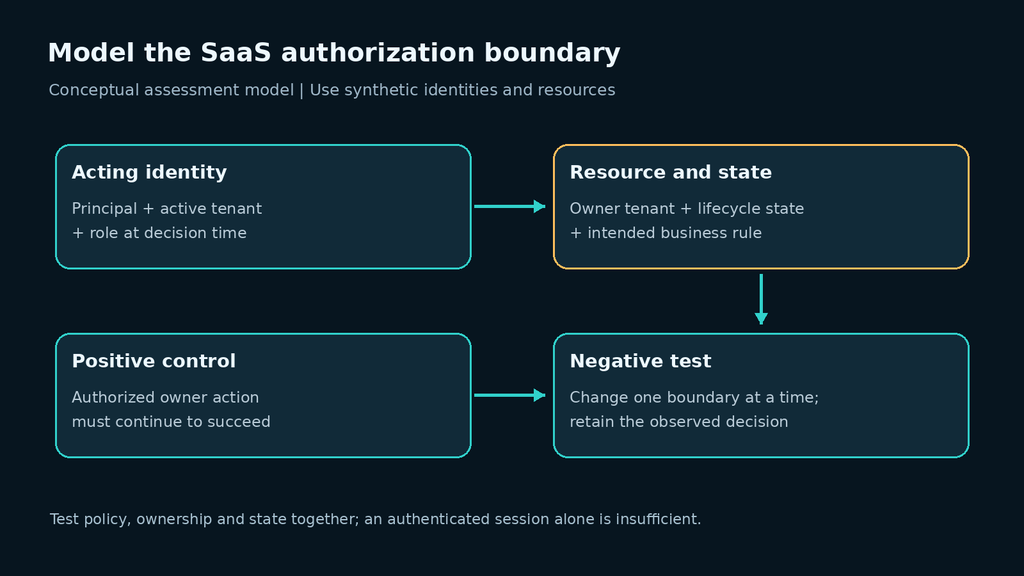
Start with the authorization model, not the endpoint list
Write down five dimensions before sending requests:
- Principal: anonymous visitor, member, manager, billing administrator, support operator or service account.
- Tenant: the organization in which the identity is acting, including any ability to switch organizations.
- Resource: invitation, project, invoice, subscription, refund, approval, export job or audit record.
- Action: create, read, update, delete, approve, cancel, refund, export or share.
- State: pending, accepted, revoked, expired, paid, refunded, approved, rejected, processing or complete.
The OWASP Authorization Cheat Sheet recommends validating permissions on every request. This model prevents a common testing error: treating authentication as authorization. A valid session proves who the application thinks the user is. It does not prove that the user may act on the selected object, call the function, modify the protected property or advance the workflow from its current state.
The OWASP API Security Top 10 separates object-level, property-level and function-level authorization, and also calls out unrestricted access to sensitive business flows. Keep those categories distinct. Reading another tenant’s invoice, changing its owner field, invoking an administrator refund route and automating thousands of valid coupon redemptions require different controls and different evidence.
A practical SaaS business logic test matrix
| Workflow | Required identities and state | Negative test | Positive control | Evidence to retain |
|---|---|---|---|---|
| Cross-tenant object access | Member A in tenant A; member B in tenant B; one synthetic object per tenant | A reads, edits or deletes B’s object by changing an identifier or context | Each owner performs the same action on its own object | Acting tenant, owner tenant, request, protected response fields and policy |
| Invitations | Inviter, invitee, revoked/expired invitation and an existing member | Reuse, accept after revocation, change target tenant or accept with the wrong identity | The intended invitee accepts one valid invitation once | Token lifecycle, intended recipient, tenant, timestamps and membership result |
| Subscription entitlement | Free, trial, paid, canceled and expired accounts | Keep or acquire a paid capability after downgrade, cancellation or direct API invocation | A paid account uses the capability within its allowance | Plan state before/after, server decision, usage ledger and resulting resource |
| Refunds and credits | Buyer, billing admin, refunded transaction and support role | Double refund, refund another tenant, refund after chargeback, or retain credits after refund | One authorized refund updates payment and internal ledger consistently | Transaction IDs, actor, idempotency key, ledger entries and external payment status |
| Approval workflow | Requester, approver, administrator; pending and completed requests | Self-approve, approve twice, edit after approval or skip a required stage | Authorized approver advances a valid pending request | State history, role at decision time, approval policy and side effect |
| Exports | Member, tenant admin, support operator and completed/expired export jobs | Request or download another tenant’s export, reuse an expired link, broaden filters after approval | Authorized requester downloads its own synthetic export | Requester, query scope, job owner, storage URL lifetime and file contents |
Do not run every permutation blindly. Prioritize boundaries with consequential effects: data leaving a tenant, money moving, access being granted, an irreversible state transition, or a bulk operation. Then add enough positive controls to prove that a secure denial is not merely a broken workflow.
Explore Penligent for authorized security testing and remediation verification.
Test cross-tenant access as a sequence
Create two synthetic tenants and at least two identities with the same nominal role. Create one resource through the normal workflow in each tenant and record its owner. Test read, update, delete and indirect references separately. An API may protect the object endpoint but expose the same record through search, export, activity feeds, attachments or background job status.
Tenant selection is part of the evidence. If a user can belong to several organizations, record the active tenant in the session, token or request context. A result is not a cross-tenant finding until the evidence establishes that the acting identity and resource belong to different security domains under the product’s intended policy.
Invitations need a lifecycle, not just an unguessable token
An invitation is an authorization grant in transit. Test who can create it, which tenant and role it grants, who can accept it and when it stops being valid. Revocation, expiration and single use must be enforced at acceptance time, not only represented in the user interface.
Useful cases include changing the signed-in account before acceptance, accepting the same token twice, accepting after the inviter loses authority, lowering and then restoring the intended role, and checking whether an invitation to one tenant can be replayed against another. Avoid collecting real addresses: dedicated test mailboxes are sufficient.
Subscription and refund tests must reconcile two systems
SaaS products often separate the payment provider from the internal entitlement ledger. Test the transitions between trial, paid, past due, canceled and refunded states, including delayed or repeated webhooks. A payment status alone does not prove the application removed or granted the correct capability.
For refunds, require idempotency and a consistent ledger. The bounded defect may be financial, an entitlement error or both. Report only what the synthetic transaction demonstrates. Do not infer a production loss total from one controlled case.
Approval testing needs separation of duties and state integrity
Map who creates, edits, submits, approves, rejects and reopens a request. Test whether the requester can become the approver through another role, whether a completed request can be edited without invalidating approval, and whether two simultaneous decisions create conflicting results.
Preserve the state history rather than only the final page. A server that displays “approved” while the protected side effect did not occur has a different defect from one that performs the side effect without an authorized decision.
Exports combine authorization, asynchronous jobs and temporary storage
Test both creation and retrieval. The user who can request an export may not be allowed to include every field, date range or project. The download route must check the job’s owner and tenant, even if the object is stored behind a difficult-to-guess URL.
Record whether the link expires, whether revoking the user or changing tenant membership affects access, and whether generated files contain fields omitted from the interactive interface. Use synthetic data and delete test files according to the engagement cleanup plan.
What a reproducible finding should contain
| Field | Example |
|---|---|
| Security rule | A member may accept only an active invitation addressed to that identity. |
| Acting identity | bob.test@example.invalid, tenant Beta, Member role. |
| Resource and owner | Invitation INV-104, tenant Alpha, addressed to alice.test@example.invalid. |
| Preconditions | Invitation is active; Bob is authenticated but is not the recipient. |
| Action | Bob submits the acceptance request with INV-104. |
| Observed result | Server creates an Alpha membership for Bob. |
| Positive control | Alice can accept a new invitation addressed to Alice. |
| Minimal impact | An unintended identity can join the synthetic tenant with the invitation’s role. |
| Remediation test | Bind acceptance to recipient, tenant, status and expiry; reject replay while preserving valid acceptance. |
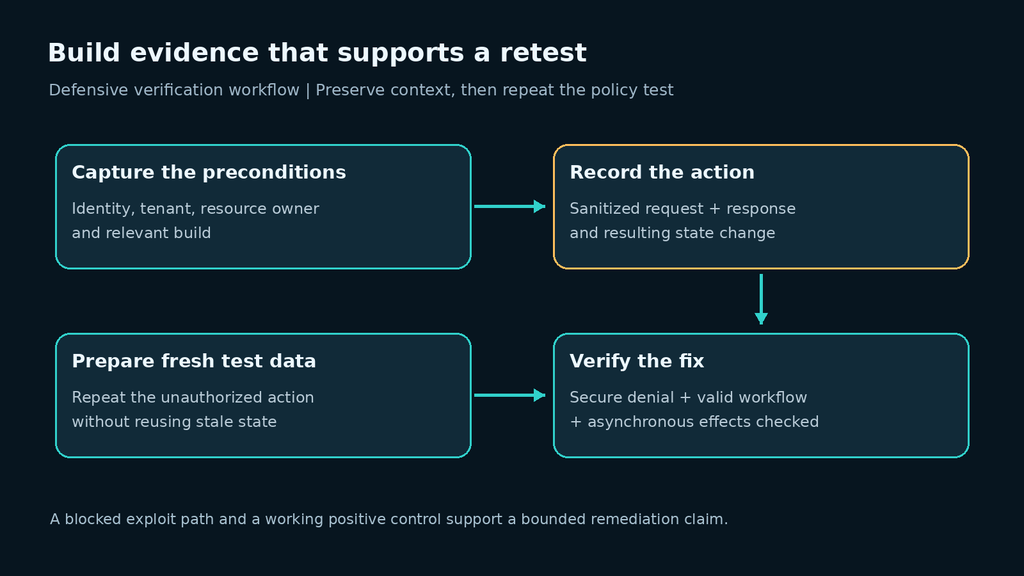
Attach sanitized request and response pairs, the relevant state before and after the action, and a timestamp or build identifier. A screenshot may help a reader, but it should not replace the identity and ownership context.
Retest the policy and the normal workflow
A fix is not proven by turning every response into 403. Repeat the original unauthorized action with fresh synthetic data, then repeat the intended owner or approver action. For asynchronous workflows, also confirm that queued jobs, webhooks and cached entitlements cannot recreate the old result.
State exactly what the retest establishes. Fixing invitation acceptance does not prove that direct membership creation, SCIM provisioning and support tooling enforce the same rule. Add related routes according to the architecture instead of declaring the whole product secure.
Explore Penligent for authorized security testing and remediation verification.
How to scope a commercial SaaS penetration test
Give the assessor an architecture summary, test tenants, representative roles, documented workflows and a list of prohibited effects. Identify payment and identity providers that are outside scope. Agree on whether the test includes web, API, mobile, background jobs, support interfaces and cloud storage used by exports.
Ask the report to list workflows reached, identities used, blocked prerequisites and untested states. Finding counts without that denominator are difficult to evaluate. Before selecting a platform or service, preview the expected report structure and use one high-value workflow as an acceptance test.
Preview Penligent’s sample penetration test report to compare scope, evidence and remediation fields. The sample is fictional and does not demonstrate testing of your application.
Frequently asked questions
What is business logic penetration testing?
It is an authorized assessment of whether valid-looking actions violate an application’s intended rules, such as tenant isolation, separation of duties, transaction limits or workflow order.
Can automated scanners find business logic vulnerabilities?
Automation can exercise identifiers, identities and sequences once the policy and test data are defined. Human judgment is usually needed to model ambiguous business rules, interpret legitimate exceptions and bound the impact.
What should a SaaS business logic report prove?
It should identify the acting identity, tenant, resource owner, expected rule, request sequence, observed result, minimal impact, affected build and a positive control that still works after remediation.
How many accounts are needed?
At minimum, use two comparable users in different synthetic tenants for isolation tests. Add roles and workflow states only when they represent a real boundary. More accounts do not improve evidence unless their authority is clear.
Make the business rule testable
The most useful SaaS penetration test does not begin with a long payload list. It begins with a precise rule and enough controlled identities and state to challenge it. When the report preserves that context, engineering can reproduce the defect, repair the correct boundary and prove that legitimate work still succeeds.
 English
 German
 French
 Spanish
 Portuguese
 Japanese
 Korean
 Hindi
 Arabic
 Turkish
 Hebrew