
If you search for bug bounty hunter software in 2026, most of what you find still looks like a listicle from a simpler era. Burp. Nmap. sqlmap. ffuf. Maybe a crawler. Maybe a wordlist. Then a short paragraph that pretends the job is solved. That was never quite true, and in 2026 it is actively misleading. The market is larger, the attack surface is more fragmented, AI is now both part of the product surface and part of the researcher workflow, and the highest-value bugs are increasingly less about “did the scanner catch it” and more about “could you understand the system well enough to prove impact.” (HackerOne)
Public data now points in the same direction from multiple angles. HackerOne says its latest report is built on more than 580,000 validated vulnerabilities and reports $81 million in payouts in 2025, with valid AI vulnerability reports up 210 percent and prompt injection up 540 percent. Bugcrowd says broken access control critical vulnerabilities rose 36 percent, API vulnerabilities rose 10 percent, network vulnerabilities doubled, and hardware vulnerabilities rose 88 percent. Google’s VRP also hit a new high, paying out $17.1 million in 2025. That is not the profile of an ecosystem where one scanner or one proxy wins the day. It is the profile of a field where coverage is cheap, but verified understanding is expensive. (HackerOne)
That is the first big idea of this article. The right answer to bug bounty hunter software in 2026 is not one product. It is a stack. More specifically, it is a stack that helps you do five jobs well: control traffic, map the asset surface, generate broad but disciplined coverage, validate promising signals without losing state, and turn raw findings into evidence a triager will accept. Most wasted time in bug bounty happens when a hunter is strong in one of those layers and weak in the others.
The second big idea is even less comfortable. The stack that works in 2026 is not necessarily the stack with the most tools. A pile of CLIs and templates can feel productive while producing almost nothing except duplicates, false positives, and out-of-scope risk. Good software now has to do more than “scan harder.” It has to help you hold context. It has to help you remember what you already learned about the target. It has to help you separate baseline noise from the one suspicious edge case that might become a payout.
The market changed, and the software had to change with it
A lot of older bug bounty writing still assumes that the average target is a reasonably stable web app with a handful of forms and some forgotten subdomains. That world still exists, but it is no longer the whole job. Current platform data shows that AI-enabled assets, APIs, gateways, identity layers, hardware, and hybrid attack surfaces are all more prominent in real-world offensive testing than they were only a few years ago. HackerOne’s 2025 report says programs with AI in scope grew 270 percent, and its researcher-side analysis says authorization flaws like IDOR and access control are climbing while commodity issues such as XSS and SQLi are declining. Bugcrowd’s 2025 data tells a similar story, with broken access control and sensitive data exposure rising sharply while boards worry about AI-driven complexity and expanding surface area. (HackerOne)
That shift changes how software should be evaluated. In 2019, a fast brute-forcer plus patience could take you surprisingly far. In 2026, speed still matters, but state matters more. A lot of valuable bugs now live behind authentication, in role-dependent flows, inside API sequences, across JavaScript-heavy front ends, or in systems where one low-severity signal only becomes meaningful when it is chained to another. That means the best software is no longer just the best at finding input fields. It is the best at helping you understand how a target actually behaves.
This is also why the old debate between “manual testing” and “automation” is now stale. The real question is where automation belongs. HackerOne’s latest researcher analysis makes that split explicit: hackbots and automation are getting good at clearing the baseline, while high-impact discoveries still depend on human curiosity, chaining, and contextual reasoning. Two-thirds of researchers expect AI to enhance their work rather than replace it, and only a small minority think it will replace them outright. In other words, automation is winning the boring battles, but the expensive wins still come from judgment. (HackerOne)
If you keep that in mind, the software picture becomes much clearer. You do not need “the best software” in the abstract. You need software that is excellent at one stage of the workflow and composable with the next stage. When a tool cannot hand off cleanly to the next step, it becomes a toy, even if it is technically impressive.
The stack that still makes sense in 2026
The practical stack below is built from current official documentation and current market signals. Burp remains the control plane for web traffic and manual validation. ProjectDiscovery’s tools still form one of the cleanest recon pipelines in the public ecosystem. OWASP Amass remains valuable for deeper external asset mapping. Nuclei still shines for fast template-based coverage. ffuf and dirsearch are still useful when you already have a hypothesis. sqlmap is still powerful when used sparingly and legally. Interactsh is still one of the clearest ways to confirm out-of-band behavior. SecLists remains a default companion, and OWASP WSTG plus PortSwigger’s Web Security Academy remain the strongest public learning layers around the tooling itself. (بورت سويجر)
| الطبقة | Tools that still matter | What they are best at in 2026 |
|---|---|---|
| Traffic control and manual proof | Burp Suite Professional or Community | Intercepting requests, preserving session state, replaying edge cases, validating impact |
| Passive and deep recon | Subfinder, Amass, gau | Building target context without immediately turning on noisy active testing |
| Enrichment and surface shaping | httpx, Naabu | Turning raw hosts into live, typed, prioritized surface area |
| Crawling and endpoint discovery | Katana, Burp Site Map, browser-driven exploration | Finding real paths in modern JS-heavy apps and APIs |
| Template and pattern coverage | النوى | Fast baseline checks for known exposures, misconfigurations, and repeatable fingerprints |
| Directed fuzzing | ffuf, dirsearch, SecLists | Testing focused hypotheses about content discovery and hidden paths |
| High-confidence exploitation support | sqlmap, Interactsh, Burp Repeater | Confirming specific signals, especially injection and out-of-band behavior |
| Learning and method | OWASP WSTG, Web Security Academy | Keeping your tooling tied to real vulnerability classes rather than cargo cult use |
That table looks obvious on paper, but most hunters still collapse too many layers into one. They expect Nuclei to do what Burp is supposed to do. Or they treat Burp like a scanner when the real value is stateful validation. Or they run ffuf before they know which host is worth fuzzing. The result is not just inefficiency. It is a distorted sense of what the target actually is.
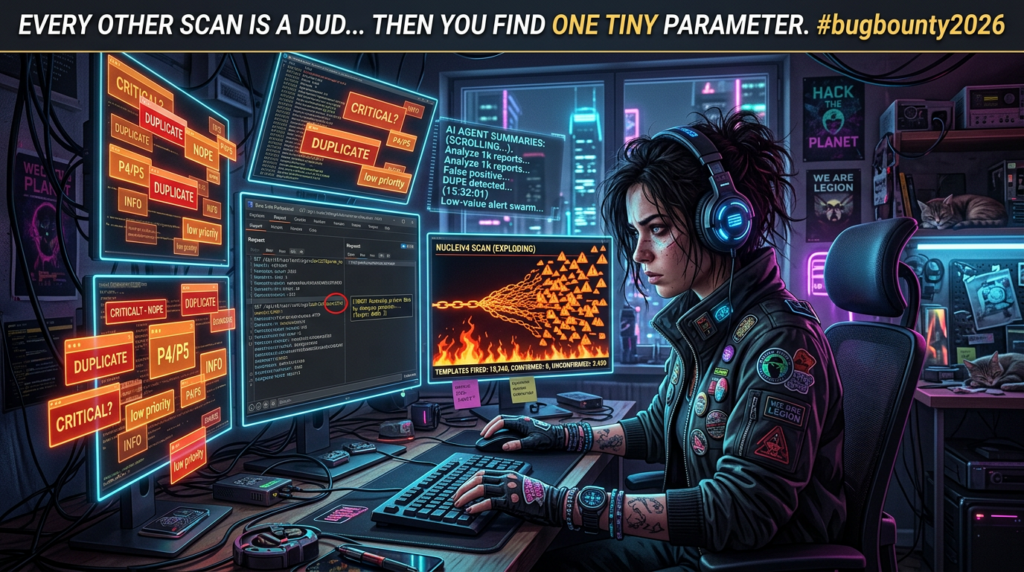
Burp Suite is still the control plane, not just a legacy favorite
Let’s start with the least controversial part. Burp still matters. Not because it is famous, and not because every old-school hunter says so, but because the core problem in modern bug bounty is still HTTP state, request mutation, and evidence. PortSwigger’s own bug bounty materials still describe the workflow as beginning with Burp Proxy, then branching into mapping, scanning, content discovery, repeater-driven testing, intruder-driven variation, and extensions where needed. Its product pages still position Burp Suite Professional as the gold-standard toolkit for discovery, attack, extensibility, and productivity, with more than 300 extensions and 250-plus BApp authors in its ecosystem. That combination is exactly why Burp remains so hard to replace. (بورت سويجر)
What Burp gives you in 2026 is not just “a proxy.” It gives you a place where your understanding of the target becomes concrete. You can see where the session changes. You can spot the missing role check. You can watch a front end send an authorization token one way in one flow and another way in a second flow. You can compare two tenants or two users side by side. And when a scanner or a template tells you something might be there, Burp is still usually where you decide whether it is real.
That matters more now because so many valuable bugs are stateful. HackerOne’s trend data around IDOR, access control, and AI-related logic issues lines up with what experienced hunters already feel in practice: the money is increasingly in places where raw pattern matching is not enough. It is in places where the difference between “works for my account” and “works for any account” is one changed identifier, one stale token, one dry-run API, one callback, or one assumption the developer never expected anyone to test. (HackerOne)
Burp’s staying power is also educational. PortSwigger’s training hub says the Web Security Academy includes over 190 interactive labs and is continuously updated with new material tied to current web security research. That matters because in bug bounty, the software and the learning path are not separate things. If your main testing console is directly tied to the best public lab ecosystem in web security, you improve not just because of the tool, but because the tool keeps you attached to current exploit patterns. (بورت سويجر)
The only real question here is whether Burp Pro is worth paying for in 2026. For most serious web or API hunters, the answer is still yes. PortSwigger currently lists Burp Suite Professional at $499, which is not trivial for a beginner, but in the context of a full year of research it is still one of the clearest “one purchase that changes your workflow” tools on the market. Community Edition is enough to learn. Professional is usually what changes the speed and comfort of real hunting. (بورت سويجر)
Recon software is not one thing, and that misunderstanding wastes months
The second layer is recon, and this is where bad articles usually fail. “Use recon tools” is not advice. Recon is not one job. It is several jobs that need different software.
Subfinder is for passive discovery. ProjectDiscovery describes it as a passive subdomain enumeration tool optimized for speed and stealth, built specifically to return valid subdomains from passive sources while respecting source licenses and restrictions. That makes it good for the very first pass, when you want breadth with low friction and without immediately creating noise. In 2026, that still matters because the first problem is often not “how do I test this host,” but “which hosts are even worth my attention.” (docs.projectdiscovery.io)
OWASP Amass solves a related but different problem. OWASP describes it as a framework for network mapping of attack surfaces and external asset discovery using OSINT and reconnaissance techniques, backed by an asset database and the Open Asset Model. In practice, that makes Amass more valuable when you want a richer model of the external environment rather than just a quick list. It is not simply a slower Subfinder. It is useful when you care about relationships and coverage depth, especially on larger targets where asset sprawl is part of the bounty opportunity. (مؤسسة OWASP)
Then comes httpx, which is one of the tools that quietly makes the whole pipeline saner. ProjectDiscovery calls it a fast, multi-purpose HTTP toolkit for probing services, web servers, and metadata, and explicitly notes that it can sit in a pipeline that moves from asset identification into technology enrichment and then vulnerability detection. That one sentence captures why httpx belongs in almost every modern stack. Raw hosts are not very useful. Live, typed, fingerprinted hosts are. Once you know which targets are alive, what status they return, what technology they expose, whether HTTPS falls back, whether there is a title, a redirect chain, a CDN, or a suspicious header, you can stop guessing. (docs.projectdiscovery.io)
Katana solves another distinct problem. ProjectDiscovery’s docs describe it as a fast web crawler with headless support that can handle modern JavaScript frameworks, SPAs, and automatic form filling. That matters because a lot of current applications no longer yield their real routes to a simple crawler. If your recon stack cannot deal with React, Angular, multi-step navigation, or lazy-loaded paths, then your target map is an illusion. In 2026, endpoint discovery increasingly means understanding client behavior, not just fetching HTML and parsing links. (docs.projectdiscovery.io)
gau is useful for historical and archival context. Its GitHub documentation says it fetches known URLs from AlienVault OTX, the Wayback Machine, Common Crawl, and URLScan. That is valuable because bounty hunters routinely underestimate how much old surface area still informs new findings. Historical URLs can reveal deprecated endpoints, parameter patterns, old admin paths, backup workflows, or routing conventions that current crawling misses. It does not prove a bug. But it often tells you where to look. (جيثب)
Naabu belongs in a narrower slice of programs, but when it belongs, it is helpful. ProjectDiscovery describes it as a fast Go-based port scanner that supports SYN, CONNECT, and UDP scanning, passive port enumeration via Shodan InternetDB, and Nmap integration. That is enough to make it useful in programs that explicitly allow network-layer exploration. It is not something to spray blindly. But on cloud-heavy or hybrid targets where exposed services drift faster than documentation, it helps convert domain-level recon into service-level reality. (docs.projectdiscovery.io)
The larger point is that recon software should build context in sequence. You discover. You enrich. You crawl. You correlate. You prioritize. If you skip that logic and just run everything everywhere, you do not get more signal. You get more output.
Template scanners and fuzzers still matter, but only in the right role
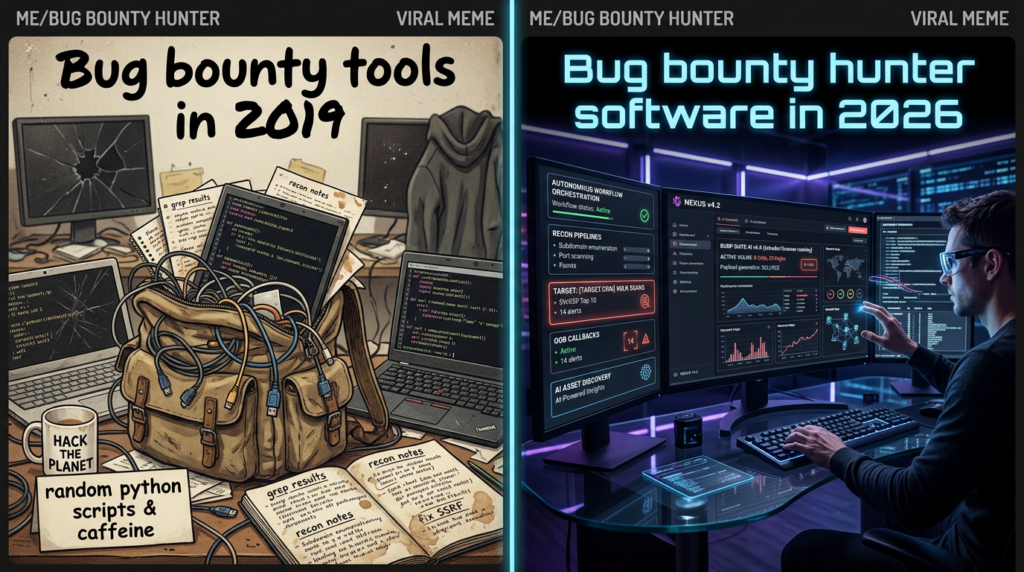
Nuclei remains one of the most useful tools in public offensive security because it is honest about what it is. ProjectDiscovery calls it a fast vulnerability scanner built around YAML templates for modern applications, infrastructure, cloud platforms, and networks, with each template expressing a possible attack route and sometimes even an associated exploit path. That template-centric model is exactly why Nuclei is still valuable in 2026. It is very good at answering a specific question quickly: does this target match a known condition worth attention. (docs.projectdiscovery.io)
What Nuclei is not good at is replacing thought. It will not understand that a role check is subtly missing only after an invited user downgrades their permissions and repeats an old API call. It will not understand that a dry-run endpoint redacts secrets in logs but leaks them in a second field. It will not understand that an OIDC flow only breaks when one client exchanges another client’s code. Those are reasoning problems, not template problems.
That distinction matters because the market is now full of hunters who are fast at running templates and slow at validating what they mean. HackerOne’s latest reporting on automation makes this boundary explicit. Automated agents are now clearly part of the ecosystem and are effective on cleanly patterned issues, but the more expensive findings still require human chaining and context. That is not an anti-automation statement. It is a reminder to use Nuclei as baseline coverage, not as a substitute for real analysis. (HackerOne)
ffuf is another tool that still earns its place when used well. Its official GitHub repository describes it simply as a fast web fuzzer written in Go, and its wiki highlights support for raw HTTP request files. That second point is the reason advanced users keep it around. ffuf is most useful not when you are blindly brute-forcing every host on day one, but when you already understand the request shape and want to mutate one variable hard and fast. In other words, ffuf is strongest later in the workflow than most beginners assume. (جيثب)
dirsearch occupies a similar role but with a different flavor. Its official GitHub project describes it as an advanced web path brute-forcer and web path discovery tool. That makes it a strong fit when you have reason to believe there is a hidden content structure worth enumerating, especially on older or less dynamic targets where path discovery still pays. But it is another tool that is easy to misuse. A brute-forcer without a hypothesis is just a rate-limit negotiation strategy. (جيثب)
SecLists remains a default companion because wordlists are still the raw material of both fuzzing and content discovery. Daniel Miessler’s repository describes it as a security tester’s companion containing usernames, passwords, URLs, sensitive data patterns, fuzzing payloads, web shells, and many other list types. The key in 2026 is not that you have wordlists. It is that you choose the right list for the target and shrink your search space intelligently. Bigger lists do not automatically mean better results. Better assumptions do. (جيثب)
This is also where many public “best tools” articles are subtly wrong. They rank fuzzers and scanners as if their value exists on its own. In reality, their value is downstream from target understanding. The same ffuf command that is useless against one host can be excellent against another because the host, the headers, the extensions, the auth state, and the wordlist all changed. Good software helps. Good sequencing pays.
Validation software is where real bug bounty work begins
Once a target starts yielding interesting signals, the software priorities change again. At that point, the job is not discovery. It is proof.
Burp Repeater is still one of the most important tools in that phase because the difference between a duplicate and a payout is often a single clean reproduction path. You need to show that the issue is not a flaky edge case. You need to preserve the exact request. You need to modify just one field and demonstrate that the impact persists. You need to see what happens when you switch identity, role, object ID, CSRF token, callback target, or tenant parameter. That is why a proxy-based workflow still dominates real bounty work even when recon and scanning are highly automated.
sqlmap is another example of a tool that remains powerful precisely because it should be used sparingly. Its official repository describes it as an open-source penetration testing tool that automates detection and exploitation of SQL injection and database takeover, with fingerprinting, data fetching, file system access, and even OS command execution features in some cases. That is exactly why it is valuable and exactly why it should not be the first thing you throw at a target. sqlmap is best when you already have strong reason to think you are looking at injectable behavior and the program rules allow the testing. Used that way, it compresses validation time dramatically. Used blindly, it mostly creates noise and risk. (جيثب)
Interactsh fills another modern gap. ProjectDiscovery describes it as an open-source tool for detecting out-of-band vulnerabilities by generating dynamic URLs and monitoring callbacks when a target requests them. It also notes that the server captures and logs out-of-band interactions while the client generates testing URLs and analyzes the interactions. That matters because in 2026 many interesting findings are not visible in-band. SSRF, blind injection, callback-driven execution, and async fetch behavior often need an OOB confirmation layer. If your software stack has no reliable way to confirm that kind of behavior, you will miss bugs or fail to prove them cleanly. (docs.projectdiscovery.io)
This validation layer is also where software quality becomes partly about restraint. The strongest hunters do not just know how to launch tools. They know when to stop one step before a risky action and still preserve enough evidence for a triager to accept the report. In practice, that means your best bug bounty software is often the software that helps you prove reachability, influence, or exposure without turning the test into damage.
Learning software is part of the stack, not an afterthought
One of the easiest mistakes in bug bounty is separating “tools” from “training.” In reality, the learning platform is part of the tooling decision because it shapes what you notice when you test.
OWASP’s Web Security Testing Guide describes itself as the premier cybersecurity testing resource for web application developers and security professionals. The current guide structure still covers information gathering, configuration testing, identity, authentication, authorization, session management, input validation, business logic, client-side testing, and API testing. That breadth is important because it reminds you that bug bounty is not a bag of payloads. It is a method for testing systems. (مؤسسة OWASP)
PortSwigger’s Web Security Academy plays a different but complementary role. PortSwigger says the Academy is a free online training center tied to its in-house research and includes over 190 interactive labs, updated with current vulnerability research. That makes it unusually valuable as a bridge between public research and daily tool use. In practical terms, it means your proxy, your lab environment, and your mental model are all moving together. That is a much better way to stay current than reading random exploit writeups on social platforms and hoping the pattern will transfer. (بورت سويجر)
OWASP Top 10 also still matters, but not because it tells you everything. OWASP’s current site says the most current released version is the OWASP Top Ten 2025 and frames it as the standard awareness document for the most critical web application security risks. In 2026 that is still useful as a framing device, especially for newer hunters, but the market data now makes clear that the money is not in memorizing the list. It is in recognizing how access control, auth, AI, APIs, and business logic issues actually appear in live products. (مؤسسة OWASP)
So yes, learning resources count as software in practice. They sharpen how you use the rest of the stack. The hunter who has a smaller toolset but better mental models almost always beats the hunter with twenty CLIs and weak pattern recognition.
What recent CVEs say about the software you actually need
The best way to judge bug bounty software in 2026 is to ask a simple question: if you had to rediscover the conditions behind recent, meaningful vulnerabilities, what software capabilities would you need. Not exploit code. Not a turnkey attack chain. Just the ability to notice the conditions and prove them safely.
Take CVE-2025-49113 in Roundcube. NVD says Roundcube Webmail before 1.5.10 and before 1.6.11 in the 1.6 branch allowed authenticated users to reach remote code execution through an unvalidated _from parameter, leading to PHP object deserialization. That is not a story about unauthenticated broad scanning. It is a story about authenticated surface area, state preservation, precise request handling, and the ability to see when a “settings upload” path is doing more than it appears to do. The software lesson is straightforward: if your stack is weak at logged-in workflow testing, you are missing a meaningful share of modern bug bounty reality. (NVD)
Now look at CVE-2025-68613 in n8n. NVD describes it as a critical RCE in the workflow expression evaluation system, affecting a large version range and allowing authenticated attackers to execute arbitrary code with the privileges of the n8n process. Again, the lesson is not “buy a better scanner.” The lesson is that admin panels, automation products, and expression engines continue to create high-value attack paths, and the hunters who do best on them usually have software that helps them preserve auth state, trace execution context, compare behavior across roles, and move from suspicious input handling to safe proof. (NVD)
Then there is CVE-2026-23744 in MCPJam inspector, which NVD says allowed remote code execution because the product defaulted to listening on 0.0.0.0 بدلاً من 127.0.0.1, letting a crafted HTTP request trigger installation of an MCP server and resulting in RCE until 1.4.3 fixed it. This is exactly the kind of case that tells you the AI era is not replacing old security fundamentals. It is reintroducing them in new packaging. The capability you need here is not mystical “AI hacking software.” It is software that helps you see exposed listener behavior, default service assumptions, and control-plane actions that should never have been remotely reachable. (NVD)
Two March 2026 NVD entries make the access-control point even more sharply. CVE-2026-32237 in Backstage exposed server-configured environment secrets through a dry-run API response, despite redaction in logs. CVE-2026-32245 in Tinyauth failed to verify that the client redeeming an authorization code was the same client that the code was issued to, enabling token theft across clients. Neither of those is the kind of issue you reliably find by blasting templates at the internet. They are the kind of issues you find when you understand identity flow, role boundaries, hidden response fields, and protocol assumptions. That means the software that matters most is software that lets you preserve sessions, replay exact flows, compare identities, and inspect subtle response differences. (NVD)
A final example is CVE-2026-29777 in Traefik. NVD says a tenant with write access to an HTTPRoute resource could inject rule tokens via unsanitized header or query parameter match values, potentially bypassing listener hostname constraints and redirecting traffic for victim hostnames to attacker-controlled backends in shared gateway deployments. That is a good reminder that modern bounty-relevant issues often live in routing, orchestration, or policy layers rather than in “the app” narrowly defined. Your software has to help you reason about infrastructure behavior, not just endpoints. (NVD)
Seen together, these CVEs tell a clear story. The software that deserves a permanent place in a 2026 bounty stack is not the software that shouts first. It is the software that helps you see authenticated behavior, compare roles, preserve state, inspect policy edges, confirm OOB effects, and produce evidence cleanly. That is the center of gravity now.
AI belongs in the workflow, but not where hype says it does
There is a temptation in 2026 to ask whether the real answer to bug bounty hunter software is simply “an AI tool.” That is too vague to be useful.
What the public data actually shows is more nuanced. HackerOne says 67 percent of researchers now use AI to speed up testing and reduce repetitive work. Its report also says only 12 percent believe AI could replace them. Google expanded and clarified its AI rewards program, and its official security materials describe prompt injection, data exfiltration, and emerging agentic risks as active research surfaces. In other words, AI is absolutely part of the current offensive security landscape, but the strong use cases are acceleration, scale, and workflow leverage, not fully replacing human reasoning. (HackerOne)
That matches reality. AI is good at turning a JavaScript bundle into a shorter set of hypotheses. It is good at summarizing repeated request patterns. It is good at drafting parameter mutation ideas, clustering similar hosts, diffing responses, organizing recon notes, proposing follow-up tests, and helping turn rough notes into a cleaner report. It is much less reliable when you ask it to infer exploitability from weak evidence or to understand legal boundaries and program nuance by itself.
This is why a lot of “AI for bug bounty” marketing feels wrong even when the product underneath is decent. The useful AI layer is not a magician. It is a force multiplier around a stateful workflow. If it can speed up the boring middle and keep your evidence structured, it is helpful. If it only produces fluent guesses, it is expensive autocomplete.
PortSwigger has already moved in this direction inside Burp itself. Its current product page describes Burp AI as helping with validation, exploration, and repetitive tasks while keeping the tester in control. That phrasing matters. “In control” is the important part. The right AI-enhanced software in 2026 does not take judgment away from the hunter. It reduces friction around the parts of the work that do not need judgment every single time. (بورت سويجر)
Where Penligent fits, naturally, in this picture
If you accept the argument of this article, Penligent fits most naturally not as a magical replacement for the classic stack, but as an orchestration layer for teams and hunters who are tired of stitching the stack together by hand. Penligent’s own product materials describe it as an end-to-end AI-powered penetration testing agent that merges tools such as nmap, Metasploit, Burp Suite, and SQLmap into an AI-driven workflow moving from asset discovery to vulnerability scanning, exploit execution, attack-chain simulation, and report generation. Penligent also frames its black-box role around running tasks, verifying findings, and producing publishable evidence against real targets. (بنليجنت)
That is the right way to think about it. Penligent is not interesting because it makes Burp, Subfinder, or Nuclei irrelevant. It is interesting because many 2026 workflows are breaking under the cost of context switching. A hunter or small team moves from passive recon to enrichment to crawling to scanning to manual proof to report writing, and every handoff leaks context. An agentic layer only becomes valuable if it reduces that leak, keeps scope visible, preserves hypotheses, verifies claims, and turns raw signal into something defensible. Penligent’s product page and related workflow articles explicitly emphasize scope control, human-in-the-loop control, verification, reproducible proof, and clean reporting, which is exactly the part of the workflow where many existing stacks still feel fragmented. (بنليجنت)
A sane 2026 workflow, using software in the order it deserves
The healthiest way to use bug bounty software in 2026 is to make each tool prove why it is in your stack. Here is a simple, scope-aware pattern for authorized targets that still makes sense:
# scope.txt contains only assets explicitly allowed by the program.
# Run only within program rules and approved automation limits.

cat scope.txt \
  | subfinder -silent \
  | sort -u \
  > subs.txt

cat subs.txt \
  | httpx -silent -title -tech-detect -status-code -follow-redirects \
  > live.txt

katana -list live.txt -silent -headless -depth 3 \
  > katana_urls.txt

cat scope.txt \
  | gau --threads 5 \
  > gau_urls.txt

cat katana_urls.txt gau_urls.txt \
  | sort -u \
  > urls.txt

cat live.txt \
  | nuclei -severity low,medium,high,critical -rate-limit 20 \
  > nuclei_hits.txt

# Manual validation happens next in Burp, not by blindly trusting scanner output.
The point of that workflow is not the exact flags. It is the order. Passive discovery first. Live-host enrichment second. Crawling and historical surface building third. Template coverage fourth. Manual proof after that. That order mirrors what the official docs actually say these tools are for: Subfinder for passive enumeration, httpx for probing and enrichment, Katana for modern crawling, gau for known historical URLs, and Nuclei for template-based detection. If you reverse the order, you mostly reverse the signal quality as well. (docs.projectdiscovery.io)
After the software helps you find something, the report still wins or loses the bounty. A simple structure like the one below is still better than a dramatic writeup with weak reproduction.
Title
A concise description of the issue and affected asset

Summary
One paragraph explaining the bug, the affected role, and the security impact

Affected asset
Exact host, endpoint, route, or workflow

Prerequisites
Account type, role, feature flag, or environment assumption

Steps to reproduce
1. Exact request or action
2. Exact modified value
3. Exact observed result

Observed result
What happened in the product

Impact
Why this matters in practice, with the narrowest honest claim

Evidence
Screenshots, raw requests, response excerpts, callback logs, IDs redacted as needed

Suggested remediation
One concrete engineering direction
That report template is boring on purpose. Triagers pay for clarity. The software that helps you preserve requests, compare states, and collect evidence cleanly is usually more valuable than the software that made the first noisy “possible issue” alert.
If you are starting from zero, buy discipline before you buy too much software
For a beginner, the best stack in 2026 is not the widest stack. It is the stack that lets you build repeatability. That usually means Burp Community if you truly have no budget, plus Subfinder, httpx, Katana, Nuclei, ffuf, gau, SecLists, OWASP WSTG, and the Web Security Academy. That set is enough to learn the entire loop from recon through validation without drowning in feature bloat. The Academy and WSTG matter as much as the CLIs because they prevent you from confusing tool usage with method. (docs.projectdiscovery.io)
If you have one paid purchase to make, Burp Pro is still the cleanest first choice for web- and API-heavy bounty work. Not because everything else is replaceable, but because Burp is the place where weak signals become real findings. If your bottleneck is not discovery but proof, Burp Pro usually pays for itself faster than another scanner, another archive source, or another shiny interface. (بورت سويجر)
For more advanced hunters, the real differentiation is not “more tools.” It is whether your software stack helps you stay stateful. Can you keep tenant A and tenant B straight. Can you replay a flow after a role change. Can you record why host 17 was interesting and host 18 was not. Can you tie an archival URL, a JS-discovered endpoint, a live probe, and a dry-run secret leak into one coherent story. Those are not glamorous software criteria, but they are the ones that decide whether your workflow scales past hobbyist speed.
What to stop doing in 2026
A good article on bug bounty software should also tell you what to stop doing. Stop treating scanners as strategies. Stop measuring progress by how many lines of output a tool created. Stop building a stack that optimizes for dopamine instead of verified findings. Public data is already telling you where the field is moving: access control, auth logic, AI surfaces, API behaviors, hardware and network edge cases, and contextual flaws are rising. Commodity scanning is not dead, but it is crowded, and platforms themselves increasingly automate that baseline. (HackerOne)
Stop copying giant “50 tools every hunter must know” checklists unless you can explain why each tool changes one stage of your workflow. Most hunters do not need fifty tools. They need a smaller number of tools used in the right sequence, with better note-taking and better validation. The stack becomes dangerous when it gives you the illusion of coverage without actual understanding.
And stop asking whether AI will replace bug bounty hunters. That is the wrong question. The better question is whether your current software stack leaves enough room for you to do the part only humans still do well: build hypotheses, notice contradictions, chain behaviors, judge impact honestly, and stop before your proof becomes reckless. HackerOne’s own data points to the same answer. AI is becoming part of the workflow, but the high-value work still lives in the boundary between machine scale and human judgment. (HackerOne)
المرجع
HackerOne 2025 Hacker-Powered Security Report
HackerOne researcher analysis on AI, hackbots, and 2026 offensive security
دليل اختبار أمان الويب OWASP
OWASP Top Ten 2025
PortSwigger Web Security Academy
Burp Suite Professional
PortSwigger bug bounty tools workflow
ProjectDiscovery Subfinder docs
ProjectDiscovery httpx docs
ProjectDiscovery Katana docs
ProjectDiscovery Naabu docs
ProjectDiscovery Nuclei docs
ProjectDiscovery Interactsh docs
OWASP Amass
ffuf on GitHub
dirsearch on GitHub
sqlmap on GitHub
SecLists on GitHub
كتالوج الثغرات الأمنية المعروفة المستغلة CISA
NVD entry for CVE-2025-49113, Roundcube
NVD entry for CVE-2025-68613, n8n
NVD entry for CVE-2026-23744, MCPJam inspector
NVD entry for CVE-2026-32237, Backstage
NVD entry for CVE-2026-32245, Tinyauth
NVD entry for CVE-2026-29777, Traefik
Penligent homepage
AI Pentest Tool, What Real Automated Offense Looks Like in 2026
The 2026 Ultimate Guide to AI Penetration Testing, The Era of Agentic Red Teaming
Overview of Penligent.ai’s Automated Penetration Testing Tool
Claude Code Security and Penligent, From White-Box Findings to Black-Box Proof
Exploit DB in 2026


 Arabic
  English
  German
  French
  Spanish
  Portuguese
  Japanese
  Korean
  Hindi
Hindi  Turkish
  Hebrew