
CVE-2026-121529 is an origin-validation error affecting specific FortiClient releases on Windows and macOS, including listed Windows PAM versions. Fortinet’s official CNA record describes possible unauthorized code or command execution by a remote attacker and states that successful exploitation requires interaction with the victim. It assigns CVSS 3.1 severity Critical with a score of 9.1.
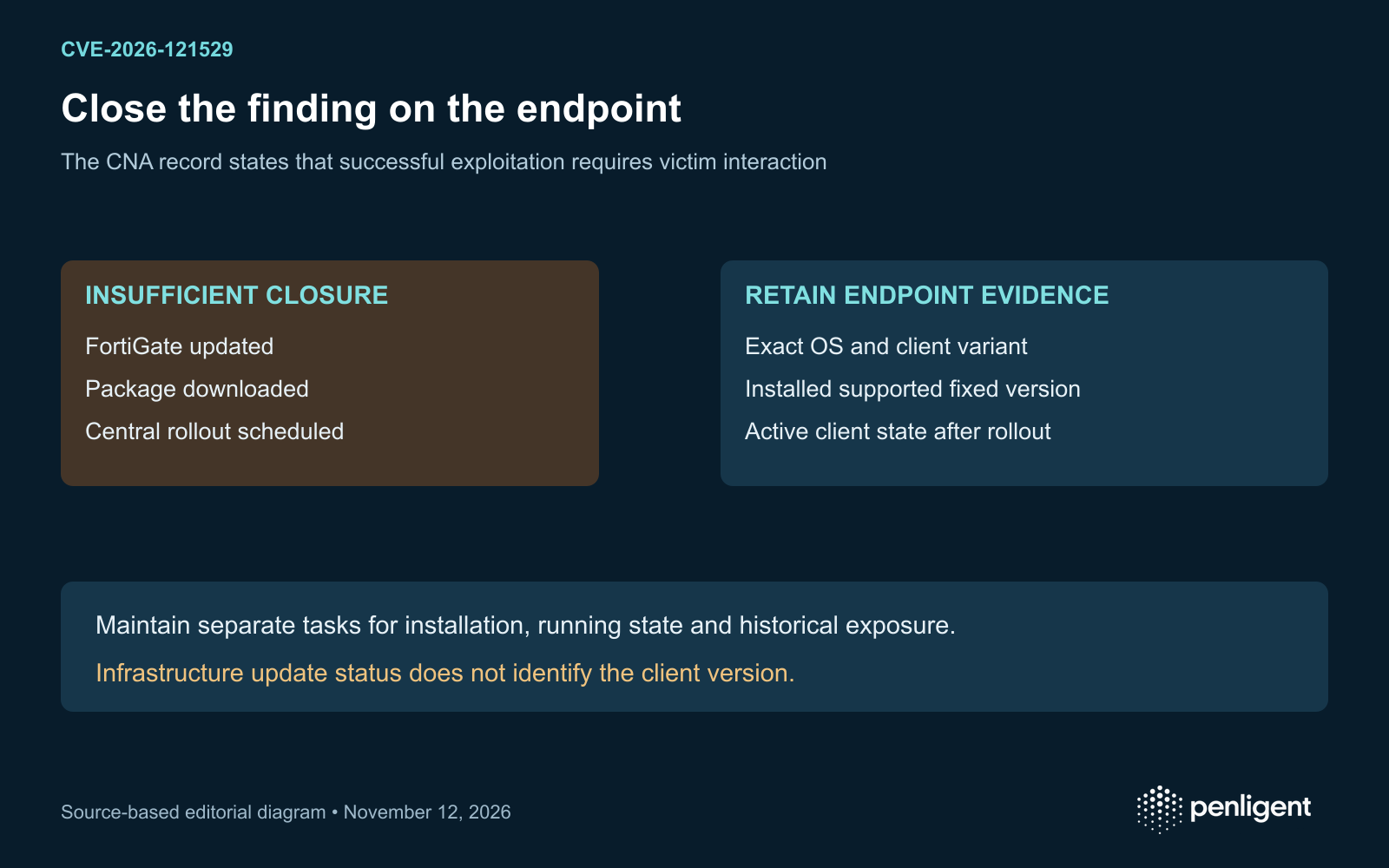
The immediate asset question is which FortiClient variant and release is installed on each endpoint. A FortiGate firmware update or an updated management server does not by itself establish that affected endpoint clients have been replaced. Build the remediation list from endpoint software evidence.
Use the exact product and branch
| Product in the CNA record | Affected releases | Listed fix paths |
|---|---|---|
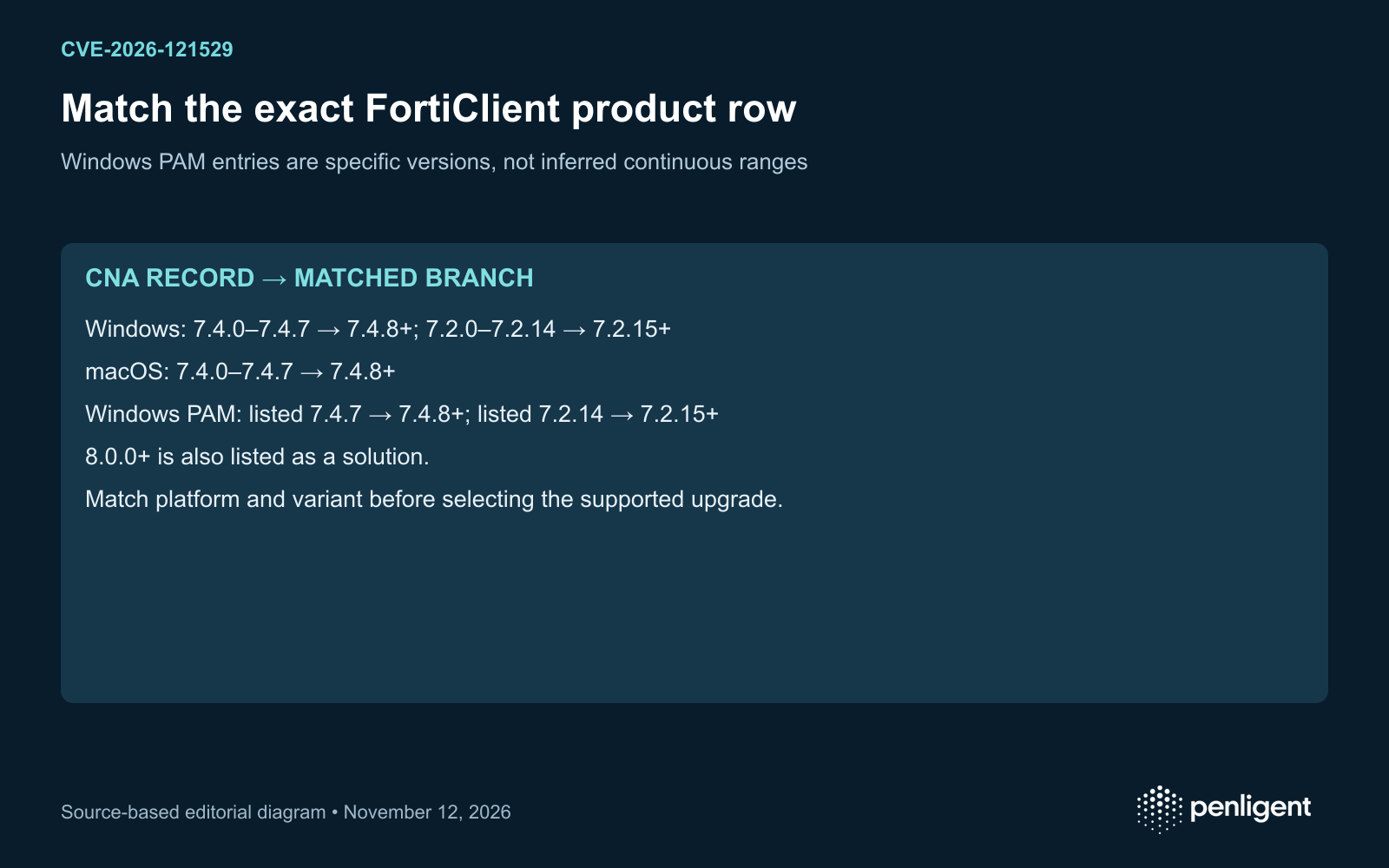
| FortiClientWindows | 7.4.0–7.4.7; 7.2.0–7.2.14 | 7.4.8+ or 7.2.15+ on the corresponding branch; 8.0.0+ is also listed. |
| FortiClientMac | 7.4.0–7.4.7 | 7.4.8+; 8.0.0+ is also listed. |
| FortiClientWindowsPAM | 7.4.7 and 7.2.14 | 7.4.8+ or 7.2.15+ on the corresponding branch; 8.0.0+ is also listed. |
These ranges and solution versions come from the CNA record updated November 12, 2026. The Windows PAM entry lists two specific releases; it does not publish the same continuous range as the standard Windows client. Preserve that distinction in inventory queries. The record does not list a macOS 7.2 affected range, so do not inherit the Windows range merely because the branch number matches.
Choose a fixed release supported by your deployment and management setup. A major-version upgrade is one listed solution path, not evidence that every environment should immediately move to 8.0. Validate compatibility through the product’s supported upgrade process.
Treat user interaction as a prerequisite, not a waiver
The record identifies victim interaction as necessary. It does not provide a verified click sequence, endpoint, command, or browser-origin bypass in the evidence reviewed here. It would be misleading to label the issue zero-click or to supply an invented exploit URL. Restricting user activity may reduce some opportunities, but the available record does not establish a complete configuration workaround.
The professional assessment is therefore bounded: identify an affected client, establish who can reach the relevant endpoint workflow, and move that client to the vendor-listed fix. A missing exploit demonstration does not clear an affected installation; a critical score does not demonstrate that a particular endpoint was compromised.
Build an endpoint record that survives handoffs
For each managed device, record device identity, operating system, exact product name or variant, installed client version, inventory timestamp, chosen fixed branch, deployment result, and post-update verification time. Keep unknown product identities and stale inventories in a separate unresolved state so that a missing version is not silently counted as a patched device.
Split Windows and macOS rollouts because their published branch coverage differs. Split Windows PAM from the standard client because its affected entry differs. Check deployment rings, contractor devices, golden images, packaged installers and devices that reconnect after being offline. Those are suggested inventory scopes, not additional products claimed to be vulnerable.
Verify installation and runtime before closing the task
An upgrade assignment shows management intent. A successful distribution job shows that a package was delivered or a task completed. Closure needs fresh endpoint evidence that the intended fixed client is installed and, where required by the supported update process, that its services or application have restarted. Validate the normal functions your organization uses after the change.
Keep three outcomes: fixed and verified, affected and awaiting remediationو unresolved because identity or current version is missing. Do not collapse the third outcome into compliance. Preserve the old and new version evidence alongside the change record so that an endpoint can be rechecked after rollback or reinstallation.
Evidence limits and the advisory reference
Fortinet’s CNA record links FG-IR-26-194. That advisory endpoint returned a server error during this review; the matrix above is sourced to the vendor-authored CVE record rather than inferred from an unavailable page. Recheck the advisory for deployment guidance and later changes before an operational rollout. The sources reviewed here do not establish in-the-wild exploitation.
The official Penligent 3.0 video below shows a general testing workflow. Keep any application assessment separate from FortiClient installation and endpoint verification. The video does not demonstrate this client vulnerability or verify a Fortinet update.
Method: AI-assisted analysis of the Fortinet-authored CVE record as retrieved November 12, 2026. No exploit, endpoint fleet, or upgrade procedure was tested.
 Arabic
 English
 German
 French
 Spanish
 Portuguese
 Japanese
 Korean
 Hindi
 Turkish
 Hebrew