
Daybreak Red Team is OpenAI’s early-access offering for testing web applications with coordinated AI agents. Its public page describes source-code and application context, validation of reported vulnerabilities, patch retesting, and scope controls using isolated environments and Guardian review. Those are the published product commitments; they are not a measurement of results on your application. The starting point is the official Daybreak Red Team product page.
A useful evaluation asks whether the service can turn an application-specific security question into evidence that an engineer can reproduce, repair, and retest. Counting candidate findings answers a different question. A team can receive many plausible reports while still lacking a reliable decision about a sensitive export, a tenant boundary, or a patch already deployed. This assessment develops a practical way to make that decision. It is a proposed evaluation method, not a hands-on benchmark of Daybreak Red Team or a claim about unpublished implementation details.
Start with the application decision, then evaluate the agent
Consider a fictional SaaS product that lets customers generate account exports. A support operator can help start a job, an account member can download an authorized result, and a background worker writes the finished archive. The business question is whether a person from one customer can obtain another customer’s export. That question is more precise than asking an agent to find vulnerabilities. It names the actor, object, prohibited outcome, and business consequence before the system begins searching.
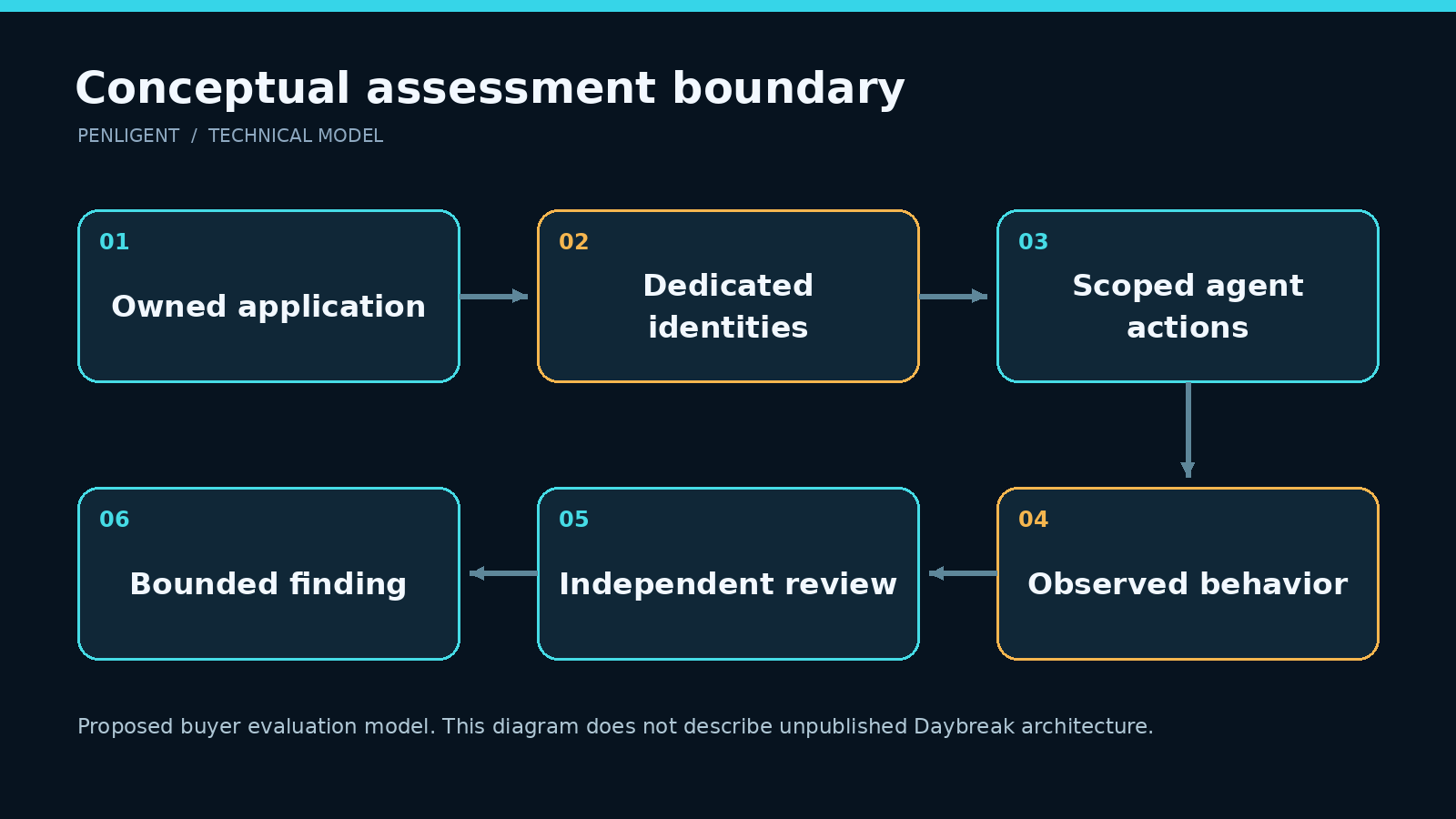
The same application may have several implementations of the export workflow: a browser route, a JSON API, a queued worker, and a temporary download link. An assessment that observes only one layer can be correct about that layer and incomplete about the workflow. The evaluation should therefore identify which interfaces the proposed engagement will examine and which remain outside it. A provider’s general description of web testing does not resolve the scope of a particular application.
Write the acceptance statement in observable terms. For example: a test account in the Cedar tenant must not retrieve an export belonging to the Harbor tenant, including after a job is queued, completed, and shared through the application’s normal interface. This is a test requirement for the fictional system. It does not assert that Daybreak supports a particular queue, sharing mechanism, or authentication integration. Those implementation questions belong in the engagement discussion.
An application owner should also define what a successful authorized action looks like. If Cedar cannot download its own export because the test identity is broken, a failed cross-tenant download proves very little. A positive control establishes that the account, fixture, and route work. A negative control establishes that the prohibited combination is rejected. The difference between those results is the security property being evaluated.
Make the intended output a decision record rather than an impressive transcript. A reviewer needs to know the application build, the identity used, the object’s ownership, the relevant request or action, and the observed result. The record should also state which alternative explanations were checked. A generated narrative that says a boundary was bypassed without identifying the boundary and the evidence cannot carry the same weight.
The application decision determines the smallest useful pilot. Start with one workflow whose owner can explain the expected permissions and whose fixtures can be reset. Expanding immediately to every subdomain, repository, role, and environment increases ambiguity before the team has learned how to review the service’s evidence. A narrow pilot can reveal whether the evaluation process works; it need not pretend to establish application-wide security.
Separate public capabilities from questions that remain open
OpenAI presents Daybreak Red Team as an early-access product, with a registration-of-interest route. Its public description says agents use application context and source code. It does not, by itself, establish your eligibility, onboarding time, supported identity provider, pricing, data-processing terms, or the exact artifacts your engagement will receive. Use the published access and capability description as the beginning of that conversation, rather than filling the gaps with assumptions.
This distinction changes how to write a comparison. An unavailable detail should remain a question, not become a zero in a feature table. A product that does not publicly list a particular export format may support it under an engagement; a product that advertises evidence may still need to show whether that evidence meets your review requirements. Fair evaluation asks the same concrete questions of every candidate and records the answers with their date and source.
| Decision | Evidence to request | What the public page does not establish |
|---|---|---|
| Can we start a pilot? | Confirmed access route and an agreed application scope | An approval date or guaranteed availability |
| Can the service test our login flow? | A documented method using dedicated identities | Support for every authentication integration |
| Can engineers verify a finding? | A sample record with reproducible observations | The exact evidence format for your engagement |
| Can a fix be retested? | A process tied to a specific patched build | A universal turnaround commitment |
| What will the assessment cost? | A scoped commercial proposal and change rules | A public per-test price |
Keep a distinction between an unanswered question and a failed requirement. An unanswered retention question calls for clarification before sharing the affected material. A failed requirement means a reviewed answer does not meet the organization’s needs. Combining both as “unsupported” makes the comparison less accurate and can hide the real reason a purchase cannot proceed.
Technical depth should also be evaluated at the engagement level. Source access can help an assessor understand object relationships, asynchronous behavior, and authorization decisions. It does not automatically prove that a suspected path is reachable in the deployed configuration. Conversely, an external observation can demonstrate a result without identifying every underlying cause. A good report preserves the difference and makes clear where additional evidence would change the conclusion.
Use an information request with a stopping condition. If the team cannot establish who will receive sensitive source material, which environment will be contacted, or how testing can be stopped, the pilot is not ready. That is an operational readiness decision, not a judgment about the model’s capability. Resolving those questions first protects the quality of the eventual technical assessment.
Make source-assisted and runtime evidence work together
A source-assisted review and a runtime test can investigate the same security property from different directions. In the export example, source review might reveal that a download handler retrieves a job by identifier and checks tenant membership only in an earlier creation route. A runtime exercise then asks whether a test identity can reach the handler under the deployed policy. Neither step should silently stand in for the other.
Record the source revision separately from the running application identity. A repository’s default branch may be ahead of the deployed service. A deployment can also include a feature flag, reverse-proxy rule, or database permission that is not visible in the reviewed file. If the report attributes an observation to a particular code path, the reviewer needs a defensible link between the two. Where that link is unavailable, state the source hypothesis and the runtime result as separate pieces of evidence.
A sensible pilot can ask for three classes of outcome. A confirmed result has a demonstrated boundary failure within the authorized setup. An unresolved lead has a concrete missing fact, such as whether a worker uses the reviewed access check. A rejected lead has an explanation supported by the relevant control or observation. These are proposed review categories for the buyer, not a claim about Daybreak’s internal labels.
Do not reward an assessor for turning every unresolved lead into a severe finding. Some leads are important precisely because they identify an unanswered architectural question. The report should tell an owner what evidence would resolve it. That may be a configuration value, a controlled account test, or a trace from a job worker. Repeating an uncertainty in more confident language does not improve the result.
Runtime observations also need a boundary. An HTTP success status does not necessarily mean that restricted data was returned. The response could be a generic application shell, a signed-in user’s own object, or an error encoded inside a successful transport status. Define a harmless fixture marker and verify the application-level outcome. The marker belongs to the evaluation dataset; real customer information is unnecessary for proving a test boundary.
إن دليل اختبار أمان الويب OWASP is a useful independent reference for organizing web assessment coverage. Its existence does not certify an agent or substitute for a scoped engagement. Use a testing reference to make coverage questions concrete, then ask the provider to explain which questions were answered and which were not.
Define scope as actions and data, not only hostnames
A hostname list is necessary for many engagements, but it is not a complete testing policy. The same application host can serve customer administration, payment actions, credential recovery, and third-party integrations. A request that stays on the approved host can still perform an excluded action. Scope should name permitted identities, data classes, business operations, and conditions for pausing, alongside the technical destination list.
For the fictional export pilot, allow the creation and retrieval of small synthetic exports owned by test tenants. Exclude production customer datasets, privileged identity changes, destructive cleanup outside the fixture namespace, and external delivery channels that have not been approved. These examples describe a buyer-designed scope. They should be adapted by the application owner rather than copied as a universal rule set.
Consider asynchronous work before granting permission to initiate it. An export request can return quickly while a worker continues consuming resources. The engagement needs a way to identify, observe, and cancel test jobs, plus an owner who can intervene. A request budget alone may not limit downstream work if one request fans out into many tasks. The pilot should measure the business operation that creates the cost or side effect.
Define the meaning of a stop request. Does stopping the assessment end only new agent actions, or also cancel queued application jobs? Who revokes test credentials? Which evidence must be retained to explain why the stop happened? These are interface and operating-model questions. They should be answered using the actual service and application behavior, not inferred from a generic promise of isolation.
Keep a clear escalation path for an unexpected result. If a test response contains data that appears outside the fixture set, the operator should know whom to notify and how to preserve only the evidence needed for investigation. The test should not continue collecting unrelated records to strengthen a screenshot. One bounded observation, reviewed promptly, may be sufficient to establish that a boundary needs attention.
Authorization should be revisited when the environment changes. A staging hostname may be repointed to a different service, a test tenant may inherit a privileged integration, or a background queue may begin processing production-like data. The scope record should identify assumptions that would invalidate the current approval. This makes continued testing a controlled decision instead of an automatic extension of yesterday’s permissions.
Build identities and fixtures that expose permission mistakes
Use a small identity matrix that reflects the application’s actual policy. The export example needs at least an authorized Cedar member and a Harbor member who should be denied access to Cedar’s records. If support operators have a distinct permission set, add one as a separate role rather than making every test account an administrator. Otherwise the pilot can accidentally remove the very distinction it is meant to evaluate.
Assign every fixture an owner, a tenant, an expected visibility, and a safe marker. A record name alone is not enough because names can be duplicated or changed. The application owner should be able to map the test object’s stable identifier to its intended policy. That mapping supports both the first finding review and the later retest, when a job may have been regenerated with a different identifier.
Prepare lifecycle states deliberately. A newly created export, a completed export, an expired link, and a revoked share can have different access paths. Testing each state is useful when it corresponds to a real application transition. Generating many random objects without knowing their expected state makes a larger dataset but a weaker permission test.
A fixture reset procedure should preserve the evidence relationship. If the team deletes and recreates every account after the first run, record which new identities replace the originals and whether their permissions are equivalent. Retesting against a fresh account with broader rights can make an unfixed issue appear resolved. Retesting against a disabled account can produce the same misleading impression for the opposite reason.
Separate credential problems from application denials. An expired session, an uncompleted verification step, or an incorrectly selected organization can prevent the authorized control from working. Diagnose those conditions before interpreting the negative case. A provider should be able to explain whether a result means the application enforced its policy or whether the assessment could not establish a valid session.
Data volume should follow the proof requirement. A single synthetic record with a unique marker can establish that one identity crossed a boundary. Additional records are justified when they answer a different question, such as whether a filter applies consistently across a collection. They should not be collected merely to make the finding seem larger. Keep the demonstration proportionate to the application decision.
Require an evidence record an engineer can challenge
A finding should expose its reasoning to review. Begin with a concise statement of the policy that should hold and the observation that contradicts it. Then attach the minimum request, response, fixture, and identity information needed to verify the contradiction. If the report relies on source reasoning, identify the revision and the relevant path. If it relies on a deployed observation, identify the build or explain why that identity is uncertain.
The reviewer should be able to ask how the result could be wrong. Was the test account legitimately entitled to the object through a group membership? Did a stale browser session select the wrong tenant? Was the response a cached result from an earlier authorized request? Did the fixture have a visibility flag different from the owner’s expectation? These questions strengthen a confirmed result by testing alternative explanations.
Capture enough timing information to distinguish events without turning the report into a dump of all application logs. For an asynchronous job, the creation action, worker completion, and download may happen at different times. A correlation identifier or stable job reference can join them. Where clocks differ, retain the original timestamps and explain the normalization used during review.
A useful record can include a compact structured section, such as the example below. Its fields are proposed for the fictional pilot; they do not describe a promised Daybreak export schema. Values are intentionally synthetic.
{
  "case_id": "EXPORT-TENANT-01",
  "environment": "owned-staging",
  "application_revision": "reviewed-build-id",
  "actor": "harbor-member-test",
  "object": "cedar-export-fixture",
  "expected": "deny without disclosing fixture content",
  "observed": "fixture marker returned",
  "control": "cedar-member can download its own fixture",
  "status": "requires application-owner review"
}
The structured record should point to the supporting evidence rather than embed unnecessary secrets. Redacted artifacts can remain useful when the redaction preserves the identifiers, relationships, and outcomes needed to reproduce the result. Reviewers should be told what was removed and why. A screenshot with every meaningful field blurred may satisfy a privacy preference while failing to support the technical claim.
Disagreement should result in a testable question. If an owner says the Harbor account is allowed to access the export through a delegated support relationship, ask for the policy and the specific relationship record. If that evidence confirms legitimate access, revise or reject the finding. If it does not, preserve the remaining uncertainty. The purpose of the review is to establish what happened, not to defend the original wording at all costs.
Retain rejected findings when they reveal a useful control or a recurring assessment mistake. They can help future reviewers recognize an application’s intended delegation model. However, rejected candidates should not be counted with confirmed failures in a headline metric. The evaluation needs separate counts and an explanation of what each category means.
A local example that separates a finding from a claim
The following toy program models an export lookup with two synthetic tenants. It does not call Daybreak, run a web server, contact a real application, or reproduce a product vulnerability. Its purpose is to demonstrate why a permission result needs a positive control, a negative control, and a known security rule. All data exists inside the program.
EXPORTS = {
    "sample-export": {"tenant": "cedar", "marker": "SYNTHETIC-ONLY"}
}

def lookup_before(actor, export_id):
    return EXPORTS[export_id]["marker"]

def lookup_after(actor, export_id):
    record = EXPORTS[export_id]
    if actor["tenant"] != record["tenant"]:
        raise PermissionError("tenant mismatch")
    if "export:read" not in actor["permissions"]:
        raise PermissionError("missing permission")
    return record["marker"]

cases = [
    ("owner", {"tenant": "cedar", "permissions": {"export:read"}}, True),
    ("other-tenant", {"tenant": "harbor", "permissions": {"export:read"}}, False),
    ("no-read-role", {"tenant": "cedar", "permissions": set()}, False),
]

for name, actor, expected_allow in cases:
    try:
        value = lookup_after(actor, "sample-export")
        observed_allow = value == "SYNTHETIC-ONLY"
    except PermissionError:
        observed_allow = False
    assert observed_allow == expected_allow, name
    print(name, "allow" if observed_allow else "deny")
The deliberately incomplete function returns an object solely because the identifier exists. The corrected function applies both tenant and operation checks. In a real application, the policy may include delegated access, object state, or administrator exceptions. The point is not that this tiny function is a universal authorization design. The point is that the expected policy must be explicit enough for a reviewer to tell which result is correct.
Run the same fixture against the before and after versions when demonstrating the example. The authorized owner should keep working after the change, while the two prohibited combinations should be denied. If every request fails after the repair, the test has shown an availability change rather than a complete security fix. If the wrong tenant is denied but an unprivileged member of the correct tenant still succeeds, the repair has closed only part of the intended boundary.
This small matrix also explains why a compelling exploit narrative is not sufficient evidence. A tester can describe a missing tenant check accurately and still use the wrong identity in the demonstration. The matrix forces the relationship between actor, object, and expected result into the record. That relationship remains useful regardless of whether the testing work is performed by an agent, a developer, or an external assessor.
Interpret three export results that look similar at first
Suppose the fictional pilot produces a screenshot showing the Harbor test identity opening a page named after a Cedar export. That is a useful lead, but the screenshot does not yet establish disclosure. The page may be a generic job-status view that exposes no protected fields. It may display the caller’s own cached export under a reused title. Or it may contain the Cedar fixture marker. Each explanation leads to a different conclusion, even though the browser address and page heading look similar.
Start by deciding which application property is under review. If job existence is itself confidential, revealing the Cedar job’s name or state may matter even without the archive. If only archive contents are restricted, the status page requires a narrower analysis. The assessor should not choose the most severe interpretation by assuming every field has the same confidentiality requirement. The owner’s policy and the fixture design should make the distinction explicit.
For a content-disclosure claim, compare the result with a unique synthetic marker stored only in the Cedar fixture. Use a different marker for the Harbor fixture. Confirm that a legitimate Cedar request receives the Cedar marker and that the prohibited Harbor combination produces the unexpected result. This small design prevents a common ambiguity: mistaking an application’s generic success page or the wrong cached object for the intended protected record.
Now consider a second result: Harbor is denied when requesting the completed archive directly, but an application notification later supplies a usable link. The direct-route result is still valuable; it shows that one path enforced the tested rule. It does not close the notification path. The assessment should identify how the link was created, which fixture it references, and which actor was entitled to receive it. The report can then describe a distinct delivery-boundary question without claiming that every direct object check failed.
A third result involves the job worker. Cedar creates an export and then an authorized owner revokes the requesting member before the job finishes. The worker completes the job and a link is delivered to the revoked identity. Whether that is a defect depends on the product’s intended revocation semantics. Some products deliberately authorize a bounded job at submission; others require the actor to remain authorized when the result is delivered. The pilot should obtain that decision before scoring the observation.
These examples show why application context is more than a repository attachment. Reviewers need to understand what the product promises about metadata, delivery, and permission changes over time. An agent can help investigate those transitions, but the business rule still needs an accountable owner. A finding becomes stronger when the rule, the test, and the observed exception are joined in one record.
The same reasoning applies to a clean result. If every prohibited combination was denied in the direct download handler, report that property accurately. Do not convert it into a statement about email delivery, delegated links, or queued work that was never examined. Conversely, do not dismiss the direct-route evidence because the broader workflow has an open question. Good assessment records allow a team to hold a verified result and an unresolved dependency at the same time.
Evaluate delegation and revocation without flattening the policy
A realistic SaaS policy may allow a support operator to access an export through a customer-approved delegation. A simple “different tenant must always be denied” rule would classify that intended behavior incorrectly. Before the pilot, model the delegation as a separate relationship with its own grantor, recipient, object scope, permitted operation, and expiration. That relationship should be distinguishable from an operator’s ordinary account role.
Prepare paired fixtures that differ in one meaningful property. One support identity can have a valid delegation to a synthetic Cedar object, while another has no grant. Alternatively, use the same identity before and after a controlled revocation, keeping the object constant. The goal is to expose which relationship the application actually checks. Changing several roles, memberships, and objects at once makes the result harder to interpret.
Document the time at which a permission decision is intended to apply. A short-lived link may be an independently authorized capability, or it may be expected to recheck the recipient’s current account state. A background operation may evaluate permission at submission, execution, or delivery. These are design choices with different consequences. The assessment should test the chosen contract rather than impose one universal rule on every application.
Revocation tests need an observation plan. Record the grant or membership change, the time it becomes effective according to the application, and the subsequent controlled action. If the application documents a bounded propagation interval, the test should respect and measure that interval. If no such behavior is defined, the unresolved question belongs with the product owner. A tester should not invent an acceptable delay after seeing an inconvenient result.
Consider the effect of session and cache state. A browser may keep a selected organization, a worker may retain a serialized identity, and a service may cache an authorization decision. The pilot need not inspect every internal cache to be useful, but it should identify which states could explain the observed behavior. A fresh-session control and a deliberately retained-session control can answer different questions when the application owner has approved both.
The repair may therefore require more than adding a comparison to one endpoint. An application can need a clear delegation record, a consistent permission helper, an invalidation path, and tests that cover the chosen decision time. The assessor’s contribution is to connect the observed exception to the policy and the relevant execution path. The engineering team then decides how to implement that policy while preserving intended support workflows.
Include these cases in the purchasing evaluation only when they reflect the application’s real needs. A small internal application without delegation should not be burdened with a fictional enterprise permission model merely to make the pilot look sophisticated. Depth comes from investigating the boundaries that exist, not from multiplying abstract scenarios. The right evaluation is the one that can resolve a consequential question in the buyer’s actual application.
Validate a patch against the original security property
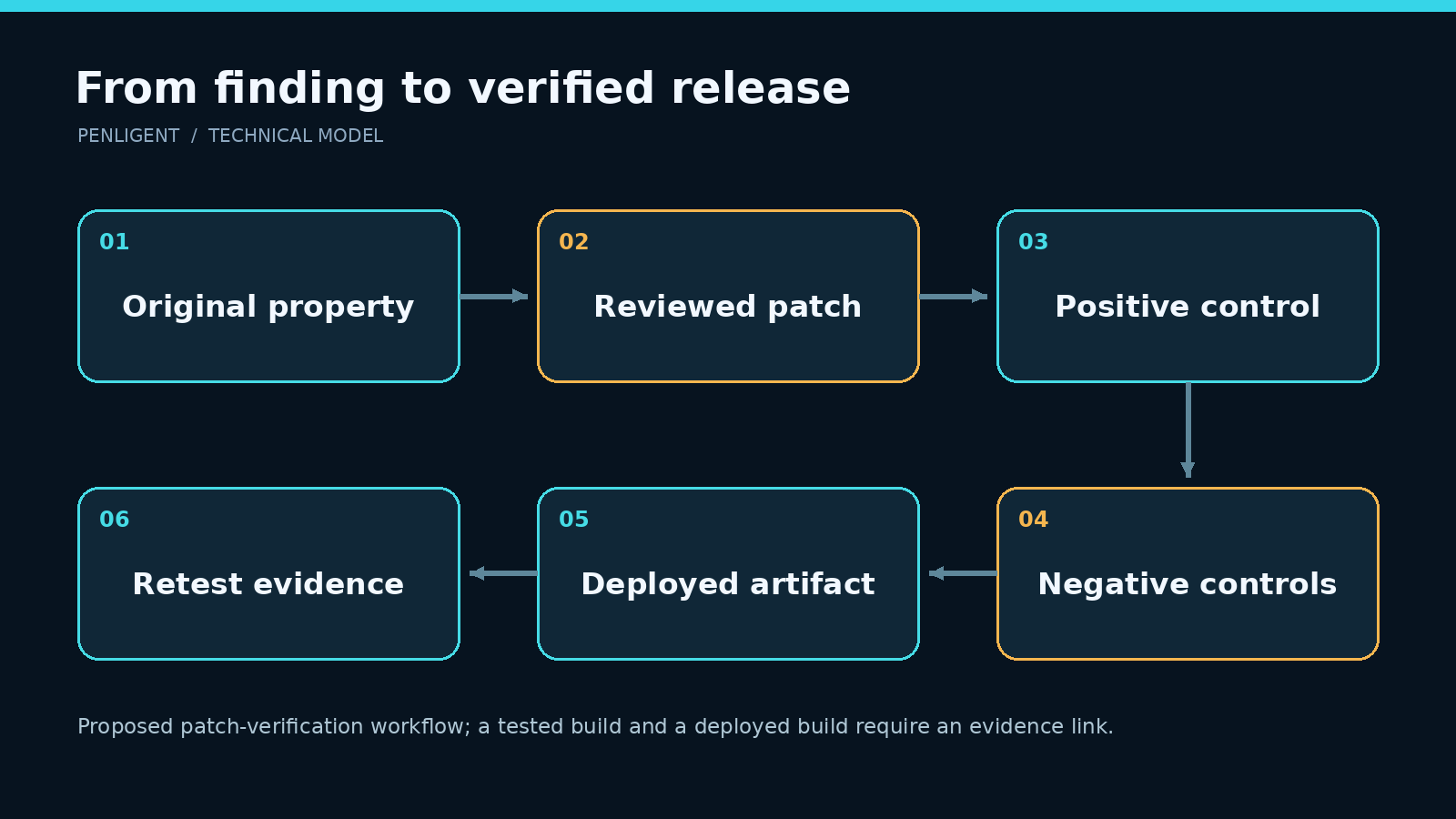
A proposed patch is a change to the application, not a conclusion about the finding. The reviewer should be able to trace which part of the original failure the change addresses. In the toy example, tenant comparison and permission checking address different policy dimensions. In the fictional SaaS, the real patch might need to apply the same rule in a download handler and a worker rather than only at job creation.
Start the repair review from the original evidence record. Keep the fixture relationship, the actor’s intended rights, and the prohibited outcome stable while changing the relevant build. A retest that quietly switches to a different object or route can miss the original problem. When a changed identifier is unavoidable, document why the new fixture is equivalent and retain the mapping.
Review the patch’s full change surface. A new authorization helper may be sound while one caller forgets to use it. A route-level check may protect a browser action while a background task accepts an already serialized object without revalidation. A test that focuses only on the edited line can miss those integration gaps. The application owner should identify every place that relies on the repaired security assumption.
Use negative controls to challenge the regression tests themselves. For the toy program, temporarily selecting the intentionally incomplete lookup should cause the prohibited cases to fail their assertions. This demonstrates that the tests are capable of detecting the modeled failure. It does not prove that a production test suite covers every authorization path, but it provides a useful check against tests that pass regardless of the implementation.
Preserve normal application behavior as part of acceptance. An export fix should not accidentally give every member administrator rights, disable all sharing, or prevent legitimate owners from retrieving their results unless that change is an explicit product decision. Security and functional acceptance should be recorded separately so the team can see whether a deployment satisfies both.
OpenAI describes Daybreak Defense Factory as a separate offering for investigating findings and preparing patches that engineers review and test. That public description supports discussing a finding-to-fix workflow, but it does not remove the buyer’s responsibility to define review and release gates. Consult the official Defense Factory description for the product distinction.
Bind the retest to the artifact that actually serves users
A passing retest against a developer’s branch does not establish that the corrected application is running everywhere it should. Track the relationship from reviewed source to built artifact to deployed instance. The exact identifiers depend on the environment: a commit, image digest, package revision, release number, or provider deployment record may each contribute part of the chain. Record their roles rather than treating them as interchangeable.
For a multi-instance service, identify which instances can receive the affected action. A load balancer may send the browser route to updated workers while an old task consumer still processes export requests. A standby region may not receive ordinary traffic during the retest but become active during an unrelated failure. The acceptance record should describe the deployed population, including exceptions that were not tested.
A practical rollout can begin with a controlled instance or staging environment whose dependencies are understood. Once the security and functional checks pass, the release owner can apply the organization’s normal rollout process. The assessment should not invent an emergency deployment policy merely because an agent produced a finding quickly. Release decisions still need an owner who understands application availability and rollback consequences.
Rollback deserves an explicit security condition. If the previous artifact contains the demonstrated failure, restoring it also restores that security state unless a separately verified control blocks the path. A rollback plan should therefore state what containment remains in effect and how the finding is reopened. Treating rollback as an availability-only operation can quietly invalidate the retest record.
Use a closure statement with a bounded claim: the tested build enforced the named property for the documented identities, objects, states, and interfaces at the recorded time. Add the deployment evidence that connects that build to the intended serving population. This is more useful than a general declaration that the application is secure, because it tells the next reviewer exactly what can be relied on.
Structure a pilot around reviewable work
Prepare the pilot as a small engineering project with an application owner, a security reviewer, and an operational contact. One person may fill several roles in a small company, but the decisions should remain distinct. The application owner explains intended behavior, the security reviewer challenges findings, and the operational contact can stop or recover the environment when a test behaves unexpectedly.
The first milestone is readiness. The team confirms the access route, the application and source versions, the fixture set, permitted operations, and the evidence format. It also verifies that the authorized control works. Starting the assessment before those conditions are met shifts avoidable setup problems into the result set and makes it harder to tell whether the service or the application caused a failure.
The next milestone is evidence review. Select a small number of completed results and ask an engineer who did not prepare the fixtures to understand them. The reviewer should be able to identify the security property, the observed behavior, and the next action without reconstructing an entire conversation. If that review fails, improve the evidence format before expanding the scope.
The repair milestone tests the interaction between the report and the engineering workflow. Can an owner locate the affected path, propose a correction, and request a retest against a specific build? Are rejected or unresolved findings handled cleanly? A service can be technically capable of finding issues while still creating friction at this handoff. The pilot should expose that friction while the scope is small.
The final milestone is a purchasing decision tied to the original need. Record what the pilot demonstrated, what remained untested, what setup work was required, and which operational questions are unresolved. A decision to expand can then name the additional applications or workflows and the controls that must scale with them. A decision to stop can state a concrete unmet requirement instead of relying on a vague impression.
Compare assessment approaches on equal questions
A buyer may be considering a source-assisted service, a self-directed runtime testing platform, a manual engagement, or a combination. Compare them against the same application task. Giving one candidate source code and administrator accounts while another receives only a public hostname does not produce a meaningful capability comparison. If those access differences reflect the actual buying situation, state them as conditions rather than concealing them in a score.
| Evaluation dimension | Question for every candidate | Useful pilot artifact |
|---|---|---|
| المتطلبات الأساسية | What code, context, identities, and environment access are required? | A reviewed setup record |
| Coverage | Which interfaces and policy states were examined? | A scoped coverage ledger |
| Finding quality | Can a different engineer challenge and reproduce the result? | A bounded evidence record |
| المعالجة | How is a proposed fix tied to the original property? | A patch and regression matrix |
| Operations | How are test actions stopped, reset, and audited? | A demonstrated control procedure |
| Commercial fit | What is included, and what changes the price or scope? | A dated scoped proposal |
A self-directed platform such as Penligent can be evaluated using the same owned application, test identities, and evidence requirements. The comparison should be based on the workflow actually demonstrated in the pilot. This article does not claim that one provider found more vulnerabilities, ran faster, or cost less than another, and it does not present an unperformed benchmark as a review result.
Distinguish the person operating the assessment from the person interpreting its output. A platform that allows a developer to initiate a test can still require security expertise to evaluate impact. A managed engagement can reduce operating effort while introducing onboarding and review coordination. Those tradeoffs matter to a small engineering team differently than to a large organization with a dedicated application security group.
Avoid using a single feature count as the purchasing rule. A long integration list is useful only if the required integration works under the organization’s access policy. A report export matters only if the receiving team can use it. A retest feature matters only if it can be tied to the corrected artifact and the original property. The pilot should convert each important feature claim into a specific acceptance question.
Measure effort without inventing a vulnerability scorecard
Record the work required to produce a decision: setup time, operator attention, reviewer time, engineering clarification, fixture repair, and retesting effort. These observations can explain whether the service fits the team even when the finding count is small. They should be measured during the actual pilot rather than copied from a vendor’s general demonstration.
Keep the denominator visible. “Five confirmed issues” means little without knowing the tested scope and the review standard. An assessment of one export workflow cannot be compared directly with an assessment of the entire application. Likewise, a low false-positive count may simply reflect a small or heavily filtered result set. Preserve scope, confidence categories, and review effort alongside the count.
Do not manufacture a dollar cost per vulnerability from an early-access product whose engagement price is unknown. Ask for a proposal that defines the application population, expected testing cadence, included retests, and the treatment of scope changes. The relevant comparison may be the cost of maintaining a continuous assessment process rather than the cost of one run.
Application-side costs need their own record. Test jobs can consume storage, queue capacity, external API usage, or engineering attention. A sensible fixture design makes those costs observable and bounded. If a pilot cannot distinguish test work from normal application traffic, the team will struggle to plan a broader rollout, regardless of the provider’s billing model.
Use the findings to decide where additional testing would be valuable. A clean result for a narrow fixture set should not end the conversation about other roles, routes, or lifecycle states. At the same time, an unresolved question should not automatically justify an unlimited assessment. State the next question and the evidence needed to answer it, then size the additional work around that question.
Review data handling as part of technical readiness
Source-assisted testing can require information that an organization treats as sensitive. Before providing it, identify the repository scope, application configuration, fixture data, and credentials that the engagement actually needs. A complete copy of every internal repository is not automatically a better input than a carefully scoped application package. The owner should understand what each item contributes to the test.
Ask for the actual data-processing terms that apply to the selected product and workspace. A general statement about another product, plan, or model endpoint may not answer the question. Relevant topics can include access by operators, retention, regional processing, deletion, and the treatment of logs and evidence. This article does not assert particular Daybreak terms that are not established by the public product page.
Use dedicated test identities whose privileges can be revoked independently. Their credentials should be delivered through the agreed secure mechanism and should not be embedded in public reports, issue titles, or copied screenshots. Where the application permits it, limit the identities to the fixture tenant and the operations required by the engagement. The application owner remains responsible for confirming that the restrictions are effective.
Evidence handling needs the same care as input handling. A response containing a synthetic marker is usually easier to share for review than a response containing real customer records. If an unexpected observation includes sensitive information, follow the agreed handling process and retain only what is necessary to establish the event. The technical record should explain the evidence boundary without reproducing unnecessary data.
At the end of the pilot, reconcile the access that was granted. Revoke or rotate test credentials as appropriate, remove temporary integrations, retire fixture data according to the owner’s process, and document any access deliberately retained for ongoing work. A pilot that quietly becomes a permanent integration has changed its operating assumptions and should be reviewed as such.
Make repeated assessments respond to application changes
A recurring assessment should be driven by what changed in the application. A new export destination, an altered support role, a different background worker, or a revised sharing policy can invalidate an earlier permission result. Keep the security property and fixture design attached to those changes so that a later run can test the relevant boundary instead of merely repeating an old action sequence.
Stable test identifiers help compare runs, but the evidence must remain current. A record from an earlier build can inform a new investigation without proving the current behavior. Mark which controls were rerun and which conclusions were carried forward only as context. This prevents an accumulating report from giving the impression that every historical test was repeated on every release.
Changes to the assessment itself also matter. A different test identity, source scope, tool configuration, or provider workflow can affect what is observable. Record those changes alongside application changes. Otherwise a rise or fall in findings may be interpreted as an application security trend when it partly reflects a different assessment method.
Define a small set of regression properties that deserve continuity. For the fictional export service, these might include tenant ownership, operation permission, expired share rejection, and correct behavior after job completion. Each property should have a clear owner and an executable or reviewable check. A long list of loosely named tests is less useful if no one can explain which business rule each protects.
Do not let scheduled execution replace human review of consequential changes. An assessment may surface a legitimate product exception that the old fixture did not represent, or a new dependency that changes the permitted scope. The operating model should allow the team to revise the test and the policy deliberately. Automation makes repetition easier; it does not decide whether the intended rule is still correct.
Recognize results that need a different next action
Some pilot outcomes point to an application correction, some to an assessment setup problem, and some to an unresolved architecture question. A useful review distinguishes them. If the authorized control fails because the test account cannot sign in, repair the setup. If a prohibited identity obtains the fixture marker under a verified policy, investigate the boundary. If the worker’s source revision is unknown, obtain deployment evidence before attributing the behavior to a particular patch.
A transient application error should not become a denial-of-service finding merely because it occurred during a test. Record the action, the observed failure, and the available correlation evidence. Determine whether the behavior is reproducible within the authorized scope and whether ordinary application behavior could explain it. Where production stability could be affected, the owner should decide how to continue in a controlled environment.
Similarly, a rejected candidate should not disappear without an explanation when it consumed significant review effort. The reason may identify an important control: a server-side permission check, an object visibility rule, or an operational restriction. Keeping that reason makes the assessment easier to audit and helps the team decide whether a future change should trigger a retest.
An incident concern calls for a different process than a normal patch task. Evidence of unexpected access, unexplained configuration changes, or suspicious activity outside the fixture set should be handed to the organization’s response owner. A penetration testing report is not automatically an incident investigation, and a successful retest does not establish that earlier access left no consequences.
The best next action is the one that resolves the actual uncertainty. That can be a small code change, a single controlled observation, a supplier clarification, or a broader response effort. The pilot’s value lies partly in making those choices legible. A service that produces evidence the team can act on may be useful even when the result is a well-supported rejection rather than a dramatic vulnerability.
Keep report revisions attached to the original decision
When a finding changes after review, preserve the original case identifier and explain the revision. The update may narrow the affected role, replace an incorrect object relationship, or change a suspected failure into an intended delegation. A new report should not silently erase the reason the earlier result was challenged. A short revision entry can identify the changed claim, the new evidence, the reviewer, and the consequence for remediation. This makes the record useful to an engineer who encounters only the final version and needs to understand why a previously urgent task was changed or closed.
Questions to answer before choosing Daybreak Red Team
Is Daybreak Red Team the same as running a security prompt in a chatbot?
- The public product page describes a dedicated early-access web application testing offering. Its exact engagement setup should be confirmed through the published access route.
- Evaluate the actual assessment workflow and artifacts. A generic conversation with a model does not establish that the named product was used.
Does source access prove that a suspected issue is exploitable?
- No. Source reasoning can identify a candidate path, while deployment conditions and reachable behavior determine whether that path exists in the tested environment.
- Require the report to distinguish a source hypothesis, a confirmed observation, and a fact that still needs validation.
What should a first pilot test?
- Choose a bounded owned workflow with known permissions, synthetic fixtures, dedicated identities, and an owner who can reset the environment.
- Include an authorized control and prohibited identity-object combinations. Expand only after the team can review the resulting evidence.
How should a team evaluate pricing and availability?
- Request a dated scoped proposal through the official route. The public page’s early-access description does not establish a universal price or onboarding time.
- Include setup, review, retest, scope changes, and application-side operating costs in the decision.
What evidence should a patch retest preserve?
- Keep the original security property, equivalent test identities and fixtures, the corrected build identity, and the positive and negative results.
- Add deployment evidence before treating the tested result as the state of the intended serving population.
Can a buyer compare Daybreak with a self-directed testing platform?
- Yes, when the comparison states the access conditions and asks the same concrete questions about scope, evidence, operations, repair, and cost.
- Use observed pilot results. Do not infer performance or coverage from product names or unperformed demonstrations.
Does a passing assessment certify that the entire application is secure?
- A passing result supports the named properties within the documented scope and conditions.
- Keep untested interfaces, unavailable evidence, and changed application assumptions visible in the final decision record.
The decision to adopt an AI pentesting service should rest on an engineering result the team can defend. Start with an application boundary that matters, prepare the identities and fixtures needed to test it, and ask for evidence that survives an independent review. Tie any repair to the original property and to the artifact that actually runs. That process gives Daybreak Red Team, or any other assessment approach, a concrete opportunity to demonstrate value without requiring the buyer to substitute confidence for proof.
 Arabic
 English
 German
 French
 Spanish
 Portuguese
 Japanese
 Korean
 Hindi
 Turkish
 Hebrew