
CVE-2026-97045 affects the Render path in golang.org/x/net/html before v0.62.0. Update the golang.org/x/net module to v0.62.0 or a later compatible release, rebuild the applications that contain it, and verify any workflow that converts untrusted markup into browser-facing HTML. The issue concerns namespace-sensitive serialization and potential cross-site scripting, not an established remote-code-execution vulnerability in the Go server.
As of October 28, 2026, the official Go vulnerability record GO-2026-6866 identifies the affected package, the Render symbol, and the fixed module version. A dependency alert is a reason to investigate, but it is not enough to conclude that every application importing golang.org/x/net is exploitable. The useful investigation follows the selected dependency into the built artifact, then follows untrusted data through rendering into its final browser context.
The decision security teams need to make first
There are two related decisions: whether the dependency needs updating and whether an exposed feature needs immediate containment. The update decision is straightforward when an affected module version is selected. The containment decision depends on what the application does with HTML. A public content preview that accepts arbitrary markup and displays it under an authenticated application origin deserves closer attention than a command-line utility that converts a fixed internal document into a local text file.
Keep those decisions separate in the incident ticket. Otherwise, teams tend to overstate a scanner finding as a confirmed application exploit or dismiss a real dependency problem because no exploit was reproduced during a short test. Neither outcome is useful. Record the version finding, the observed call path, the trust boundary, the consumer of the output, and the controls that apply to that consumer. This creates a defensible risk assessment even when the upstream report contains limited exploitation detail.
The immediate owner should be someone who can connect application behavior with release evidence. A source code maintainer can explain why Render is called, while a release engineer can establish which version entered the production artifact. A browser security specialist can determine whether a transformation actually changes the executable document. These are complementary responsibilities; none can be replaced by copying a severity label into a dashboard.
| Decision point | What to establish | Useful next step |
|---|---|---|
| Dependency exposure | The selected golang.org/x/net version and any replacement | Plan an upgrade to v0.62.0 or a later compatible fixed release |
| Code reachability | Whether the shipped command reaches html.Render | Inspect the call path and its wrapper functions |
| Security reachability | Whether untrusted document data reaches browser-facing output | Review the input owner, rendering context, and viewer privileges |
| Remediation completeness | Whether the patched build is actually deployed | Match build metadata and release digests to running instances |
Confirmed scope and disclosure timing
The CVE Project record is marked PUBLISHED, names Go as the assigning CNA, and gives October 27, 2026 as its UTC publication date. It classifies the issue under CWE-79. The affected component is not the entire Go language, compiler, or standard library. It is the separately versioned x/net module’s HTML package. Updating a Go toolchain without changing the selected module does not establish that this particular fix is present.
The vulnerable version boundary and the exported symbol are also represented in the Go vulnerability database’s OSV record. That record identifies the module range ending at the fixed version 0.62.0 and the HTML rendering path. Use the CVE description for human review and the structured Go record for tooling. Do not substitute an unavailable secondary database entry for the maintainer’s explicit fixed-version information.
The primary sources reviewed here do not establish an active exploitation campaign or an application-independent RCE chain. That is a limit of the evidence, not a statement that exploitation is impossible. A local test can establish behavior for one application and one build; it cannot establish the absence of exploitation across the ecosystem. When communicating with leadership, distinguish a confirmed dependency issue from a confirmed malicious incident and from a theoretical downstream consequence.
What the namespace defect changes
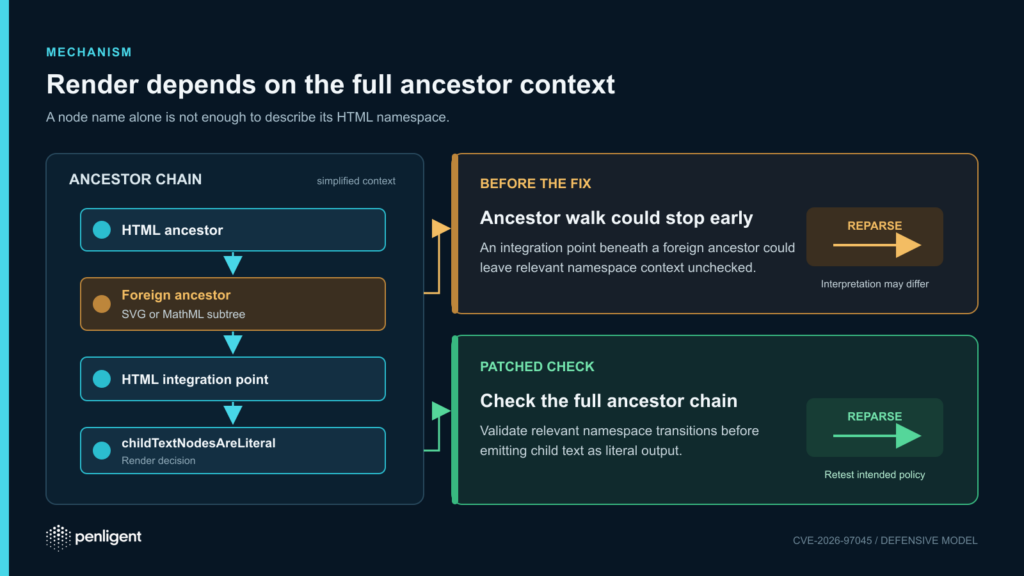
The official description centers on childTextNodesAreLiteral, an internal decision used during rendering. Its ancestor walk could stop after finding an HTML integration point beneath a foreign ancestor. That integration point could itself sit inside a subtree whose namespace had been affected by foster parenting. Re-parsing the rendered output could therefore resolve the subtree differently. The correction examines the full ancestor chain and checks the relevant transitions before emitting literal text, as described by the Go vulnerability record.
The practical lesson is not to memorize a list of suspicious tags. It is to recognize that a tree carries context that a string does not. A node’s interpretation depends on its ancestors and namespace, not merely its displayed name. A serializer has to emit bytes that remain consistent with the intended interpretation when the next parser reconstructs a document. Security checks that examine one tree and then assume the serialized form preserves every relevant property can miss an important boundary.
Consider a defensive review of a document transformation service. A user supplies markup, the service parses it, an application policy edits the tree, and the service serializes the result for viewing. The policy might inspect element names and remove unwanted attributes. If rendering changes how a later parser reconstructs the tree, the policy decision and the viewer’s interpretation no longer necessarily describe the same document. The review must therefore include the post-serialization result, not only the inspected input.
This is an explanatory model of the risk, not a claim that every sanitizer using this package is bypassed. To make that claim about a specific product, a tester must identify the sanitizer, its configuration, the relevant transformation, the rendering context, and a demonstrated policy violation. The CVE establishes a defect in the library. An application finding requires additional evidence about the application.
HTML, SVG, MathML, and integration points
The WHATWG HTML parsing algorithm defines how the parser handles foreign content and integration points. HTML documents can contain SVG and MathML subtrees, and selected elements allow processing to switch back toward HTML rules. These transitions are structural. A string search for svg or math cannot reconstruct the parser state, and a generic XML assumption does not describe the HTML parsing algorithm.
For a security review, track three representations separately: source markup, the intermediate tree, and the final consumer’s document. A change between representations is not automatically a vulnerability. Parsers can normalize documents, add implied containers, or repair malformed input. The security question is whether the change violates a defined policy, such as allowing text to become an element, allowing an unexpected namespace, or creating an unapproved URL-bearing attribute.
Define the policy before designing the test. If a product permits only paragraphs and links, the intended invariant is different from that of a scientific editor that intentionally supports MathML. A blanket removal of foreign content might be acceptable for one application and a functional outage for another. An effective patch review should preserve legitimate functionality while demonstrating that serialization does not reopen a prohibited interpretation.
The Render API documentation explicitly describes a best-effort round trip rather than an unconditional exact clone of every tree. That caveat matters when building tests. Do not assert that every structural difference is proof of CVE-2026-97045, and do not assume that a successfully parsed document is automatically safe. Use application-specific security invariants and inspect meaningful changes instead of treating byte identity as the only success condition.
Synthetic sample findings, not a certification or audit-acceptance guarantee. Sign in or register to download.
XSS risk is not the same as server-side RCE
In this context, rendering means writing an in-memory node tree into an output representation. The Go process does not thereby execute JavaScript. A browser or another active document consumer may later interpret the output. That distinction determines the relevant privileges, evidence, and mitigation. A browser-side finding should describe the viewing origin and user role; a server-side code-execution finding would require a different execution boundary and evidence that the reviewed sources do not provide.
The OWASP XSS Prevention Cheat Sheet distinguishes output encoding, HTML sanitization, safe sinks, and unsafe handling patterns. For this issue, the applied lesson is to inspect where serialized content enters a document, rather than considering a sanitizer call a universal safety guarantee. The final context may be a page response, an HTML fragment, a preview iframe, or a later client-side insertion.
An illustrative risk scenario is a low-privilege account submitting a document that a privileged reviewer opens. The potential business impact depends on what the reviewer can do and what controls apply to the preview. This scenario is not a disclosed incident associated with this CVE. It is a way to prioritize a review: the privilege difference between author and viewer can matter more than whether both users are authenticated.
Another illustrative scenario is a tenant-controlled report embedded in a shared administrative application. The question is not simply whether the report author can edit HTML. It is whether the service promises to restrict the resulting document and whether a viewer receives it under a more powerful origin. A harmless standalone export and a same-origin administrative preview should not receive identical impact descriptions just because they share the same rendering package.
Avoid unsupported severity shortcuts. There is no basis here for claiming that all Go web servers are affected, that every SVG document triggers the issue, or that a specific victim action is unnecessary. Describe the verified module problem first, then the application conditions that increase or reduce exposure. Where those conditions remain unknown, state that they are under investigation instead of filling the gap with a dramatic consequence.
Find the dependency in the build you actually ship
Start in the module root that builds the relevant command. These read-only checks establish the module environment, selected dependency, and reason for inclusion. Run them in an owned checkout with the same workspace settings used by the release process.
go env GOMOD GOWORK GOFLAGS
go list -m -json golang.org/x/net
go mod why -m golang.org/x/net
go mod graph
rg -n 'golang.org/x/net/html|html\.Render' --glob '*.go' .
The Go Modules Reference explains module requirements, build lists, replacement directives, and workspaces. A requirement written in one go.mod file is not always the whole answer. Capture the selected version and replacement information in the environment used for the intended command. If a local replacement is active, the public version label may not describe the source that will be compiled.
Use the source search as a starting point, not a complete import analysis. An import alias can change the visible spelling of Render. A helper can call it from another package. Generated source can introduce an import after the initial scan. A monorepo can contain several module roots with independent dependency choices. Check the command’s package graph and release configuration before concluding that the HTML package is absent.
When the repository uses a workspace, compare local development with CI. A developer may build against a sibling checkout while CI uses a published module. That difference can produce opposite results from apparently identical source branches. Include the workspace file and relevant build settings in the evidence, but do not publish private module locations or credentials in a customer-facing report.
Investigate a missing module result carefully. It may mean the command does not use the module, that the current directory is the wrong module root, or that the build uses a vendored or generated path not represented by the current invocation. A failed command is not evidence of an unaffected product. Resolve why the command failed and state the precise scope of the successful check.
Separate development tools from shipped commands
A repository can use x/net for a documentation generator, a test fixture, and a production service at the same time. Those uses deserve separate records. The documentation tool might be invoked only during a controlled build, while the service accepts untrusted documents continuously. Conversely, a build tool can process untrusted repository content in a privileged CI environment. Do not dismiss a tool dependency solely because it is not part of the final service binary.
For each command, record its input sources and outputs. A small matrix containing command name, artifact identity, dependency version, Render reachability, input owner, and output consumer often makes the decision clearer than a repository-wide vulnerable-or-safe label. That matrix can also identify a common wrapper whose upgrade and regression tests resolve several findings together.
Use govulncheck without overstating its result
The official govulncheck tutorial describes checking dependencies and narrowing findings through direct or indirect calls. Run an approved installed version against the relevant package set. Preserve the tool version, database retrieval context, build tags, and output so another reviewer can understand what was checked.
govulncheck ./...
govulncheck -show verbose ./...
go test ./...
These commands are diagnostic and test commands, not proof of successful exploitation or proof of universal safety. A successful test suite only covers the cases that exist. A vulnerability scan depends on the database and the build configuration it analyzed. Run the checks after generating any required source, and reproduce the production tags and platform choices where they affect package inclusion.
The govulncheck command documentation describes source analysis and binary symbol analysis. Their evidence is different. A source result can help locate a call path; a binary result concerns the symbols represented in that artifact. Neither by itself identifies which HTTP parameter an attacker controls or proves that a browser receives executable output. That part of the investigation still requires application analysis.
Classify a result using explicit language. “Affected module selected” means the version finding is established. “Affected symbol reachable in this build” is a stronger code-level conclusion. “Untrusted document reaches a browser-sensitive sink” adds data-flow evidence. “Policy violation reproduced in an authorized test” is an application result. Keeping those labels distinct makes the report more useful and avoids converting a scanner’s confidence into claims it did not make.
When a scan reports no reachable symbol, inspect whether the analysis covered the production command and its relevant build configuration. Document the conclusion as bounded evidence rather than an eternal exemption. A new wrapper, a feature flag, or a different target can change the result. An upgrade can still be sensible even when current reachability is low, especially if it avoids repeated exception reviews.
Trace the complete document pipeline
Draw the pipeline before deciding where to add a test. Include input acquisition, decoding, parsing, transformations, policy enforcement, serialization, storage, delivery, and client-side insertion. A security decision made before a later transformation may not describe the final document. A policy enforced on upload may not apply to a legacy document that was imported through a different path.
For each transition, ask who owns the representation. A request body may be attacker-controlled; a database record may be considered trusted by a downstream worker even though it originated from that request. The transition from storage to rendering does not automatically remove the trust boundary. Record provenance and permissions so a reviewer can see whether an assumption of trusted input is justified.
Check fragment context separately from whole-document context. An application may parse a fragment for a div, serialize it, and later insert it into a different element or an iframe. The final consumer’s context matters. A test that opens serialized text as a standalone document can give different results from the actual client-side insertion, even when both use the same browser engine.
Review cached and pre-rendered output. A library patch does not automatically rewrite HTML that was serialized earlier and stored in a database or cache. If the application persists rendered content, decide whether affected records need regeneration, invalidation, or quarantine. Base that decision on the storage model and test evidence; do not assume that all stored content is malicious or that every cache requires a global purge.
Finally, identify delayed consumers. A report might be rendered now but viewed later in an email, a support portal, or a PDF preview service. The exposed endpoint may therefore be different from the endpoint that invokes Render. Include the delayed step in the retest plan so the fix is checked where users actually encounter the output.
Prove which dependency entered the deployed artifact
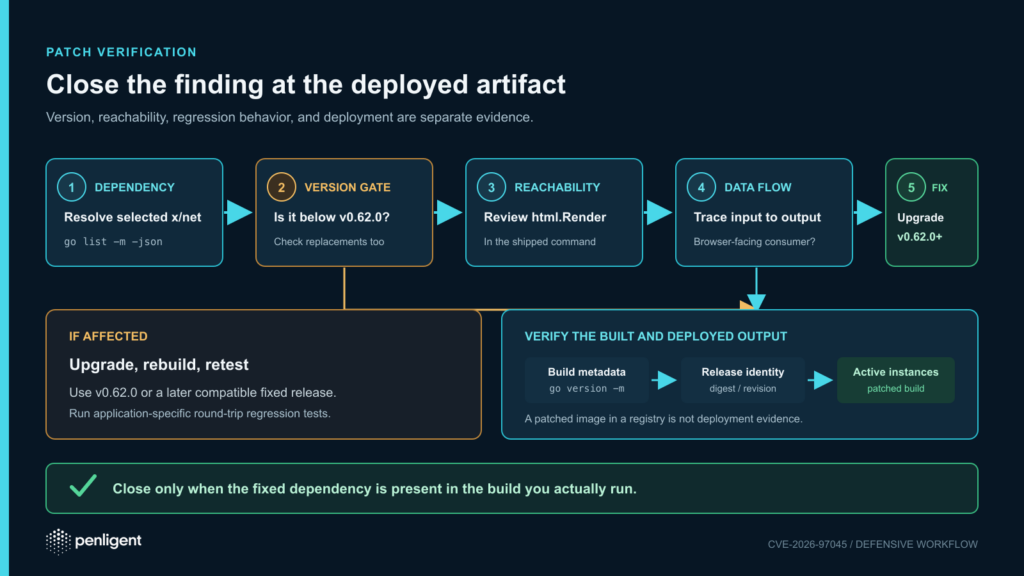
The Go command reference documents go version -m, which reads embedded module information when available. Use it on the exact executable you intend to deploy and, where operationally possible, on a copy of the executable from the running environment. Do not confuse the version of the local go command with the dependency version inside the service binary.
go version -m ./bin/your-owned-service
go list -m -json all
Replace the example path with the owned artifact under review. If module metadata is unavailable, record that limitation and use reproducible build provenance, source revision, and release records to establish the dependency. Missing build information is not evidence that an affected module is absent. Avoid exposing detailed internal build paths through a public diagnostic endpoint just to make scanning easier.
The runtime/debug documentation provides an in-process way to retrieve embedded module build information when it exists. A controlled internal diagnostic can help operations teams match a running process to its release. Prefer restricted access and a narrowly scoped output. The objective is release verification, not publishing an inventory of private dependencies to every visitor.
Connect the artifact evidence to deployment evidence. Record the image digest or executable checksum, the environment, and the deployment revision. A patched image sitting in a registry is not proof that active instances use it. Likewise, a deployment controller reporting success does not necessarily cover independently managed workers or long-lived jobs. Inventory those consumers deliberately.
Review rollback targets as part of closure. If the operational rollback image contains the vulnerable module, a routine recovery action can reintroduce exposure. Prepare a patched rollback-compatible build when practical, or document the containment required if rollback becomes necessary. A remediation plan should remain safe during recovery, not only during the ideal release path.
Synthetic sample findings, not a certification or audit-acceptance guarantee. Sign in or register to download.
A safe localhost round-trip demonstration
This educational proof of concept demonstrates the validation boundary, not a working exploit for CVE-2026-97045. It uses a fixed benign document, renders it with Go, parses the result again, and checks that a marker is still a text node. It then serves only that generated document on 127.0.0.1. It accepts no uploaded markup, includes no scripts or event handlers, and does not contact any target. No CVE exploit was run to produce this article.
Use a disposable directory on a machine you control with a supported Go toolchain. Create a new scratch module and select the fixed dependency. Keep this separate from production so the demonstration cannot accidentally change a service’s dependency graph. If your environment cannot retrieve the module or satisfy its toolchain requirements, stop and resolve that prerequisite rather than substituting an unverified build.
go mod init example.com/local-render-check
go get golang.org/x/net@v0.62.0
Save the following example as main.go in that scratch module. The fixture includes benign HTML, SVG, and MathML content to make namespace transitions visible in the printed tree. It intentionally does not reproduce the nested foster-parenting arrangement described in the advisory and should not be presented as a regression test for that exact defect.
package main


import (
    "bytes"
    "fmt"
    "log"
    "net/http"
    "strings"
    "time"


    "golang.org/x/net/html"
)


const marker = "local-round-trip-marker"
const fixture = `<!doctype html><html><head><title>Local check</title></head><body><svg><foreignObject><p>local-round-trip-marker</p></foreignObject></svg><math><mtext>benign math text</mtext></math></body></html>`


func markerCount(n *html.Node) int {
    count := 0
    if n.Type == html.TextNode && n.Data == marker {
        count++
    }
    for c := n.FirstChild; c != nil; c = c.NextSibling {
        count += markerCount(c)
    }
    return count
}


func inspect(n *html.Node, depth int) {
    if n.Type == html.ElementNode {
        fmt.Printf("%snamespace=%q element=%q\n",
            strings.Repeat("  ", depth), n.Namespace, n.Data)
    }
    for c := n.FirstChild; c != nil; c = c.NextSibling {
        inspect(c, depth+1)
    }
}


func main() {
    first, err := html.Parse(strings.NewReader(fixture))
    if err != nil {
        log.Fatal(err)
    }
    var output bytes.Buffer
    if err := html.Render(&output, first); err != nil {
        log.Fatal(err)
    }
    second, err := html.Parse(strings.NewReader(output.String()))
    if err != nil {
        log.Fatal(err)
    }
    if markerCount(first) != 1 || markerCount(second) != 1 {
        log.Fatal("marker did not remain one exact text node")
    }
    inspect(second, 0)
    page := append([]byte(nil), output.Bytes()...)
    mux := http.NewServeMux()
    mux.HandleFunc("/", func(w http.ResponseWriter, r *http.Request) {
        if r.URL.Path != "/" || r.Method != http.MethodGet {
            http.NotFound(w, r)
            return
        }
        w.Header().Set("Content-Type", "text/html; charset=utf-8")
        w.Header().Set("X-Content-Type-Options", "nosniff")
        w.Header().Set("Content-Security-Policy",
            "default-src 'none'; script-src 'none'; base-uri 'none'; form-action 'none'; frame-ancestors 'none'")
        _, _ = w.Write(page)
    })
    server := &http.Server{
        Addr: "127.0.0.1:8080", Handler: mux,
        ReadHeaderTimeout: 5 * time.Second,
    }
    log.Print("Local demonstration at http://127.0.0.1:8080")
    log.Fatal(server.ListenAndServe())
}
Run go run . and open the loopback address in a disposable browser profile. Confirm the marker remains visible text and inspect the namespace URI and local name of the relevant DOM elements. Stop the server when finished. Do not change its bind address to expose it publicly, add an upload route, or replace the synthetic fixture with private customer data.
The code prints Go’s node namespace representation, while browser developer tools expose the DOM namespace URI. Those representations are not necessarily identical strings. Compare their meaning rather than requiring a literal string match. Record which elements are HTML, SVG, or MathML and whether the final browser tree matches the intended benign structure.
A passing marker check establishes only that this marker remained text in this demonstration. It does not prove that arbitrary HTML is safe, that a sanitizer is correct, or that an affected build cannot be exploited. Similarly, a difference in serialized whitespace or implied document containers does not establish exploitation. A meaningful application test must express the application’s actual security policy.
For an authorized regression test, use reviewed upstream regression material or a minimally scoped fixture approved for the product under assessment. Keep any sensitive reproduction in the private engineering record. The public demonstration here is deliberately harmless so it can explain parse-render-parse reasoning without distributing a browser execution payload.
Design useful namespace-aware regression assertions
Start with an inventory of allowed output. Enumerate permitted namespaces, element types, attributes, URL schemes, and embedding contexts. Then define what must remain true after every transformation. A rich-text product might allow links but prohibit embedded active content. A diagram product might permit SVG while restricting external references. A scientific editor may require MathML. Tests should reflect those specific requirements rather than an assumed universal safe subset.
Separate semantic assertions from compatibility assertions. A semantic assertion can require that a marker remains a text node or that no unapproved attribute appears. A compatibility assertion can require that an equation or diagram still displays correctly. Both matter, but a visual regression and a security regression are not the same failure. Give each a distinct message so the release team knows whether it is investigating safety or functionality.
Store a small corpus of representative legitimate documents alongside carefully reviewed negative cases. Include the ways users actually enter content: editor-generated markup, imported files, pasted fragments, and legacy stored documents. A test corpus built only from manually constructed trees may miss application preprocessing. A corpus built only from browser-generated HTML may miss documents imported through an API or migration job.
Apply the assertions at the final consumption boundary. If the application sends a fragment to client-side code that transforms it again, inspect the post-transformation DOM. If it converts HTML to another document format, include any preview stage that opens the original markup. This avoids declaring success at an intermediate point while leaving the user-visible path untested.
Record the serializer version, browser engine, test fixture revision, and insertion context with the result. These are not decorative details: they explain why two teams might see different behavior. A future retest can then reproduce the same context or deliberately compare a changed one. Without that record, screenshots alone rarely establish which build or parser produced the observed document.
Use fuzzing to test invariants, not to manufacture confidence
The official Go fuzzing documentation describes coverage-guided fuzzing and preservation of failing inputs. Applied defensively, a local fuzz target can exercise a parse-transform-render-reparse helper and assert a narrow security property. This can discover unexpected combinations that a small hand-authored corpus misses, but it does not replace a reviewed policy or prove that a whole product is safe.
Keep fuzzing isolated from live services and limit its resources. Do not allow generated inputs to trigger external fetches, write customer records, or enter production queues. Review saved failures before sharing them because a failure may contain a useful attack primitive. Prefer publishing a reduced benign explanation when the full fixture would create unnecessary risk.
Choose an invariant that the implementation can legitimately satisfy. Exact tree equality may reject harmless parser normalization. A more useful property might require that a policy-approved text marker never becomes an element, that disallowed namespaces remain absent, or that all accepted links retain an allowed scheme after the final parse. If the invariant is too vague, fuzzing produces a large workload without a meaningful security conclusion.
When a failure appears, first distinguish an application assumption from a dependency defect. Minimize the input, reproduce it deterministically, and record both trees. Confirm whether the issue is new after a dependency update or existed before. A namespace difference deserves investigation, but attribution to this CVE requires matching the affected behavior rather than merely observing malformed HTML.
Patch with a controlled dependency change
The Go dependency-management guide documents version selection through go get and module cleanup through go mod tidy. In an owned development branch, request v0.62.0 as the minimum known fixed baseline, inspect the resulting selected version, and review the dependency diff. If the project already uses a later compatible fixed version, do not downgrade it merely to match the example.
go get golang.org/x/net@v0.62.0
go mod tidy
go list -m -json golang.org/x/net
go test ./...
govulncheck ./...
Review every changed module and toolchain directive. A targeted update can still affect related dependencies or minimum build requirements. Explain those changes in the pull request and run the normal release checks. Do not silently combine the security change with unrelated refactors, a new sanitizer policy, and a template redesign unless operational constraints require it; separate changes are easier to validate and roll back.
If an upgrade is blocked by a compatibility problem, record the exact error and identify whether it is a toolchain prerequisite, API change, generated-code issue, or application test failure. “The upgrade breaks the build” is not specific enough to support an exception. A precise blocker lets the owner decide between fixing compatibility, updating an intermediate dependency, or applying an approved downstream patch.
For a downstream backport, retain the upstream reference and a review of the changed code. A version scanner may continue to report the older public version, so the exception needs artifact identity and patch evidence rather than a blanket suppression. Set an expiry condition and a plan to return to an upstream release. Do not claim the fixed upstream version is deployed when the organization is actually using a custom patched branch.
Vendor and rebuild deliberately
When the release uses vendored dependencies, regenerate the vendor tree with the project’s established process and inspect its changes. Confirm that CI builds from the intended source. Do not assume a local build using the module cache proves that a vendor-mode release includes the patch. Conversely, do not treat a stale cache directory found on a build machine as evidence that the running binary contains that version.
Build the release from a recorded source revision using the approved pipeline. Capture the dependency selection before packaging and the build metadata afterward. Promote the same verified artifact through environments when possible rather than rebuilding independently for each deployment. If separate builds are required, keep their provenance separate so an approval for one binary is not accidentally applied to another.
Run functional tests for legitimate rich content as well as the security assertions. Removing namespace features can appear to solve a security test while breaking a product’s essential functionality. An emergency feature restriction can be appropriate, but name it as a temporary containment measure and communicate the user-visible effect. The long-term remediation should restore intended behavior on the fixed dependency.
Contain exposure while the patch is being released
The lowest-complexity temporary control is often to stop interpreting the relevant untrusted content as HTML. A plain-text presentation can preserve access to information while removing a rendering feature. Whether that is acceptable depends on the product. Do not automatically apply HTML escaping to arbitrary JavaScript, CSS, or URL contexts; the destination determines the required handling.
Where foreign content is not a business requirement, a reviewed policy that excludes SVG and MathML may reduce exposure. Treat this as an application-specific restriction, not a universal proof that the vulnerability is unreachable. Test every ingress path and stored-content path. A restriction enforced only in the interactive editor may not apply to API imports, migrations, or older records.
The Content Security Policy specification defines browser policies for resource loading and script-related behavior. A restrictive policy can provide defense in depth, but it needs application-specific testing and should not replace the module fix. In a real application, a policy copied from a toy demonstration may block required functionality or leave important allowances that change its protective value.
Preview isolation requires similar care. Serving untrusted content from a separate origin can reduce shared privileges, but origin choice, cookies, navigation permissions, embedding rules, and communication with the parent page all need review. Do not describe an iframe as a security boundary simply because it is visually separate. A security reviewer should establish the actual permissions granted to the preview.
Document what each temporary control does and does not cover. Give it an owner, a deployment scope, and an expiry condition tied to patch rollout. If a feature is disabled for new documents but cached previews remain available, say so. Accurate containment records are more valuable than a broad “mitigated” label that hides an untested path.
Turn testing into a release gate
A release gate should require several kinds of evidence without making every check redundant. Dependency evidence proves that the selected module satisfies the fixed baseline. Build evidence proves which artifact contains that selection. Functional testing proves intended content still works. Security testing proves the defined output invariants. Deployment evidence proves the reviewed artifact reached the intended environment.
Assign a clear failure behavior to each gate. If vulnerability database retrieval fails, do not record the scan as clean. If the browser test fails to load its fixture, do not count it as a passed policy assertion. If artifact metadata is absent, use an approved alternative evidence path rather than silently skipping verification. These distinctions prevent infrastructure failures from becoming false security assurance.
Use a staged rollout that reflects the application architecture. Begin with an environment capable of exercising the complete document pipeline, then monitor a small production cohort where the deployment process supports it. Observe rendering errors, preview failures, worker backlog, and user-facing regressions. These are operational acceptance signals, not evidence that the CVE has been exploited.
After rollout, check long-lived consumers and scheduled tasks. A web deployment can finish while a background renderer retains an older image. A batch process may start later from a stale job template. Verify those release definitions as well as currently running processes, then update rollback references so recovery cannot quietly reintroduce the old dependency.
Build an application-specific exposure record
A useful exposure record follows one feature from its author to its viewer. Name the feature and owner, identify the deployed artifact, and state how the initial content enters the system. Then record the privileges required to author the content and the privileges held by people who view it. This makes stored and cross-user risk visible without assuming that every authenticated flow is trustworthy.
Next, describe the document policy in observable terms. “Sanitized HTML” is too broad for an engineer to retest. A useful statement identifies allowed namespaces, the classes of elements and attributes that are retained, and the point where the policy is applied. Note whether the policy operates before or after application transformations and whether the final output is inspected again.
Describe the sink precisely. A full HTML response, a fragment inserted by client-side code, a downloaded attachment, and an isolated preview have different handling requirements. Record response headers and the relevant client-side insertion behavior, but omit secrets and unrelated user data. The objective is to establish the security context, not to reproduce an entire production session in a report.
Assign each conclusion an evidence level. A module inventory can support “affected dependency present.” A source trace can support “renderer reachable.” An authorized synthetic test can support “defined policy violated in this configuration.” An operational investigation is needed to support “malicious exploitation observed.” These statements should not be interchangeable, especially when the finding will be read by customers or auditors who cannot examine the source.
Use the record to explain residual risk after patching. If a vulnerable dependency is removed but the application still lacks a clear HTML policy, the specific CVE may be resolved while a broader design issue remains. Open a separate improvement task instead of keeping the CVE indefinitely open or pretending the dependency update solved every markup-handling problem.
Report evidence that developers can actually use
The most useful report starts with the smallest reproducible statement of the problem. Identify the affected command, module version, build revision, and feature. Explain the difference between the document the policy intended to permit and the document the final consumer interpreted. A screenshot can illustrate that difference, but it should accompany structured observations rather than replace them.
Include a sanitized call path from the application entry point to the renderer. Identify the wrapper where the relevant trust decision occurs, the source of the node tree, and any transformation after validation. Do not paste hundreds of lines of source into the report. A short trace with function names and a precise description of the data flow is usually more actionable.
For a confirmed application issue, describe the required actor and interaction. State whether the author needs an account, whether a second user must view the content, and which origin handles the result. If those conditions were not established, leave them as unresolved questions. A finding with a clear uncertainty is safer to remediate than a confident description based on assumptions.
Keep raw reproduction material access-controlled. A synthetic fixture, a before-and-after node summary, and an artifact identifier are often sufficient for the general report. Store more sensitive data only where the authorized engineering team needs it. Reports can themselves become a source of exposure when they contain customer content, session identifiers, or reusable execution payloads.
For teams using Penligent within an authorized testing workflow, apply the same evidence standard to any generated finding: selected version, reachable path, input ownership, output context, and a bounded verification result. A product workflow should make those facts easier to review, not turn a dependency match into an unsupported claim of successful exploitation.
The sample penetration test report provides a synthetic example of report organization, including SOC 2 criteria mapping and ISO/IEC 27001 risk-treatment material. It is a sample reporting resource, not a claim that Penligent holds those certifications, an independent audit opinion, or a guarantee of auditor acceptance. Use it to examine how evidence can be organized, then document the actual controls and test results for the system under review.
Keep audit mapping separate from technical proof
A compliance mapping and a vulnerability verification answer different questions. The technical record establishes what was present, what was reachable, what changed, and what was retested. A control mapping explains how an organization’s process relates to its chosen framework. Neither becomes stronger when the report overstates the other. A patch ticket is not a certification, and a framework label does not prove that an executable contains the fixed dependency.
For this CVE, an audit-ready evidence packet can include the initial inventory, the assigned owner, the approved change, the build result, the deployment record, and the retest. Link those records using stable identifiers so a reviewer can follow the change without needing privileged access to every engineering system. Redact secrets while preserving enough detail to establish scope.
Document exceptions in terms of actual exposure. If a service cannot upgrade immediately, describe its selected version, the reason for delay, the temporary control, and the verification of that control. Include a review date and an accountable owner. Avoid an exception that simply repeats “not exploitable” without showing which required condition is absent.
When communicating externally, use language that matches the evidence. “The affected dependency was upgraded and the deployed artifact verified” is supportable when the records exist. “No customer could have been affected” requires much broader evidence and may be impossible to establish from a patch exercise alone. Do not allow pressure for a simple status message to erase those differences.
Distinguish this issue from adjacent classes of bugs
CVE-2026-97045 should not be merged with every HTML security finding. A template that deliberately marks untrusted input as trusted HTML can create an XSS problem independently of a serializer defect. A client-side unsafe insertion can create a problem after the Go service has returned correctly encoded data. A URL policy error can allow an unwanted destination even when namespaces remain stable.
During triage, label the failed boundary. If the policy never prohibited a dangerous element, the issue may be a policy design flaw. If a later transformation bypasses a correctly applied policy, it may be a pipeline ordering problem. If the affected serializer changes interpretation through the documented ancestor-handling behavior, that connects the application finding to this CVE. These distinctions lead to different tests and owners.
Likewise, do not turn every parser difference into a vulnerability. HTML parsers repair malformed input and can insert implied elements. A difference is security-relevant when it breaks a required invariant or creates an unauthorized capability. Review the final meaning, not just the existence of a diff. This prevents large numbers of low-quality findings from obscuring a genuine output-integrity problem.
When more than one defect contributes to a chain, document them separately and explain the relationship. A dependency fix might remove one path while an unsafe sink remains available through another feature. Closing the dependency finding should not automatically close the broader application issue. A clear dependency graph of findings is more useful than one oversized label covering unrelated causes.
Monitoring can support investigation but cannot prove absence
Operational telemetry can help locate the features that process risky content. Consider recording a document identifier, feature name, actor identifier, processing stage, and result. Avoid retaining raw untrusted markup unless there is an approved investigative need. A minimal event can connect a rendering failure to a build and input source without placing sensitive documents into general-purpose logs.
Browser policy reports and rendering errors can provide leads, but they do not identify this CVE on their own. A blocked script may result from an unrelated application bug, an extension, or a legitimate feature incompatible with the current policy. Investigate the context before attributing it. Conversely, a quiet dashboard is not proof that the vulnerable rendering path was never reached.
If an incident review is warranted, preserve relevant records before normal retention removes them. Establish the exposure window from artifact deployment history rather than the date a scanner first noticed the vulnerability. A library can be present before public disclosure, and a report can arrive after remediation. Those timestamps describe different events and should remain separate in the chronology.
Escalate from vulnerability management to incident response only when evidence justifies it or the organization’s risk process requires it. A dependency alert alone is not a breach declaration. At the same time, do not stop an investigation merely because the patch is deployed if there is evidence of suspicious document activity. Remediation and historical impact assessment are separate workstreams.
A practical handoff between engineering and security
Security should give engineering a bounded question rather than an unexplained CVE identifier. Provide the affected version, the relevant API, the suspected document path, and the evidence needed to answer whether untrusted content reaches that path. Engineering can then confirm or correct the model and identify the least disruptive update.
Engineering should return more than “fixed in main.” Provide the selected module version, source revision, passing regression checks, and artifact identity. Operations should confirm rollout scope, including background consumers and rollback targets. Security can then validate the defined policy and close the dependency finding with a reproducible evidence chain.
Product owners can help decide temporary feature restrictions. If SVG support is essential, disabling it might create an unacceptable outage; if it is incidental, a short restriction may be a reasonable containment step. Make that tradeoff explicit and time-bounded. Avoid asking security engineers to infer product requirements from code while a patch deadline is approaching.
Customer-facing communication should use one shared factual summary. State the affected component, the action taken, and the evidence-backed limitations. Different teams should not describe the same issue as both “RCE across all services” and “no risk” merely because they looked at different layers. A concise common summary reduces unnecessary escalations and supports a more credible response.
Acceptance criteria for closing the finding
| Closure requirement | Acceptable evidence | Insufficient substitute |
|---|---|---|
| Fixed dependency selected | Build-list output showing v0.62.0 or a later compatible fixed release, with replacements explained | A changed requirement in an unrelated module |
| Reviewed artifact produced | Recorded source revision, build result, dependency metadata, and artifact identity | A developer’s local test binary |
| Relevant behavior tested | Namespace-aware policy assertions and legitimate content regression checks | A successful HTTP response alone |
| Deployment verified | The reviewed artifact active across the intended services and workers | A patched image available only in the registry |
| Exception or residual issue tracked | Owner, scope, controls, expiry, and separate follow-up where necessary | An unqualified permanent suppression |
Use the table as a compact closure contract, not as a reason to delay a safe emergency patch. Evidence can be gathered in parallel with a controlled rollout, and low-risk applications may need a proportionate test set. What should not change is the meaning of the conclusion: the organization needs to know which code was reviewed and which code now serves users.
Retain enough detail for a later reviewer to repeat the important checks. A release note that says “security fixes” cannot establish which dependency version was included. A screenshot without an artifact identifier cannot establish which build was tested. A concise record tying those elements together is more useful than a large volume of disconnected logs.
Once the specific CVE is closed, preserve the regression tests in the normal suite. The broader lesson is representation integrity across parse, transform, serialize, and consume stages. Future library changes, new content features, and client-side refactors can alter that chain. A durable policy test protects the application beyond the immediate version update.
Frequently asked questions
- What is CVE-2026-97045? It is a published Go CNA vulnerability affecting namespace-sensitive rendering in golang.org/x/net/html. An ancestor-checking decision could produce output whose later parsing differs from the intended tree. The security concern is a potential XSS path where untrusted content is rendered into a browser-sensitive context, not an automatic compromise of every Go application.
- Which version contains the fix? The official Go vulnerability record identifies golang.org/x/net v0.62.0 as the fixed module version. Use that version or a later compatible release containing the fix. Verify the selected build list and the deployed artifact; updating the Go compiler or changing an unrelated go.mod file does not prove this module was updated.
- Does a scanner finding prove that my service is exploitable? No. Establish affected-version presence, code reachability, attacker influence over the rendered tree, and the final output context separately. A scanner can supply valuable dependency or symbol evidence, but application-specific data flow and policy testing are needed to support a practical exploitation claim.
- Is this a remote-code-execution vulnerability? The reviewed primary records do not establish RCE in the Go server. Rendering serializes a document; a later browser may interpret it. Keep browser-side consequences and server-side execution claims separate. Any stronger application-specific consequence needs its own verified chain and evidence.
- Can I rely on CSP or sanitization instead of upgrading? Treat those controls as defense in depth or bounded temporary containment. Their value depends on configuration, insertion context, and complete coverage of the document pipeline. Patch the dependency, test the final document, and confirm that cached or delayed content paths are included in the remediation plan.
- What does the localhost demonstration prove? It demonstrates how to render a benign fixture, parse the output again, and inspect a harmless marker and namespace structure. It is not a reproduction of the CVE, was not presented as an executed exploit, and cannot prove arbitrary documents are safe. Use reviewed application-specific regression tests for formal verification.
- What evidence should remain after remediation? Retain the selected fixed version, source revision, artifact identity, reachability assessment, relevant regression results, and deployment confirmation. For reports with compliance mappings, keep those mappings separate from the technical proof and do not describe sample reports or control references as certifications or audit guarantees.
The durable fix is a verified rendering pipeline
CVE-2026-97045 has a clear dependency remediation: use golang.org/x/net v0.62.0 or a later compatible fixed release. The harder work is ensuring that the affected code path and the deployed artifact are understood. Prioritize applications that accept untrusted content and deliver interpreted markup to users with meaningful privileges, then verify the complete path rather than stopping at the package inventory.
Combine module evidence, reachability analysis, namespace-aware tests, and deployment provenance. Keep the safe demonstration separate from a formal reproduction, keep potential XSS separate from unsupported RCE claims, and keep audit mapping separate from certification. That precision lets teams patch quickly without trading accuracy for urgency.
Close the finding when the fixed artifact is deployed and the relevant output policy is verified. Preserve the tests and evidence so future changes can be evaluated against the same invariants. The long-term objective is not just a clean scanner result; it is a document pipeline whose security decisions still hold when the final consumer parses the bytes.


 English
 German
 French
 Spanish
 Portuguese
 Japanese
 Korean
 Hindi
 Arabic
 Turkish
 Hebrew