
CVE-2026-131914 affects the legacy Idunno.AntiCsrf module used by ASP.NET WebForms applications. Mandiant reports active exploitation and says the defunct project has no official patch. The practical response is to find deployed copies, determine whether the module processes reachable POST requests, and replace it with a supported anti-forgery implementation.
This guide turns the disclosed request-processing order into an inventory and remediation workflow for IIS and ASP.NET owners. No Penligent exploit reproduction or deployment test is claimed.
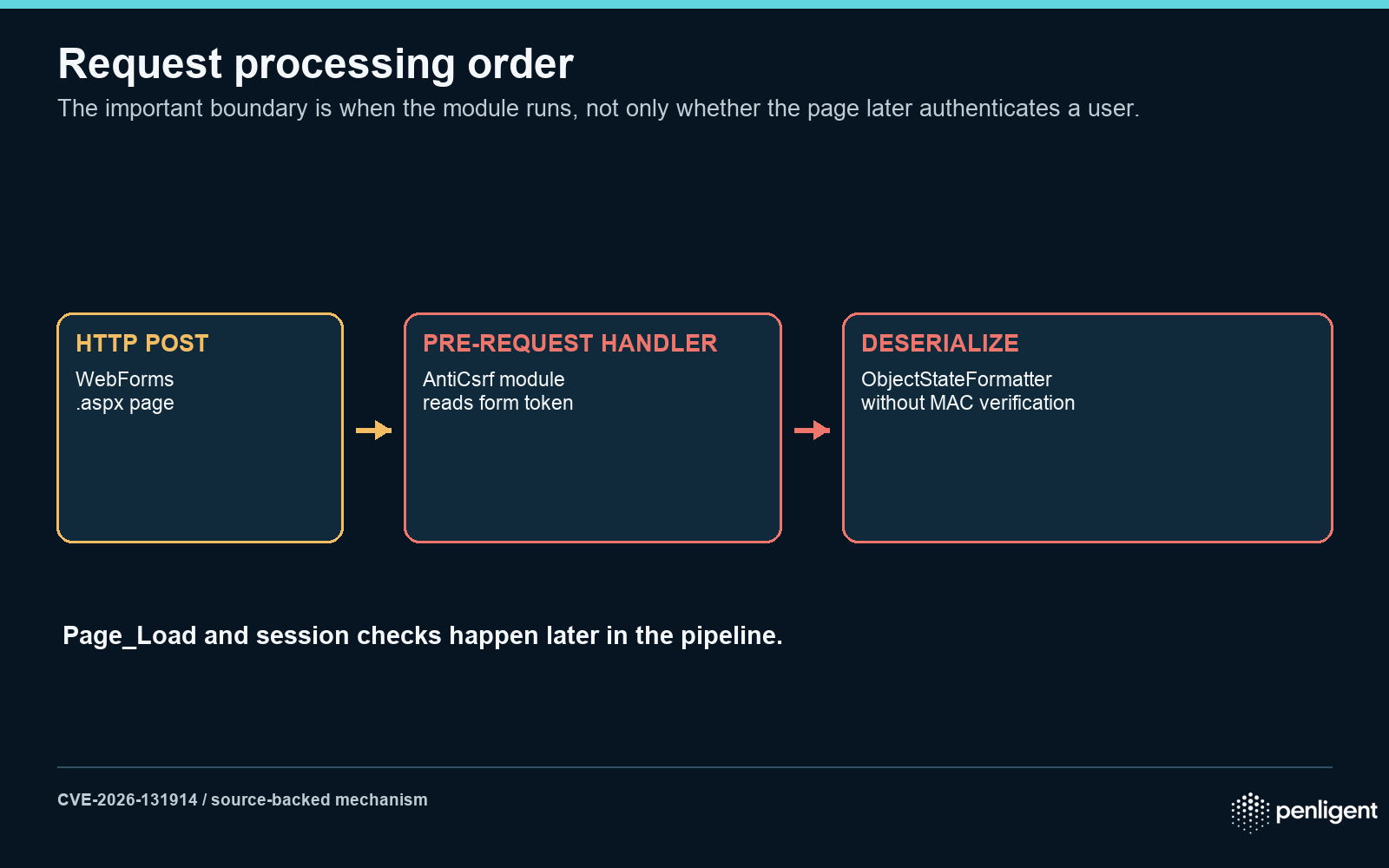
Why a later page check may not protect the request
En CVE record identifies insecure deserialization through version 0.9.1 Beta. Mandiant identifies the vulnerable path in Idunno.AntiCsrf.AntiCsrfModule: for an applicable ASP.NET WebForms POST, the module processes the form token during PreRequestHandlerExecute y llama ObjectStateFormatter.Deserialize without cryptographic MAC or signature verification.
The module runs before the page lifecycle and checks commonly placed in Page_Load. A session or authorization check inside Page_Load therefore should not be treated as a control that stops the earlier deserialization. Pipeline authentication and authorization rules execute earlier; review those controls separately. The disclosure also identifies suppression interfaces and attributes that affect whether a page is processed, so confirm actual module behavior instead of assuming every route is identical.
A DLL match is an inventory lead, not proof of reachable exploitation. Conversely, checking only the source repository can miss copied binaries in deployed applications.
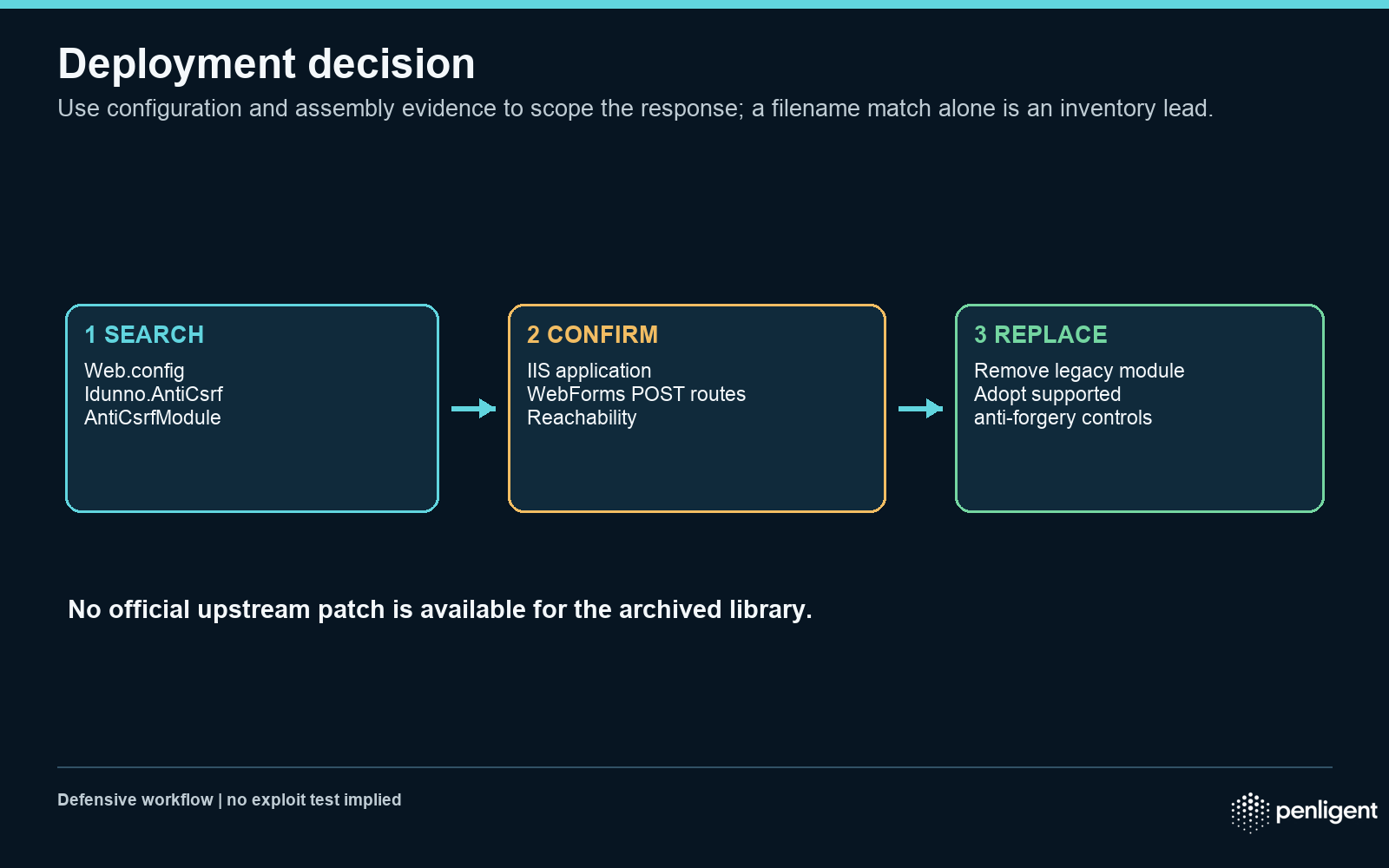
Find the module in deployed applications
Search IIS application directories and deployment packages for Idunno.AntiCsrf.dll, Idunno.AntiCsrfy Idunno.AntiCsrf.AntiCsrfModule. Review Web.config for module registration under httpModules o modules and for the legacy csrfSettings configuration section. Mandiant notes that internally rebuilt or customized copies have different hashes, making a hash-only inventory insufficient.
- Record the application owner, deployed assembly path, version or hash, and configuration registering the module.
- Confirm that the application uses WebForms and identify POST-enabled
.aspxpaths the module processes. - Check whether authentication is enforced before the page handler. Document page-level session checks separately.
- Prioritize deployments reachable from the internet or other untrusted networks, and preserve the historical exposure window for investigation.
Replace the component without removing CSRF protection
Mandiant recommends discontinuing the library. Remove its module registrations, legacy configuration section and assembly, then migrate to a supported anti-forgery mechanism suitable for the application’s framework. Removing a security module without replacing its protection leaves a different problem unresolved.
The disclosure lists System.Web.Helpers.AntiForgery, appropriate WebForms ViewState protections, and ASP.NET Core anti-forgery APIs as possible replacement approaches. These require application-specific implementation; an ASP.NET Core example is not a drop-in WebForms fix. Consult Microsoft’s anti-forgery guidance alongside the framework documentation and test legitimate submissions and token rejection in staging.
After rollout, verify the legacy assembly and registrations are absent from deployed configuration, and that the running application uses the replacement. Repeat across replicas, deployment slots, older packages, and recovery images. Keep the deployed build and test results with the closure record.
Review the exposed period and preserve evidence
Because Mandiant reports exploitation in the wild, preserve IIS, endpoint, application, and identity telemetry before cleanup of a reachable affected deployment. Review anomalous POST activity to WebForms endpoints and correlate it with process creation and unexpected file changes. Mandiant highlights HTTP 302 or 500 responses and elevated request-byte counts where logged; those signals alone do not prove compromise.
If host evidence indicates execution, assess what the IIS worker identity could access, investigate unauthorized webroot files, and rotate exposed application secrets according to the incident-response scope. A matching version alone does not establish secret exposure, and missing logs do not establish safety.
For an authorized assessment, Penligente can support application security workflows. Keep any validation evidence tied to the specific build and routes assessed. The following video is a general product demonstration, not evidence of CVE-2026-131914 exploitation or remediation.
Source and method note: Primary records checked November 24, 2026: the CVE record and Mandiant MNDT-2026-0048 linked above. AI assisted research and drafting; the asset and closure workflow is Penligent analysis of those records. No first-hand exploit testing or human review is claimed.
 Spanish
 English
 German
 French
 Portuguese
 Japanese
 Korean
 Hindi
 Arabic
 Turkish
 Hebrew