
CVE-2026-20182 is not a routine management-interface bug. It is a critical authentication bypass in Cisco Catalyst SD-WAN Controller, formerly vSmart, and Cisco Catalyst SD-WAN Manager, formerly vManage. Cisco assigned it a CVSS 3.1 base score of 10.0 and classified it under CWE-287, Improper Authentication. NVD describes the issue as a failure in peering authentication that can let an unauthenticated remote attacker log in as an internal, high-privileged, non-root account and access NETCONF, which can then be used to manipulate SD-WAN fabric configuration. (Cisco)
That last sentence is the reason this vulnerability deserves immediate attention. A compromise of the SD-WAN control plane is different from a single exposed web service. SD-WAN controllers and managers sit near the trust center of a distributed enterprise network. They participate in control connections, policy distribution, routing decisions, device onboarding, certificate trust, and administrative automation. A successful attack can move from “I reached a service” to “I became a trusted peer” to “I can influence the network fabric.” Cisco Talos says it is tracking active exploitation of CVE-2026-20182 and clusters the activity under UAT-8616 with high confidence, while Cisco’s own advisory states that PSIRT became aware of limited exploitation in May 2026. (Blog Cisco Talos)
Security teams should treat CVE-2026-20182 as an emergency control-plane exposure problem, not just a patch-ticket item. The immediate task is to preserve forensic data, identify every affected Cisco Catalyst SD-WAN Controller and Manager, confirm whether the relevant control-plane and management services are reachable from untrusted networks, inspect peering and authentication evidence, and upgrade to a fixed software release. Cisco says there are no workarounds that address this vulnerability. (Cisco)
The facts that matter first
| Campo | What matters for defenders |
|---|---|
| CVE | CVE-2026-20182 |
| Vendor | Cisco |
| Affected products | Cisco Catalyst SD-WAN Controller and Cisco Catalyst SD-WAN Manager |
| Former product names | vSmart and vManage |
| Clase de vulnerabilidad | Authentication bypass caused by improper peering authentication |
| CWE | CWE-287, Improper Authentication |
| CVSS | CVSS 3.1 base score 10.0, Critical |
| Remote attack | Yes, Cisco and NVD describe unauthenticated remote exploitation |
| Privileges needed | None before exploitation |
| Interacción con el usuario | Ninguno |
| Impact after successful exploitation | Access as an internal high-privileged non-root account, NETCONF access, and potential manipulation of SD-WAN fabric configuration |
| Workaround | Cisco states there are no workarounds |
| Fix | Upgrade to a Cisco fixed software release |
| Known exploitation | Cisco reported limited exploitation, Talos reported active in-the-wild exploitation, and CISA added the CVE to KEV |
| First Cisco advisory release | May 14, 2026 |
Cisco’s advisory says the vulnerability affects Cisco Catalyst SD-WAN Controller and Cisco Catalyst SD-WAN Manager regardless of device configuration, across On-Prem Deployment, Cisco SD-WAN Cloud-Pro, Cisco SD-WAN Cloud managed by Cisco, and Cisco SD-WAN for Government FedRAMP deployments. Cisco also advises customers to collect admin-tech files from each SD-WAN control component before upgrading so possible indicators of compromise are preserved. (Cisco)
NVD’s record adds the operational consequence: after the authentication bypass, the attacker can access NETCONF and manipulate network configuration for the SD-WAN fabric. That is the pivot from device compromise into fabric-level risk. (NVD)
Why this vulnerability is different from a normal login bypass
The most dangerous part of CVE-2026-20182 is the location of the broken trust decision. Many authentication bypasses target a web session, API endpoint, password reset flow, or misconfigured reverse proxy. This one targets the peering authentication path used by SD-WAN control components.
Cisco Catalyst SD-WAN is built around separate planes. Cisco’s design documentation describes orchestration, management, control, and data planes. The SD-WAN Manager provides centralized configuration and monitoring, the SD-WAN Controller maintains the centralized control plane and distributes route and policy information through OMP, the SD-WAN Validator assists onboarding and connectivity, and WAN Edge routers forward traffic at sites or cloud locations. (Cisco)
That architecture makes identity central. Devices are not supposed to become trusted participants in the overlay simply because they can speak to the right port. Cisco’s design documentation describes an authorized list model for WAN Edge devices and control components, certificate-based identity checks, organization-name checks, root CA validation, and control connections over DTLS or TLS. (Cisco)
CVE-2026-20182 breaks that model at a sensitive point. Cisco says the peering authentication mechanism is not working properly. Rapid7’s technical analysis narrows the issue to the vdaemon service over DTLS, commonly associated with UDP port 12346, and explains that this is the same service family affected by CVE-2026-20127 but not a patch bypass of that earlier issue. It is a separate flaw in a similar part of the networking stack. (Cisco)
The practical difference is simple: a firewall team may think, “This is only a control-plane service.” A red teamer hears, “That is the service that decides who becomes a trusted peer.” A defender should hear both.
The vulnerable path, without turning this into an exploit recipe
Rapid7’s analysis describes the vulnerable handshake in more detail than the vendor advisory. In simplified form, the affected service accepts a DTLS connection, sends a challenge, receives a challenge acknowledgement, and then applies device-type-specific verification logic. Rapid7 states that a peer claiming to be a vHub device type reaches a missing verification path, after which the peer is marked authenticated. (Rápido7)
The important defensive idea is not the exact packet sequence. It is the trust failure:
| Escenario | Expected security property | What the vulnerability undermines |
|---|---|---|
| Control-plane connection begins | A peer should not become trusted only because it can reach the DTLS service | Network reachability becomes too powerful |
| Challenge exchange happens | The peer’s claimed identity should be verified against the correct trust rules | One device-type path lacks the expected verification |
| Peer state changes | Only verified control-plane participants should move into an authenticated state | An unauthenticated remote party may be marked authenticated |
| Post-auth messages are processed | Privileged control-plane operations should be available only to real peers | A fake peer can reach operations that assume trust already exists |
| NETCONF access follows | Configuration access should be limited to legitimate internal management flows | Attackers may reach high-impact fabric configuration paths |
Rapid7 also described a post-authentication primitive involving SSH public key injection into the vmanage-admin account’s authorized keys file, converting a transient peer relationship into persistent high-privileged access. Rapid7 further showed that after key injection, SSH public key authentication to NETCONF over TCP port 830 can succeed as vmanage-admin. (Rápido7)
Those details explain why security teams should not stop at “patch complete.” A patched device may still have evidence of prior compromise: unauthorized SSH keys, suspicious control connection history, modified NETCONF configuration, unexpected accounts, altered SSH daemon settings, cleared logs, or configuration drift. Talos reported that UAT-8616 attempted to add SSH keys, modify NETCONF configurations, and escalate to root privileges after exploiting CVE-2026-20182. (Blog Cisco Talos)
Why UDP 12346 and TCP 830 are high-value exposure signals
Rapid7 identifies vdaemon over DTLS on UDP port 12346 as the affected control-plane service and NETCONF over SSH on TCP port 830 as a post-compromise access path. Cisco’s own advisory does not frame remediation as a port-only problem, and defenders should not either. A device can be vulnerable even if a quick scan misses it. UDP scans are noisy and unreliable. Cloud routing, NAT, ACLs, intermediate firewalls, and management VPN paths can distort reachability results.
Still, those ports matter because they help teams find risky exposure. A safe internal exposure check against assets you own or are authorized to test can start like this:
# Run only against authorized inventory.
# TCP exposure check for SSH and NETCONF.
nmap -sT -p 22,830 --open -oA sdwan_control_tcp authorized-sdwan-targets.txt

# UDP check for the DTLS control-plane service.
# UDP results can be ambiguous, so treat this as an exposure signal, not proof.
sudo nmap -sU -p 12346 --open --max-retries 2 --host-timeout 30s \
  -oA sdwan_vdaemon_udp authorized-sdwan-targets.txt
Use the output to answer a narrow question: can an untrusted or broadly routed network path reach services associated with the affected control plane? That is not the same as proving compromise. It is the beginning of triage.
A stronger inventory should combine scanner data with SD-WAN asset records, cloud firewall rules, external attack surface records, VPN ACLs, and device-side configuration. If a Cisco Catalyst SD-WAN Controller or Manager is vulnerable and reachable from the internet or an untrusted partner network, treat it as urgent even before you have perfect exploitability proof. Cisco says internet-exposed Controller systems with ports exposed to the internet are at risk of compromise. (Cisco)
Affected products and fixed releases
Cisco states that CVE-2026-20182 affects Cisco Catalyst SD-WAN Controller and Cisco Catalyst SD-WAN Manager regardless of device configuration. The affected deployment types include On-Prem Deployment, Cisco SD-WAN Cloud-Pro, Cisco SD-WAN Cloud managed by Cisco, and Cisco SD-WAN for Government FedRAMP. (Cisco)
Cisco’s fixed-release table should be treated as the source of truth for remediation planning. The following table summarizes Cisco’s advisory, but teams should still validate the final target release against their own compatibility matrix, hardware resources, support contract, and Cisco TAC guidance.
| Cisco Catalyst SD-WAN release | First fixed release listed by Cisco |
|---|---|
| Earlier than 20.9 | Migrate to a fixed release |
| 20.9 | 20.9.9.1 |
| 20.10 | 20.12.7.1 |
| 20.11 | 20.12.7.1 |
| 20.12 | 20.12.5.4, 20.12.6.2, or 20.12.7.1 |
| 20.13 | 20.15.5.2 |
| 20.14 | 20.15.5.2 |
| 20.15 | 20.15.4.4 or 20.15.5.2 |
| 20.16 | 20.18.2.2 |
| 20.18 | 20.18.2.2 |
| 26.1 | 26.1.1.1 |
Cisco notes that some release trains have reached End of Software Maintenance and strongly encourages customers on those releases to upgrade to a supported release. Cisco also states that Cisco SD-WAN Cloud managed by Cisco was addressed in cloud-based Release 20.15.506, with no user action required for that managed cloud service, while customers can check current status or version through the service GUI. (Cisco)
The practical remediation rule is blunt: if you run an affected supported branch, move to Cisco’s listed fixed release or a later appropriate release. If you run an unsupported branch, do not try to build a compensating-control story that pretends to be equivalent to a fix. Segmenting access helps reduce exposure, but Cisco states there is no workaround that addresses the vulnerability. (Cisco)
Exploitation status and why KEV changes the priority
Cisco says PSIRT became aware of limited exploitation in May 2026. Talos says it is tracking active exploitation of CVE-2026-20182 and describes UAT-8616 as the cluster associated with exploitation and follow-on activity. Tenable’s summary states that CVE-2026-20182 was disclosed on May 14, 2026, had confirmed active exploitation, and that CISA added it to the Known Exploited Vulnerabilities catalog with a May 17 action deadline under Emergency Directive 26-03. (Cisco)
CISA’s KEV entry matters because it turns the vulnerability from “critical on paper” into “known exploited in the wild.” CISA’s public KEV catalog result for CVE-2026-20182 references Cisco SD-WAN devices and directs organizations to Emergency Directive 26-03 and CISA hunt and hardening guidance for Cisco SD-WAN systems. (cisa.gov)
For private-sector teams, KEV does not create the same legal deadline that federal civilian executive branch agencies face, but it should still change the queue. A CVSS 10.0 vulnerability in a control-plane product is already high priority. A CVSS 10.0 vulnerability in a control-plane product that is being exploited and has no workaround is an incident-response priority.
A good internal prioritization rule looks like this:
| Condición | Prioridad |
|---|---|
| Affected version, internet reachable, KEV-listed | Emergency patch and hunt |
| Affected version, reachable from partner or broad internal networks | Emergency patch and targeted hunt |
| Affected version, tightly isolated management network | Accelerated patch and evidence review |
| Fixed version but exposed ports remain open | Validate exposure, harden ACLs, review logs around pre-patch window |
| Cisco-managed cloud deployment | Confirm service remediation status, review tenant-specific logs and Cisco guidance |
Do not delay remediation because exploit details are incomplete. For CVE-2026-20182, the public record is already strong enough: Cisco advisory, NVD record, Talos active exploitation reporting, Rapid7 technical analysis, and CISA KEV inclusion all point in the same direction. (Cisco)
How compromise can affect the SD-WAN fabric
A useful mental model is to separate the vulnerability from the post-compromise objectives.
The vulnerability gets the attacker past peering authentication. The post-compromise value comes from what a trusted or high-privileged internal control-plane path can do. Cisco and NVD emphasize NETCONF access and SD-WAN fabric manipulation. Rapid7 emphasizes vmanage-admin key injection and NETCONF access. Talos emphasizes SSH key addition, NETCONF configuration modification, and attempted root escalation. (NVD)
That can create several realistic risk paths:
| Risk path | Por qué es importante |
|---|---|
| Unauthorized peer relationship | A malicious or fake peer can appear in control-plane state and receive trust intended for legitimate control components |
| SSH key persistence | An attacker may keep access even after the transient control session ends |
| NETCONF configuration access | SD-WAN fabric configuration can be read or changed through an administrative protocol |
| Route or policy manipulation | Changes to overlay policy can affect traffic paths, inspection points, segmentation, or reachability |
| Credential and token theft | Adjacent SD-WAN Manager vulnerabilities and post-compromise tooling have targeted secrets, hashes, JWT material, and cloud credentials in observed campaigns |
| Log clearing | Talos and Tenable describe post-compromise cleanup behavior, so missing logs can be evidence rather than reassurance |
For network defenders, the nightmare is not only downtime. It is silent path manipulation. An attacker with control-plane influence may try to reroute traffic, weaken segmentation, add persistence, create a future access path, or use the SD-WAN system as a privileged vantage point into a distributed enterprise. That is why the right response includes both patching and hunting.
Safe exposure validation for defenders
The safest validation workflow does not run public exploit modules. It confirms version, reachability, control-plane state, logging evidence, and configuration integrity. Public proof-of-concept or Metasploit modules may exist for research and authorized lab testing, but production validation should be designed to avoid disrupting control-plane services or creating new persistence artifacts.
A defensive validation sequence can look like this.
| Paso | Question | Pruebas |
|---|---|---|
| Inventory | Which Cisco Catalyst SD-WAN Controllers and Managers exist across all deployment types | CMDB, SD-WAN Manager inventory, cloud inventory, third-party managed service records |
| Version check | Which instances run affected releases | Cisco GUI, CLI, software inventory, TAC case data |
| Exposure check | Are UDP 12346 or TCP 830 reachable from untrusted networks | Firewall rules, scanner results, flow logs, external attack surface data |
| Forensic preservation | Were admin-tech files collected before upgrade | Stored admin-tech artifacts and chain-of-custody notes |
| Peering validation | Are there unexpected state:up peers or challenge anomalies | show control connections detail and history |
| Auth log review | Are there vmanage-admin publickey logins from unknown IPs | /var/log/auth.log, centralized logs |
| Configuration review | Are there unexpected NETCONF changes or policy drift | SD-WAN Manager audit logs, config diffs, change tickets |
| Remediation proof | Is the fixed release installed and still healthy | Cisco version output, controller health checks, post-upgrade logs |
Cisco explicitly recommends collecting admin-tech files from control components before upgrading to preserve possible indicators of compromise. Cisco also recommends reviewing auth.log for “Accepted publickey for vmanage-admin” entries from unknown or unauthorized IP addresses and validating those IPs against configured System IPs in SD-WAN Manager. (Cisco)
A safe log triage command on the device or on exported logs could look like this:
# Run on exported logs or on a system where you are authorized to inspect logs.
# Review unknown public-key logins to the internal vmanage-admin account.

grep -E "Accepted publickey for vmanage-admin" /var/log/auth.log* \
  | awk '{print $1, $2, $3, $0}' \
  | sort
Do not treat the presence of vmanage-admin as automatically malicious. Cisco’s guidance is to compare the source IP address against configured System IPs in the SD-WAN Manager Web UI. The signal is not “vmanage-admin exists.” The signal is “vmanage-admin was accessed from a source that is not a legitimate control component or authorized management path.” (Cisco)
Control connection checks that matter
Cisco’s advisory gives specific control-connection guidance. From a Controller or Manager CLI, Cisco says to use show control connections detail o show control connections-history detail. From a Validator CLI, Cisco says to use show orchestrator connections detail o show orchestrator connections-history detail. Cisco also says to look for command output containing state:up and no challenge-ack, and to open a Cisco TAC case if that appears. (Cisco)
Representative defensive checks:
show control connections detail
show control connections-history detail
For Validator systems:
show orchestrator connections detail
show orchestrator connections-history detail
When reviewing output, focus on context:
| Field or clue | Defensive question |
|---|---|
| peer type | Is the peer role expected in this deployment |
| peer system IP | Does it match assigned SD-WAN system IP records |
| public IP | Does it belong to your organization, cloud account, Cisco-managed service path, or authorized partner |
| timestamp | Did the event happen during a maintenance window or known onboarding event |
| state | Is the peer unexpectedly up |
| challenge-ack | Is there a zero or missing acknowledgement pattern that Cisco says requires escalation |
| repeated events | Is the same source trying multiple times |
| correlation | Do authentication logs, change records, and flow logs agree |
Cisco warns that some indicators may occur during standard operations and must be assessed against normal network posture to avoid false positives. That warning is important. A mature response does not blindly page the incident team for every peering log entry. It compares events against topology, maintenance windows, device inventory, NAT mappings, and authorized partners. (Cisco)
A small local script can help compare observed peer IPs against an authorized inventory after you export log lines or parsed control-connection data:
#!/usr/bin/env python3
"""
Compare observed SD-WAN peer public IPs against an authorized inventory.

Input files:
  authorized_ips.txt  one IP or CIDR per line
  observed_peers.txt  one observed public IP per line

This script does not exploit anything. It only helps triage whether
observed control-plane peers are expected.
"""

from ipaddress import ip_address, ip_network
from pathlib import Path
import sys

def load_networks(path: str):
    networks = []
    for raw in Path(path).read_text().splitlines():
        line = raw.strip()
        if not line or line.startswith("#"):
            continue
        try:
            networks.append(ip_network(line, strict=False))
        except ValueError as exc:
            raise SystemExit(f"Invalid authorized IP or CIDR '{line}': {exc}")
    return networks

def main():
    if len(sys.argv) != 3:
        raise SystemExit("Usage: python3 check_sdwan_peers.py authorized_ips.txt observed_peers.txt")

    authorized = load_networks(sys.argv[1])
    observed_lines = Path(sys.argv[2]).read_text().splitlines()

    for raw in observed_lines:
        line = raw.strip()
        if not line or line.startswith("#"):
            continue

        try:
            peer = ip_address(line)
        except ValueError:
            print(f"INVALID_INPUT {line}")
            continue

        allowed = any(peer in network for network in authorized)
        status = "AUTHORIZED" if allowed else "UNKNOWN_REVIEW_REQUIRED"
        print(f"{status:24} {peer}")

if __name__ == "__main__":
    main()
This is intentionally simple. It should not be the only detection logic. Its value is forcing a disciplined question: “Do the peers we see match the peers we expect?”
Network-side detection and IDS coverage
Cisco Talos lists Snort SIDs 66482 and 66483 for CVE-2026-20182. Talos also lists additional Snort and ClamAV coverage for related Cisco SD-WAN threat clusters and malicious tooling observed in the broader 2026 activity. (Blog Cisco Talos)
If you run Snort or a Cisco security stack that consumes Talos rules, confirm that rules are up to date and that traffic to and from SD-WAN control components is in sensor visibility. A rule that exists but never sees the relevant traffic is documentation, not detection.
A practical network-side detection plan should include:
| Controlar | Propósito | Limitación |
|---|---|---|
| IDS signatures for CVE-2026-20182 | Detect known exploit patterns or protocol anomalies | May miss variants or encrypted paths |
| Flow logs on control-plane networks | Identify unexpected sources reaching UDP 12346 or TCP 830 | Flow logs do not prove exploitation |
| Firewall deny logs | Detect scanning or blocked attempts | Attackers may already have trusted network access |
| Centralized syslog | Preserve device evidence if local logs are cleared | Must be configured before compromise |
| Configuration-drift monitoring | Detect unauthorized policy or route changes | Requires trusted baseline and change control |
| Admin account monitoring | Find unexpected use of internal service accounts | Needs identity context and source validation |
Do not overstate IDS coverage. Rapid7’s analysis shows a protocol-level logic flaw. Once encrypted or allowed control-plane paths are involved, network signatures may not see enough detail. Device-side logs, control-connection state, and configuration review remain essential.
Remediation sequence for production environments
The safest sequence is preserve, contain, patch, hunt, verify, and then harden.
Preserve evidence before changing state
Cisco’s advisory is explicit: to preserve possible indicators of compromise, customers should run request admin-tech from each control component before upgrading. That matters because patching and rebooting can change volatile evidence, rotate logs, or make later triage harder. (Cisco)
request admin-tech
Store the resulting files in an evidence repository with device name, role, version, timestamp, collector identity, and hash. If you later open a Cisco TAC case, Cisco says customers are encouraged to provide admin-tech files from each control component for review. (Cisco)
Reduce exposure while preparing the upgrade
Because Cisco states there is no workaround, access restriction is not a replacement for patching. It is a risk-reduction move while the upgrade is being planned and executed.
Immediate exposure reduction should include:
| Acción | Objetivo |
|---|---|
| Restrict management and control-plane reachability to known administrative networks and SD-WAN control components | Reduce unauthenticated remote reachability |
| Review firewall and cloud security group rules for UDP 12346, TCP 830, and administrative SSH | Remove accidental internet exposure |
| Disable broad partner or VPN access that does not need controller reachability | Reduce lateral access paths |
| Confirm centralized logging for SD-WAN control components | Preserve evidence if local logs are manipulated |
| Freeze nonessential SD-WAN configuration changes until triage completes | Make abnormal changes easier to identify |
Upgrade to a fixed release
Upgrade to the fixed software version listed by Cisco for your branch, or a later appropriate release validated for your environment. Cisco says it strongly recommends upgrading to a fixed release and that no workaround addresses the vulnerability. (Cisco)
Do not assume that a version string alone proves you are safe. Confirm that:
| Consulte | Por qué es importante |
|---|---|
| All Controllers are upgraded | Redundant controllers can leave one vulnerable node behind |
| All Managers are upgraded | Manager exposure still matters |
| Cluster health is normal | A failed cluster node may remain vulnerable or out of sync |
| Control connections re-establish as expected | Upgrade issues can degrade SD-WAN operations |
| Logs continue forwarding centrally | Post-upgrade hunting still depends on evidence |
| Compatibility matrix is respected | Control components, Manager, and Edge versions need a supported path |
Hunt for signs of prior access
After patching, inspect for persistence and configuration manipulation. The minimum hunt should cover:
| Evidence source | En qué fijarse |
|---|---|
/var/log/auth.log | Accepted publickey for vmanage-admin from unknown or unauthorized IPs |
| Control connection history | Unexpected peer type, source IP, system IP, or state transitions |
| SSH authorized keys | Unknown keys for internal service accounts |
| NETCONF configuration history | Unexpected policy, route, certificate, or system changes |
| SD-WAN Manager audit logs | Administrative changes outside approved windows |
| Local user accounts | New or modified users |
| SSH daemon settings | Unexpected root login or authentication changes |
| Log integrity | Gaps, truncation, or cleared history |
Talos and Tenable both describe post-compromise actions in the broader Cisco SD-WAN campaign, including SSH key injection, NETCONF manipulation, malicious account creation, and log clearing. Tenable also summarizes Talos reporting that UAT-8616 used a downgrade technique in prior activity involving CVE-2026-20127 and CVE-2022-20775 to reach root privileges. (Blog Cisco Talos)
Decide whether this is vulnerability management or incident response
If you find only an affected version and no suspicious evidence, the task may remain an emergency vulnerability remediation. If you find suspicious public-key logins, unauthorized peers, unexpected NETCONF changes, unknown SSH keys, malicious accounts, or missing logs, treat the environment as potentially compromised.
That difference changes the work:
| If no compromise evidence is found | If compromise evidence is found |
|---|---|
| Complete upgrade | |
| Validate fixed version | |
| Restrict exposure | |
| Monitor for new attempts | |
| Document remediation | |
| Open Cisco TAC case | |
| Preserve forensic artifacts | |
| Rotate affected credentials and keys | |
| Review SD-WAN policy and route integrity | |
| Hunt connected environments | |
| Consider rebuilding affected control components | |
| Produce incident report and lessons learned |
A critical CVE ticket can be closed with a version check and change record. A suspected SD-WAN control-plane compromise cannot.
The related Cisco SD-WAN CVEs that explain the campaign
CVE-2026-20182 should be understood alongside earlier Cisco SD-WAN vulnerabilities disclosed in 2026. The relationship is not that all of them are the same bug. The relationship is that attackers and researchers are focusing on SD-WAN control and management planes as high-value trust infrastructure.
Tenable’s summary lists five Cisco SD-WAN CVEs associated with the 2026 exploitation activity, plus CVE-2022-20775 as an older vulnerability used in post-compromise privilege escalation. The 2026 set includes CVE-2026-20182, CVE-2026-20127, CVE-2026-20133, CVE-2026-20128, and CVE-2026-20122. (Tenable)
| CVE | Why it is relevant to CVE-2026-20182 |
|---|---|
| CVE-2026-20127 | A separate critical authentication bypass in Cisco Catalyst SD-WAN Controller and Manager, also tied to broken peering authentication and exploitation activity |
| CVE-2026-20182 | The new critical authentication bypass discussed here, discovered after the earlier February disclosure and affecting control connection handshaking |
| CVE-2026-20133 | A Cisco SD-WAN Manager information disclosure issue that Talos says was exploited as part of a distinct chain |
| CVE-2026-20128 | A Cisco SD-WAN Manager credential access issue associated with the same broader SD-WAN campaign |
| CVE-2026-20122 | A Cisco SD-WAN Manager arbitrary file overwrite vulnerability requiring read-only API credentials according to NVD |
| CVE-2022-20775 | An older Cisco SD-WAN CLI path traversal privilege escalation issue discussed by Tenable and Talos as a post-compromise escalation path in related activity |
Talos says CVE-2026-20133, CVE-2026-20128, and CVE-2026-20122 are distinct from and pre-date CVE-2026-20182, and that exploitation of those earlier issues expanded after public proof-of-concept code appeared. Talos also notes that the public proof-of-concept was incorrectly attributed to CVE-2026-20127, while its analysis found the targeted CVEs were CVE-2026-20133, CVE-2026-20128, and CVE-2026-20122. (Blog Cisco Talos)
This matters for defenders because CVE handling often fails at the boundary between “single vulnerability” and “campaign.” If your team patches CVE-2026-20182 but ignores evidence that attackers previously used the February SD-WAN issues, you can miss persistence. If you hunt only for one exploit path, you can miss webshells, credential theft, or downgrade-based privilege escalation described in the broader campaign. (Blog Cisco Talos)
Common mistakes during response
The first mistake is treating CVSS as the whole decision. CVSS 10.0 tells you the technical severity is maximum. It does not tell you which device is exposed, whether a specific node is already compromised, whether logs are complete, or whether an unsupported release blocks your upgrade path. The real decision combines CVSS, KEV, exposure, asset criticality, version, and evidence.
The second mistake is patching before preserving evidence. Cisco’s advisory explicitly tells customers to collect admin-tech files before upgrading. That is unusual enough to respect. If you patch first and hunt later, you may erase context that would help Cisco TAC or your incident response team understand what happened. (Cisco)
The third mistake is checking only the SD-WAN Manager GUI. CVE-2026-20182 touches control-plane peering. GUI inventory is useful, but it must be paired with CLI output, logs, control connection history, and network visibility.
The fourth mistake is assuming “not internet-facing” means “not urgent.” Internet exposure is the fastest risk path, but broad internal reachability can still matter. Many enterprise networks give jump hosts, partner VPNs, monitoring systems, or cloud transit networks more access than intended. An unauthenticated remote vulnerability on a control-plane service should be minimized even inside the perimeter.
The fifth mistake is looking for only one indicator. Talos and Tenable describe multiple post-compromise behaviors across the broader campaign: SSH key injection, NETCONF changes, malicious account creation, webshells, red team frameworks, miners, credential stealing, and log clearing. Not every behavior maps to CVE-2026-20182 directly, but the campaign context should expand the hunt. (Blog Cisco Talos)
A practical defensive playbook
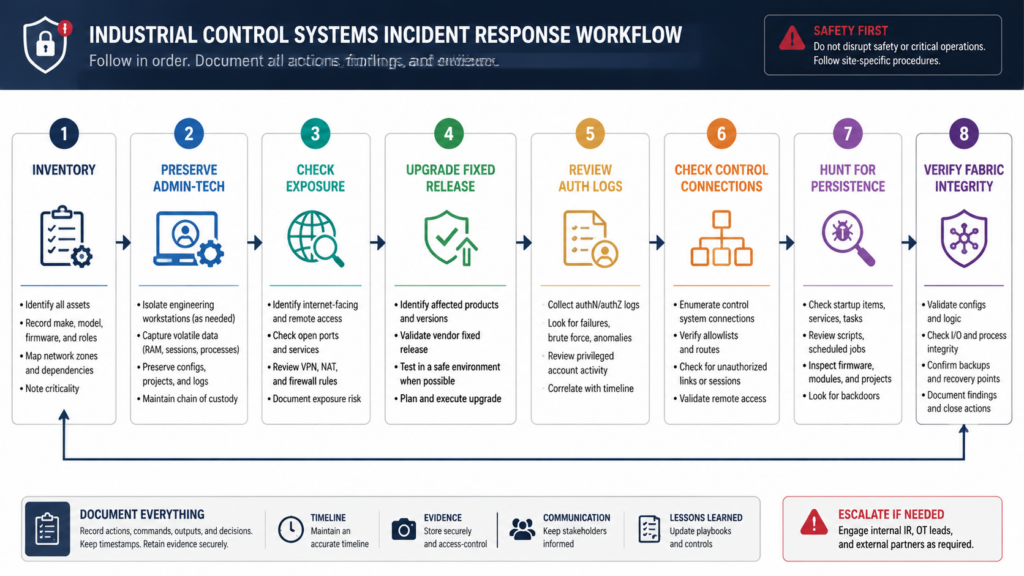
Use this playbook as a structure, not a substitute for Cisco TAC guidance or your incident response process.
| Fase | Acciones | Output |
|---|---|---|
| Alcance | Identify all Catalyst SD-WAN Controllers and Managers across on-prem, Cisco-managed, Cloud-Pro, FedRAMP, labs, standby clusters, and decommissioned-but-reachable systems | Complete asset list |
| Preserve | Ejecutar request admin-tech on each control component before upgrade | Evidence package |
| Exposición | Check firewall, VPN, cloud security group, NAT, scanner, and flow data for UDP 12346 and TCP 830 reachability | Exposure map |
| Versión | Compare installed versions to Cisco fixed releases | Patch target list |
| Parche | Upgrade to fixed release or supported later release | Remediated software |
| Device-side hunt | Review auth.log, control connection detail, control connection history, SSH keys, accounts, and logs | Compromise assessment |
| Fabric integrity | Compare current SD-WAN policy, route, certificate, and template state to expected baselines | Configuration assurance |
| Network-side hunt | Check IDS, flow logs, denied traffic, and suspicious source IPs | Attempt and intrusion context |
| Recovery | Rotate keys or credentials if evidence warrants it, rebuild if trust is lost | Restored trust boundary |
| Verificación | Confirm fixed versions, no unexpected peers, no suspicious vmanage-admin access, and normal cluster health | Closure evidence |
For organizations that run authorized validation workflows at scale, the challenge is not only finding a CVE. It is moving from “there is a critical advisory” to “these exact assets are exposed, these are the logs, this is the evidence, this is the fix, and this is the retest result.” Penligent’s broader AI-assisted penetration testing workflow focuses on guided execution, evidence generation, and reproducible reporting, which maps naturally to this kind of controlled validation and remediation proof when used only against authorized targets. (penligent.ai)
A useful companion process is risk-based vulnerability management: discover assets, prioritize by exploitability and exposure, remediate, and verify that the issue is no longer exploitable. Penligent’s 2026 vulnerability management overview frames effective programs around discovery, prioritization, remediation, verification, and reporting, which is the same lifecycle defenders need for CVE-2026-20182 once the emergency patch window opens. (penligent.ai)
Example detection logic for SIEM teams
A SIEM rule for CVE-2026-20182 should not claim to detect the vulnerability itself. It should detect behaviors that match suspicious use or follow-on activity.
Example logic for auth logs:
title: Suspicious vmanage-admin Public Key Login
status: experimental
description: Detects public key authentication to vmanage-admin from sources that should be validated against SD-WAN system IP inventory.
logsource:
  product: linux
  service: sshd
detection:
  selection:
    message|contains:
      - "Accepted publickey for vmanage-admin"
  condition: selection
fields:
  - host
  - source_ip
  - user
  - message
falsepositives:
  - Legitimate SD-WAN control component communication
  - Approved maintenance activity
level: high
This rule is intentionally incomplete without inventory enrichment. A better production version should suppress known-good System IPs and authorized management sources, then escalate unknown sources for review.
Example logic for peering events:
title: Unexpected Cisco SD-WAN Control Connection Peer
status: experimental
description: Flags control connection state changes that should be compared with expected SD-WAN topology and maintenance windows.
logsource:
  product: cisco
  service: sdwan
detection:
  selection:
    message|contains:
      - "control-connection-state-change"
      - "new-state:up"
  condition: selection
fields:
  - host
  - peer_type
  - peer_system_ip
  - public_ip
  - site_id
  - domain_id
  - timestamp
falsepositives:
  - Controller upgrades
  - Planned onboarding
  - Cisco-managed cloud operations
  - NAT changes
level: medium
This is not a drop-in rule. It is a starting point for a detection engineering conversation. The useful work is enrichment: expected peer roles, assigned system IPs, authorized public IP ranges, maintenance windows, and normal control-component behavior.
Hardening after the patch
Once the fixed release is installed and compromise review is complete, treat this incident as a chance to improve SD-WAN control-plane resilience.
| Hardening area | Recommended direction |
|---|---|
| Network access | Restrict control and management ports to known SD-WAN components and administrative networks |
| Central logging | Forward logs off-device so local log clearing does not erase evidence |
| Change control | Tie SD-WAN policy, template, route, certificate, and account changes to approved tickets |
| Config drift | Compare current SD-WAN configuration to trusted baselines |
| Key management | Review SSH authorized keys and internal service account access |
| Exposure review | Re-run external and internal exposure scans after firewall changes |
| Incident readiness | Predefine Cisco TAC escalation path and evidence collection steps |
| Upgrade hygiene | Keep unsupported release trains out of production control-plane roles |
| Threat intelligence | Track CISA KEV, Cisco advisories, Talos updates, and IDS coverage |
| Retesting | Verify that fixed versions remain deployed after failover, rollback, and cluster recovery |
Do not rely on obscurity of management networks. SD-WAN control components often sit in places that are operationally sensitive and politically difficult to patch. That is exactly why attackers value them. If a team cannot answer “who can reach UDP 12346 and TCP 830 on every control component,” it does not yet have enough control-plane visibility.
Primary sources worth reading
Cisco’s advisory should be the first reference for affected releases, fixed versions, product scope, Cisco’s detection notes, and TAC guidance. It is the source of truth for whether a release is fixed and what Cisco recommends customers do before upgrading. (Cisco)
Rapid7’s technical analysis is valuable for understanding the vdaemon handshake failure, why the vHub device type matters, how the authentication state is reached, and why NETCONF access becomes possible after the bypass. Read it carefully in a lab or defensive context, not as permission to test systems you do not own. (Rápido7)
Cisco Talos provides the campaign context: active exploitation, UAT-8616 tracking, post-compromise behavior, related SD-WAN vulnerability activity, Snort SIDs, and indicators for the broader cluster of attacks. (Blog Cisco Talos)
CISA’s KEV and Emergency Directive context matters because it confirms that this is not only theoretical. CISA added CVE-2026-20182 to KEV and directed organizations to ED 26-03 and hunt and hardening guidance for Cisco SD-WAN systems. (cisa.gov)
PREGUNTAS FRECUENTES
What is CVE-2026-20182?
- CVE-2026-20182 is a critical authentication bypass in Cisco Catalyst SD-WAN Controller and Cisco Catalyst SD-WAN Manager.
- Cisco assigns it CVSS 3.1 10.0 and CWE-287, Improper Authentication.
- The vulnerability involves peering authentication in the SD-WAN control connection path.
- A successful unauthenticated remote attack can allow access as an internal high-privileged non-root account and can lead to NETCONF access affecting SD-WAN fabric configuration. (Cisco)
Is CVE-2026-20182 being exploited in the wild?
- Yes, according to public sources.
- Cisco states PSIRT became aware of limited exploitation in May 2026.
- Cisco Talos says it is tracking active in-the-wild exploitation and clusters activity under UAT-8616.
- CISA added the vulnerability to its Known Exploited Vulnerabilities catalog. (Cisco)
Which Cisco products are affected?
- Cisco says the affected products are Cisco Catalyst SD-WAN Controller and Cisco Catalyst SD-WAN Manager.
- The older names are vSmart and vManage.
- Cisco says the vulnerability affects those products regardless of device configuration.
- Deployment types include on-premises, Cisco SD-WAN Cloud-Pro, Cisco Managed Cloud, and FedRAMP deployments. (Cisco)
Is there a workaround for CVE-2026-20182?
- Cisco says there are no workarounds that address this vulnerability.
- Access controls, segmentation, and firewall restrictions can reduce exposure, but they are not a full fix.
- The primary remediation is upgrading to a Cisco fixed software release.
- Preserve admin-tech evidence before upgrading if compromise is possible. (Cisco)
How can defenders check for possible compromise?
- Collect admin-tech files from each SD-WAN control component before upgrading.
- Review
/var/log/auth.logparaAccepted publickey for vmanage-adminfrom unknown or unauthorized IP addresses. - Ejecutar
show control connections detailyshow control connections-history detailon Controllers or Managers. - On Validators, run
show orchestrator connections detailyshow orchestrator connections-history detail. - Investigate
state:upwith nochallenge-ack, unexpected peer types, unrecognized public IPs, and changes outside maintenance windows. (Cisco)
Why is NETCONF important in this vulnerability?
- NETCONF is an administrative protocol used for configuration operations.
- NVD says successful exploitation can allow the attacker to access NETCONF and manipulate SD-WAN fabric configuration.
- Rapid7 showed that the attack path can result in SSH public key authentication to NETCONF over TCP port 830 as vmanage-admin.
- That makes the issue more serious than a simple login bypass because it can affect fabric-level configuration. (NVD)
How does CVE-2026-20182 relate to CVE-2026-20127?
- Both are critical Cisco Catalyst SD-WAN authentication bypass vulnerabilities involving control-plane trust.
- Rapid7 says CVE-2026-20182 affects the same vdaemon service family as CVE-2026-20127 but is not a patch bypass.
- Talos says UAT-8616 previously exploited CVE-2026-20127 and later performed similar post-compromise actions after CVE-2026-20182 exploitation.
- Defenders should review both historical and current exposure, because earlier compromise may leave persistence behind. (Rápido7)
What should teams do first?
- Identify every Cisco Catalyst SD-WAN Controller and Manager.
- Collect admin-tech files before upgrading.
- Confirm whether each device is on an affected release.
- Restrict reachability to control and management services while patching.
- Upgrade to Cisco’s fixed release.
- Hunt for prior compromise, especially unknown vmanage-admin public-key logins, suspicious control peers, NETCONF changes, and unknown SSH keys. (Cisco)
Closing judgment
CVE-2026-20182 is severe because it attacks the trust mechanism that SD-WAN control components depend on. The right response is not just “install the patch.” The right response is to preserve evidence, reduce exposure, upgrade, validate control-plane state, inspect logs and keys, review NETCONF-driven configuration changes, and prove that the SD-WAN fabric is back in a trusted state.
For exposed or broadly reachable deployments, treat this as an active-risk control-plane event. For isolated deployments, do not dismiss it; use the isolation as breathing room to patch cleanly and verify evidence. The deciding question is not whether the CVE looks bad on a dashboard. It is whether an unauthenticated party could have reached the control-plane service, become trusted, and left behind changes that survive after the first reboot.

 Spanish
  English
  German
  French
  Portuguese
  Japanese
  Korean
  Hindi
Hindi  Arabic
  Turkish
  Hebrew