
CVE-2026-43074 is a Linux kernel memory-safety issue that should be handled with evidence, not exploit drama. The public record describes it as an eventpoll use-after-free in fs/eventpoll.c: in certain situations, ep_free() can free the epi->ep struct eventpoll while another concurrent thread may still use it, and the fix is to defer the free through an RCU callback. NVD lists the Linux/kernel.org CNA CVSS 3.1 score as 7.8 High with a local attack vector, low attack complexity, low privileges required, no user interaction, unchanged scope, and high impact to confidentiality, integrity, and availability. NVD’s own independent CVSS assessment is not shown on the record, so the practical response should be anchored in distribution advisories, package evidence, and the kernel that is actually running on the host. (NVD)
That framing matters. A safe validation workflow for CVE-2026-43074 does not begin with a public exploit. It begins with a narrow operational question: is this system running a kernel that contains the eventpoll lifetime fix, and does this system expose realistic local code execution paths that make the issue urgent? For a kernel use-after-free, the wrong validation method can crash hosts, corrupt state, leak secrets, or turn a patch ticket into an incident. A failed proof-of-concept run also proves very little because race conditions are sensitive to timing, CPU scheduling, kernel configuration, allocator state, and hardware behavior.
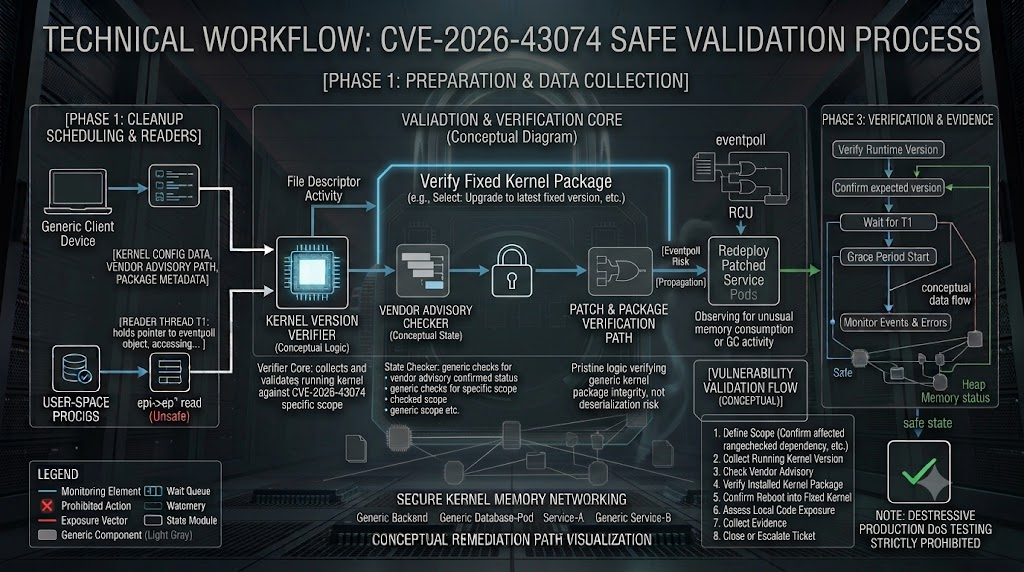
The right workflow is more disciplined. Confirm the authoritative vulnerability facts. Map them to the Linux distributions and kernel streams you run. Verify installed kernel packages. Verify the running kernel after reboot. Rank unpatched hosts by local-code exposure. Preserve enough evidence that a second engineer can reproduce your conclusion without executing exploit code. That is the difference between “we tried something scary and it did not crash” and “we can prove the vulnerable kernel path is no longer running on the systems that matter.”
CVE-2026-43074 at a glance
| Campo | Practical meaning |
|---|---|
| CVE | CVE-2026-43074 |
| Componente | Linux kernel eventpoll, implemented in fs/eventpoll.c |
| Bug class | Use-after-free caused by unsafe object lifetime handling |
| Public fix theme | Defer struct eventpoll free to an RCU grace period |
| CNA severity | CVSS 3.1 7.8 High |
| Vector de ataque | Local |
| Privileges required | Bajo |
| Interacción con el usuario | Ninguno |
| Safe validation goal | Prove fixed running kernel state and local exposure priority |
| Unsafe validation pattern | Running unreviewed kernel exploit code on production systems |
| Highest-priority environments | CI runners, shared hosts, container nodes, developer workstations with secrets, and systems that run untrusted local code |
The stable patch context provides the key technical clue. A patch mirror for the Linux stable tree shows the fix title as eventpoll: defer struct eventpoll free to RCU grace period. The diff adds an rcu_head a struct eventpoll and changes the free path from direct kfree(ep) a kfree_rcu(ep, rcu). The patch note states that ep_get_upwards_depth_proc() may still have epi->ep under RCU, so the object must not be immediately freed while that kind of reader can still reach it. (Amazon Linux)
That is the core of the vulnerability in one sentence: the kernel needed to delay reclamation of an eventpoll object because a concurrent reader could still be holding a path to it.
What epoll does, and why eventpoll lifetime is hard
epoll is Linux’s scalable I/O event notification facility. The Linux manual describes an epoll instance as maintaining an interest list, which contains file descriptors being monitored, and a ready list, which contains references to file descriptors that are ready for I/O. User-space programs create and manage epoll instances through system calls such as epoll_create, epoll_ctly epoll_wait. (man7.org)
That sounds ordinary until you look at how widely epoll sits under real software. A high-concurrency web server may use epoll to watch thousands of sockets. A reverse proxy may use it for client and upstream events. A browser may rely on it through lower-level event loops. Databases, message brokers, language runtimes, application frameworks, containerized services, and network daemons often depend on epoll directly or indirectly. Many engineering teams never write an epoll_ctl() call, but their production processes still use epoll because their runtime or framework uses it.
The security complexity comes from object relationships and concurrency. An epoll instance is represented by a file descriptor, and file descriptors have their own lifetime rules. A watched file can be duplicated. Multiple descriptors can refer to the same underlying open file description. An epoll file descriptor can itself be added to another epoll instance, although self-registration is prohibited. Cleanup can happen through explicit removal, close paths, process exit, file release callbacks, and concurrent thread activity. A safe kernel implementation has to preserve object lifetime across all of those paths.
That is not just a bookkeeping problem. It is a memory-safety problem. If one path decides an object is no longer needed and frees it while another path can still reach it, the second path may access memory that has been returned to the allocator. That is a use-after-free. In kernel space, a use-after-free can become a crash, a denial of service, data exposure, or, under the right conditions, privilege escalation.
CVE-2026-43074 is in that category. It is not about a remote packet parser. It is not about a web route. It is not fixed by changing an application setting. It is an object-lifetime bug in the kernel’s eventpoll code, and the fix uses a kernel synchronization primitive to make object reclamation safe.
The RCU detail that explains the fix
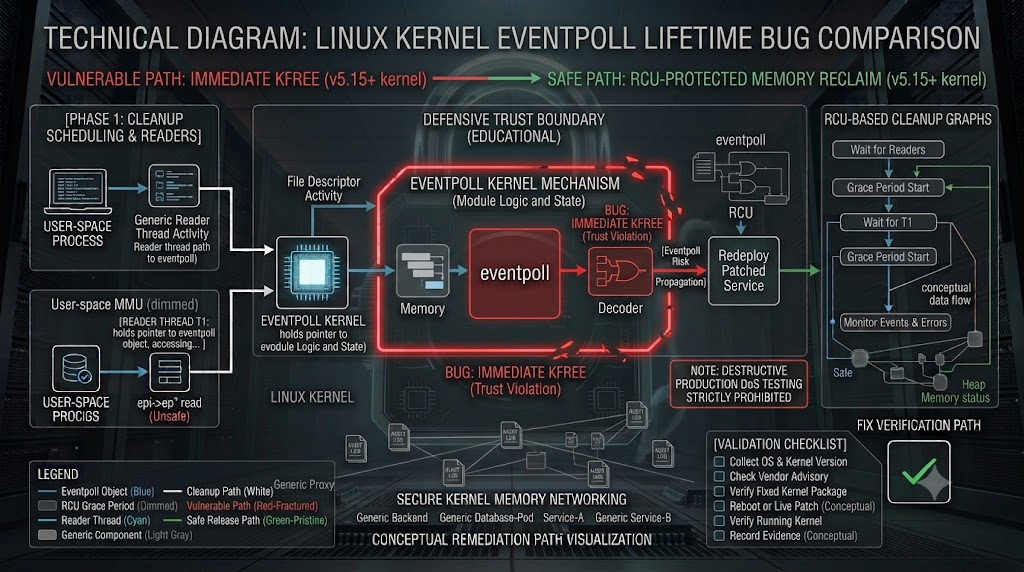
RCU, or Read-Copy-Update, is a Linux kernel synchronization mechanism designed for situations where readers are common and must be fast. The official kernel documentation describes RCU as a synchronization mechanism added during the Linux 2.5 development effort and notes that it requires a different way of thinking about concurrent code. (arXiv)
For defenders, the most important idea is not the full internal implementation of RCU. The important idea is delayed reclamation. A writer may remove an object from a data structure, but the memory backing that object must not be freed until pre-existing readers that may have observed the old pointer are safely past their read-side critical sections. In plain English: removing a pointer and freeing the object are not always the same moment.
That is why the CVE-2026-43074 patch shape is meaningful. Replacing kfree(ep) con kfree_rcu(ep, rcu) does not disable epoll. It does not remove all concurrency. It does not prove that the entire eventpoll subsystem can never have another race. It specifically delays the freeing of struct eventpoll until an RCU grace period makes the memory reclamation safe for readers that may still hold the old path.
This distinction is essential for validation. You are not looking for a runtime switch that turns CVE-2026-43074 off. You are looking for a kernel build that contains the corrected eventpoll object reclamation behavior, as provided by your upstream kernel, distribution kernel, or cloud vendor kernel stream.
Why local does not mean low risk
CVE-2026-43074 is local, not network. That is important and should not be exaggerated. A remote attacker cannot be assumed to exploit it directly by sending a single request to a service. The public vector requires local code execution with low privileges. (NVD)
But “local” does not mean “ignore.” Many serious attack chains include a local stage. An attacker may first land through a web application flaw, stolen SSH credentials, malicious dependency, compromised developer tool, CI workflow abuse, browser sandbox compromise, plugin execution path, or container workload. Once an attacker has a low-privileged process, a local kernel vulnerability can become the step that turns an application compromise into host control.
The risk is highest where local execution is normal. CI runners execute code by design. Kubernetes nodes run container processes that share the host kernel. Developer workstations often hold cloud credentials, source code, SSH keys, browser sessions, and deployment tokens. Shared bastions and multi-user systems naturally expose local privilege boundaries. In these environments, local kernel bugs matter because the first step of the chain is realistic.
| Medio ambiente | Why CVE-2026-43074 may matter | Suggested priority |
|---|---|---|
| Shared CI runner | Pull requests, dependency hooks, and build scripts execute local code | Más alto |
| Kubernetes node | Containers share the host kernel, and workloads may cross trust zones | Highest for mixed-trust clusters |
| Developer workstation | Local compromise may expose cloud tokens and source code | High when sensitive credentials exist |
| Shared bastion | Multiple users already have local shells | Alta |
| Internet-facing app server | A separate RCE could become local code execution | Medium to high depending on app exposure |
| Single-tenant internal server | Fewer local execution paths | Medio |
| Embedded or appliance Linux | Depends on whether scripts, plugins, or shells are exposed | Case-by-case |
| Vendor-marked not affected kernel stream | No direct CVE action if evidence is sound | Monitor only |
This is the practical risk model: CVE-2026-43074 is not a remote entry bug, but it can be a privilege boundary bug after local foothold. Your patch priority should follow local-code exposure, not only the abstract CVSS score.
A safe validation workflow for CVE-2026-43074
A useful validation objective is simple:
Determine whether each in-scope Linux host is running a kernel that contains the CVE-2026-43074 eventpoll fix, rank any unpatched hosts by local-code exposure, and produce evidence without running exploit code.
That objective keeps the team focused. It avoids the common failure mode of turning a kernel patch question into an uncontrolled exploitation exercise.
Step 1, define scope and authorization
Start with the systems you are allowed to inspect. Include cloud instances, bare-metal servers, Kubernetes nodes, CI runners, developer workstations, bastion hosts, lab systems, and embedded Linux devices under your control. Exclude third-party systems unless you have explicit written authorization.
For each asset group, record the operating owner, maintenance window, acceptable validation method, reboot owner, and evidence location.
Asset group:
Business owner:
System owner:
Allowed validation method:
Maintenance window:
Kernel update owner:
Reboot owner:
Local untrusted code exposure:
Evidence storage location:
Reviewer:
The allowed validation method should usually be “read-only patch and kernel state checks.” For a lab kernel team, deeper stress testing may be appropriate. For production application teams, exploit execution should not be part of normal closure.
Step 2, capture the running kernel and OS identity
The first technical fact is the running kernel, not the package you hope is installed. These commands are read-only and safe on systems you administer.
uname -a
uname -r
cat /etc/os-release
uptime -s 2>/dev/null || who -b
cat /proc/cmdline
Preserve the output with timestamps.
mkdir -p cve-2026-43074-evidence

{
  echo "Collected UTC: $(date -u)"
  echo "Hostname: $(hostname -f 2>/dev/null || hostname)"
  echo
  echo "== Running kernel =="
  uname -a
  echo
  echo "== Kernel release =="
  uname -r
  echo
  echo "== OS release =="
  cat /etc/os-release 2>/dev/null || true
  echo
  echo "== Boot time =="
  uptime -s 2>/dev/null || who -b || true
  echo
  echo "== Kernel command line =="
  cat /proc/cmdline 2>/dev/null || true
} | tee cve-2026-43074-evidence/kernel-baseline.txt
This does not prove the host is fixed. It proves the current state you are evaluating.
Step 3, check distribution advisories and package status
The upstream Linux version range is useful, but enterprise systems usually run distribution kernels with backports. Debian, SUSE, Amazon Linux, Red Hat, Ubuntu, and other vendors may carry security fixes without moving to the exact upstream version that first contained the patch. Debian’s security tracker lists CVE-2026-43074 as a Linux kernel issue and publishes fixed package versions by Debian release. (Debian Security Tracker) SUSE publishes its own CVE page and rating for the issue. (suse.com) Amazon Linux lists CVE-2026-43074 in ALAS data and identifies affected or fixed kernel streams for Amazon Linux 2023. (Explore AWS)
On Debian or Ubuntu family systems:
KREL="$(uname -r)"

echo "Running kernel: $KREL"
echo

echo "Installed Linux image packages:"
dpkg -l | awk '/linux-image|linux-modules|linux-headers/ {print $1, $2, $3}' | sort

echo
echo "Package policy for the running kernel package, if present:"
apt-cache policy "linux-image-${KREL}" 2>/dev/null || true

echo
echo "Upgradeable kernel-related packages:"
apt list --upgradable 2>/dev/null | grep -E '^linux-image|^linux-headers|^linux-modules' || true
On DNF-based systems:
echo "Running kernel:"
uname -r

echo
echo "Installed kernel packages:"
rpm -qa 'kernel*' | sort

echo
echo "Vendor advisory data for CVE-2026-43074, if available:"
sudo dnf updateinfo info --cve CVE-2026-43074 || true

echo
echo "Kernel changelog hints:"
rpm -q --changelog kernel 2>/dev/null | grep -i -C 3 'CVE-2026-43074\|eventpoll\|kfree_rcu' || true
On SUSE systems:
echo "Running kernel:"
uname -r

echo
echo "Installed kernel packages:"
rpm -qa 'kernel*' | sort

echo
echo "SUSE patches for CVE-2026-43074:"
zypper lp --cve CVE-2026-43074 || true

echo
echo "Kernel changelog hints:"
rpm -q --changelog kernel-default 2>/dev/null | grep -i -C 3 'CVE-2026-43074\|eventpoll\|kfree_rcu' || true
These commands do not trigger the vulnerability. They collect package and advisory evidence.
Step 4, distinguish installed from running
Kernel updates normally require a reboot. A fixed kernel package sitting on disk does not protect the host if the machine is still running the old kernel. This is one of the most common false closures for kernel CVEs.
Use this pattern:
echo "Running kernel:"
uname -r

echo
echo "Installed kernel packages:"
if command -v rpm >/dev/null 2>&1; then
  rpm -qa 'kernel*' | sort
elif command -v dpkg >/dev/null 2>&1; then
  dpkg -l | awk '/linux-image|linux-modules|linux-headers/ {print $2, $3}' | sort
fi

echo
echo "Boot time:"
uptime -s 2>/dev/null || who -b || true

echo
echo "Reboot indicators:"
test -f /var/run/reboot-required && cat /var/run/reboot-required || true
command -v needrestart >/dev/null 2>&1 && needrestart -k || true
Then classify the host.
| State | Significado | Acción |
|---|---|---|
| Fixed package installed and fixed kernel running | Host is likely remediated for this CVE, subject to vendor advisory accuracy | Preserve evidence |
| Fixed package installed but old kernel running | Patch is staged but inactive | Reboot during an approved window |
| No fixed package available | Host may remain exposed unless vendor marks not affected | Escalate to OS owner or vendor |
| Vendor marks kernel stream not affected | No patch action for this CVE if evidence is sound | Preserve vendor evidence |
| Container image updated but node kernel unchanged | Kernel risk is unchanged | Patch or replace the host or node |
| Scanner flags upstream version but vendor backport is fixed | Scanner needs override evidence | Attach vendor changelog and running kernel proof |
This distinction should appear in your ticket template. “Package installed” is not enough. “Running fixed kernel after reboot” is the closure condition.
Step 5, rank hosts by local-code exposure
Once patch state is known, prioritize unpatched systems by the likelihood that an attacker can run local code. CVE-2026-43074 requires local execution, so the exposure model is the heart of the risk decision.
A practical priority model:
P0:
Affected kernel running, untrusted local code executes regularly, secrets or tenant boundaries are at risk.

P1:
Affected kernel running, local code execution is plausible through services, users, plugins, or containers.

P2:
Fixed kernel package installed but reboot pending, or affected kernel running in a low-exposure environment.

P3:
Vendor marks not affected, or fixed kernel is running and evidence is complete.
Examples:
| Asset | Patch state | Local-code exposure | Prioridad |
|---|---|---|---|
| Shared CI runner | Affected running kernel | External pull-request jobs | P0 |
| Kubernetes node | Affected running kernel | Mixed-trust workloads | P0 or P1 |
| Bastion host | Affected running kernel | Many low-privileged users | P1 |
| Web app server | Affected running kernel | No shell users, but internet-facing app | P1 or P2 |
| Internal database host | Reboot pending | Restricted local users | P2 |
| Vendor-not-affected appliance | Vendor evidence present | No local code path | P3 |
This model avoids two bad extremes: ignoring the CVE because it is local, or treating every Linux host as equally urgent without considering how attackers could reach the local boundary.
Step 6, collect evidence that can survive review
A defensible CVE-2026-43074 evidence bundle should include:
Host or asset ID
OS distribution and release
Running kernel version
Installed kernel package version
Vendor advisory or package changelog source
Reboot timestamp
Local-code exposure rating
Validation command output
Remediation ticket or change record
Reviewer and date
Residual risk notes
A simple read-only collection script:
#!/usr/bin/env bash
set -u

OUT="cve-2026-43074-$(hostname 2>/dev/null || echo host)-$(date -u +%Y%m%dT%H%M%SZ).txt"

{
  echo "CVE-2026-43074 safe validation evidence"
  echo "Collected UTC: $(date -u)"
  echo

  echo "== Host identity =="
  hostname -f 2>/dev/null || hostname
  echo

  echo "== OS release =="
  cat /etc/os-release 2>/dev/null || true
  echo

  echo "== Running kernel =="
  uname -a
  echo

  echo "== Kernel release =="
  uname -r
  echo

  echo "== Boot time =="
  uptime -s 2>/dev/null || who -b || true
  echo

  echo "== Installed kernel packages =="
  if command -v rpm >/dev/null 2>&1; then
    rpm -qa 'kernel*' | sort
  elif command -v dpkg >/dev/null 2>&1; then
    dpkg -l | awk '/linux-image|linux-modules|linux-headers/ {print $1, $2, $3}' | sort
  else
    echo "No rpm or dpkg found"
  fi
  echo

  echo "== Advisory data, if supported by local package manager =="
  if command -v dnf >/dev/null 2>&1; then
    dnf updateinfo info --cve CVE-2026-43074 || true
  fi
  if command -v zypper >/dev/null 2>&1; then
    zypper lp --cve CVE-2026-43074 || true
  fi
  if command -v apt-cache >/dev/null 2>&1; then
    apt-cache policy "linux-image-$(uname -r)" || true
  fi
} | tee "$OUT"

echo "Evidence written to $OUT"
The script does not fuzz epoll, manipulate kernel memory, run exploit payloads, scan third-party systems, or attempt privilege escalation. It is safe because it answers a state question.
A safe PoC model for the bug class
A PoC for a kernel use-after-free can easily cross a line from education into weaponization. The following example is intentionally not a CVE-2026-43074 exploit. It does not call epoll. It does not access kernel memory. It does not attempt privilege escalation. It only demonstrates the object-lifetime pattern behind a use-after-free: one thread frees an object while another thread still holds a pointer.
Run it only in a local temporary directory you control. If your compiler supports AddressSanitizer, it should make the unsafe access visible. Without AddressSanitizer, the program may appear to work, which is also an important lesson: a memory-safety bug does not always crash on demand.
// uaf_lifetime_demo.c
// Safe toy model for object lifetime risk.
// This is not a Linux kernel exploit and does not reproduce CVE-2026-43074.

#include <pthread.h>
#include <stdio.h>
#include <stdlib.h>
#include <unistd.h>

struct demo_object {
    int generation;
    char label[32];
};

static struct demo_object *shared;

void *reader_thread(void *arg) {
    (void)arg;

    // The reader snapshots the shared pointer.
    struct demo_object *local = shared;

    // Simulate a concurrent read path that lasts longer than the owner expects.
    usleep(100000);

    // If the owner freed local, this is a use-after-free.
    printf("reader saw generation=%d label=%s\n", local->generation, local->label);
    return NULL;
}

void *owner_thread(void *arg) {
    (void)arg;

    // Free the object before the reader wakes up.
    usleep(20000);

    free(shared);
    shared = NULL;

    return NULL;
}

int main(void) {
    shared = malloc(sizeof(*shared));
    if (!shared) {
        perror("malloc");
        return 1;
    }

    shared->generation = 42;
    snprintf(shared->label, sizeof(shared->label), "demo-object");

    pthread_t reader;
    pthread_t owner;

    pthread_create(&reader, NULL, reader_thread, NULL);
    pthread_create(&owner, NULL, owner_thread, NULL);

    pthread_join(reader, NULL);
    pthread_join(owner, NULL);

    return 0;
}
Compile it locally:
cc -O0 -g -pthread -fsanitize=address uaf_lifetime_demo.c -o uaf_lifetime_demo
./uaf_lifetime_demo
This toy program maps to CVE-2026-43074 only at the concept level.
| Toy model | CVE-2026-43074 concept |
|---|---|
shared pointer | A reachable kernel object pointer |
| Reader thread | A concurrent read-side path |
| Owner thread | Cleanup or release path |
free(shared) before reader finishes | Object reclamation before all readers are safe |
| AddressSanitizer report | Lab memory-safety signal, not exploitability proof |
| Safer design | Delay reclamation or enforce object lifetime until readers finish |
A safer user-space version can model explicit lifetime management with reference counting.
// lifetime_fixed_demo.c
// Safe toy model for protecting object lifetime.
// This is a teaching model, not the kernel RCU implementation.

#include <pthread.h>
#include <stdio.h>
#include <stdlib.h>
#include <unistd.h>
#include <stdatomic.h>

struct demo_object {
    atomic_int refs;
    int generation;
    char label[32];
};

static struct demo_object *shared;
static pthread_mutex_t lock = PTHREAD_MUTEX_INITIALIZER;

static struct demo_object *get_object(void) {
    pthread_mutex_lock(&lock);
    struct demo_object *obj = shared;
    if (obj) {
        atomic_fetch_add(&obj->refs, 1);
    }
    pthread_mutex_unlock(&lock);
    return obj;
}

static void put_object(struct demo_object *obj) {
    if (atomic_fetch_sub(&obj->refs, 1) == 1) {
        free(obj);
    }
}

void *reader_thread(void *arg) {
    (void)arg;

    struct demo_object *local = get_object();
    if (!local) {
        return NULL;
    }

    usleep(100000);
    printf("reader saw generation=%d label=%s\n", local->generation, local->label);

    put_object(local);
    return NULL;
}

void *owner_thread(void *arg) {
    (void)arg;

    usleep(20000);

    pthread_mutex_lock(&lock);
    struct demo_object *old = shared;
    shared = NULL;
    pthread_mutex_unlock(&lock);

    if (old) {
        put_object(old);
    }

    return NULL;
}

int main(void) {
    shared = malloc(sizeof(*shared));
    if (!shared) {
        perror("malloc");
        return 1;
    }

    atomic_init(&shared->refs, 1);
    shared->generation = 42;
    snprintf(shared->label, sizeof(shared->label), "demo-object");

    pthread_t reader;
    pthread_t owner;

    pthread_create(&reader, NULL, reader_thread, NULL);
    pthread_create(&owner, NULL, owner_thread, NULL);

    pthread_join(reader, NULL);
    pthread_join(owner, NULL);

    return 0;
}
Compile it:
cc -O0 -g -pthread -fsanitize=address lifetime_fixed_demo.c -o lifetime_fixed_demo
./lifetime_fixed_demo
This fixed toy example uses reference counting, not RCU. The real kernel fix for CVE-2026-43074 uses RCU-delayed freeing for the relevant eventpoll object. The purpose of the example is limited and safe: it helps defenders understand why freeing an object before concurrent readers are done can become a use-after-free, and why delayed reclamation can be the correct class of fix.
What not to do
Do not run unreviewed public exploit code on production hosts. Kernel exploit code can crash a machine, corrupt memory, disable defenses, leak secrets, or leave the host in a state that is difficult to trust. Even code labeled as a “checker” may contain destructive behavior, architecture assumptions, hidden network calls, or unreliable timing loops.
Do not treat a failed exploit run as proof of safety. Race-condition exploits often fail on vulnerable systems because the timing is wrong. A different CPU count, preemption model, allocator state, kernel configuration, container boundary, or mitigation setting can change behavior.
Do not treat scanner output as final. A scanner may flag an upstream version range without understanding vendor backports. It may also report kernel CVEs from inside container images even though the host kernel is what matters.
Do not close the finding after installing a kernel package unless the system has rebooted into the fixed kernel. Kernel patch closure requires running-state evidence.
Do not assume that fixing CVE-2026-43074 fixes every eventpoll race. Nearby lifetime bugs can be separate. CVE-2026-46242, widely discussed as Bad Epoll, is another eventpoll use-after-free issue with a different root path and a different fix shape. NVD describes it as an ep_remove y struct file use-after-free involving a concurrent __fput() path, not the same exact lifetime fix as CVE-2026-43074. (NVD)
Detection logic without exploit signatures
Detection for CVE-2026-43074 should be realistic. A timing-sensitive kernel object-lifetime bug is not a noisy web exploit with a reliable request signature. A clean production detector may not exist. Patch state is the primary control.
Use three layers.
The first layer is vulnerability state:
Is the host running a kernel stream affected by CVE-2026-43074?
Has the vendor shipped a fixed kernel package?
Is the fixed package installed?
Has the host rebooted into the fixed kernel?
Does the vendor mark this stream not affected?
The second layer is local-code exposure:
Does the host execute untrusted builds?
Does it run containers from different trust zones?
Does it allow many low-privileged users?
Does it hold high-value secrets?
Can an internet-facing service realistically become a local service process?
The third layer is anomaly monitoring. Kernel memory-corruption attempts may produce oopses, panics, RCU stalls, KASAN reports, general protection faults, unexpected reboots, or suspicious post-compromise behavior. These are not CVE-specific signals, but they can matter during incident review.
Useful read-only checks:
journalctl -k --no-pager | grep -Ei 'oops|BUG:|general protection|use-after-free|KASAN|slab|RCU stall|panic' || true
journalctl -k -b -1 --no-pager | grep -Ei 'oops|BUG:|general protection|KASAN|panic' || true
last -x | head -50
Short-term syscall auditing can help in a lab or high-sensitivity diagnostic window, but epoll is common enough that blanket monitoring can be noisy.
# Lab or short diagnostic window only.
sudo auditctl -a always,exit -F arch=b64 -S epoll_create1 -S epoll_ctl -S epoll_wait -k epoll_activity
sudo ausearch -k epoll_activity | tail -100

# Remove after the diagnostic window.
sudo auditctl -d always,exit -F arch=b64 -S epoll_create1 -S epoll_ctl -S epoll_wait -k epoll_activity
This is not a CVE-2026-43074 exploit detector. It is a controlled way to understand local epoll activity when needed. For normal enterprise response, kernel patch state and reboot evidence are stronger.
Remediation workflow
The durable fix is a vendor kernel update that includes the CVE-2026-43074 eventpoll fix, followed by a reboot into that kernel. Temporary controls can reduce exposure, but they do not remove the vulnerable code path from a running kernel.
For Debian or Ubuntu family systems:
sudo apt update
sudo apt full-upgrade
sudo reboot
After reboot:
uname -r
cat /etc/os-release
dpkg -l | awk '/linux-image|linux-modules|linux-headers/ {print $2, $3}' | sort
For DNF-based systems:
sudo dnf updateinfo info --cve CVE-2026-43074 || true
sudo dnf upgrade --security
sudo reboot
After reboot:
uname -r
rpm -qa 'kernel*' | sort
For SUSE systems:
sudo zypper refresh
sudo zypper lp --cve CVE-2026-43074
sudo zypper patch
sudo reboot
After reboot:
uname -r
rpm -qa 'kernel*' | sort
For Amazon Linux 2023, use the ALAS advisory and kernel stream that applies to the host. Amazon’s advisory data for CVE-2026-43074 identifies the issue in the Linux kernel and shows fixed status for relevant Amazon Linux 2023 kernel streams, so the validation step is to match the host to its stream, install the fixed kernel package, and reboot into it. (Explore AWS)
If you cannot reboot immediately, document the gap. Temporary actions may include pausing shared CI workloads, moving untrusted jobs to fixed runners, disabling privileged containers, reducing shell access, rotating exposed secrets, or isolating sensitive workloads. Those actions reduce opportunity and impact. They do not equal remediation.
Kubernetes and container environments
CVE-2026-43074 is a host kernel issue. Updating a container image does not fix the host kernel because containers share the kernel of the node. A container scanner may surface the CVE in a confusing way, but the remediation target is the node OS, managed node image, custom AMI, bare-metal host, or device kernel.
For Kubernetes, start with node inventory:
kubectl get nodes -o wide

kubectl get nodes -o jsonpath='{range .items[*]}{.metadata.name}{"\t"}{.status.nodeInfo.osImage}{"\t"}{.status.nodeInfo.kernelVersion}{"\n"}{end}'
Then map each node to the owner of its kernel:
| Node type | Correct remediation |
|---|---|
| Managed node group | Upgrade or roll the node group image |
| Self-managed VM node | Apply OS kernel update and reboot or replace node |
| Bare-metal node | Patch through the OS vendor and reboot |
| Immutable node image | Build a fixed image and replace old nodes |
| Container image only | Not sufficient |
A careful node rollout may look like this:
kubectl cordon NODE_NAME
kubectl drain NODE_NAME --ignore-daemonsets --delete-emptydir-data

# Patch, reboot, or replace the node outside Kubernetes.

kubectl uncordon NODE_NAME
For mixed-trust clusters, CVE-2026-43074 should move up the queue. A local kernel bug is more serious when different teams, customers, or trust zones share a node. If every workload on a node belongs to the same tightly controlled service, the priority may be lower, but the patch still belongs in the normal kernel maintenance cycle.
CI runner environments
CI runners are one of the most important environments for CVE-2026-43074 because they execute code by design. Pull-request builds, dependency install hooks, test scripts, package lifecycle scripts, generated code, container builds, and integration tests all create local execution.
Rank these runner patterns highest:
| Runner pattern | Por qué es importante | Acción |
|---|---|---|
| Shared runners for external PRs | Untrusted code runs locally | Patch or replace immediately |
| Privileged Docker runners | Workloads may reach a wider kernel attack surface | Patch and reduce privilege |
| Long-lived mutable runners | State persists across jobs | Prefer ephemeral runners |
| Runners with deployment tokens | Local compromise can become cloud compromise | Patch and reduce secrets |
| Multi-project runners | One project may affect another | Separate trust zones |
| Single-project trusted runner | Lower exposure | Patch in maintenance window |
Do not validate a runner by adding exploit execution to a build job. That normalizes dangerous behavior and can leave artifacts in logs, caches, and worker state. Validate runner images, host kernels, reboot timestamps, and isolation controls instead.
Handling scanner findings and vendor backports
Scanner findings are useful starting points, but Linux kernel CVEs often require interpretation. A scanner may compare the running kernel string to an upstream affected range. That can be wrong when a distribution backports the fix. It can also be incomplete when a fixed package is installed but the old kernel is still running.
Use this order of trust:
- Running kernel evidence from the host.
- Vendor advisory for the exact distribution and kernel stream.
- Installed package version and changelog.
- Upstream kernel commit status.
- Scanner result.
- Generic CVE summary.
A strong false-positive closure might read:
Scanner flagged CVE-2026-43074 because the upstream kernel version appears in an affected range.
Host is running VendorLinux kernel X.Y.Z-build.
Vendor advisory VENDOR-SA-YYYY-NNNN states this kernel stream contains the backported eventpoll RCU-delayed free fix.
Installed package version is X.Y.Z-build.
Host rebooted into that kernel at UTC timestamp.
Conclusion: accepted as remediated for CVE-2026-43074, pending normal advisory monitoring.
A weak closure says:
Scanner is probably wrong because the CVE is local.
That is not evidence. Local attack vector affects priority, not vulnerability truth.
Related CVEs that clarify the risk
CVE-2026-46242, Bad Epoll, is the closest conceptual neighbor. NVD describes it as a Linux kernel eventpoll use-after-free involving ep_remove, struct file, and a concurrent __fput() path. (NVD) Public security reporting describes Bad Epoll as a local race use-after-free that can let an unprivileged local user gain root on affected Linux and Android systems, and notes that epoll is widely used by servers, network services, and browsers. (Noticias Hacker) The relevance is not that CVE-2026-43074 and Bad Epoll are identical. They are not. The relevance is that adjacent eventpoll lifetime bugs can exist in the same subsystem, and a patch for one race does not prove that all nearby races are gone.
CVE-2026-31431, often discussed as Copy Fail, is a different Linux kernel local privilege escalation in the algif_aead cryptographic interface. NVD describes the fix as reverting in-place operation because the source and destination come from different mappings and the added complexity was unnecessary. (NVD) CISA added CVE-2026-31431 to its Known Exploited Vulnerabilities catalog based on evidence of active exploitation, which shows how quickly local kernel issues can become urgent when exploitability and public attention converge. (CISA) The relation to CVE-2026-43074 is operational: local kernel flaws should be prioritized by exposure and exploit context, not dismissed by the word “local.”
CVE-2016-5195, Dirty COW, is the historical reminder. NVD describes it as a race condition in Linux mm/gup.c that allowed local users to gain privileges through incorrect copy-on-write handling and notes that it was exploited in the wild in October 2016. (NVD) Dirty COW is a different bug class and a different subsystem, but it remains one of the clearest examples of why local kernel races can have broad real-world impact.
Evidence-driven automation, with guardrails
Automation can make CVE-2026-43074 validation safer when it is used to collect evidence, not to execute exploits. A good automated workflow can inventory kernels, enrich scanner findings with vendor advisories, detect reboot-pending hosts, rank local execution exposure, generate change tickets, and attach proof after remediation. A bad automated workflow downloads public PoCs and runs them across a fleet.
For teams using AI-assisted security workflows, the guardrail is straightforward: the agent should help build the validation record, not perform uncontrolled exploitation. It can generate read-only commands, compare vendor advisories, summarize changelog evidence, draft remediation tickets, and produce a report that separates confirmed facts from assumptions. Penligent’s AI pentesting material describes evidence-driven testing and reporting in authorized workflows, which is relevant when the task is controlled vulnerability validation rather than exploit chasing. (Penligente)
The nearby Bad Epoll case is a useful companion topic because it shows why eventpoll lifecycle bugs need careful separation. Penligent’s Bad Epoll analysis explicitly compares CVE-2026-46242 with CVE-2026-43074 and treats CVE-2026-43074 as the related eventpoll use-after-free fixed with RCU-delayed free. (Penligente) That kind of comparison is useful in a validation workflow because it prevents teams from closing one eventpoll finding and accidentally ignoring a distinct adjacent CVE.
Common mistakes in CVE-2026-43074 validation
The first mistake is relying only on CVSS. The 7.8 High score is important, but it does not know whether your host executes untrusted pull requests, stores production credentials, or runs mixed-tenant workloads. Local context decides urgency.
The second mistake is relying only on upstream version matching. Vendor backports can make an older-looking kernel fixed. Vendor lag can also leave a stream exposed. Use the advisory for the distribution and kernel stream you actually run.
The third mistake is closing after package installation but before reboot. Kernel fixes become active after the host boots into the fixed kernel.
The fourth mistake is treating container image updates as kernel remediation. A container image is not the host kernel.
The fifth mistake is using public exploit code as a production checker. That approach is risky and often inconclusive.
The sixth mistake is ignoring local-code exposure. A host that runs untrusted CI jobs deserves faster action than a tightly controlled single-purpose system.
The seventh mistake is assuming CVE-2026-43074 and Bad Epoll are the same issue. They are related by subsystem and bug class, but they have distinct CVE records and fix paths.
Practical ticket language
For an affected host with high exposure:
CVE-2026-43074 is a Linux kernel eventpoll use-after-free fixed by deferring struct eventpoll reclamation through RCU. The public CNA CVSS 3.1 score is 7.8 High and the attack vector is local with low privileges required. This host runs untrusted CI workloads, so local code execution is realistic. Update the kernel through the vendor-supported package stream and reboot into the fixed kernel. Attach running kernel, package version, advisory mapping, and reboot timestamp before closure.
For a reboot-pending host:
Kernel package containing the CVE-2026-43074 fix appears installed, but the running kernel remains the previous release. The host must reboot into the fixed kernel before this finding can be closed.
For a vendor-backported fix:
Scanner flagged CVE-2026-43074 based on upstream version range. Vendor advisory confirms this kernel stream contains the backported eventpoll fix. Running kernel and package evidence are attached. Accepted as remediated for this CVE, pending normal advisory monitoring.
For a not-affected stream:
Vendor advisory marks this kernel stream not affected by CVE-2026-43074. Running kernel, OS release, and advisory evidence are attached. No remediation action required for this CVE at this time.
Precise language reduces friction between security, infrastructure, compliance, and application teams. It also prevents overclaiming.
PREGUNTAS FRECUENTES
What is CVE-2026-43074 in plain English?
- CVE-2026-43074 is a Linux kernel
eventpolluse-after-free vulnerability. - The issue involves
ep_free()freeing astruct eventpollwhile another concurrent path may still use it. - The public fix delays freeing through RCU so readers have time to finish safely.
- It is a local kernel issue, not a remote web vulnerability.
Is CVE-2026-43074 remotely exploitable?
- The public CVSS vector lists the attack vector as local.
- A remote attacker generally needs another foothold first, such as web RCE, stolen credentials, malicious dependency execution, or container workload execution.
- The vulnerability can still matter in real attacks because local kernel bugs often act as second-stage privilege escalation.
- Prioritize systems where untrusted local code can realistically run.
How do I safely validate CVE-2026-43074 on Linux?
- Check the running kernel with
uname -r. - Identify the OS and release with
/etc/os-release. - Compare the host against your distribution or cloud vendor advisory.
- Verify the installed kernel package and changelog.
- Confirm the host rebooted into the fixed kernel.
- Avoid running public exploit code on production systems.
Does updating a container image fix CVE-2026-43074?
- No.
- Containers share the host kernel.
- Updating a container base image may fix user-space packages inside the image, but it does not replace the node or host kernel.
- Kubernetes remediation should happen at the node image, OS package, managed node group, AMI, or bare-metal host level.
Should I run a public exploit to confirm exposure?
- Not on production systems.
- Kernel exploit code can crash machines, corrupt memory, or create security incidents.
- A failed exploit attempt does not prove safety because race bugs are timing-sensitive.
- Use vendor advisories, package evidence, running kernel checks, reboot proof, and isolated lab modeling instead.
Why does a local kernel bug matter for cloud and CI systems?
- CI runners execute local code by design.
- Container workloads share the host kernel.
- Developer workstations and build hosts often hold valuable credentials.
- A local kernel bug can turn a low-privileged process into host-level control.
- Patch priority should reflect how easily an attacker can reach local execution.
How is CVE-2026-43074 related to Bad Epoll?
- Both involve Linux eventpoll lifetime safety.
- CVE-2026-43074 is fixed by delaying
struct eventpollfreeing through RCU. - CVE-2026-46242, Bad Epoll, is a distinct eventpoll use-after-free involving
ep_remove,struct file, and a concurrent file release path. - Treat them as related but separate findings, and validate each according to vendor advisories.
Closing judgment
CVE-2026-43074 rewards careful operations. The safest response is not to prove root compromise. It is to prove that vulnerable kernel code is no longer running where local attackers can reach it. A strong validation record ties together the CVE facts, vendor advisory, installed package, running kernel, reboot timestamp, local-code exposure, and remediation evidence. For a kernel eventpoll use-after-free, that evidence chain is more useful than an exploit run, more repeatable than a crash test, and safer for the systems you are responsible for protecting.
 Spanish
  English
  German
  French
  Portuguese
  Japanese
  Korean
  Hindi
Hindi  Arabic
  Turkish
  Hebrew