
External network penetration testing should determine what an authorized attacker can reach and validate from the public internet. It should not turn every discovered hostname into implicit permission, nor should it report banner versions as confirmed compromise without checking prerequisites and active configuration.
Build an ownership-aware scope
Provide domains, IP ranges, autonomous systems, cloud accounts, subsidiaries, acquired brands and known third-party services. Mark assets as in scope, discovery-only or excluded. Define how the tester should handle newly discovered infrastructure.
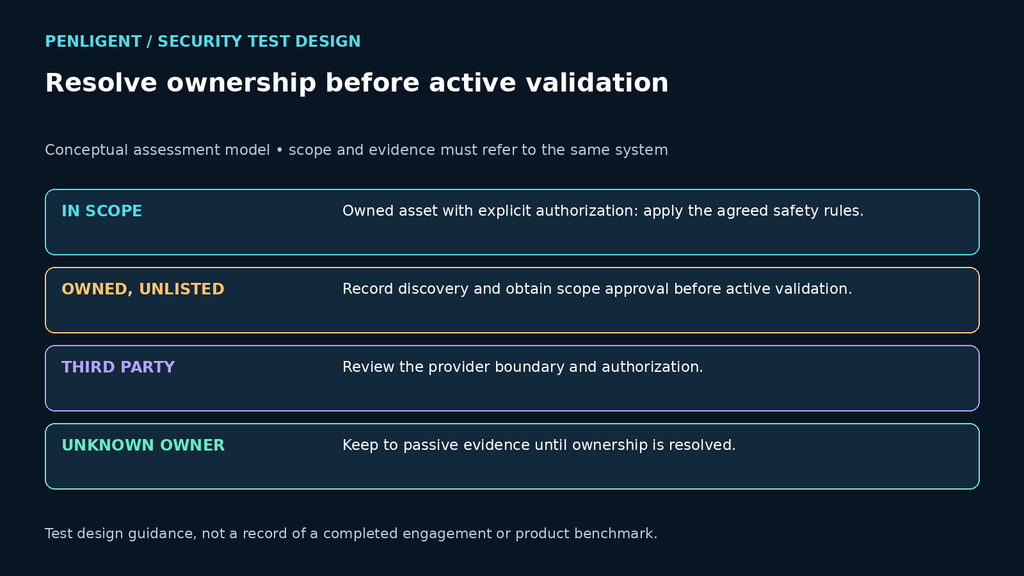
| Asset state | Allowed action | Required decision |
|---|---|---|
| Confirmed owned and in scope | Perform approved discovery and validation | Apply rate and safety rules |
| Owned but not listed | Record and pause active validation | Obtain written scope expansion |
| Third-party hosted service | Identify exposure without intrusive testing | Review provider authorization and contract |
| Unknown ownership | Use passive evidence only | Resolve ownership before testing |
Explore Penligent for authorized security testing
The NIST testing guide provides a planning and execution foundation. For prioritization, consult authoritative vendor advisories and the CISA KEV catalog, but do not infer that every matching version is exploitable in the observed deployment.
Discovery versus validation
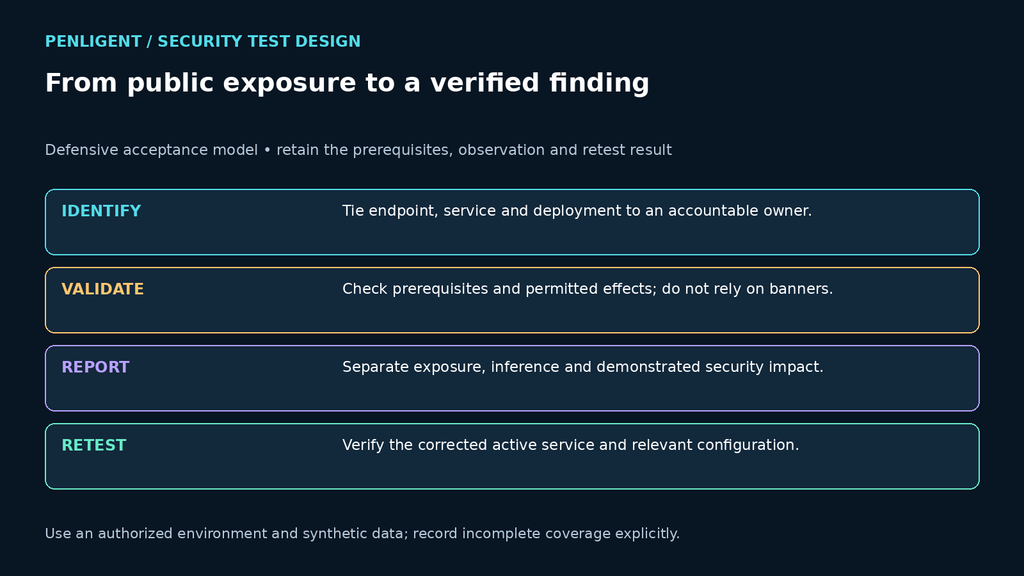
Discovery maps DNS, services, certificates, exposed applications and management interfaces. Validation determines whether a security property is actually broken. Record which evidence comes from fingerprinting, authenticated inspection, configuration, safe interaction or demonstrated impact.
Common testing objectives
- internet-exposed management and remote-access services;
- authentication, default or weak configuration and legacy protocols;
- public web applications and APIs;
- cloud storage, load balancers and origin exposure;
- email and identity infrastructure;
- DNS, certificate and abandoned-service risks;
- known vulnerabilities with validated prerequisites;
- segmentation between the perimeter and sensitive internal systems.
Safe exploitation boundaries
Define whether the tester may authenticate, upload harmless files, execute non-destructive commands, create accounts or pivot. Prohibit persistence, destructive actions, customer-data access and denial of service unless a separately approved scenario requires them. Use proof markers and reversible actions.
Evidence requirements
A finding should identify the asset, ownership, service, active version or configuration evidence, prerequisites and demonstrated impact. It should distinguish exposure from exploitability. For cloud or proxy-fronted services, identify whether the observed endpoint is the true origin and which party controls remediation.
Credentials and assumed breach
An external test can include a limited assumed-breach path using synthetic credentials or an authorized foothold. Keep it distinct from the unauthenticated perimeter result. Document the identity, privileges and network position so readers understand what the test proves.
Reporting and retest
Group duplicate services and shared root causes. Provide an asset appendix, scope limitations, verified findings and an exposure inventory that operations can reconcile. During retest, confirm the active service and configuration rather than accepting a ticket or package update alone.
Provider questions
- How do you validate ownership before active testing?
- How do you control scan rate and distributed workers?
- Which exploitation actions require additional approval?
- How do you distinguish version matches from validated exposure?
- How are critical findings communicated during the engagement?
- What evidence and asset data can be exported?
Explore Penligent for authorized security testing
Make the purchase measurable
An external network pentest should reduce uncertainty about real internet exposure while respecting ownership and operational safety. Evaluate Penligent or another provider by scope control, validation quality and remediation evidence.
The following Penligent overview introduces a general authorized testing workflow. It does not demonstrate that every assessment capability discussed in this guide is included in a particular product plan.
 English
 German
 French
 Spanish
 Portuguese
 Japanese
 Korean
 Hindi
 Arabic
 Turkish
 Hebrew