
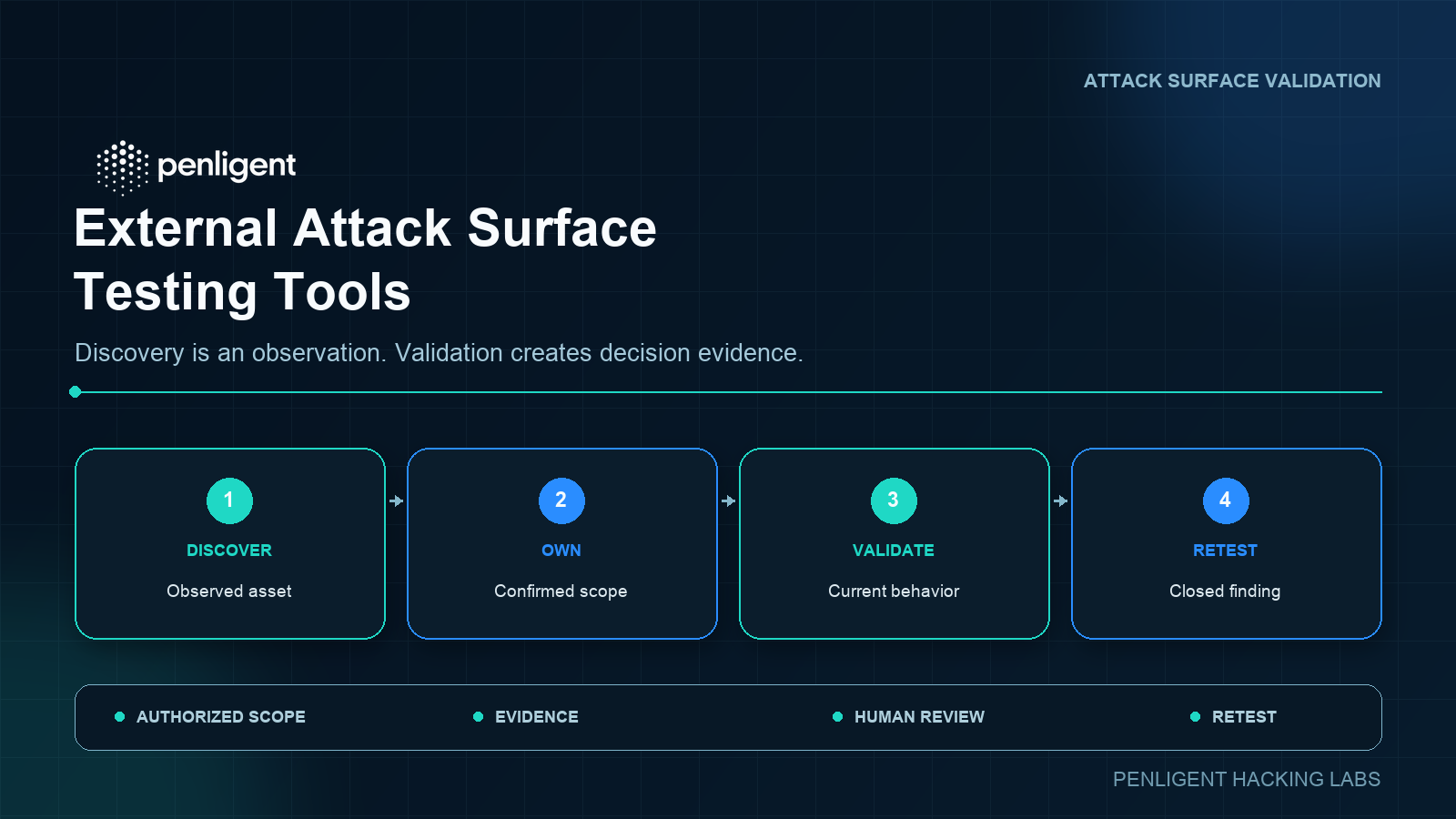
External attack surface testing tools should turn an internet observation into a defensible security decision—not simply produce a longer list of domains, ports and possible CVEs. The useful workflow is discovery, ownership confirmation, safe validation, evidence, remediation and retesting. If a product cannot show where an observation came from, whether the asset belongs to you, what was tested and how the result changed after remediation, it is not closing risk. It is creating another queue.
Explore Penligent for your first authorized test →
This distinction matters because several product categories now overlap. Internet search engines, external attack surface management platforms, vulnerability scanners, automated penetration testing systems and reporting tools may all display the same hostname. They do not necessarily answer the same question, and a result from one category should not silently inherit the confidence of another.
Discovery results are hypotheses
An IP address, DNS record, TLS certificate, software banner or open port is an observation made at a particular time and from a particular position. It can be accurate and still be insufficient. The address may have been reassigned. A reverse proxy may hide the application that matters. A version string may be suppressed, spoofed or unaffected because a vendor backported a fix. A certificate may belong to an old deployment that no longer receives traffic.
For that reason, a discovery record should begin with three labels: source, observation time et confiance. It should not begin life as a “critical vulnerability” merely because a fingerprint matched a rule. NIST Cybersecurity Framework 2.0 separates inventories of hardware, software, services, communications and supplier-provided services into distinct Asset Management outcomes. An outside-in tool can help reconcile those inventories, but it does not replace them.
Define the job before comparing tools
“Attack surface testing” is often used as an umbrella phrase. Break the purchase into concrete jobs before building a shortlist.
| Job | Question principale | Typical output | What it does not prove by itself |
|---|---|---|---|
| External discovery | What can an outside observer associate with the organization? | Domains, IPs, certificates, services and relationships | Ownership, current state or exploitability |
| External attack surface management | Which observed assets and exposures are changing over time? | Inventory candidates, change alerts and exposure policies | That every inferred vulnerability is present |
| Vulnerability scanning | Which known checks match a reachable target? | Detection records with severity and signatures | Business impact or a complete attack path |
| Security validation | Does a stated control or vulnerability condition hold in this environment? | Reproducible proof, prerequisites and confidence | Coverage beyond the approved test cases |
| Penetration testing | Can an authorized tester combine weaknesses into meaningful impact? | Attack paths, evidence, impact and remediation guidance | Continuous inventory unless that is part of scope |
| Reporting workflow | Can owners reproduce, fix and retest the result? | Findings, artifacts, ownership, status and closure evidence | That the underlying test was accurate |
A platform may cover more than one job. Treat that as a claim to test, not a reason to collapse the categories. Readers comparing autonomous or agent-assisted options can use the broader AI pentesting tools landscape as a separate category view.
A current market signal, not a benchmark
On November 3, 2026, Novee announced a product named External Surface Testing. Its announcement describes starting from a domain, discovering assets, letting the user approve scope, conducting outside-in non-destructive testing, importing discoveries from EASM platforms, and producing evidence-backed findings and reports. It also describes one-off and scheduled testing.
Those are vendor statements from a product announcement. The source does not independently establish discovery coverage, false-positive or false-negative rates, operational safety, or comparative performance. The announcement is useful because it shows how discovery, validation and reporting are converging in product positioning. It also shows why buyers should validate each stage separately in their own authorized pilot.
Evaluate discovery coverage and provenance
Start by listing the asset classes that matter to your organization: registered domains, delegated subdomains, netblocks, cloud load balancers, content-delivery edges, APIs, SaaS tenants, acquired brands, supplier-hosted services and temporary campaign infrastructure. Then ask how the tool obtains each class. Sources may include DNS, certificate transparency, routing data, internet observations, cloud connectors, code repositories, application crawling or data supplied by the customer.
A useful record preserves provenance rather than presenting a single unexplained confidence score. During a pilot, select known assets, known non-assets and deliberately retired assets. Check whether the tool:
- shows the evidence that created the asset relationship;
- records first-seen, last-seen and last-validated times separately;
- distinguishes direct evidence from inferred relationships;
- lets an analyst correct ownership without destroying the original observation; and
- propagates corrections to alerts, tickets and future testing scope.
Do not score a product only by the number of assets it finds. More results can mean better coverage, weaker attribution, or both. Measure confirmed additions, confirmed stale records, incorrect ownership matches and time-to-correction as separate pilot outcomes.
Put an ownership gate before active validation
Ownership is a safety control, not a clerical field. A company name in a page title, an old certificate subject or a similar domain string is not sufficient authority to test. Stronger signals include a registered netblock, a controlled DNS record, a cloud-account resource identifier, a certificate inventory, a deployment record, or confirmation from the system owner.
Use four states: owned and expected, owned and unexpected, stale or reassignedet unknown or not owned. Only the first two should be eligible for active testing, and only after the approved scope, method and time window are attached. Unknown assets can remain in an investigation queue without receiving validation traffic.
This gate should be enforceable in the product. Ask whether an analyst must approve newly discovered assets, whether inherited scope can expand automatically, and whether API or scheduled jobs can bypass manual exclusions. Review the audit log after the pilot rather than accepting a checkbox shown in a demonstration.
Freshness must be visible
External data ages at different rates. DNS can change in minutes. Internet-wide observations may be refreshed on a different schedule. Cloud addresses can be released and reassigned. A scanner can validate a listener now while its software inventory still reflects yesterday’s deployment. The interface should expose these differences.
For every finding, require the observation time, the validation time and the evidence time. Test changes during the pilot: close a test listener, rotate a certificate, move a hostname, patch a controlled service and retire a disposable asset. The goal is not to create a public benchmark; it is to learn how the product represents change, conflicting evidence and eventual consistency in your environment.
Safe validation requires rules of engagement
NIST SP 800-115 organizes assessments into planning, execution and post-execution phases and describes rules of engagement as the authority and constraints for the work. That governance remains useful even when tests are automated. A tool should not convert “technically reachable” into “permitted to test.”
An approved validation profile should include:
- included assets and explicit exclusions;
- allowed test techniques and prohibited actions;
- test windows, request-rate limits and concurrency;
- credential source, privilege level and secret-handling rules;
- data-retention and evidence-access controls;
- stop conditions and a tested emergency stop;
- business and technical contacts; and
- incident handling if a test affects availability or data.
Prefer the least invasive method that answers the decision. Version and package evidence may be enough for one issue. A configuration or access-control check may be needed for another. Behavioral proof should use a controlled, non-destructive trigger and stop once the security property is demonstrated. High-risk checks belong in an isolated replica unless the owner has explicitly accepted the production risk.
Evidence quality is more important than screenshot volume
A remediation owner needs to know what was tested and what must change. At minimum, a finding should preserve asset identity, timestamp, tester position, method, prerequisites, sanitized request and response details, relevant logs, observed result, confidence and limitations. Screenshots can support that record, but they should not be the only artifact.
Separate five evidence levels:
- Presence: the component or configuration exists.
- Accessibilité : the relevant interface is reachable from the approved test position.
- Déclencheur : the security property fails in a safe, reproducible way.
- Impact : the controlled result affects a stated data, privilege or business boundary.
- Closure: the same test no longer succeeds after the fix, and adjacent cases remain controlled.
Do not let a product label level one evidence as level four impact. Conversely, do not require an invasive exploit when levels one through three already support the remediation decision. Teams that need a separate reporting workflow can turn validated evidence into an AI pentest report without changing the proof standard.
Prioritize with context, not one score
Keep exposure, evidence confidence, exploit prerequisites, business criticality and threat intelligence as separate fields. A CISA Known Exploited Vulnerabilities entry is a strong prioritization signal because it records known exploitation in the wild. It does not prove that your asset contains the affected component, exposes the vulnerable path or lacks a compensating control. Local validation still matters.
A practical queue can first separate confirmed from inferred findings, then consider internet reachability, authentication requirements, exploit maturity, asset criticality and remediation effort. Preserve the underlying values so analysts can understand why a priority changed instead of receiving an opaque number.
Score the pilot across the whole workflow
Use a simple 0–3 scale: 0 means absent, 1 means mostly manual or unreliable, 2 means usable with documented limitations, and 3 means controlled, auditable and integrated. Score only what your team observes in the pilot.
| Dimension | Questions to test | Minimum acceptable evidence |
|---|---|---|
| Coverage and provenance | What asset classes and data sources are covered? | Source, timestamps and relationship evidence are exportable |
| Ownership confidence | Can analysts approve, reject and correct attribution? | Corrections persist and testing cannot bypass scope |
| Freshness | How are stale, conflicting and changed observations handled? | Observation and validation times remain distinct |
| Validation safety | Can methods, rate, windows and stop conditions be enforced? | Audit log plus a demonstrated emergency stop |
| Evidence quality | Can an engineer reproduce the finding? | Method, prerequisites, artifacts, result and limitations |
| Workflow integration | Can owners receive, correct and track findings? | Stable identifiers, status history and controlled exports |
| Retest and closure | Can the original condition be rerun after remediation? | Before-and-after evidence linked to the same finding |
Treat four failures as stop signs rather than low scores: the tool cannot enforce authorized scope, lacks a reliable stop control, cannot export enough evidence for review, or presents observations as validated findings without showing the transition.
Run a bounded operating workflow
- Import a controlled seed set containing known assets, known retired assets and explicit exclusions.
- Review discovery relationships and confirm ownership with authoritative records.
- Create the approved test scope and attach rules of engagement.
- Run low-risk checks first and escalate methods only when they add decision value.
- Export the evidence package and have a system owner reproduce a sample.
- Remediate selected findings through the normal change process.
- Retest the same conditions and record both internal state and later external observation.
External disappearance may lag a configuration change, while an internal dashboard may report success before every edge node or running process has changed. Closure should reconcile both views. Keep the finding open when the evidence conflicts.
Watch the Penligent 3.0 product overview
The following video is included as a product overview. Its title is not used as evidence for any capability or performance claim in this article.
Questions to ask before procurement
- Which discovery sources are first-party observations, licensed datasets, customer connectors or inferences?
- How quickly are changes reflected, and how is stale evidence displayed?
- What prevents an inferred asset from entering active test scope?
- Which validation methods can affect availability, data or third parties?
- Can the organization define per-asset exclusions, rate limits and stop conditions?
- How are credentials encrypted, rotated, used and removed?
- Can findings and raw artifacts be exported without losing provenance?
- How does the product represent disputed, accepted and remediated findings?
- Can retests reproduce the original method and preserve before-and-after evidence?
- What data is retained by the vendor, in which regions, and for how long?
Ask the vendor to demonstrate these controls against assets your organization owns, with exclusions and stop conditions you define. A polished demonstration environment may show usability; it cannot establish attribution quality, operational safety or evidence fit for your systems.
Conclusion
The best external attack surface testing tool is not the one that returns the largest number of possible issues. It is the one that preserves provenance, confirms ownership, shows freshness, enforces authorization, validates safely, exports reproducible evidence and proves that remediation changed the result. Evaluate the complete workflow, keep discovery separate from proof, and require closure evidence before risk leaves the queue.
Sources d'information
- NIST Cybersecurity Framework 2.0
- NIST SP 800-115, Guide technique pour les tests et l'évaluation de la sécurité de l'information
- OWASP Web Security Testing Guide: Reporting Structure
- CISA Binding Operational Directive 23-01
- Catalogue des vulnérabilités connues et exploitées de la CISA
- Novee product announcement, November 3, 2026
 French
 English
 German
 Spanish
 Portuguese
 Japanese
 Korean
 Hindi
 Arabic
 Turkish
 Hebrew