
Grafana’s November 24, 2026 release notes name three CVE fixes in four release branches, but the 13.3.2 note lists only two of them. That difference is useful for planning a branch-specific update; it does not establish the status of the omitted CVE. Use the release line and the exact note together, then verify the deployed instances separately.
The checked official releases are 12.4.16, 13.0.14, 13.1.11, 13.2.7, and 13.3.2. The first four explicitly list CVE-2026-107561, CVE-2026-88943, and CVE-2026-88960 as fixed. Release 13.3.2 explicitly lists CVE-2026-107561 and CVE-2026-88960. Grafana’s notes do not provide enough detail here to infer the cause, affected range, severity, or exploitation status of these identifiers.
Match the installed branch to the published fix
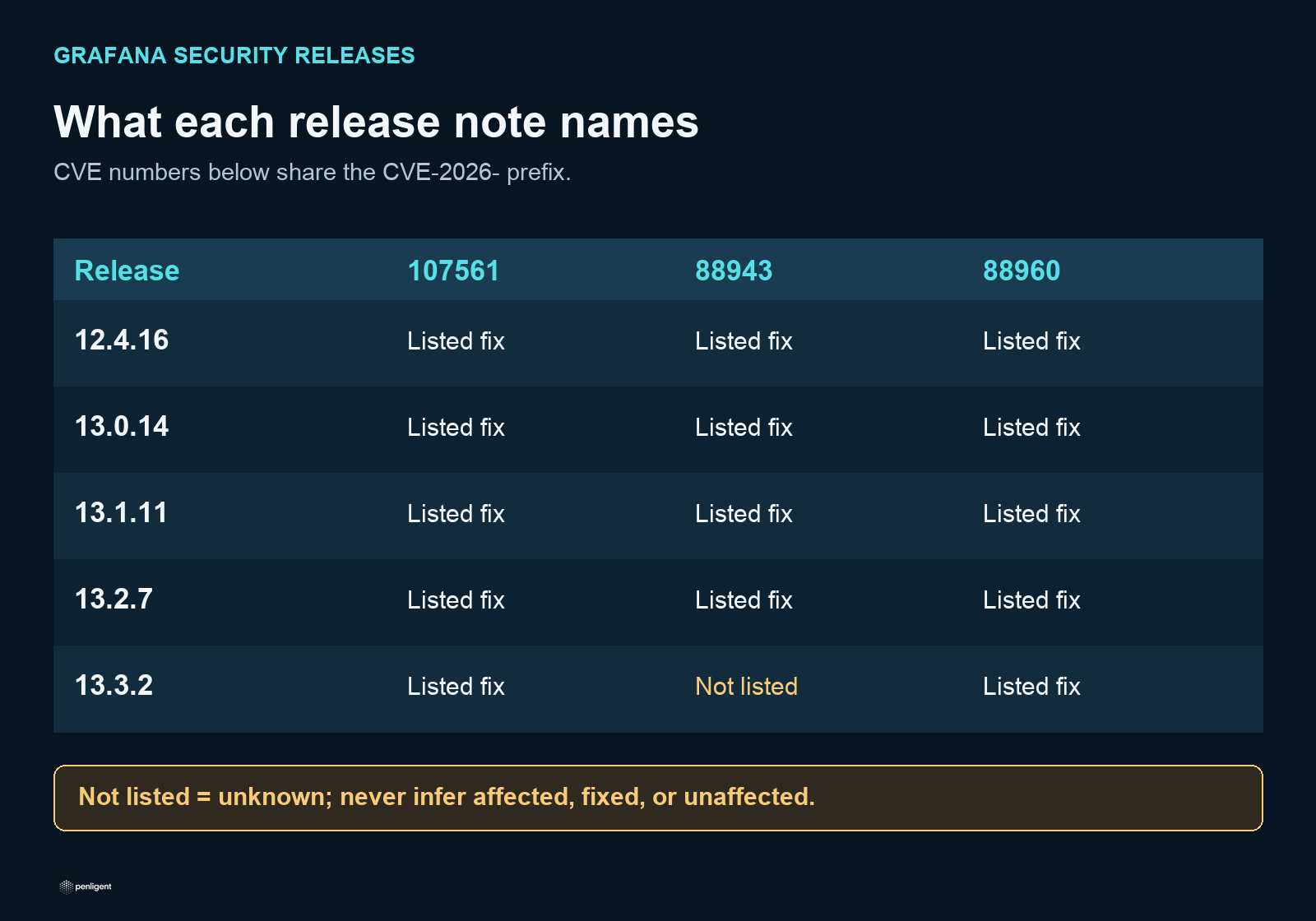
| Grafana release | CVE-2026-107561 | CVE-2026-88943 | CVE-2026-88960 |
|---|---|---|---|
| 12.4.16 | Listed as fixed | Listed as fixed | Listed as fixed |
| 13.0.14 | Listed as fixed | Listed as fixed | Listed as fixed |
| 13.1.11 | Listed as fixed | Listed as fixed | Listed as fixed |
| 13.2.7 | Listed as fixed | Listed as fixed | Listed as fixed |
| 13.3.2 | Listed as fixed | Not listed; status unknown | Listed as fixed |
“Listed as fixed” reports what the corresponding Grafana release description says. It is not a complete affected-version range, and the table should not be read as proving that every earlier version is vulnerable. The 13.3.2 note’s omission of CVE-2026-88943 is inconclusive: it could not be used to classify that release as affected, fixed, or unaffected. Check a later vendor clarification or an applicable official advisory before making that decision.
Treat the release record as one checkpoint
A published upstream release establishes that a release exists and records the security entries Grafana included. It does not prove that a package repository, container registry, managed service, or every production replica has completed the update. Build the change record around the deployment method actually in use, and retain the source release link that justified the target.
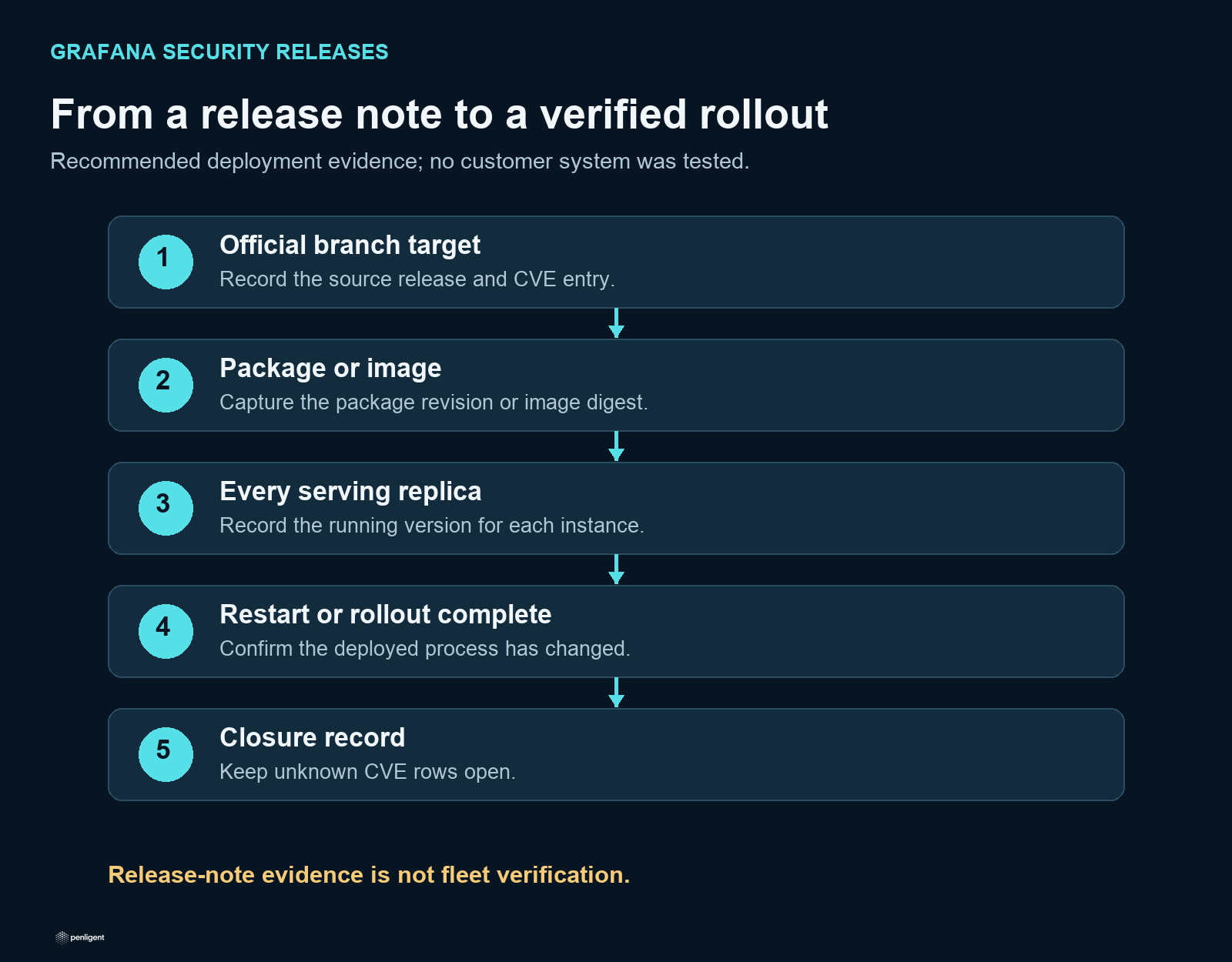
- Identify the branch. Record the running Grafana version and whether it comes from an upstream package, a container image, or a managed service.
- Select a documented target. Compare the branch’s release note to each CVE in scope. Keep “not listed” as unknown until Grafana provides a specific answer.
- Track distribution separately. Capture the package revision or image digest and the repository or registry source. If a provider backports fixes without adopting the upstream version, require that provider’s evidence.
- Verify the rollout. Check every serving replica or managed deployment, confirm the process restart or rollout completion, and retain the observed version or image digest.
- Close by CVE and branch. Keep an unresolved row when the source matrix leaves it uncertain. Do not convert a release-note gap into a successful or failed remediation claim.
What this matrix cannot answer
The release descriptions identify the CVEs each release says it fixes. They do not, in the checked text, explain the technical mechanism, CVSS score, prerequisites, affected version ranges, configuration exposure, or exploitation in the wild. Those details should come from a matching Grafana security advisory or CVE record, not from assumptions based on a rising search query.
Methodology: source-based reconciliation of Grafana’s five official GitHub release records, checked November 25, 2026. AI assisted research organization and drafting. Penligent did not test a Grafana instance, inspect customer deployment state, or reproduce a vulnerability. The release matrix is an editorial aid; verify current vendor guidance before closing a production finding.
The following official Penligent 3.0 video demonstrates a general product workflow. It does not demonstrate exploitation or remediation of these Grafana CVEs.
 Japanese
 English
 German
 French
 Spanish
 Portuguese
 Korean
 Hindi
 Arabic
 Turkish
 Hebrew