
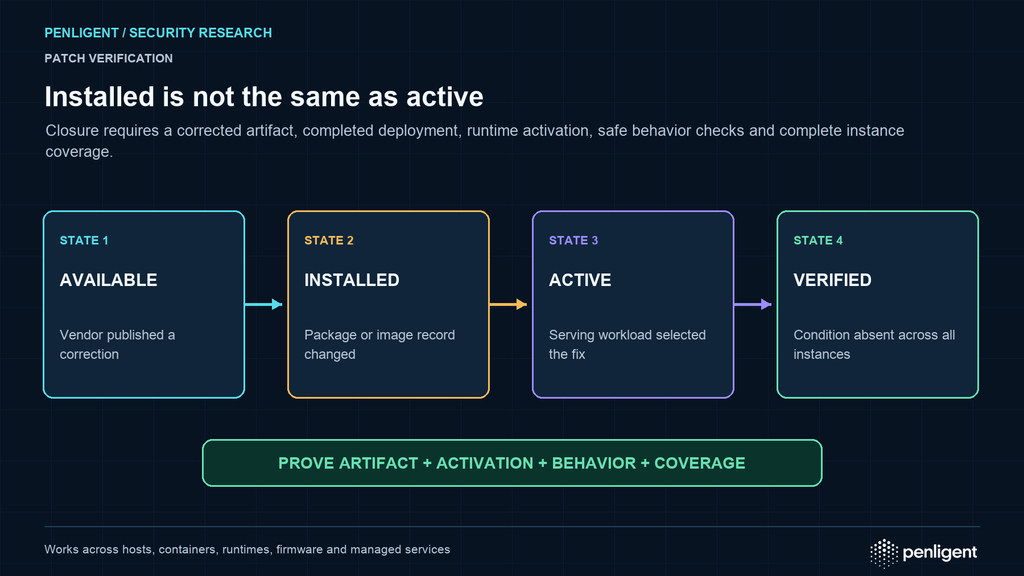
A security patch is not complete when it is downloaded, approved or reported by a scanner. It is complete when the corrected artifact is active on every in-scope instance and the vulnerable condition is no longer reachable. That distinction matters across operating systems, containers, language runtimes, firmware, serverless functions and SaaS services.
NIST SP 800-40 Revision 4 defines enterprise patch management as identifying, prioritizing, acquiring, installing and verifying patches, updates and upgrades. Verification is not an optional final checkbox. It is the step that connects the vendor correction to the system that actually handles production traffic.
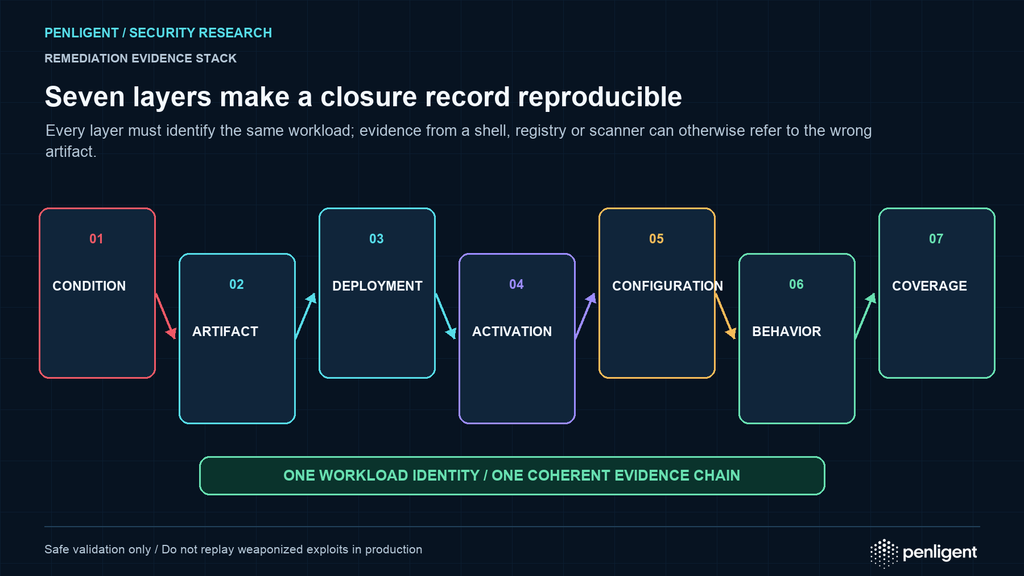
A defensible closure record answers seven questions: what was affected, which artifact contains the fix, where it was deployed, whether the active runtime selected it, whether the vulnerable configuration changed, whether normal behavior still works and whether every instance is covered.
Patch available, installed and active are different states
| State | What it proves | What remains unknown |
|---|---|---|
| Patch available | A vendor or maintainer published a correction | Whether your environment acquired or deployed it |
| Patch downloaded | The artifact reached a repository or endpoint | Whether installation succeeded |
| Patch installed | A package, image, firmware or application record changed | Whether the serving process or device booted into it |
| Patch active | The running workload uses the corrected artifact | Whether every replica and exposure path is covered |
| Remediation verified | The affected condition is absent and expected functions pass | Whether earlier compromise occurred |
| Incident closed | Exposure and any compromise evidence received appropriate response | Future regressions or newly discovered scope |
Do not combine the last two states. A fixed version can coexist with persistence or stolen credentials from the earlier exposure window. Patch verification and incident investigation may need to run in parallel.
Explore Penligent for authorized security testing
Use a seven-layer evidence model
- Affected-condition evidence: vendor product, version, feature, configuration and prerequisite match.
- Artifact evidence: trusted fixed package, build, runtime, image, firmware or provider release.
- Deployment evidence: the correction reached the intended host, cluster, device, function or service tier.
- Activation evidence: the process restarted, the device rebooted, the new replica became ready or the service provider activated the change.
- Configuration evidence: vulnerable features, routes, permissions or trust settings are corrected.
- Behavior evidence: a safe validation confirms the vulnerable condition is absent and critical functions still work.
- Coverage evidence: every serving instance, region, tenant, node and rollback path is accounted for.
The layers should refer to the same workload identity. A package query from an administrative container does not prove the application container uses that package. A developer workstation lockfile does not prove the production build contains the same dependency. A registry tag does not prove which image digest is active.
Start with the vendor’s affected condition, not a generic version rule
Vendor advisories may define exposure by more than version. A component can be affected only when an optional module is installed, a protocol is enabled, a route is public, a file is extracted with particular ownership, or an application bundles a vulnerable library. Build the finding from those conditions.
Version comparison also needs package provenance. Linux distributions commonly backport security fixes while retaining an older upstream version. A scanner that compares only upstream numbers can report a false positive. The reverse can occur when an application embeds or statically links an old library while the operating-system package is current.
Record the vendor advisory, product edition, distribution, package source, architecture, build identifier, affected configuration and fixed boundary. When sources disagree, preserve the disagreement and use the most direct maintainer evidence rather than silently choosing the most convenient result.
Verify hosts and running processes separately
Package managers can establish what is installed. They do not always establish what a long-running process has loaded. Shared libraries can remain mapped until the process restarts; a kernel correction may require a reboot; an alternate runtime on PATH can differ from the one used by a service.
# Examples of read-only host observations; use the applicable platform tools
systemctl show example.service -p ExecStart -p Environment -p MainPID
readlink -f /proc/<pid>/exe
cat /proc/<pid>/maps

# Debian-family package identity
dpkg-query -W 'package-name'

# RPM-family package identity
rpm -q --qf '%{NAME} %{EPOCHNUM}:%{VERSION}-%{RELEASE}.%{ARCH}\n' package-name
These commands are evidence collection examples, not universal vulnerability detectors. Interpret them using the vendor or distribution advisory. Retain timestamps and asset identity so results from a maintenance shell are not confused with the serving workload.
Container remediation requires a new image and a completed rollout
Editing a running container does not correct the image used by the next replica. Rebuild from trusted fixed inputs, produce a new immutable digest, scan or inspect the built artifact, deploy it and confirm the old digest is no longer serving traffic.
| Container layer | エビデンス |
|---|---|
| Build input | Fixed base image and dependency lock or package repository |
| Built artifact | Image digest, provenance and software bill of materials when available |
| 配備 | Workload specification references the intended digest or immutable release |
| Rollout | All ready replicas use the corrected digest; old pods or tasks are drained |
| Traffic | Load balancer and service discovery no longer route to old instances |
| Rollback | Rollback target is also corrected or explicitly blocked |
A mutable tag such as 最新 または stable is not sufficient closure evidence. Tags can move while active replicas continue using an older digest.
Trace language dependencies into the deployable artifact
Java, .NET, Python, JavaScript, Go and Rust applications can obtain vulnerable code through different paths: a shared runtime, a package manager, a vendored archive, a virtual environment, a fat JAR, a self-contained deployment or a statically linked executable. The version command for the system runtime may inspect the wrong layer.
Start with the production artifact and work backward. Record its build revision, dependency manifest, resolved lockfile, embedded components and build environment. Rebuild when the fix changes a bundled dependency. For statically linked code, updating the host library does not replace code already compiled into an executable.
For virtual environments and application-local modules, interrogate the interpreter and environment selected by the service. Do not clear production from a package query run in a different virtual environment or developer shell.
Firmware and appliances need running-build proof
For network appliances, industrial devices, mobile endpoints and embedded systems, preserve the exact model, hardware revision, installed firmware, booted partition and vendor advisory. Uploading a firmware file or completing a management-console task may not mean the device rebooted successfully into the new image.
Confirm the running build after restart, validate configuration migration, test critical connectivity and retain rollback information. In clustered appliances, verify every node and any standby unit. Unsupported devices require a replacement, isolation or decommission plan rather than an indefinite “patch unavailable” status.
SaaS and managed services require provider and customer evidence
A managed service may remove direct patch access, but it does not remove the need for a closure record. Identify whether the provider corrected the control plane, data plane, regional deployment or customer-facing component. Preserve the provider advisory, support case, service health notice or account-specific confirmation.
Some fixes require customer action: rotating credentials, redeploying functions, updating agents, changing a configuration or recreating an integration. Separate provider completion from customer completion. For multi-region services, confirm whether the correction reached every region and deployment tier in scope.
Use safe behavior checks instead of replaying a weaponized exploit
Patch validation rarely requires a production exploit. Prefer a vendor-supported version check, configuration audit, benign parser corpus, negative authentication test, integrity check, service health test or controlled staging reproduction. For memory corruption, remote code execution and privilege escalation, a malicious payload can destabilize the environment and create legal or operational risk without improving closure evidence.
A behavior check should state the security property, prerequisites, expected result and limitations. “The scanner is green” is weaker than “all serving pods use digest X, the vulnerable feature is disabled, an unauthenticated test receives the expected denial, and the application health suite passes.”
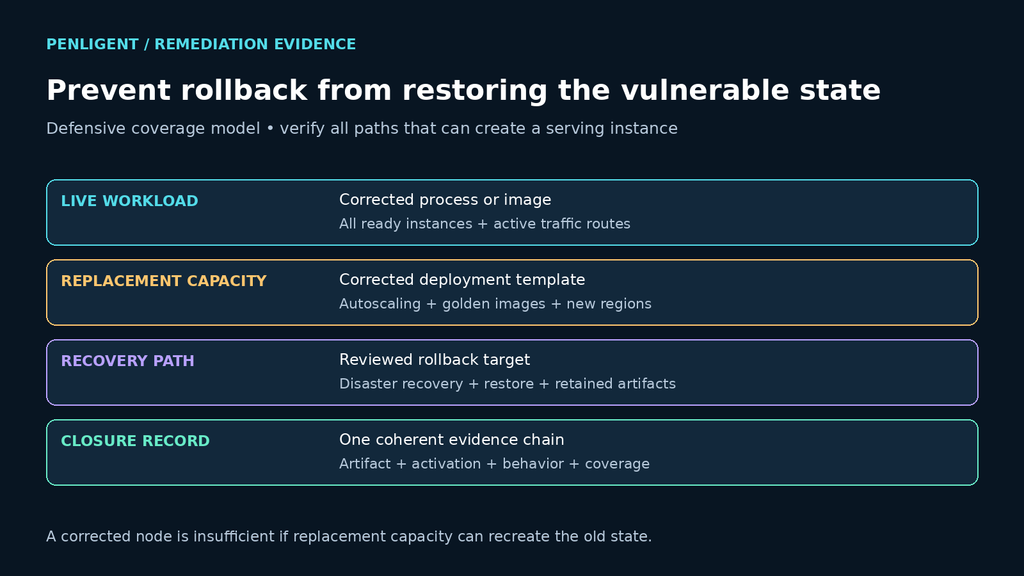
Keep rollback from reintroducing the vulnerability
Patch failures often trigger rollback under pressure. Verify the rollback target before the change window. If the only known-good operational build is vulnerable, define containment and an approval path rather than silently returning it to production. Update deployment templates, golden images, autoscaling groups, disaster-recovery images and infrastructure code so replacement capacity does not recreate the old state.
After a successful rollout, remove or quarantine obsolete artifacts according to retention and incident-response needs. Keep enough evidence to reconstruct the earlier state if compromise is later discovered.
Explore Penligent for authorized security testing
Build a compact closure bundle
| フィールド | Required content |
|---|---|
| Finding | CVE or advisory, affected condition and source links |
| スコープ | Assets, workloads, replicas, regions and owners |
| Before state | Artifact, configuration, exposure and collection time |
| 変更 | Patch/build/firmware, change record and deployment time |
| Active state | Process, image digest, running build or provider confirmation |
| バリデーション | Safe security-property check and functional regression result |
| Coverage | Every instance accounted for; exceptions have owners and expiration |
| Incident decision | Evidence of compromise absent, suspected or confirmed, with next action |
This bundle should be reproducible by a reviewer who did not perform the maintenance. Screenshots can supplement it, but structured identifiers, commands, logs and deployment records are easier to compare during retest.
Connect the advisory to the active runtime
Patch verification is the point where vulnerability management becomes evidence. Start with the vendor’s affected condition, identify the corrected artifact, prove deployment and activation, test the security property safely, and account for every serving instance and rollback path. A scanner can reopen the conversation, but closure should rest on a coherent chain from advisory to active runtime.
The following Penligent overview shows a general authorized security-testing workflow. It is not evidence that the systems discussed here were tested by Penligent.
 Japanese
 English
 German
 French
 Spanish
 Portuguese
 Korean
 Hindi
 Arabic
 Turkish
 Hebrew