
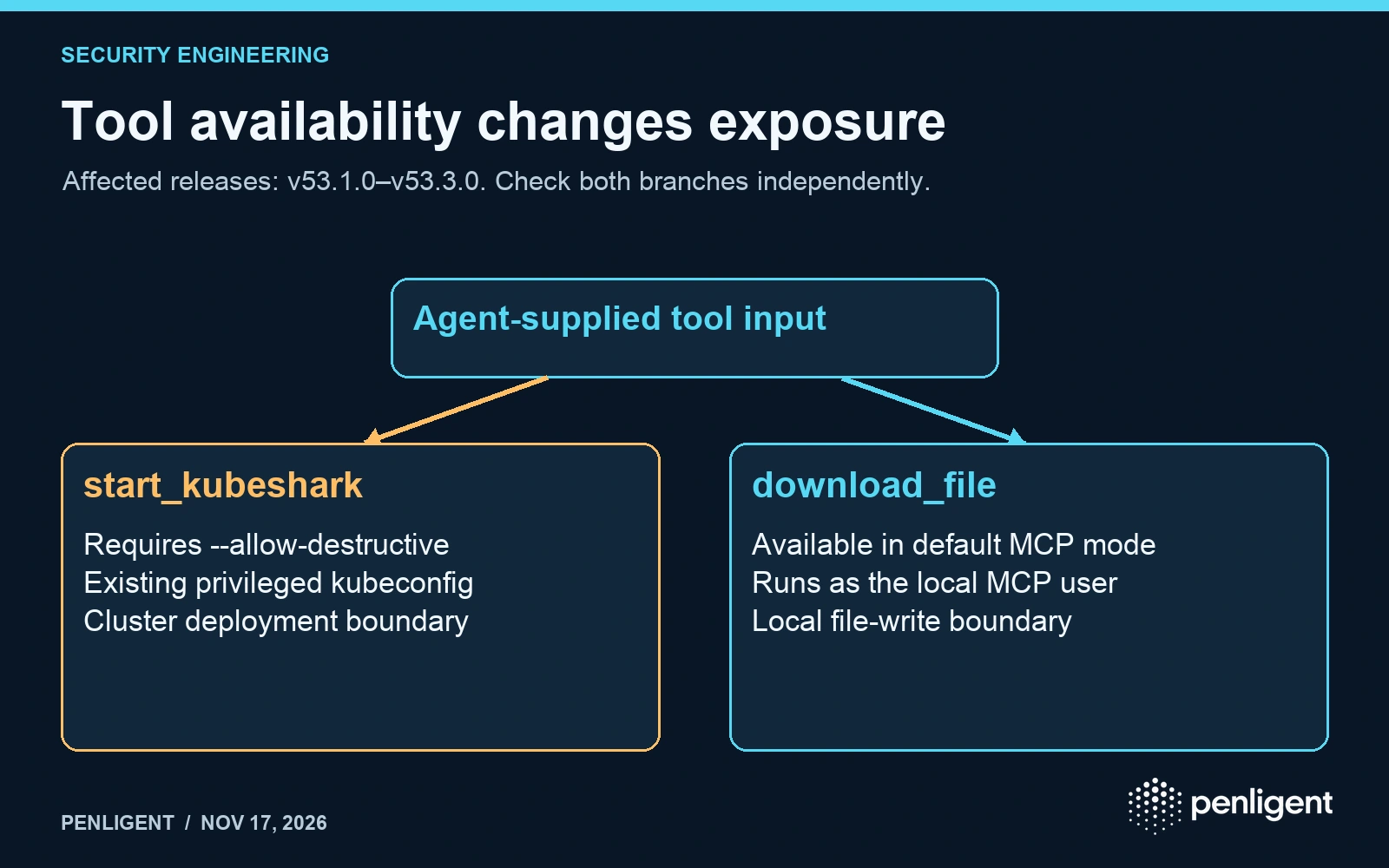
Kubeshark operators assessing CVE-2026-129236 need to check the MCP launch configuration and the Kubernetes permissions behind it. The vulnerable start_kubeshark tool is available only with --allow-destructive, and the host must already possess a kubeconfig able to deploy the privileged Kubeshark DaemonSet. The related CVE-2026-129235 affects download_file, which is available in the default MCP configuration. Both affect CLI releases from v53.1.0 through v53.3.0 and are fixed in v53.4.0. These distinctions come directly from the startup-tool advisory そして file-download advisory.
The operational task is to close two different trust boundaries: tool input becoming deployment configuration, and tool output reaching the local filesystem. Upgrading the CLI addresses the documented input-handling defects. The upgrade still needs an explicit review of the identity, output directory, and Hub access available to the agent.
What is affected, and why the dates matter
| 項目 | CVE-2026-129236 | CVE-2026-129235 |
|---|---|---|
| MCP tool | start_kubeshark | download_file |
| Defect | Argument injection through pod_regex | Destination path lacks confinement |
| Affected released CLI versions | v53.1.0–v53.3.0 | v53.1.0–v53.3.0 |
| First fixed release | v53.4.0 | v53.4.0 |
| Important prerequisite | --allow-destructive and Kubernetes deployment privileges | An operator-driven agent can invoke the tool; no destructive-mode flag is required |
| Primary boundary | Local MCP tool to privileged cluster deployment | Hub response to a local path writable by the MCP process |
| Maintainer severity | High, CVSS 7.2 | Medium, CVSS 5.3 |
The table follows the two maintainer advisories. The v53.4.0 release notes date the fix release to August 13, 2026. The global GitHub advisory records were published on November 16, 2026: CVE-2026-129236 そして CVE-2026-129235. A November 17 assessment should therefore look for old MCP-capable CLI deployments that missed an available fix; the CVE records do not mean the patch first appeared today.
CVE-2026-129236: a positional argument became an option
The vulnerable implementation appended the caller’s pod_regex directly to the argument list for kubeshark tap. Cobra, the command-line parser, could interpret a leading option-like value as a flag. That allowed tool input to change Helm deployment values, including image-selection settings. The maintainer advisory explains why this can be severe: the worker DaemonSet uses privileged containers, host networking, and a host filesystem mount. An attacker-controlled image in that deployment context can compromise nodes and the cluster.
The input need not pass through a shell for this failure to occur. A separate argument element can still acquire option semantics when the target program parses it. That is the useful lesson from the patch: the code now adds the pod regular expression last, after the literal -- end-of-options separator. The boundary is enforced where the command interprets input.
The attack prerequisites remain consequential. Kubeshark describes a local stdio MCP server, with an operator driving an agent. An attacker must influence tool arguments, for example through indirect prompt injection. The startup tool must be enabled with --allow-destructive, and the available Kubernetes identity must permit the privileged deployment. The severity rationale explicitly retains these conditions. Treating every installation of the CLI as an unauthenticated network takeover would obscure the environments that need the fastest response.
CVE-2026-129235: default MCP mode still has a write boundary
について download_file tool retrieves a caller-selected Hub API response and writes the bytes to dest. In affected releases, the destination reached os.Create without base-directory confinement. The advisory distinguishes control of the destination from control of the response content: bytes come from what the Hub returns. It does not demonstrate reliable remote code execution from this write primitive.
Disabling destructive mode does not remove this tool. The maintainer states that it is registered unconditionally. A triage process that checks only the startup flag can therefore correctly rule out the documented startup-tool path while leaving the file-write defect unresolved.
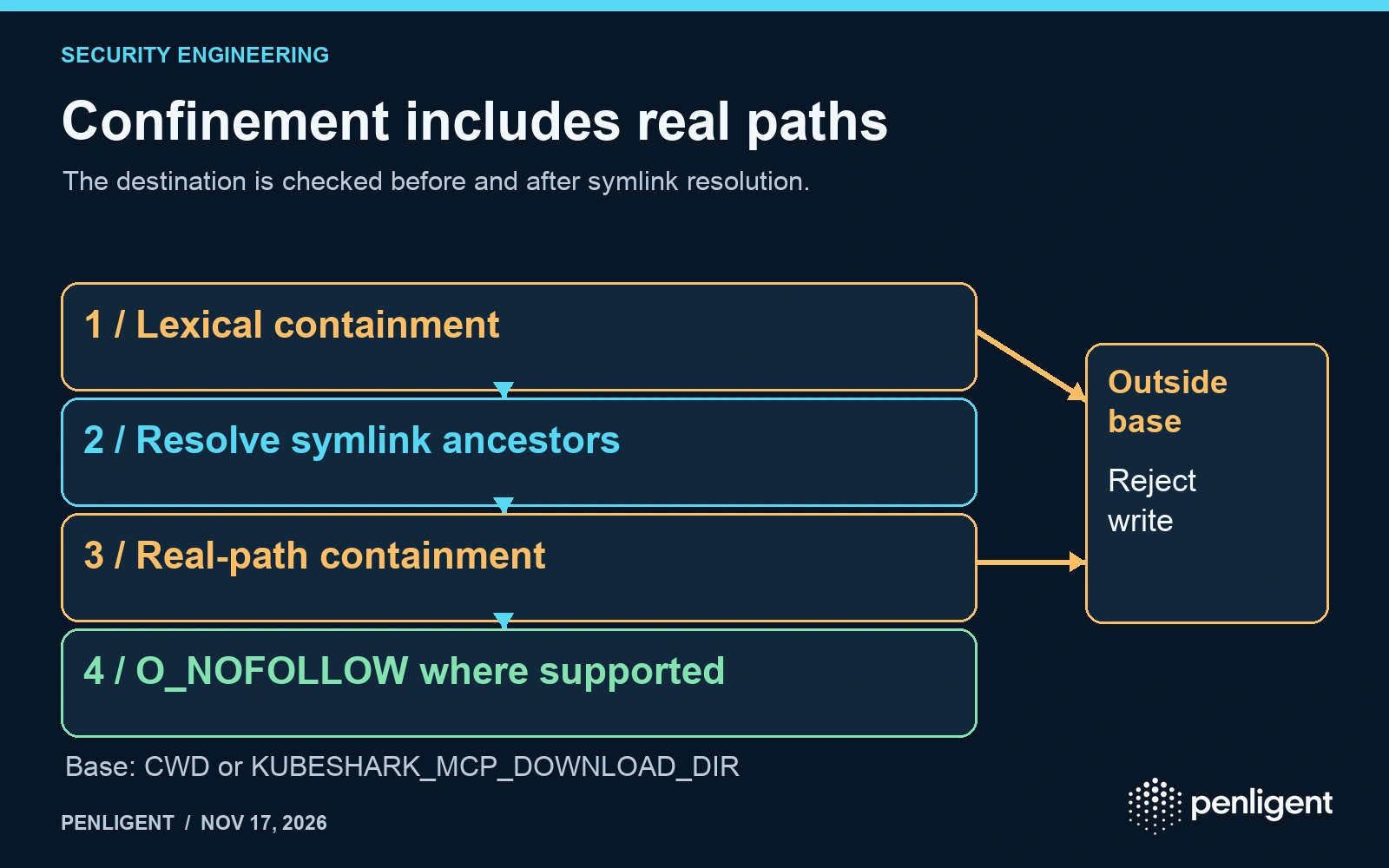
について fix introduces secureDownloadDest, confines destinations to a base directory, resolves existing symlink ancestors, and checks containment again. Where supported, opening the final path with O_NOFOLLOW narrows a symlink race. The base defaults to the current working directory and can be set with KUBESHARK_MCP_DOWNLOAD_DIR. Hub paths containing .. segments are rejected.
That means the chosen base directory is part of the deployment’s security policy. A dedicated output directory creates a clearer boundary than a broad home or project directory containing sensitive files. This is an operational inference from the confinement design, rather than a claim that the patch forbids all sensitive writes inside an operator-selected base.
Hub authentication is a separate check
The download advisory describes captured-traffic exposure when the Hub is operating without authentication. It also says that a strict Hub path-prefix allowlist and default authentication enforcement are separate follow-ups. The release notes describe gated-Hub authentication and credential forwarding alongside the input-handling fixes. Those statements cover different controls; a fixed CLI version alone does not establish the effective authentication state of a particular Hub.
For that reason, retain evidence of the actual deployed Hub authentication configuration and the identity the MCP client uses. Check an approved, non-sensitive route under an unauthenticated session according to the deployment’s access policy. Do not use a production traffic export as a casual health check. Successful destination confinement and enforced Hub authorization should be recorded separately.
A practical exposure and closure record
Use one record per MCP launch profile, including developer machines and automation runners. The following sequence is a proposed defensive review based on the documented prerequisites and patch; it is not an exploit test.
- Identify the executable actually launched. Record the CLI release, executable path, launch configuration, and running process. A patched binary elsewhere on the machine does not establish which binary the MCP client starts.
- Record tool availability. Inspect the launch arguments and the client’s MCP tool inventory. If destructive mode is unnecessary, remove it and restart the session. Confirm the startup tool is absent afterward. Continue the download-tool review regardless.
- Record the Kubernetes identity and scope. Use the effective kubeconfig context and an authorized RBAC review to establish the permissions available to the process. Avoid copying credential material into the review record.
- Set the output boundary deliberately. On the fixed release, use a dedicated directory for
KUBESHARK_MCP_DOWNLOAD_DIRand an unprivileged process identity. Record the resolved directory and its ownership. This narrows what a legitimate tool invocation may write. - Verify Hub access independently. Record whether authentication is required and what credentials the MCP session forwards. The path-confinement fix does not replace this authorization check.
- Restart and verify the full workflow. Confirm the running MCP process uses v53.4.0 or a later release containing the fix. In an isolated test environment, use a harmless file response and temporary directories to verify ordinary writes work and an outside-base destination is rejected. Use the upstream regression tests as the expected behavior, without writing into real credential or startup locations.
The last check is grounded in the patch’s traversal and symlink regression tests. A successful result supports the tested boundary only; it does not establish that the agent cannot be influenced or that every cluster permission is appropriate.
For an authorized assessment, 寡黙 can sit within a workflow that keeps scope, expected boundaries, and collected evidence explicit. The relevant evidence here is the executed version, registered tools, effective permissions, and observed rejection behavior.
The official Penligent 3.0 video demonstrates a general product workflow. It is not evidence of exploitation or remediation of either Kubeshark CVE.
What the assessment can conclude
An affected CLI with the startup tool enabled and a privileged kubeconfig has the prerequisites identified in CVE-2026-129236. An affected CLI without that tool still requires attention to CVE-2026-129235. A fixed CLI, an explicitly chosen output directory, appropriate cluster permissions, and separately verified Hub authentication provide a much more useful closure record than a single “MCP secure” checkbox.
Methodology: This analysis was prepared with AI assistance and checked against the maintainer advisories, release notes, and patch as of November 17, 2026. It includes source-based reasoning and a proposed validation workflow. No live exploitation or Penligent laboratory reproduction is claimed.
 Japanese
 English
 German
 French
 Spanish
 Portuguese
 Korean
 Hindi
 Arabic
 Turkish
 Hebrew