
Danfoss AK-SM800A owners need a defensible answer to two different questions: can an untrusted network reach the controller, and has the vendor confirmed a correction for the specific vulnerability set? The November 2026 disclosures make it unsafe to close both questions with a firmware version alone.
Midnight Blue reports six pre-authentication remote code execution vulnerabilities affecting AK-SM800A firmware through 5.3.2. The researcher identifies stack-based buffer overflows and lists CVE assignments as pending. This article provides an exposure-verification method for refrigeration asset owners and maintenance providers; it does not reproduce those vulnerabilities.
Why 5.4.0 is not a verified closure condition
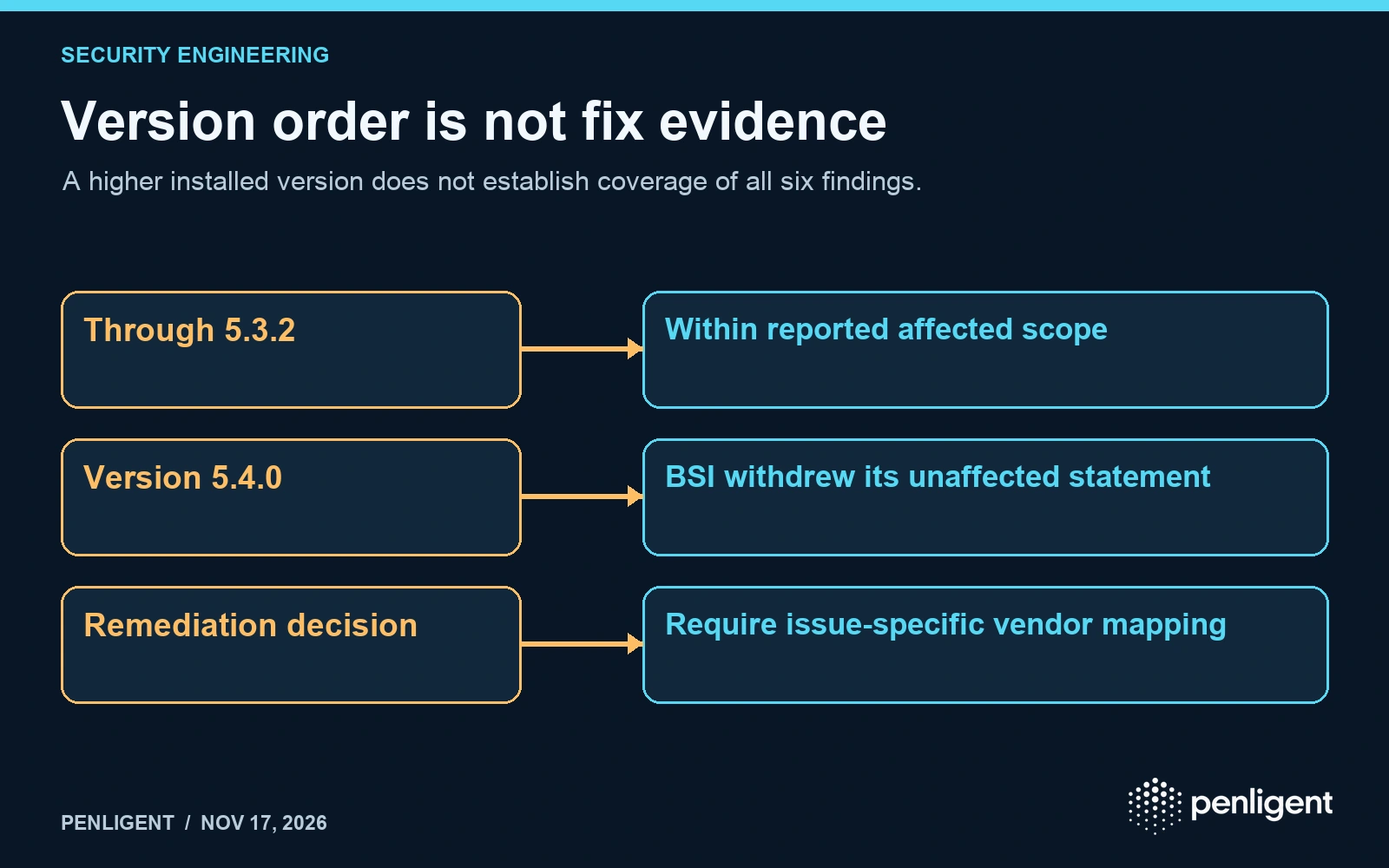
Germany’s BSI issued a warning on November 13, 2026. At 13:25 that day, it corrected an earlier statement that firmware 5.4.0 was unaffected: BSI said it could not exclude that version being affected. Its warning identifies firmware through at least 5.3.2 and advises keeping the devices off the internet, with a VPN in front when remote maintenance requires connectivity.
The practical consequence is a three-state record. Firmware through 5.3.2 falls within the researcher’s affected scope. Firmware 5.4.0 requires a specific vendor determination for these six issues. A later installed version also requires a documented mapping to the issues before it can be accepted as a correction. Version order is useful inventory evidence; the release number by itself does not establish security coverage.
| Observed evidence | Supported conclusion | Remaining decision |
|---|---|---|
| AK-SM800A firmware at or below 5.3.2 | Within the researcher’s reported affected range | Restrict network exposure and follow the applicable vendor response |
| Firmware 5.4.0 installed | BSI withdrew its earlier unaffected statement | Obtain issue-specific correction evidence |
| Controller reachable only through an approved maintenance path | The checked public path has been restricted | Verify other routes and track firmware remediation separately |
| No suspicious events found in retained records | No match within the records searched | State the retention and visibility limits |
Keep the new vulnerability set separate from earlier Danfoss CVEs. Midnight Blue discusses older findings as background, but the six newly reported overflows had pending identifiers in its report. An older CVE number, an older patch record, or a general security release must not silently become the identifier or correction for this set.
Inventory maintenance routes, including the integrator’s connection
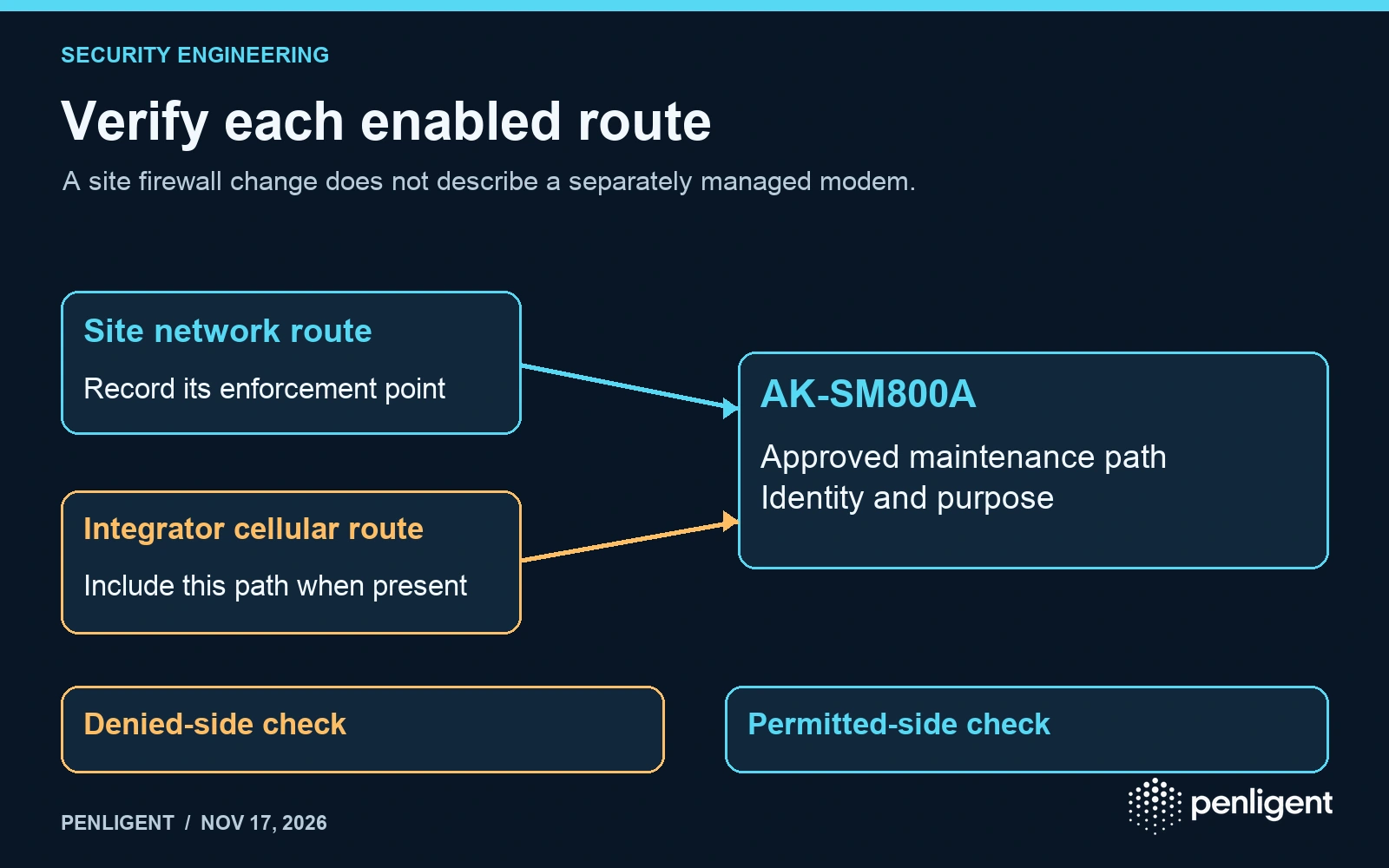
Midnight Blue specifically recommends checking exposure through system integrators’ 4G modems as well as the asset owner’s public address ranges. This matters to the acceptance decision: changing a store firewall rule cannot establish the status of a separately managed cellular route.
Build one record per physical controller and connect it to the service it supports. Record the model, firmware observed, maintenance provider, approved remote-access method and accountable owner. Ask the maintainer to identify every enabled path: the site network, cellular modem, remote-support gateway and temporary maintenance arrangements. Treat an unknown route as an open inventory item.
For each route, retain the enforcement point and the person who controls it. The same controller may be protected by a store firewall on one path and exposed through another provider’s modem on a second path. The useful unit of review is therefore the controller–route pair. A device-level checkbox is too coarse to show which restriction was actually verified.
Verify the boundary while keeping refrigeration operations observable
The following is a proposed administrative acceptance method, not a device exploit test. Coordinate it with the refrigeration owner and maintenance provider so the team can observe normal monitoring and alarm delivery while access policy changes.
- Describe the permitted route. Identify the maintenance identity, approved gateway or private network, destination controller and purpose. Keep credential values out of the record.
- Review the enforcement configuration. Retain the relevant firewall, VPN or private-APN configuration reference. Record which party can change it and whether an alternative path exists.
- Check the denied side. From an authorized test position outside the approved path, verify that the expected management route is unavailable. Use a limited connection or access check agreed with the operator, not vulnerability payloads or broad scanning.
- Check the permitted side. Have the maintainer complete an ordinary, approved read-only monitoring task through the intended route. Record the identity and connection path used.
- Confirm the operational dependencies. Ask the owner to confirm that the selected monitoring and alarm workflow still functions. Record only the workflow actually observed.
- Resolve exceptions. Track unavailable sites, unidentified modems and unverified standby arrangements with an owner and next action. Do not include them in the completed count.
One failed external connection establishes only the result of that connection at that time. The configuration review and route inventory explain why the restriction should persist. Together they support a stronger conclusion than either a screenshot of a firewall rule or an isolated connection result.
Use temporary restrictions with explicit ownership
The researcher recommends VPNs, private APNs or tightly restricted IP allowlists. Its discussion treats allowlisting as an interim measure that can degrade through configuration drift. BSI’s recommendation also prioritizes removing internet connectivity or placing a VPN in front of required remote maintenance. These sources support reducing reachability while the vulnerability-specific firmware position is resolved.
If an allowlist is the immediate option, document the exact maintenance source, enforcement device, authorized change owner and review date. A broad country filter does not identify the individual maintenance path that the acceptance record needs to prove. Keep emergency exceptions visible so a temporary troubleshooting rule does not become an undocumented permanent route.
Continue the supported firmware process after containment. Ask the vendor or integrator for the advisory reference, affected release mapping and corrected release applicable to the six findings. Retain that response alongside the installed version and the post-change operational check. Removing public exposure and correcting vulnerable software remain separate work items with separate evidence.
Do not assign the new flaws to every refrigeration incident
BSI’s November 13 warning said it did not then know of active exploitation of the newly identified vulnerabilities. That dated statement does not establish that no exploitation could have occurred, and reports of attacks on refrigeration controllers do not prove use of these six flaws. Keep incident observations and the vulnerability hypothesis in separate fields until evidence connects them.
When an owner sees an unexplained configuration change, service interruption or unauthorized connection, preserve the available records and involve the maintenance provider and incident-response lead. Rebooting, upgrading or replacing a device may change evidence; the responsible team should weigh preservation against the operational recovery requirement. An updated device can still require investigation of what happened before the change.
The resulting closure record should say precisely what was established: the management routes reviewed, the denied and permitted access observations, the firmware mapping used, the ordinary operational workflow checked and the unresolved exceptions. That record lets the next maintenance engineer understand the security boundary without relying on an unsupported “fully patched” label.
Source review: November 17, 2026. This analysis was prepared with AI assistance using the original researcher report and the BSI warning. The route-verification method is proposed operational analysis. No Danfoss device testing, exploitation or customer incident investigation is claimed.
The official Penligent 3.0 video below is a general product workflow demonstration. It is not evidence of support for testing Danfoss controllers or proof of remediation for these findings.
 Japanese
 English
 German
 French
 Spanish
 Portuguese
 Korean
 Hindi
 Arabic
 Turkish
 Hebrew