
A password reset bug in a camera is not just a password problem. In CVE-2026-5386, the vulnerable object is a CCTV security camera, the target account is the administrator, and the outcome is full access to camera feeds and settings. The affected KMW CCTV Security Cameras allow an unauthenticated remote attacker to reset the administrator password to a known value, according to the NVD record and CISA’s ICS-CERT data. (nvd.nist.gov)
That is the whole risk in one sentence: no current password, no user interaction, no preexisting account, and no complicated exploit chain required by the public advisory language. If the camera management interface is reachable by the wrong network path, the password reset workflow itself becomes the takeover path.
Security teams should treat CVE-2026-5386 as a management-plane control failure in a physical-security system. The device is not merely streaming video. It stores and brokers access to evidence, monitoring workflows, user permissions, network settings, P2P or cloud access state, and sometimes NVR integrations. A compromised camera can expose live views, alter configuration, weaken recording reliability, and reduce trust in footage after an incident.
Quick facts
| フィールド | Current public information |
|---|---|
| CVE | CVE-2026-5386 |
| Vendor and product | KMW CCTV Security Cameras |
| Confirmed affected devices | KM-IP521 and KM-IP421 |
| Confirmed affected firmware | KM-IP521 running IPCAM_V4.04.91.230307; KM-IP421 running IPCAM_V4.04.53.210416 |
| 弱さ | CWE-620, Unverified Password Change |
| CNA severity | CVSS v3.1 9.1 Critical |
| Attack requirements | Network reachability, low complexity, no privileges, no user interaction |
| Main impact | Full unauthorized access to camera feeds and settings |
| Public exploitation status in CISA advisory data | CISA reported no known public exploitation specifically targeting the vulnerability at the time of publication |
| Primary fix | Firmware update issued by KMW |
| Operational complication | KM-IP421 loses cloud authorization after update and needs customer support re-authorization for P2P connection |
CISA’s CSAF record lists the affected KMW KM-IP521 firmware as IPCAM_V4.04.91.230307 and the affected KMW KM-IP421 firmware as IPCAM_V4.04.53.210416. The same record maps the vulnerability to CWE-620 and assigns a CVSS v3.1 base score of 9.1 with the vector CVSS:3.1/AV:N/AC:L/PR:N/UI:N/S:U/C:H/I:H/A:N. (ギットハブ)
The NVD page was still marked “Awaiting Enrichment” when checked, meaning NVD had not yet added its own full enrichment beyond the contributed data. The CNA-provided ICS-CERT score and vector, however, were already visible in the NVD record. (nvd.nist.gov)
The bug class, not just the CVE number
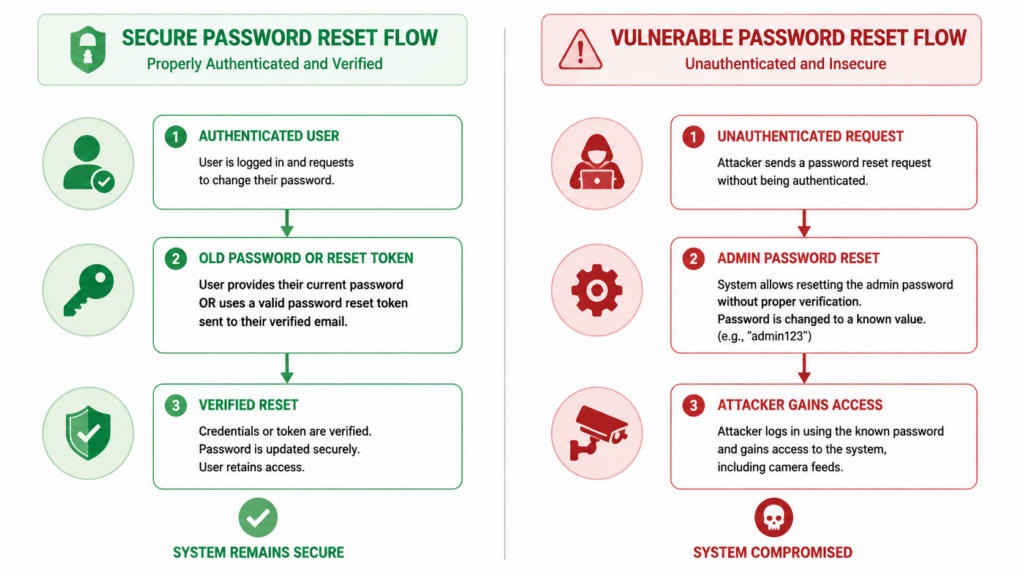
CVE-2026-5386 is mapped to CWE-620, Unverified Password Change. MITRE’s CWE definition describes this weakness as a product setting a new password without requiring knowledge of the original password or another form of authentication. MITRE also notes that the weakness can let an attacker change another user’s password and gain the privileges associated with that user. (cwe.mitre.org)
That maps cleanly to the public description of CVE-2026-5386. The target is the administrator password. The attacker is unauthenticated. The reset lands on a known value. The result is administrative access to camera feeds and settings. (nvd.nist.gov)
A safe mental model is this:
| Normal password-change boundary | Broken password-change boundary |
|---|---|
| User is already authenticated | Request can be sent without a valid authenticated identity |
| Current password, reset token, or equivalent proof is required | No meaningful proof is required |
| Reset token is single-use, time-limited, and bound to an account | Reset path can change a sensitive account without adequate verification |
| Security event is logged and user is notified | Embedded devices may have limited logs or weak alerting |
| Password change preserves account ownership | Password change transfers account control |
A CCTV camera is a bad place to learn this lesson. The device may be installed high on a wall, behind a contractor-managed account, outside the normal endpoint inventory, or inside a flat “security devices” subnet that nobody revisits until footage disappears. The vulnerability is a product defect, but the real exposure comes from deployment habits.
Why the CVSS vector deserves attention
The CNA vector for CVE-2026-5386 is:
CVSS:3.1/AV:N/AC:L/PR:N/UI:N/S:U/C:H/I:H/A:N
Each field matters in plain operational terms.
| CVSS metric | 意味 | Defender interpretation |
|---|---|---|
| AV:N | Network attack vector | Any reachable network path to the vulnerable service matters, including internet exposure, VPN exposure, flat internal networks, or contractor-accessible segments. |
| AC:L | Low attack complexity | The advisory does not describe unusual environmental prerequisites. Treat reachable affected devices as high priority. |
| PR:N | No privileges required | The attacker does not need a camera account first. Access control must come from patching and network reachability, not from trusting the login screen. |
| UI:N | No user interaction | No operator needs to click a link or open a file. Passive user training does not mitigate the core risk. |
| S:U | Scope unchanged | The affected security authority is the camera itself, but that can still affect physical-security operations. |
| C:H | High confidentiality impact | Camera feeds and configuration data can expose sensitive physical spaces and security procedures. |
| I:H | High integrity impact | Settings, accounts, recording behavior, stream configuration, and related controls may be altered. |
| A:N | No direct availability impact in the score | The score does not fully capture business disruption from altered recording settings, blind spots, or evidentiary gaps. |
Availability being scored as none does not make the issue safe. A camera can keep responding while its security value collapses. If an attacker changes where it records, who can view it, which stream is active, whether timestamps are accurate, or whether a critical field of view is preserved, the system may look “up” while the organization loses monitoring integrity.
A camera management plane is an attack surface
Many teams still describe CCTV gear as if it were separate from application security. That separation is obsolete. A modern IP camera usually has at least some of the following:
| 表面 | なぜそれが重要なのか |
|---|---|
| HTTP or HTTPS admin UI | Password resets, user management, firmware upload, time settings, stream configuration, and logs often live here. |
| RTSP or media streaming services | Stream access may expose sensitive spaces and can reveal credential or segmentation mistakes. |
| ONVIF or device-discovery services | Discovery and management protocols can leak device metadata or expose administrative workflows. |
| NVR integration | The recorder may store camera credentials, push configuration, and mask individual device compromise. |
| P2P or cloud relay | Remote viewing convenience introduces account, authorization, and vendor-service dependencies. |
| Mobile app linkage | Operator access may depend on consumer-style account recovery and device authorization behavior. |
| Local maintenance paths | Installers and facilities teams may retain credentials or undocumented access procedures. |
CISA’s CSAF record says the affected KMW cameras are deployed worldwide and identifies the relevant critical infrastructure sectors as Commercial Facilities, Government Services and Facilities, Critical Manufacturing, Financial Services, and Transportation Systems. The same record lists KMW’s headquarters location as Romania. (ギットハブ)
That sector list matters because it changes the impact conversation. In a small shop, camera takeover may expose storefront footage. In a transit, manufacturing, financial, government, or commercial-facilities environment, the same class of access can affect safety monitoring, incident reconstruction, guard operations, loading docks, server rooms, cash-handling areas, parking structures, and controlled entrances.
The camera is not the only asset. The camera is a sensor attached to an operational process.
What an attacker can realistically gain
The public advisory language for CVE-2026-5386 says successful exploitation may grant full unauthorized access to camera feeds and settings. (ギットハブ) That does not prove every deployment exposes every possible function, but it is enough to define the risk.
A defender should assume the following categories are in scope until proven otherwise:
| Attacker capability after admin takeover | Security impact |
|---|---|
| View live camera feeds | Privacy loss, surveillance of guard routines, observation of entrances, inventory, staff movement, or restricted spaces. |
| Modify user accounts | Persistence, lockout of legitimate operators, shared-account confusion, or delayed recovery. |
| Change stream settings | Reduced recording quality, disabled secondary stream, altered frame rate, or degraded monitoring. |
| Change time settings | Weakens evidentiary value and complicates incident timelines. |
| Change storage or recording configuration | Creates gaps, reduces retention, or shifts where footage is stored. |
| Modify network configuration | Breaks NVR connectivity, redirects traffic, or changes access paths. |
| Alter cloud or P2P settings | Affects remote viewing, authorization, and recovery workflows. |
| Hide behind normal camera behavior | The device may still display video, making compromise harder to notice. |
A password reset bug is especially damaging because it does not require the attacker to guess weak credentials. Strong passwords are still necessary, but they do not repair a workflow that lets someone replace the password without proving ownership.
The known affected versions
The confirmed affected products in CISA’s CSAF data are narrow:
| 製品 | Affected firmware in public advisory data |
|---|---|
| KMW KM-IP521 | IPCAM_V4.04.91.230307 |
| KMW KM-IP421 | IPCAM_V4.04.53.210416 |
CISA’s structured advisory data marks those two product IDs as known affected. (ギットハブ)
This does not mean every other camera on a network is safe. It means the current public record specifically identifies those product and firmware combinations. Asset teams should verify exact device model and firmware instead of relying on invoice names, wall labels, camera descriptions, or NVR display names. A CMDB entry that says “front gate camera” is not enough.
Useful evidence includes:
| Evidence source | 価値 | 制限 |
|---|---|---|
| Device web UI | Often shows model and firmware | Requires admin access and may be unavailable after lockout. |
| NVR device inventory | May list model, IP, and protocol | Can be stale or normalized by the NVR. |
| DHCP lease records | Helps locate devices | Usually does not show firmware. |
| Switch MAC address tables | Helps map ports and physical locations | Vendor OUI is not a firmware indicator. |
| Procurement records | Helps identify model families | May not reflect replaced units or firmware updates. |
| Installer documentation | Often contains deployment details | May be incomplete or contractor-owned. |
| Authorized network scan | Helps find management services | Version banners may be missing, wrong, or generic. |
A version string alone is not proof of exploitability, but it is an important starting point. For a camera vulnerability, the best evidence chain is model, firmware, reachability, network path, current patch status, and post-update validation.
Safe validation, stay away from the reset path
The safest first move is not to reproduce the password reset. The safest first move is to confirm exposure conditions without changing device state.
Authorized validation should answer these questions:
| Question | なぜそれが重要なのか |
|---|---|
| Do we have KMW KM-IP521 or KM-IP421 devices? | CVE-2026-5386 is product-specific in the current public record. |
| Are any running the affected firmware versions? | Firmware determines whether the public advisory applies directly. |
| Which network paths can reach the management interface? | A vulnerable device behind tight access control is still vulnerable, but the immediate exploitation path is narrower. |
| Is any camera management surface reachable from the internet? | Internet exposure turns a local operational bug into a remote perimeter issue. |
| Can ordinary user subnets reach the camera management plane? | Flat internal networks make post-compromise abuse much easier. |
| Are P2P or cloud features enabled? | Remote access dependencies affect patch planning and incident response. |
| Has the firmware update been applied and verified? | The fix must be tested, not assumed. |
Use the following examples only on assets you own or are explicitly authorized to test. They intentionally avoid password reset endpoints and avoid exploit reproduction.
# Discover common camera and embedded-device management ports in an authorized subnet.
# Adjust the subnet to your approved scope.

nmap -Pn -n \
  -p 80,443,554,8000,8080,8443,8554,8899,9000 \
  --open \
  --script http-title,http-headers \
  10.20.30.0/24 \
  -oA camera-management-survey
The goal is to identify reachable management surfaces and streaming services. A result that shows an HTTP login page, RTSP service, or device-specific title should be treated as a lead for asset verification, not as final proof.
# Check HTTP response headers and page title behavior without logging in.
# Replace the host with an authorized camera or NVR address.

curl -k -s -I https://10.20.30.41/ | sed -n '1,20p'
curl -k -s https://10.20.30.41/ | head -n 40
Be careful with automated crawling. Embedded devices can be fragile. Avoid brute-force tools, recursive crawling, fuzzing, or unauthenticated POST requests unless you have a clear test plan, a maintenance window, and owner approval.
A lightweight Python inventory script can help teams triage management-plane exposure without touching sensitive functions:
#!/usr/bin/env python3
"""
Safe camera exposure checker for authorized internal ranges.

What it does:
- Attempts TCP connection to common camera management ports.
- Sends a HEAD request to HTTP(S) ports where appropriate.
- Records status line and selected headers.
- Does not authenticate.
- Does not attempt password reset.
- Does not brute force or fuzz.

Use only on networks you own or have explicit permission to assess.
"""

import csv
import socket
import ssl
from http.client import HTTPConnection, HTTPSConnection
from ipaddress import ip_network

PORTS = [80, 443, 554, 8000, 8080, 8443, 8554, 8899, 9000]
HTTP_PORTS = {80: "http", 8080: "http", 8000: "http", 443: "https", 8443: "https"}

TIMEOUT = 2.0

def tcp_open(host: str, port: int) -> bool:
    try:
        with socket.create_connection((host, port), timeout=TIMEOUT):
            return True
    except OSError:
        return False

def http_head(host: str, port: int, scheme: str) -> dict:
    result = {"status": "", "server": "", "www_authenticate": ""}
    try:
        if scheme == "https":
            context = ssl._create_unverified_context()
            conn = HTTPSConnection(host, port=port, timeout=TIMEOUT, context=context)
        else:
            conn = HTTPConnection(host, port=port, timeout=TIMEOUT)

        conn.request("HEAD", "/")
        resp = conn.getresponse()
        result["status"] = f"{resp.status} {resp.reason}"
        result["server"] = resp.getheader("Server", "")
        result["www_authenticate"] = resp.getheader("WWW-Authenticate", "")
        conn.close()
    except Exception as exc:
        result["status"] = f"error: {type(exc).__name__}"
    return result

def scan_subnet(cidr: str, output: str) -> None:
    with open(output, "w", newline="") as f:
        writer = csv.DictWriter(
            f,
            fieldnames=["host", "port", "tcp_open", "http_status", "server", "www_authenticate"],
        )
        writer.writeheader()

        for ip in ip_network(cidr, strict=False).hosts():
            host = str(ip)
            for port in PORTS:
                is_open = tcp_open(host, port)
                row = {
                    "host": host,
                    "port": port,
                    "tcp_open": is_open,
                    "http_status": "",
                    "server": "",
                    "www_authenticate": "",
                }

                if is_open and port in HTTP_PORTS:
                    details = http_head(host, port, HTTP_PORTS[port])
                    row["http_status"] = details["status"]
                    row["server"] = details["server"]
                    row["www_authenticate"] = details["www_authenticate"]

                writer.writerow(row)

if __name__ == "__main__":
    scan_subnet("10.20.30.0/24", "camera_exposure.csv")
This kind of script helps answer a basic but often neglected question: which camera-like services are reachable from the network segment being tested? It does not determine whether the KMW reset flaw is exploitable. It gives you a safer starting point for asset owners to verify models, firmware, and access control.
Evidence that should go into a real finding
A useful CVE-2026-5386 finding should not be a screenshot of a CVE page pasted into a ticket. It should prove whether your environment is exposed.
A strong evidence chain looks like this:
| エビデンス | Good example | Weak example |
|---|---|---|
| Asset identity | “KMW KM-IP421, serial recorded by facilities, firmware IPCAM_V4.04.53.210416 observed in admin UI on June 3, 2026.” | “Looks like a KMW camera.” |
| Network path | “HTTP admin interface reachable from office subnet 10.40.0.0/16 and VPN pool.” | “Camera has a web page.” |
| Exposure boundary | “No internet exposure detected from approved external test vantage point, but internal reachability is too broad.” | “Probably internal only.” |
| Patch status | “Firmware update not yet applied, affected firmware confirmed.” | “Needs patch.” |
| Operational risk | “Camera covers loading dock and NVR stores footage for investigations.” | “Camera vulnerable.” |
| Remediation owner | “Facilities owns device, IT owns VLAN, security owns validation.” | “Assign to IT.” |
| Retest plan | “Verify firmware, password rotation, NVR reconnect, P2P reauthorization, and ACL changes.” | “Retest later.” |
For teams using AI-assisted security workflows, this is where automation is useful but must stay bounded. In an authorized scope, tools can help transform sparse CVE context into repeatable asset checks, network reachability evidence, version correlation, remediation tickets, and retest steps. Penligent’s public material describes controlled AI pentesting workflows that emphasize scope locking, evidence access, and careful CVE validation instead of treating a banner or version string as proof. (寡黙)
The product angle is secondary to the workflow principle: do not let a model “declare” a camera vulnerable without preserving the raw evidence a human can review. That matters more for CCTV than for many web apps because the asset owner may be facilities, the patch may require a maintenance window, and the security impact may affect physical monitoring rather than a neat application owner queue. Penligent positions itself as an AI-powered penetration testing tool with human-in-the-loop control and verification/reporting workflows, which is relevant only when used for authorized validation and evidence collection rather than exploit guessing. (寡黙)
Patch planning matters because cameras are operational assets
CISA’s structured advisory data says KMW has issued a firmware update for CVE-2026-5386. The same data includes an important operational note: KM-IP421 devices will lose cloud authorization after the update, so users need to contact customer support to re-authorize the P2P connection. (ギットハブ)
That detail is not a footnote. It is exactly why camera patching gets delayed. A server patch is usually owned by IT. A camera firmware update may involve facilities, a security integrator, a remote viewing app, a guard desk, a network team, a vendor support queue, and a location manager who does not want cameras offline during business hours.
The answer is not to defer the patch. The answer is to plan the update like an operational change.
Before patching, record:
| Pre-update item | なぜそれが重要なのか |
|---|---|
| Camera model and firmware | Confirms whether the advisory applies. |
| Current IP, gateway, DNS, and VLAN | Prevents loss of management access after reboot. |
| Local admin account status | Reduces dependency on cloud access during recovery. |
| NVR connection settings | Ensures recording continues after update. |
| RTSP or stream URLs used by monitoring systems | Prevents silent breakage in dashboards or analytics. |
| P2P or cloud authorization state | Required for KM-IP421 planning. |
| Current recording schedule and retention settings | Helps detect unexpected configuration changes. |
| Physical location and field of view | Helps prioritize critical cameras first. |
| Vendor support contact | Required if reauthorization or recovery is needed. |
After patching, validate:
| Post-update check | Expected result |
|---|---|
| Firmware version | No longer matches the affected firmware listed in the advisory. |
| Admin password | Rotated to a strong unique value after update. |
| User accounts | No unknown accounts remain. |
| NVR connection | Camera records normally and event timestamps are correct. |
| Remote viewing | Works only through approved access paths. |
| P2P or cloud status | Reauthorized where required and documented. |
| Network ACLs | Only approved systems can reach camera management interfaces. |
| 過去ログ | No suspicious password or configuration changes around the maintenance window. |
Do not rely on the firmware file being downloaded. The device has to be updated, rebooted if required, verified, and retested from the relevant network paths.
Short-term mitigation versus long-term hardening
CISA’s recommended practices in the CSAF record include minimizing network exposure for control system devices so they are not accessible from the internet, placing control system networks and remote devices behind firewalls, isolating them from business networks, and using more secure remote access methods such as updated VPNs when remote access is required. The advisory also warns that a VPN is only as secure as the connected devices. (ギットハブ)
For CVE-2026-5386, those recommendations translate into practical controls.
| Timeframe | アクション | 目的 | 制限 |
|---|---|---|---|
| Immediate | Remove public internet access to camera management interfaces | Shrinks remote attack surface quickly | Does not fix internal exposure or the vulnerable firmware. |
| Immediate | Restrict camera management access to NVRs, jump hosts, and admin workstations | Limits who can reach the reset workflow | Requires accurate network mapping. |
| Immediate | Apply KMW firmware update | Fixes the known product issue | Must be planned around cloud/P2P reauthorization for KM-IP421. |
| Immediate | Rotate admin and integration credentials | Reduces risk from previous exposure or shared credentials | Does not replace firmware update. |
| Near term | Segment camera VLAN from office and guest networks | Reduces lateral movement paths | Needs firewall policy and monitoring. |
| Near term | Add logging around camera management access | Improves detection | Embedded device logs may be weak. |
| Long term | Put CCTV assets into the vulnerability management lifecycle | Prevents “forgotten appliance” risk | Requires ownership across IT and facilities. |
| Long term | Standardize procurement security requirements | Reduces future exposure | Does not remediate existing devices. |
A VLAN alone is not enough. A separate camera network that every office workstation can reach is not meaningful segmentation. A better pattern is explicit allow-listing.
Policy goal:
- NVR can reach camera streaming and management ports required for recording.
- Admin jump host can reach camera management ports.
- Security monitoring can receive logs or poll health status if supported.
- Ordinary user subnets cannot reach camera management interfaces.
- Guest Wi-Fi cannot reach cameras.
- Internet inbound access to camera management is denied.
- Outbound access from cameras is denied by default except documented vendor services that are explicitly required.
A simplified firewall policy might look like this:
# Conceptual ACL, adapt to your firewall syntax and environment.

permit tcp 10.10.10.20        10.30.50.0/24 eq 80,443,554   # NVR to cameras
permit tcp 10.10.20.10        10.30.50.0/24 eq 80,443       # Admin jump host to camera UI
permit udp 10.10.30.15        10.30.50.0/24 eq 161          # Monitoring host to SNMP if used
deny   ip  10.40.0.0/16       10.30.50.0/24                 # Office users to cameras
deny   ip  10.60.0.0/16       10.30.50.0/24                 # Guest or contractor network
deny   ip  any                10.30.50.0/24                 # Default deny
Do not copy this literally into production. The point is the shape of the policy: cameras should have a small set of approved peers, not broad trust from the entire internal network.
Detection signals defenders should look for
Patching and segmentation are the main controls. Detection is still necessary because CCTV devices may have been exposed before the advisory, and embedded devices often lack rich endpoint telemetry.
Useful detection sources include:
| ソース | 信号 |
|---|---|
| Firewall logs | New access to camera management ports from non-admin subnets. |
| VPN logs | Remote users accessing camera VLAN directly. |
| NVR logs | Camera password failures, reconnect loops, stream errors, or configuration sync failures. |
| Camera logs | Password changes, admin login source changes, time changes, account creation, firmware changes. |
| DHCP logs | Camera MAC address appearing on unexpected VLANs. |
| DNS logs | Cameras resolving unknown external domains. |
| NetFlow or Zeek | Unusual outbound connections from cameras, especially to the internet. |
| Physical security logs | Video gaps, camera offline events, unexplained view changes, or operator lockouts. |
A basic SIEM query concept for firewall logs:
Find events where:
  destination_ip is in CAMERA_VLAN
  and destination_port in (80, 443, 554, 8000, 8080, 8443, 8554, 8899, 9000)
  and source_ip not in (NVR_HOSTS, ADMIN_JUMP_HOSTS, MONITORING_HOSTS)
Group by:
  source_ip, destination_ip, destination_port
Alert when:
  unique camera destinations > 3 within 10 minutes
  or any source from guest, office, contractor, or VPN pools reaches camera management ports
A Sigma-like logic pattern for normalized network events:
title: Unauthorized Access to CCTV Camera Management Plane
status: experimental
description: Detects non-approved hosts reaching camera management ports.
logsource:
  category: firewall
detection:
  selection:
    destination_port:
      - 80
      - 443
      - 554
      - 8000
      - 8080
      - 8443
      - 8554
      - 8899
      - 9000
  filter_approved_sources:
    source_ip|cidr:
      - 10.10.10.20/32
      - 10.10.20.10/32
      - 10.10.30.15/32
  filter_camera_destinations:
    destination_ip|cidr:
      - 10.30.50.0/24
  condition: selection and filter_camera_destinations and not filter_approved_sources
level: high
fields:
  - source_ip
  - destination_ip
  - destination_port
  - action
falsepositives:
  - New NVR migration
  - Approved maintenance window
  - Security assessment from authorized scanner
For incident response, a single alert is rarely enough. Correlate management-plane access with camera status changes, NVR reconnects, account changes, and footage gaps.
What to do if compromise is suspected
If a vulnerable camera may have been accessed before patching, treat it as a security incident affecting both cyber and physical-security workflows.
A practical response sequence:
| ステップ | アクション | なぜ |
|---|---|---|
| 1 | Preserve current logs, NVR events, and relevant footage before rebooting or factory resetting | Embedded evidence can disappear quickly. |
| 2 | Remove broad network access to the camera management interface | Stops ongoing unauthenticated interaction. |
| 3 | Identify model, firmware, IP, MAC address, switch port, and physical location | Establishes scope and impact. |
| 4 | Review recent password changes, user changes, and configuration changes | Looks for takeover evidence. |
| 5 | Check NVR recording continuity and timestamp integrity | Determines whether surveillance evidence was affected. |
| 6 | Apply the firmware update and reboot as required | Remediates the known vulnerability. |
| 7 | Reset administrator credentials after patching | Removes attacker-known or shared passwords. |
| 8 | Rotate related NVR, RTSP, cloud, P2P, and integrator credentials | Prevents reuse of exposed secrets. |
| 9 | Reauthorize P2P/cloud access where required and document the owner | Prevents shadow recovery paths. |
| 10 | Report suspected malicious activity through internal procedures and, where appropriate, to CISA | CISA explicitly encourages reporting suspected malicious activity for tracking and correlation. (ギットハブ) |
Avoid factory reset as the first step unless operational recovery requires it. A factory reset can destroy useful evidence and may restore insecure defaults.
Related camera and surveillance CVEs show the pattern
CVE-2026-5386 is not an isolated lesson. Several recent CCTV and surveillance-stack vulnerabilities point to the same operational reality: video systems have web apps, APIs, credential workflows, and management planes that deserve the same security discipline as any other exposed application.
| 脆弱性 | Product area | 弱さ | Why it is relevant |
|---|---|---|---|
| CVE-2026-5386 | KMW CCTV cameras | Unverified password change | Shows how an unauthenticated reset path can become direct administrator takeover. |
| CVE-2026-1670 | Honeywell CCTV products | Unauthenticated API endpoint exposure | NVD says the flaw may let an attacker remotely change the “forgot password” recovery email address; the CNA scored it CVSS v3.1 9.8 Critical. (nvd.nist.gov) |
| CVE-2026-8598 | ZKTeco CCTV cameras | Authentication bypass through an undocumented configuration export port | NVD says the unauthenticated port can expose open services and camera account credentials; the CNA scored it CVSS v3.1 9.1 Critical. (nvd.nist.gov) |
| CVE-2024-51482 | ZoneMinder surveillance stack | SQL injection in a CCTV-oriented web application | Demonstrates that surveillance risk also lives in web apps, APIs, event workflows, and database paths, not only in camera firmware. (寡黙) |
The common thread is not one vendor. The common thread is management-plane trust. If a camera, recorder, or surveillance application exposes sensitive workflows to networks that should not reach them, a single CVE can become a physical-security problem.
CVE-2026-1670 is particularly close in theme because it also involves account recovery. Changing a password recovery email is not the same bug as resetting an administrator password to a known value, but both flaws attack the ownership boundary around camera administration. (nvd.nist.gov)
CVE-2026-8598 shows a different path to the same operational problem. Instead of changing a password, the attacker reaches an undocumented configuration export port and obtains sensitive configuration data, including account credentials, according to NVD. That is still management-plane failure: the device exposes the keys to its own control surface. (nvd.nist.gov)
ZoneMinder is not KMW, and an open-source CCTV stack is not an embedded camera firmware. The relevance is architectural. Surveillance systems often include web-facing administrative workflows, API endpoints, event handling, storage logic, and operator dashboards. Penligent’s ZoneMinder security analysis makes the same practical point: defenders should not let the word “camera” lower their standards for patching, access control, and validation. (寡黙)
Common mistakes that make CVE-2026-5386 worse
Treating CCTV as facilities equipment only
Facilities may own installation. IT may own VLANs. Security may own risk. The attacker does not care which department owns the camera. If the management interface is reachable and the firmware is vulnerable, the ownership boundary has already failed.
Waiting for confirmed exploitation
CISA’s CSAF data said no known public exploitation specifically targeting CVE-2026-5386 had been reported to CISA at the time of publication. (ギットハブ) That should not be read as safety. Unauthenticated, network-reachable, low-complexity administrator takeover belongs in the urgent queue even before public exploitation is confirmed.
Assuming strong passwords fix the issue
Strong passwords help against guessing and credential reuse. They do not fix an unverified password change workflow. If the device lets an unauthenticated requester reset the administrator password, the old password’s strength is not the decisive control.
Assuming “internal only” is enough
Internal-only exposure is better than internet exposure, but it is not a fix. Internal attackers, compromised workstations, unmanaged contractor laptops, VPN users, and malware can all abuse overly broad internal reachability.
Treating VPN access as a magic boundary
CISA’s advisory data recommends more secure methods such as VPNs for remote access, but it also warns that VPNs may have vulnerabilities and are only as secure as the connected devices. (ギットハブ) A VPN pool that gives every remote user direct access to cameras is still too broad.
Skipping post-patch validation
Firmware updates can fail, roll back, break cloud authorization, or leave configuration in an unexpected state. CVE-2026-5386 needs post-patch validation, especially for KM-IP421 deployments that require P2P reauthorization after update. (ギットハブ)
Forgetting the evidence role of cameras
A compromised camera can affect investigations. Even when no data is stolen, configuration changes, timestamp changes, recording gaps, or operator lockouts can weaken confidence in footage.
A practical remediation playbook
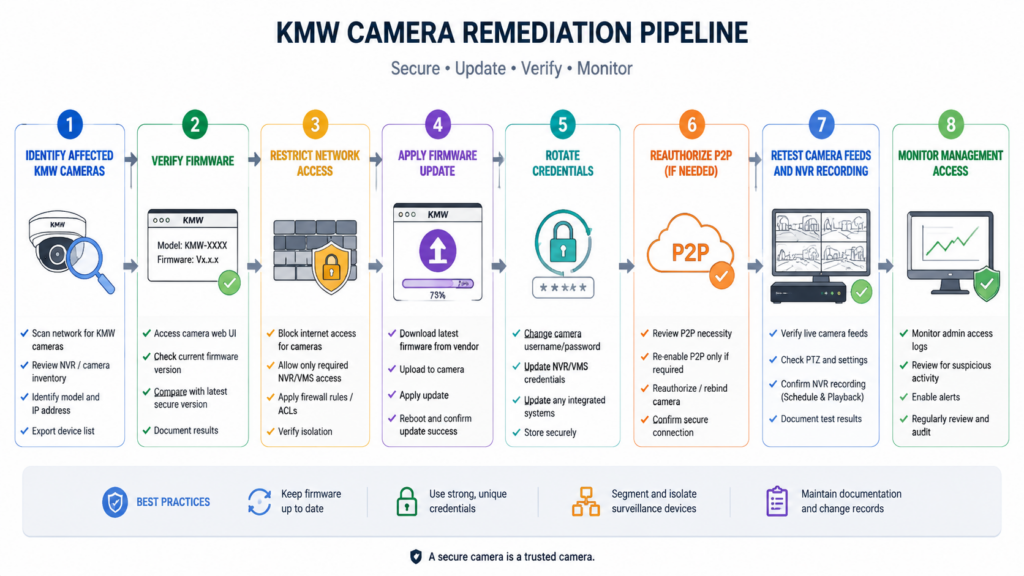
Use this as a working sequence for security, IT, and facilities teams.
| フェーズ | アクション | Output |
|---|---|---|
| スコープ | Identify all KMW cameras and any cameras with unknown model or firmware | Inventory list with owner and physical location |
| Confirm | Check whether KM-IP521 or KM-IP421 devices run the affected firmware versions | Affected and unaffected asset groups |
| Contain | Block internet access and restrict internal management access | Firewall or ACL change record |
| Patch | Apply KMW firmware update | Updated firmware evidence |
| Account security | Rotate admin, NVR, RTSP, cloud, and integrator credentials | Credential rotation record |
| Reauthorize | For KM-IP421, coordinate customer support reauthorization for P2P connection if needed | Remote access restored through approved process |
| 検証 | Confirm recording, stream, timestamp, NVR, and management access behavior | Retest evidence |
| モニター | Add alerts for non-approved access to camera management ports | SIEM or firewall monitoring rule |
| Document | Update asset inventory and standard operating procedure | Durable operational control |
A good remediation ticket should include device model, firmware, physical location, business owner, network segment, exposure path, patch status, and retest evidence. Without those fields, the ticket is likely to bounce between IT, facilities, and the security team.
Procurement questions for the next camera refresh
CVE-2026-5386 is also a procurement lesson. Security teams often inherit cameras after purchase. That is too late.
For future CCTV and NVR purchases, ask vendors and integrators:
| Question | なぜそれが重要なのか |
|---|---|
| How are password reset and account recovery protected? | Prevents CWE-620-style ownership failure. |
| Are reset tokens single-use, time-limited, and bound to a verified identity? | Reduces unauthenticated takeover risk. |
| Can local admin access be separated from cloud or P2P access? | Helps recovery when cloud authorization changes. |
| Is MFA supported for remote viewing and cloud administration? | Reduces account takeover risk. |
| Are firmware updates signed and easy to verify? | Reduces supply-chain and downgrade risk. |
| How long are security updates provided? | Prevents unsupported devices from becoming permanent risk. |
| Can logs be exported to SIEM or syslog? | Improves detection and incident response. |
| Can management interfaces be disabled or restricted by interface? | Reduces exposed attack surface. |
| Is ONVIF, RTSP, P2P, or cloud relay configurable per deployment? | Prevents unnecessary services from staying enabled. |
| Are default credentials unique and forced to change at setup? | Reduces mass compromise risk. |
Do not let “works with the mobile app” substitute for security architecture.
よくあるご質問
What is CVE-2026-5386?
- CVE-2026-5386 is a critical vulnerability affecting certain KMW CCTV Security Cameras.
- The public advisory data describes it as an unauthenticated password reset flaw.
- An attacker can remotely reset the administrator password to a known value without authentication.
- Successful exploitation can grant full access to camera feeds and settings. (nvd.nist.gov)
Which KMW CCTV devices are affected?
- Current CISA CSAF data identifies KMW KM-IP521 running IPCAM_V4.04.91.230307.
- It also identifies KMW KM-IP421 running IPCAM_V4.04.53.210416.
- Teams should verify exact model and firmware from the device UI, NVR inventory, installer records, or direct vendor-supported methods.
- Do not rely only on a generic asset name such as “front door camera” or “warehouse camera.” (ギットハブ)
Does CVE-2026-5386 require authentication?
- No, the public advisory description says the reset is unauthenticated.
- The CVSS vector includes PR:N, meaning no privileges required.
- It also includes UI:N, meaning no user interaction is required.
- That combination is why network reachability is so important. (nvd.nist.gov)
Is CVE-2026-5386 being exploited in the wild?
- CISA’s CSAF record stated that no known public exploitation specifically targeting this vulnerability had been reported to CISA at the time of publication.
- That does not mean the vulnerability is low risk.
- A remotely reachable, unauthenticated administrator password reset should be prioritized before exploitation is publicly confirmed.
- Defenders should patch, restrict access, and monitor for suspicious management-plane activity. (ギットハブ)
How can defenders safely check exposure without exploiting the device?
- Confirm whether KMW KM-IP521 or KM-IP421 devices exist in the environment.
- Verify firmware versions through approved administrative, asset-management, or vendor-supported methods.
- Check whether camera management ports are reachable from the internet, VPN pools, office subnets, guest networks, or contractor networks.
- Use non-destructive checks such as port reachability, HTTP headers, device inventory, and NVR records.
- Do not trigger password reset workflows as a test unless you have explicit approval, a maintenance window, and a recovery plan.
Is patching enough if the cameras are on a separate VLAN?
- Patching is required because segmentation does not remove the vulnerable code.
- A separate VLAN reduces who can reach the vulnerable management plane.
- The VLAN must be backed by firewall rules that allow only approved NVRs, admin jump hosts, and monitoring systems.
- If office users, VPN users, or guest networks can reach the camera VLAN, segmentation is not doing enough.
- Post-patch validation should confirm both firmware status and access-control boundaries.
What should teams do if a camera may have been compromised?
- Preserve logs, NVR events, and relevant footage before resetting the device.
- Remove broad access to the camera management interface.
- Record model, firmware, IP, MAC address, switch port, and physical location.
- Apply the KMW firmware update and rotate administrator credentials.
- Rotate NVR, RTSP, cloud, P2P, and integrator credentials if they may have been exposed.
- Review footage continuity, timestamp integrity, user accounts, and configuration changes.
- Follow internal incident response procedures and report suspected malicious activity through appropriate channels.
CVE-2026-5386 is severe because it turns account recovery into account takeover. The public record is narrow enough to act on: two affected KMW camera models, two affected firmware versions, CWE-620, CVSS v3.1 9.1, a vendor firmware update, and a clear warning about the KM-IP421 P2P reauthorization step. (ギットハブ)
The defensive priority is equally clear. Find the cameras. Confirm firmware. Patch. Rotate credentials. Remove broad network reachability. Retest recording and remote access. Put CCTV assets into the same vulnerability, segmentation, monitoring, and incident-response discipline used for other critical systems.
A camera that watches the perimeter should not become the easiest way through it.


 Japanese
  English
  German
  French
  Spanish
  Portuguese
  Korean
  Hindi
Hindi  Arabic
  Turkish
  Hebrew